Forex Blog: Currency Trading News & Analysis.

Marketplace

  • Free Forex Trading Starter Kit

    Name: 
    Email: 

Search Forex Blog

Monthly Archives

Forex Brokers

Archive for the 'News' Category

Euro: Which Investors Know Best?

Jan. 2nd 2011

As the WSJ recently pointed out, there is a bizarre disconnect between equities and currency markets regarding the Euro. On the one hand, the Euro was the world’s worst performing major currency in 2010, and some analysts insist that its breakup is inevitable. On the other hand, stock market investors are increasingly bullish about Europe: “We remain positive on the outlook for [European] stocks in 2011, with a favorable macro backdrop, solid earnings and attractive valuations.” Who’s right?

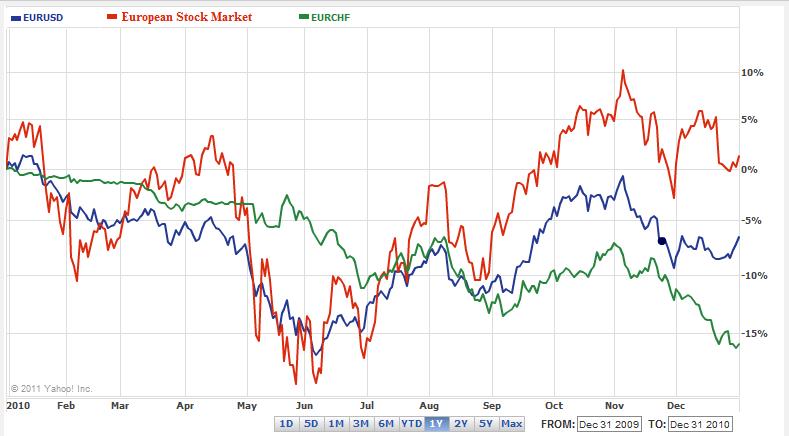
In fact, both sets of investors are justified. As you would expect, stock market investors are focusing on corporate earnings and the macroeconomic environment. In this regard, the fact that the EU economy expanded in 2010 – buoyed by a cheap currency and loose monetary policy – should certainly be reflected in a stronger stock prices. On the other hand, the sovereign debt crisis in EU has not yet abated, and accordingly, it is still being priced into EUR/ exchange rates.

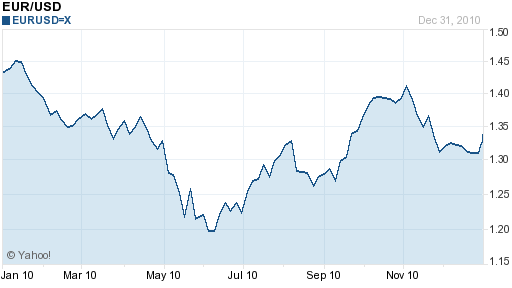
In the immediate short-term, it’s possible that stock market investors will prevail and that that their collective view will be adopted by currency markets. According to Deutsche Bank, “The euro may rise to $1.45 by the end of the first quarter of next year, as concerns about the single-currency area’s indebted periphery diminish.” Meanwhile, China recently pledged its support for the Euro via a promise to purchase up to €5 Billion in Portuguese Sovereign debt. Over the short-term, then, it’s possible that (currency) investors can be persuaded to temporarily forget about the prospect of default, and focus instead on the Eurozone’s nascent economic recovery.

Over the medium-term, however, the markets will have no choice but to  return their attention to the possibility of default, which is why the same team of analysts from Deutsche Bank “forecasts the euro will fall back to $1.40 by the end of the second quarter and to $1.30 by the year-end.” For example, Eurozone members will need to issue more than €500bn in debt in 2011, including €400bn that needs to be refinanced by Spain and Italy. In this context, China’s purchases will fade to the point of becoming trivial.

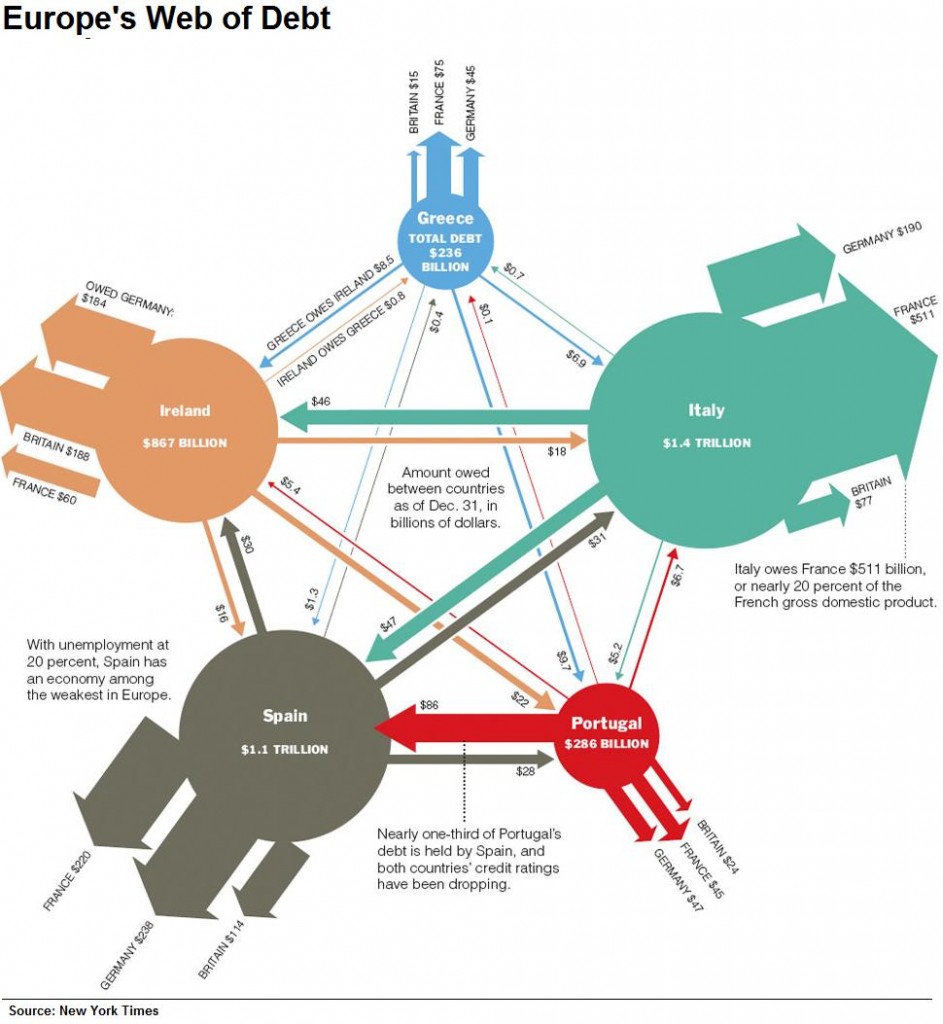
Meanwhile, Moody’s has warned that it could follow up on its 5-notch downgrade of Ireland’s sovereign credit rating with further downgrades for Spain and Portugal. Fitch added that it might bump Greece’s rating to junk status, which would deal a significant blow to its solvency. Default is now rapidly on course to becoming a self-fulfilling prophecy, as fleeing investors cause yields to rise and credit ratings to fall, further scaring away more investors.

The EU response has been to “set up a permanent mechanism from mid-2013,” while investors continue to push for an expansion of the European Financial Stability Facility or the joint issuance of European sovereign bonds. As a result, the Center for Economics and Business Research has issued a striking forecast that there is an 80% probability that the European Monetary Union will dissolve over the next decade: “If the euro doesn’t break up, this could be the year when it weakens substantially towards parity with the dollar.” Already, spot market traders are once again increasing their short bets for the Euro, and options trading remains “skewed toward euro puts.”

To be fair, some analysts continue to insist that it is better to think of the sovereign debt problems as a crisis of credit, rather than of currency. In that sense, there is hope that a solution can be engineered (perhaps encompassing a default) that doesn’t endanger the existence of the Euro. In addition, the Euro finished 2010 on a high note, formally welcoming Estonia into the fold. It is 10% above its June trough, including a 2% rise in the month of December. Given all of the bad news in 2010, that might just be cause for optimism.

SocialTwist Tell-a-Friend
Posted by Adam Kritzer | in Euro, News | No Comments »

Brazilian Real Supported By Fundamentals, but Obstacles Remain

Dec. 30th 2010

Despite all of the talk of currency war (a term first introduced by Brazili’s Finance Minister) and volatility in forex markets, the Brazilian Real is on pace to finish 2010 only slightly higher from where it began the year. While fundamentals would seem to support a further rise, Brazil’s government and Central Bank have made it clear that they will do everything in their combined power to prevent such an outcome. In short, the outlook for the Real in 2011 is incredibly uncertain.

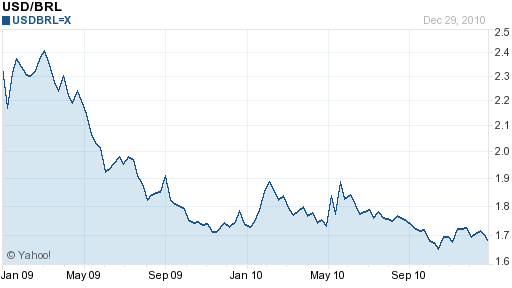
There are two (somewhat contradictory) trends that have played a role in driving the Real to its current level. The first is the resurgence of the carry trade, whereby investors shift capital from low-risk, low-yield investments to higher-yield, higher-risk alternatives. With interest rates that are among the highest in the world – and certainly the highest among stable currencies – Brazil has been one of the prime recipients of carry trade funds. Since 2009, when concerns over the credit crisis began to ebb, the Real has risen a whopping 40%!

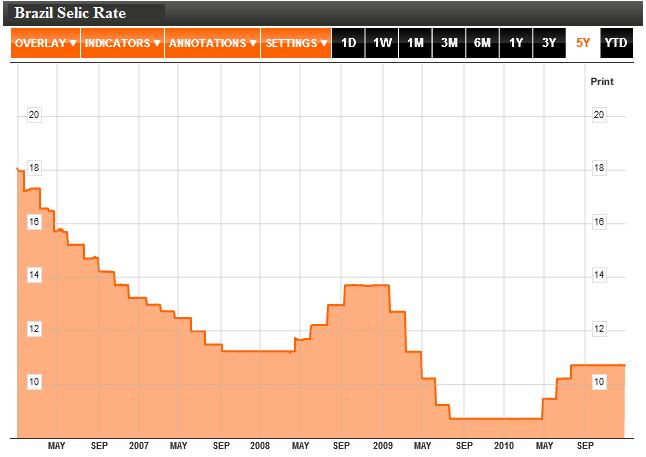
Moreover, the Central Bank might have no choice but to hike its benchmark Selic rate further over the next couple years. Inflation, at 5.5%, has already breached the Bank’s 4.5% target, and is projected to remain at an elevated level throughout 2011. According to futures prices, investors expect the bank to lift the Selic rate (currently at 10.75%) by 1.5% over the next twelve months, including a 50 basis point hike at its scheduled meeting in January. When you factor in low rates in the rest of the world, this would lift the yield spread between the Brazilian Real and most other comparable currencies to astronomical levels.

Alas, this first trend started to abate in the second half of 2010, due primarily to the EU sovereign debt crisis. Fortunately, the consequent move towards risk aversion hasn’t hurt the Real much. To be sure, Brazil is still an emerging-market economy, and is still perceived as being fraught with risk. However, when you consider that (certain) commodities prices (sugar, cotton) are at record highs and that the Brazilian economy barely dipped during the credit crisis, there are certainly riskier locales to park capital. Besides, many investors have determined that the interest rate premium that they receive from investing in Brazil is more than enough to compensate them for any added risk.

All else being equal, then, the Brazilian Real would probably continue rising at a measured pace in 2011. As I said, however, all else is not equal, since Brazil has pledged to do everything in their power to hold down the Real. According to the WSJ, “Earlier this year Brazil raised the IOF tax on foreign investment in fixed-income securities to 6% from 2% and also raised the tax for guarantees on derivatives investments.” Meanwhile, the Central Bank has intervened regularly in the spot market to purchase Dollars. The Bank’s newly appointed President, Alexandre Tombini, has voiced concerns over the Real’s rise: “We can’t let the economic policies of other countries determine the direction of foreign exchange.” On the day that he testified before the Senate’s Economic Affairs Committee, the Real fell by a substantial margin, suggesting that investors take his warnings seriously.

The Central Bank will also work closely with the new Brazilian administration to combat inflation, in a way that doesn’t cause the Real to appreciate. Rather than raise interest rates – which invites speculative capital inflows – the Bank will probably put pressure on the government to rein in spending and tighten access to credit. Over the long-term, this should allow it to lower rates to more sustainable levels, and prevent an expensive Rea from eroding the competitiveness of its export sector before it is too late.

Over the short-term, however, the immediate focus is to bring down inflation, most likely through rate hikes. That means that the Ministry of Finance will have to resort to more conventional weapons – such as taxes and intervention – to stem the Real’s rise. It managed to hold the Real to a 3% rise in 2010, but it remains to be seen whether it can repeat this feat in 2011.

SocialTwist Tell-a-Friend
Posted by Adam Kritzer | in Emerging Currencies, News | No Comments »

Swiss Franc Surges to Record High(s)

Dec. 29th 2010

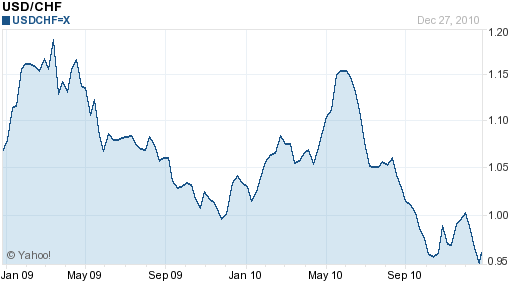
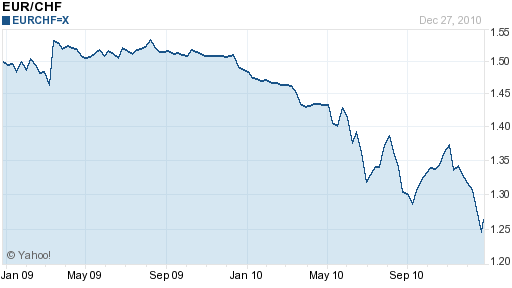
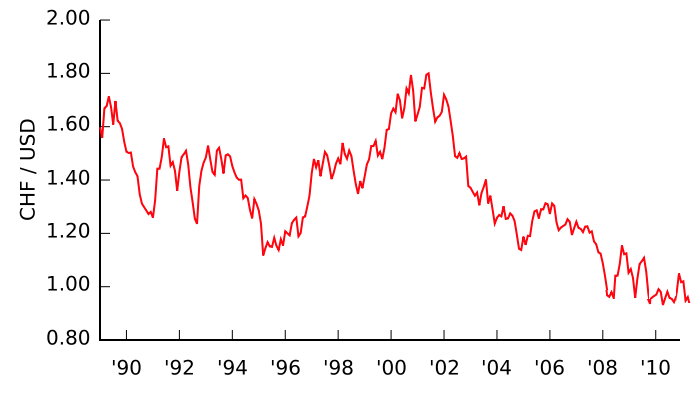
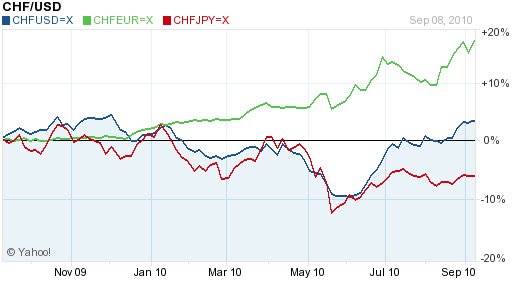
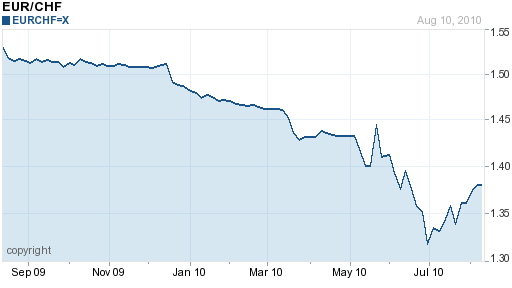
In the last two weeks, the Swiss Franc rose to record highs against not one, not two, but three major currencies: the US Dollar, Euro, and British Pound. The Franc is now entrenched well above parity against the Dollar, and is closing in on the magical level of 1:1 against the Euro. With market uncertainty projected to run well into 2011, continued strength in the Franc is all but assured.

usd CHF 2 Year Chart

The Franc’s rise is due entirely to its being perceived as a safe haven currency. Its debt levels are comparable to other industrialized countries, its economy is in mediocre shape, and interest rates are the lowest in the entire world (the overnight lending rate is a paltry .1%). Some analysts have cited the “strong Swiss economic outlook” and “the health of Swiss public finances” as two factors buttressing its strength, but make not mistake: if not for the tide of risk aversion sweeping through the world’s financial markets, the Franc would hardly be attracting any attention.

As I have reported recently, the Dollar and the Yen have also benefited from the spike of risk aversion caused by renewed concerns over the fiscal health of the EU and the prospect of conflict in Korea. Perhaps owning to nothing more than proximity, the Franc has been the primary beneficiary from EU sovereign debt crisis. “It appears that smart money investors are pre-emptively bailing funds out of the eurozone with Switzerland providing a safe port to ride out the eurozone sovereign debt storm that appears to loom on the horizon,” summarized one analyst.

Unfortunately, it looks like the situation in the EU can only become serious. Despite a collective move towards fiscal austerity, all of the problem countries are still running budget deficits. As a result, members of the EU are set to issue no less than €500 Billion of new debt in 2011. To make matters worse, “The onslaught of credit warnings and downgrades of sovereign ratings over the past few days added to worries that borrowing costs in many euro zone nations could rise further.” This could trigger a self-fulfilling descent towards default and further buoy the Franc.

EUR CHF 2 Year Chart
As far as I can tell, the notion that, “Despite the Swiss franc’s recent sharp gains, we still believe there is plenty of room for further upside ahead,” seems to encapsulate current market sentiment. According to the most recent Commitment of Traders Report, investors continue to increase their long positions in the Franc. According to Bloomberg News, “Options traders are more bullish on the franc for the next three months than any major currency except the yen.” Meanwhile, a sample of analysts’ forecasts suggests that the Franc could appreciate another 5% over the next six months.

At this point, the main variable the Swiss National Bank (SNB), which could resume intervention on behalf of the Franc. After spending close to €200 Billion to depress the Franc, the SNB accepted the futility of its efforts and formally renounced intervention in June. However, Swiss National Bank President Philipp Hildebrand recently referred to the Franc’s rise as a “burden,” and warned that the SNB “would take the measures necessary to ensure price stability” in the event of  “renewed financial market tensions.”

As to whether intervention is likely, analysts remain divided. “The timing [for intervention] would certainly be perfect, with liquidity very thin….pre-holiday markets are ideal for springing a surprise,” said one strategist. According to Morgan Stanley, however, the SNB is “unlikely to intervene in the near term to stem the rise in the franc. The previous intervention earlier this year has left a huge overhang of liquidity in the economy and the Swiss National Bank doesn’t want to further boost the money supply.” In addition, the SNB experienced losses of €22 Billion on its forex reserves in the first nine months of this year, and will be reluctant to incur further losses by resuming intervention.

In short, aside from this lone point of uncertainty, all factors point to continued upside.

SocialTwist Tell-a-Friend
Posted by Adam Kritzer | in News, Swiss Franc | 3 Comments »

Forex Volatility Remains Abnormally High

Dec. 26th 2010

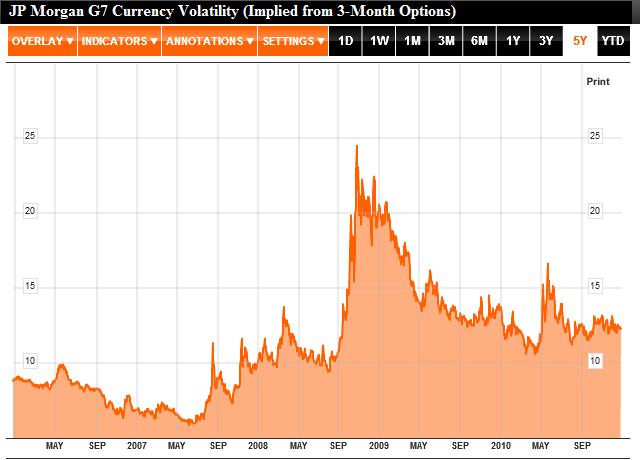
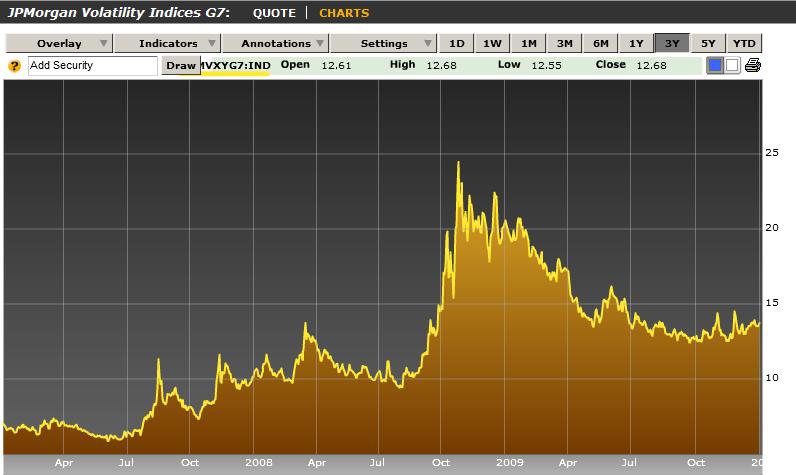
If you look at a chart of currency volatility over the last five years, two major spikes immediately jump out. The first took place in the wake of the collapse of Lehman Brothers in late 2008, while the second occurred earlier this year during the height of the EU sovereign debt crisis. While volatility has gradually subsided since then, it is still well above its historical average, and many analysts forecast that it will remain at an elevated level through at least 2011.

G7 Currency Volatility 2006-2010

2010 was a volatile year for the forex markets for good reason. The EU sovereign debt crisis officially emerged, and spread from Greece to Ireland, and potentially to Portugal and Spain as well. There was uncertainty surrounding the impact of the Fed’s second quantitative easing program (QE2), as well as the impact of similar plans announced by the Bank of England and Bank of Japan. A handful of Central Banks ignited what has since been termed the “currency war,” which the G7/G20 are still trying to end. China allowed the Yuan to resume its upward march against the US Dollar, but at a pace that has failed to satisfy most critics. Emerging market currencies in general, and Asian currencies in particular surged, despite the best efforts of their respective Central Banks to contain them.

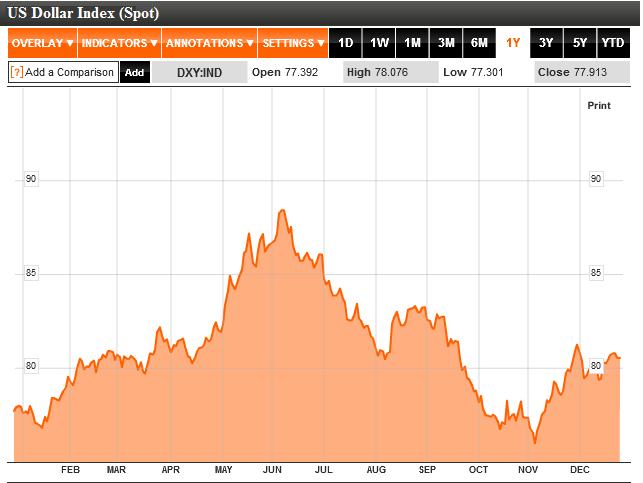
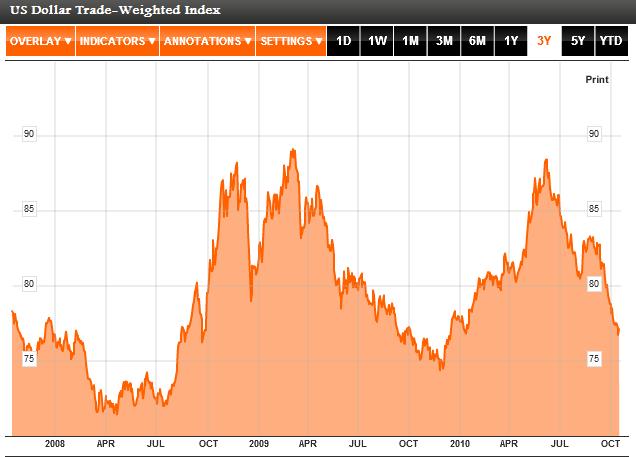
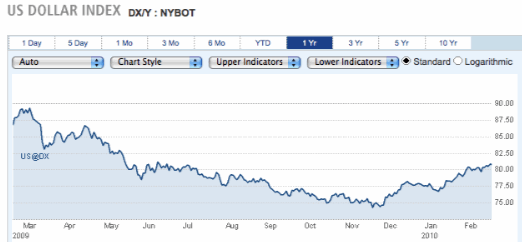
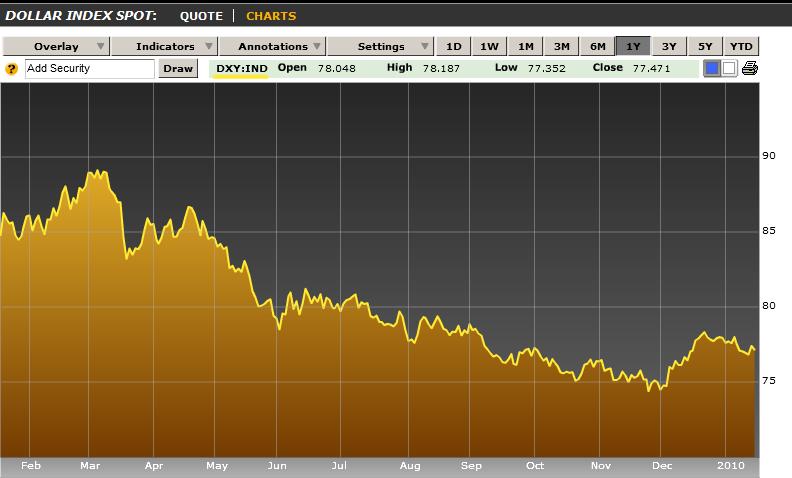
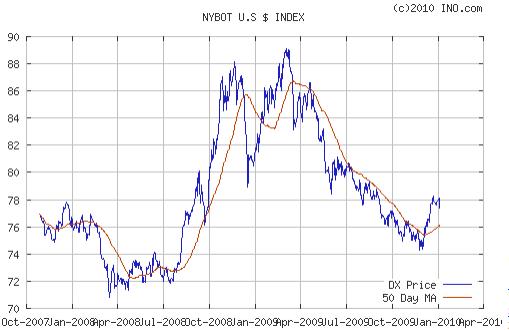
As a result, investors struggled to figure out what the right levels to buy and sell even the major currency pairs.  The Euro has ranged from $1.1877 to $1.4579 (against the Dollar) so far this year; and the Yen has ranged from 80.22 to 94.99. Amidst this backdrop of volatility, investors once again flocked to the US Dollar. On a trade-weighted basis, it appreciated 5% for the year. Against its arch-rival, the Euro, it gained an impressive 10%. The Japanese Yen and Swiss Franc – the other two major safe-haven currencies – also outperformed, even touching record levels against some other currencies.

US Dollar Index 2010

At this point, the only certainty is that uncertainty will persist well into 2011. Economic and monetary policymakers around the world will continue to struggle to keep (or merely put) their economies on the recovery track, while minimizing the risk of inflation in the medium-term. According to the currency strategy team at UBS, “There is…high risk of policy-maker error in relation to interest rates, quantitative easing and fiscal tightening.” To make matters worse, there is still a lack of coordination among, and in some cases, outright contradiction between countries’ respective policies. “There are doubts about the mutual consistency in economic strategies pursued by major economies…We have seen in recent weeks a tendency by countries to publicly challenge each others’ monetary or exchange rate policies,” said European Central Bank governing council member Christian Noyer.

As a result, it’s more than likely that volatility levels will remain proportionately high. Added UBS, “The euro may range from $1.1 and $1.5…and U.S. dollar may touch as low as 70 yen and high as 100 yen in 2011…Overall investors will have to be more aware of foreign exchange risk in 2011. For at least several more years, volatility will be structurally higher.”

In this kind of environment, the implications are clear. While commodity and emerging market currencies may still be girded by strong fundamentals, a lack of investor risk appetite could trigger another round of capital flight. Meanwhile, the US Dollar (and other safe haven currencies) will benefit, and the Euro will suffer.

SocialTwist Tell-a-Friend
Posted by Adam Kritzer | in News | No Comments »

Interview with Boris Schlossberg: “Risk control is EVERYTHING”

Dec. 23rd 2010

Today, we bring you an interview with Boris Schlossberg, director of currency research at GFT Forex, co-founder of BK Forex Advisors, and co-contributor to FX360. He is also a weekly contributor to CNBC’s Squawk Box and a regular commentator for Bloomberg radio and television. His daily currency research is widely quoted and appears in numerous newspapers worldwide. He is the author of Technical Analysis of the Currency Market (2006) and Millionaire Traders (2007). Below, Mr. Schlossberg shares his thoughts on risk management, leverage, currency wars, and other assorted topics.

Read the rest of this entry »

SocialTwist Tell-a-Friend
Posted by Adam Kritzer | in Interviews, News | 3 Comments »

IPOs Raise Questions about the Future of Retail Forex

Dec. 21st 2010

It has been said before, but now I think it’s official: retail forex has entered the mainstream. In the month of December, two retail forex brokerages – Forex Capital Markets (FXCM) and Gain Capital Holdings (GCAP) – went public on the New York stock exchange. Combined with some juicy information revealed in their regulatory filings, I think this event raises some interesting questions about the future of forex.

Some background: both FXCM and Gain Capital operate trading platforms and news/analysis websites (DailyFX.com and Forex.com, respectively). FXCM has a current market capitalization of $850 million, compared to $250 million for Gain Capital. The former earned net income of $98 million last year on revenue of $339 million, and it has 135,000 active clients. The latter earned $36 million net income on $188 million revenue, and its client base totals 52,000. (For the sake of comparison, consider that ETrade has more  than $4 million and its ttm revenues exceeded $2.5 Billion).

If you do some simple arithmetic, you will discover that revenue per account is substantially higher for forex brokers than for stock brokers: $2,500/account for  FXCM versus $100-200 that I’ve been told is standard for retail stock brokers. Of course, some of that disparity is natural, given that the average forex account-holder trades at a higher frequency and higher volume than the average stock investor, who apparently only makes one round-trip trade per month, on average. However, the bulk of that discrepancy is probably due to a lack of transparency/competition.

Although information on average account size was not released, it nonetheless stands to reason that a significant portion of forex account-holder equity is being “transferred” to brokers every year. (Interestingly, FXCM loses money on the majority of its accounts.  Accounts worth more than $10K – which presumably do the most trading – generate the most revenue, and yet more than half of them are still unprofitable for FXCM).

I think this raises some serious questions about transparency in forex commissions. While other brokers make money from the bid/ask spread (which also suffers from a lack of transparency) and by taking offsetting positions, FXCM boasts that it “makes an identical amount of money in the form of pip markups (which are really commissions) regardless of whether the customer made or lost money on the account.” Basically, FXCM matches up buyers/sellers with banks and financial institutions, and takes a cut for facilitating the transaction. While this is somewhat less opaque than filling orders directly for customers, the fact that it doesn’t disclose its commissions should be cause for concern. For the sake of comparison, consider that when you buy/sell stock, the commission that you pay the broker is clearly disclosed.

Someone recently asked me if trading commissions (i.e. spreads) in forex were fair/stable, and in the context of this data, I think it shows that there are is still room for commissions to fall. As the number of retail forex traders grows, you would expect spreads to tighten further, and profit/account to decline from the current level of $700+ per year.

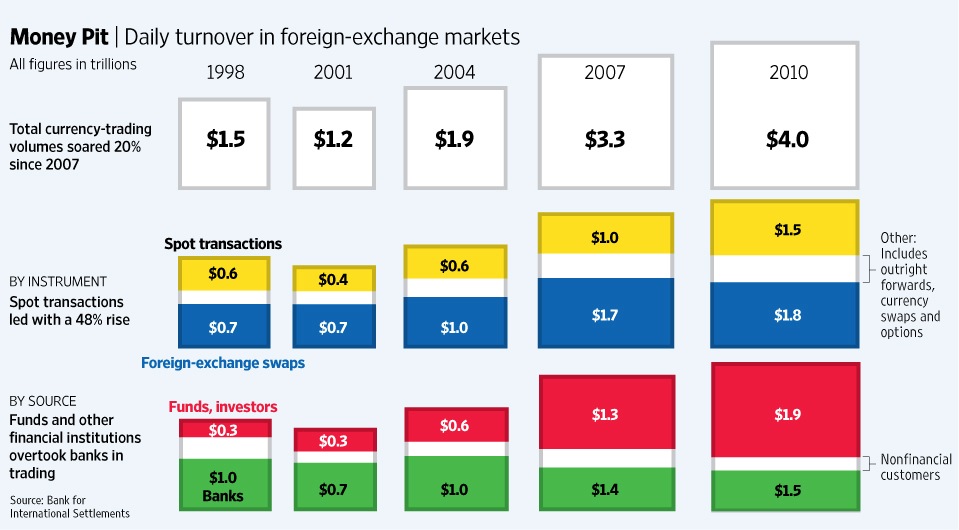
Since both FXCM and Gain Capital are now public companies, they will be subject to increased scrutiny and regulatory oversight, and will henceforth be required to make frequent disclosures. If Oanda and other top-tier brokers accede to competitive pressures and also go public, the result should be increased transparency for the industry and better pricing for traders. In short, daily volume figures ($4 Trillion/day) notwithstanding, retail forex trading still has a ways to go before it can really be compared to retail stock trading.

IPOs Raise Questions about the Future of Retail Forex

It has been said before, but now I think it’s official: retail forex has entered the mainstream. In the month of December, two retail forex brokerages – Forex Capital Markets (FXCM) and Gain Capital Holdings (GCAP) – went public on the New York stock exchange. Combined with some juicy information revealed in their regulatory filings, I think this raises interesting questions about the future of forex.

Some background: both FXCM and Gain Capital operate trading platforms and news/analysis websites (DailyFX.com and Forex.com, respectively). FXCM has a current market capitalization of $850 million, compared to $250 million for Gain Capital. The former earned net income of $98 million last year on revenue of $339 million, and it has 135,000 active clients. The latter earned $36 million net income on $188 million revenue, and its client base totals 52,000. (For the sake of comparison, consider that ETrade has more  than $4 million and its ttm revenues exceeded $2.5 Billion).

If you do some simple arithmetic, you quickly discover that revenue per account is substantially higher for forex brokers than for stock brokers: $2,500 in the case of FXCM compared to $100-200 that I’ve been told is standard for retail stock brokers. Of course, some of that is to be expected, given that the average forex account-holder trades at a higher frequency and higher volume than stock investors, which apparently only make one round-trip trade per month, on average. While information on average account size was
not released, it nonetheless stands to reason that a significant portion of forex account-holder equity is being “transferred” to brokers every year. (Interestingly, FXCM loses money on the majority of its accounts.  Accounts worth more than $10K – which presumably do the most trading – generate the most revenue, and yet more than half of them are still unprofitable for FXCM).

I think this raises some serious questions about transparency in forex commissions. While other brokers make money from the bid/ask spread (which also suffers from a lack of transparency) and by taking offsetting positions, “FXCM makes an identical amount of money in the form of pip markups (which are really commissions) regardless of whether the customer made or lost money on the account.” Basically, FXCM matches up buyers/sellers with banks and financial institutions, and takes a cut for facilitating the transaction. While this is somewhat less opaque than filling orders directly for customers, the fact that it doesn’t disclose its commissions should be cause for concern. For the sake of comparison, consider that when you buy/sell stock, the commission that you pay the broker is clearly disclosed.

Someone recently asked me if trading commissions (i.e. spreads) in forex were fair/stable, and in the context of this data, I think it shows that there are is still room for commissions to fall further. As the number of retail forex traders grows, you would expect spreads to tighten further, and profit/account to decline from the current level of $700+ per year.

Since both FXCM and Gain Capital are now public companies, they will be subject to increased scrutiny and regulatory oversight, and will henceforth be required to make frequent disclosures. If Oanda and other top-tier brokers accede to competitive pressures and also go public, the result should be increased transparency for the industry. As of yet, I think that daily volume figures ($4 Trillion/day) notwithstanding, retail forex trading still has a ways to go before it can really be compared to retail stock trading.IPOs Raise Questions about the Future of Retail Forex

It has been said before, but now I think it’s official: retail forex has entered the mainstream. In the month of December, two retail forex brokerages – Forex Capital Markets (FXCM) and Gain Capital Holdings (GCAP) – went public on the New York stock exchange. Combined with some juicy information revealed in their regulatory filings, I think this raises interesting questions about the future of forex.

Some background: both FXCM and Gain Capital operate trading platforms and news/analysis websites (DailyFX.com and Forex.com, respectively). FXCM has a current market capitalization of $850 million, compared to $250 million for Gain Capital. The former earned net income of $98 million last year on revenue of $339 million, and it has 135,000 active clients. The latter earned $36 million net income on $188 million revenue, and its client base totals 52,000. (For the sake of comparison, consider that ETrade has more  than $4 million and its ttm revenues exceeded $2.5 Billion).

If you do some simple arithmetic, you quickly discover that revenue per account is substantially higher for forex brokers than for stock brokers: $2,500 in the case of FXCM compared to $100-200 that I’ve been told is standard for retail stock brokers. Of course, some of that is to be expected, given that the average forex account-holder trades at a higher frequency and higher volume than stock investors, which apparently only make one round-trip trade per month, on average. While information on average account size was
not released, it nonetheless stands to reason that a significant portion of forex account-holder equity is being “transferred” to brokers every year. (Interestingly, FXCM loses money on the majority of its accounts.  Accounts worth more than $10K – which presumably do the most trading – generate the most revenue, and yet more than half of them are still unprofitable for FXCM).

I think this raises some serious questions about transparency in forex commissions. While other brokers make money from the bid/ask spread (which also suffers from a lack of transparency) and by taking offsetting positions, “FXCM makes an identical amount of money in the form of pip markups (which are really commissions) regardless of whether the customer made or lost money on the account.” Basically, FXCM matches up buyers/sellers with banks and financial institutions, and takes a cut for facilitating the transaction. While this is somewhat less opaque than filling orders directly for customers, the fact that it doesn’t disclose its commissions should be cause for concern. For the sake of comparison, consider that when you buy/sell stock, the commission that you pay the broker is clearly disclosed.

Someone recently asked me if trading commissions (i.e. spreads) in forex were fair/stable, and in the context of this data, I think it shows that there are is still room for commissions to fall further. As the number of retail forex traders grows, you would expect spreads to tighten further, and profit/account to decline from the current level of $700+ per year.

Since both FXCM and Gain Capital are now public companies, they will be subject to increased scrutiny and regulatory oversight, and will henceforth be required to make frequent disclosures. If Oanda and other top-tier brokers accede to competitive pressures and also go public, the result should be increased transparency for the industry. As of yet, I think that daily volume figures ($4 Trillion/day) notwithstanding, retail forex trading still has a ways to go before it can really be compared to retail stock trading.

SocialTwist Tell-a-Friend
Posted by Adam Kritzer | in Investing & Trading, News | 3 Comments »

Chinese Yuan: Appreciation or Inflation?

Dec. 19th 2010

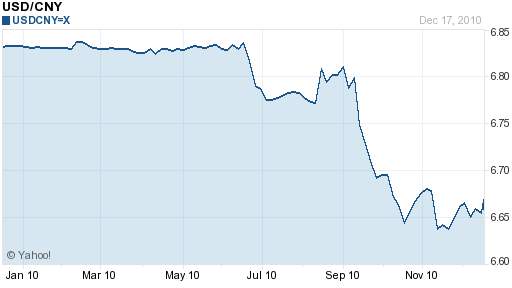
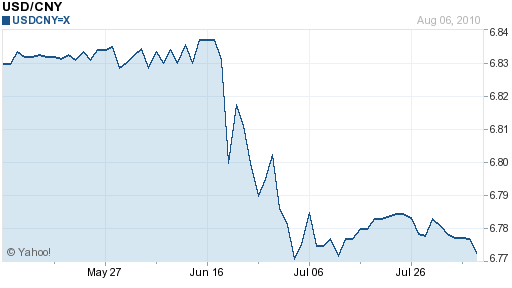
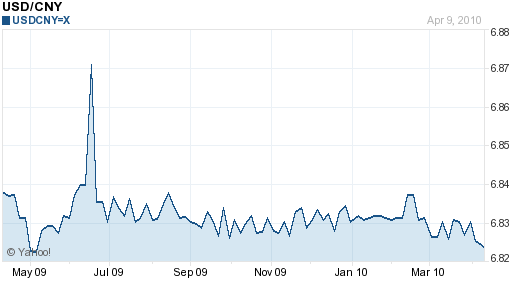
Based on nominal exchange rates, the Chinese Yuan has appreciated by a modest 2% against the US Dollar since the month of September (when the People’s Bank of China (PBOC) adjusted the currency peg for the first time in nearly two years). If you take inflation into account, however, the Chinese Yuan has risen by much more. In fact, if current trends persist, the Chinese Yuan exchange rate controversy might resolve itself.

CNY USD 1 year chart
Demands from the international community for China to appreciate its currency hinge on two related arguments. The first is that at its current level, the artificially low exchange has allowed China to build up a massive trade surplus. The second is that Chinese prices seem to be lower than they should be (when quoted in other currencies), and the economic principle of Purchasing Power Parity (PPP) suggests that for this discrepancy to be eliminated, the Chinese Yuan must rise.

As it turns out, both of these claims are more problematic than they would appear. For example, China’s official trade surplus is already massive, and is steadily increasing. For 2010, it will probably near $200 Billion. However, it turns out that majority of that surplus is being captured by foreign-funded companies: “Their 112.5-billion U.S.-dollar surplus accounts for 66 percent of China’s total surplus over the past 11 months.”

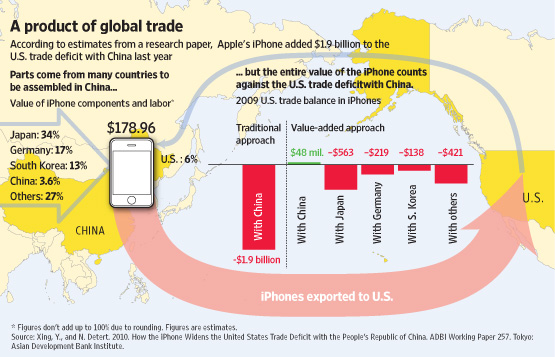
In addition, trade statistics are calculated in such a way that the country that assembles the finished product gets credit for the full export value of that product. By looking specifically at Apple’s popular iPhone, researchers calculated that the product officially contributed $2 Billion to the US trade deficit with China. When the nuances of the iPhone’s supply chain are taken into account, that figure swings to a surplus of $48 million. In both of these cases, the fact that these products are manufactured in China doesn’t detract from US GDP (though it probably does cost the US jobs). Hence, the US probably isn’t hurting as much from the weak RMB to the extent that some lobbyists insist.

iPhone US China trade deficit
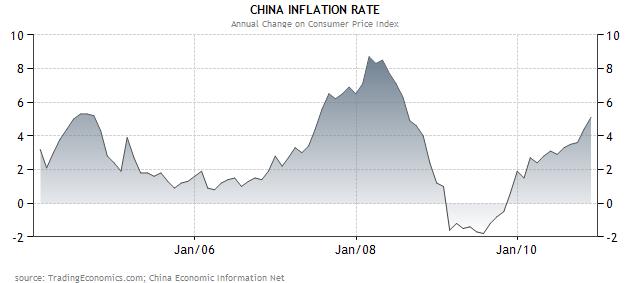
As for inflation, the official rate is now 5.1% on an annualized basis. Even if we accept this (and living in China, I can tell you that the actual rate is much, much higher), that means that the value of other currencies is eroding at a much faster rate than is implied by official exchange rates. That’s because a currency is only worth its purchasing power; as prices and wages in China rise, the purchasing power of the US Dollar (and other currencies) falls.

The Chinese government is trying to address the problem in the form of price controls and mandated increases in supply, but it is still reluctant to rein in inflation using conventional monetary policy measures. M2 money supply in China is increasing at a rate of 20% a year, the majority of which is being spent on another boom in fixed asset investment. While the PBOC has responded by increasing the required reserve ratio of Chinese banks, it remains reluctant to raise interest rates lest it contribute to further inflows of “hot money” on more upward pressure on the Yuan. As a result, the consensus among economists is that inflation will continue rising unabated: “We see a strong chance of underlying price pressures continuing to build over the medium-term.”

China inflation rate 2004-2010
Unless circumstances change, then, the argument for further RMB appreciation is somewhat weak. Nonetheless, analysts remain optimistic: “A Bloomberg survey based on the median estimates of 20 analysts predicts the yuan to increase 6.1 percent to 6.28 percent by the end of 2011.” Given that Hu Jintao is schedule to visit the US in January – and China’s fondness for symbolic policy gestures – a token move of 1% or so before then wouldn’t be surprising. As for the predicted 6% rise next year, well, that depends on inflation.

SocialTwist Tell-a-Friend

Japanese Yen Down on Risk Aversion

Dec. 15th 2010

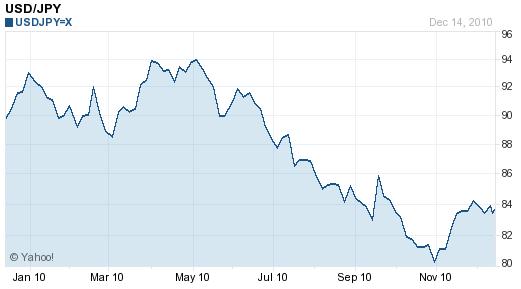
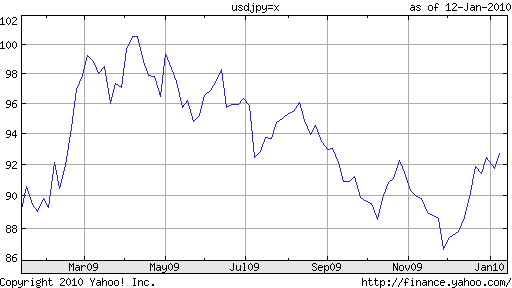
It seems the gods of the forex market read my previous post on the Japanese Yen, in which I puzzled over the currency’s appreciation in the face of contradictory economic and financial factors. Since then, the Yen’s 6-month, 15% appreciation (against the US Dollar) has arrested. It has retreated from the brink of record highs, and undergone the most significant correction since March of this year. Have investors come to their senses, or what?!

USD JPY Chart
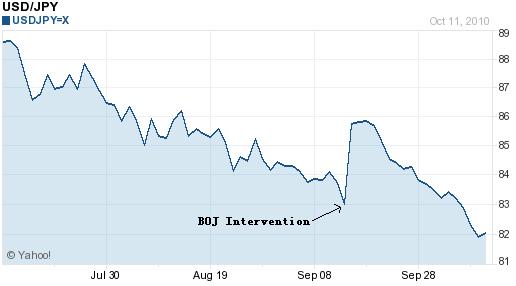
You certainly can’t give the Bank of Japan (BOJ) any credit. Aside from its single-day $25 Billion intervention in September, it hasn’t entered the forex markets. In fact, it has already repaid the funds lent to it by the Ministry of Finance, which suggests that it doesn’t have any intention to replicate its earlier intervention in the immediate future, regardless of where the Yen moves.

Perhaps the BOJ foresaw the current correction in the Yen, which was probably inevitable in some ways. After all, Japanese interest rates – while gradually rising – still remain at levels that are unattractive to investors. While US short-term rates are low, long-term rates are more than 1.5% higher than their Japanese counterparts. When you factor in that Japan’s fiscal condition is worse than the US, there is really very little reason, in this aspect, to prefer Japan. As one analyst summarized, “The whole interest-rate differential argument is turning out to be dollar supportive, at least in the near term.”

The same is true for risk-averse capital. For reasons of liquidity and psychology, the Japanese Yen will continue to be a safe-haven destination in times of distress. Still, it’s hardly superior to the Dollar, in this sense. Inflation is slowly emerging (or at least, the risk of deflation is slowly abating) in Japan, and it could conceivably reach 1% this year if the Bank of Japan has its way. Its proposed 35 trillion yen ($419 billion) of asset purchases dwarfs the comparable Federal Reserve Bank’s QE2 program (in relative terms) and contradicts the notion that the Yen is the best store of value.

Japan Economic Structure - Dependence on Exports
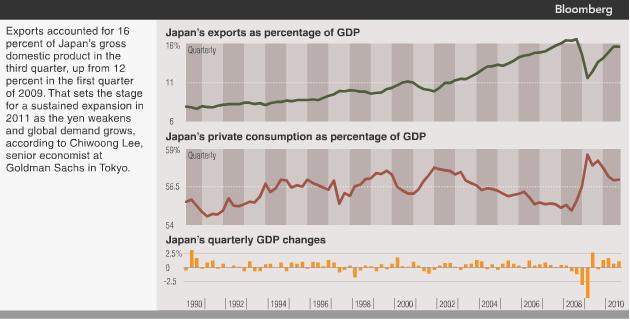
Finally, the Japanese economy remains weak, and vulnerable to a double-dip recession. On the one hand, “Japan’s economy expanded at an annual 4.5 percent rate in the three months ended Sept. 30.” On the other hand, its economy remains heavily reliant on exports (see chart above, courtesy of Bloomberg News) to drive growth, which is complicated by the expensive Yen and concerns over a drop-off in demand from China and the rest of the world. In fact, “Exports rose 7.8 percent in October, the slowest pace this year, while industrial production fell for a fifth month and the unemployment rate climbed to 5.1 percent.” In addition, the closely watched Tankan survey registered a drop in September, “the first fall in seven quarters.” While Japanese companies are still net optimistic, analysts expect that this to change in the beginning of 2011.

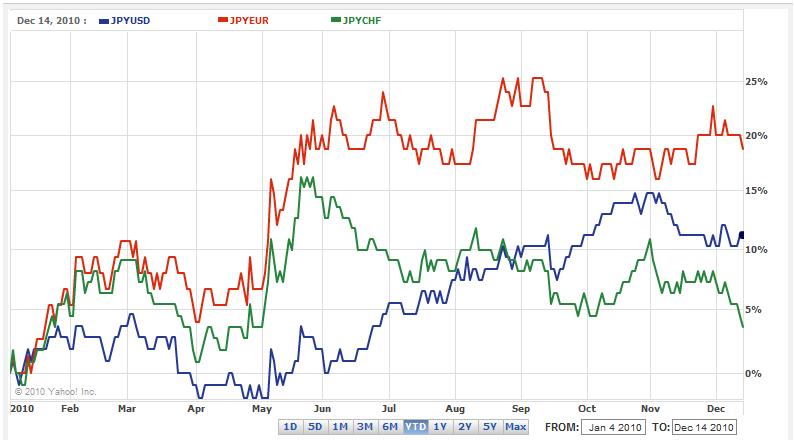
For the rest of the year, how the Yen performs will depend largely on investor risk-appetite. If risk aversion predominates, then the Yen should hold its value. In addition, it’s worth pointing out that even as the Yen has fallen against the Dollar, it has appreciated against the Euro, and remained flat against a handful of other currencies. Against the US Dollar, however, I still don’t see any reason for why the Yen should trade below 85, and I expect the correction will continue to unfold.

JPY comparison chart 2010

SocialTwist Tell-a-Friend
Posted by Adam Kritzer | in Japanese Yen, News | 2 Comments »

Canadian Dollar: Parity Vs Reality

Dec. 13th 2010

After a stellar 2009, the Canadian Dollar (“Loonie”) has had a relatively lackluster 2010 against the Dollar, rising by only 3-4%. As the Loonie has inched (back) towards parity, it has encountered significant resistance. I think there is reason to believe that the currency has reached its limit, and that there are little prospects for further appreciation for at least the first half of 2011.

Canadian Dollar  Oil   Commodity Price Chart 2010
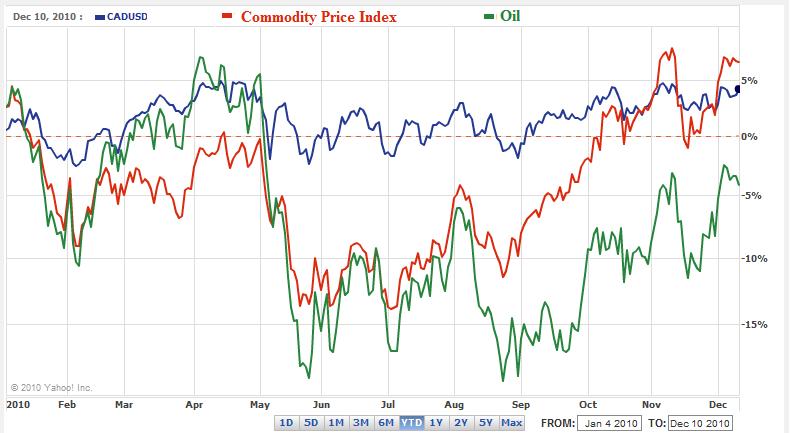
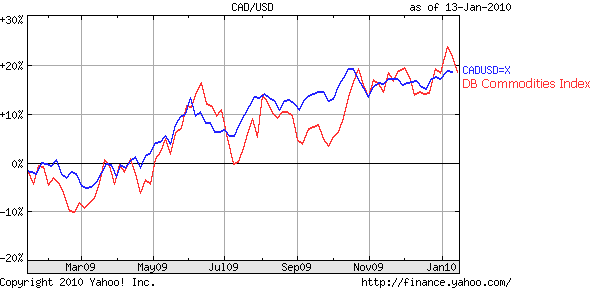
Everyone likes to think of the Canadian Dollar as a commodity currency, but I don’t think this is an accurate representation. Net energy exports account for only a small portion (2.9%) of Canadian GDP, a fraction which is dwarfed by the export of automobiles, for example. In fact, eastern Canada, which is comparatively poor in natural resources, is actually a net energy importer. I think that investors have largely come to the same conclusion, and significant rallies in oil and other commodity prices in the second half of 2010 spurred only a modest appreciation in the Loonie.

The currency has risen so fast over the last couple years that Canada has run a trade deficit for six consecutive months, including a record $2.5 Billion in July. (In some ways, doesn’t this prove that economic imbalances will ultimately self-correct?!). In addition, to say that Canadian export sector is heavily reliant on the US would be an understatement: “The U.S. bought 70 percent of Canada’s exports in October, down from 75 percent in June, and a record of about 85 percent in 2001.” It’s no wonder that Canadian economic officials have defended the Fed’s QE2 monetary easing program; they know that Canada’s economic health is contingent on a strong US economy.

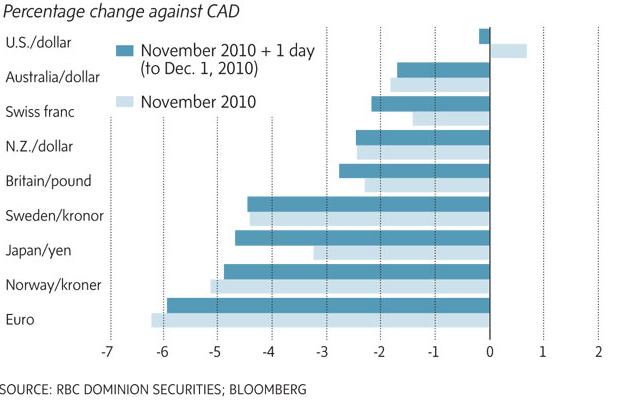
As for how fluctuations in risk affect the Loonie, it’s not clear. On two separate occasions, the WSJ reported first that “With investors more willing to take on riskier assets than they were the day before, the Canadian dollar was able to move sharply higher,” and then that “Canada’s relatively strong fiscal and economic fundamentals attract safe-haven flows when investors are fleeing from risk.” What a blatant contradiction if there ever was one! Personally, I think that Canada’s economic structure and relatively high debt levels disqualify the Loonie from consideration as a safe-haven currency. That being said, it has notched some impressive gains against other non-safe haven currencies.

Canadian Dollar Versus Other Currencies November 2010

If not for its low interest rates, nobody would even mention it in the same breath as the US Dollar or Japanese Yen. Speaking of low rates, the Bank of Canada voted last week to keep its benchmark interest rate on hold at 1% and indicated that it won’t consider raising them for quite some time. Said Central Bank Governor Mark Carney, “There are limits to the divergence that there can be between Canada and the United States.” In other words, the BOC probably won’t hike rates until the Fed does, at which point there will be very little basis for buying the Loonie over the US Dollar.

Analysts tend to agree with this assessment: “The loonie will trade at parity by the end of March and weaken to C$1.01 per dollar through the end of third-quarter 2011, according to…a Bloomberg survey: ‘We still think the Canadian dollar will continue to hover around here and test parity; we don’t think the Canadian dollar is going to back up against the U.S. dollar until the new year.’ Interestingly enough, Canadian investment advisers echo this sentiment: “We’re saying to clients that the Canadian dollar is strong right now, so buying U.S. assets is cheaper than it would be if the dollar were weak.”

It’s a bad sign for the Loonie when even Canadians think it’s overvalued.

SocialTwist Tell-a-Friend
Posted by Amy Cottrell | in Canadian Dollar, News | 2 Comments »

Russian Ruble Undervalued According to Central Bank

Dec. 9th 2010

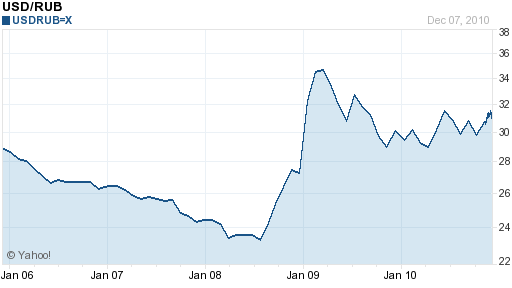
In the midst of the currency war controversy, there is one emerging market country that continues to insist that its currency is undervalued: Russia. While being a member of the illustrious group of BRIC (Brazil / Russia / India / China) countries would seem to guarantee an appreciating currency, there are strong forces weighing on the Ruble. In other words, that it remains weak is not due to investor oversight.
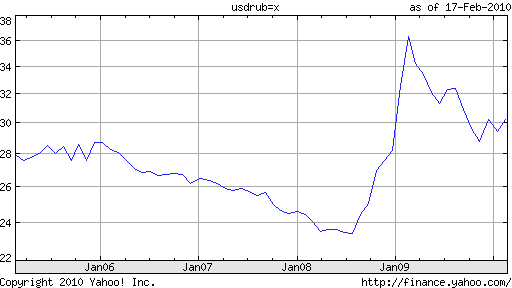
Ruble Dollar Chart 2006-2010

If you view the performance of the Russian Ruble over the last few years, it’s clear that it never recovered from the rapid depreciation that took place during the height of the credit crisis. Given that nearly every other emerging market currency is either closing in on or has already breached its pre-credit crisis level, there must be something holding down the Ruble.

That something happens to be a sizable current account deficit. Unlike with other emerging markets, capital is actually flowing out of Russia. There are a few reasons for this: first of all, much of Russia’s debt is denominated in foreign currency, as a consequence of its massive default in 1998. Specifically, “The private sector has about $16 billion in foreign debt, including interest-rate payments, due this month [December], double the $8 billion of redemptions in October and November.” This means that every month, Russian companies must scramble to exchange Rubles for Dollars and Euros.

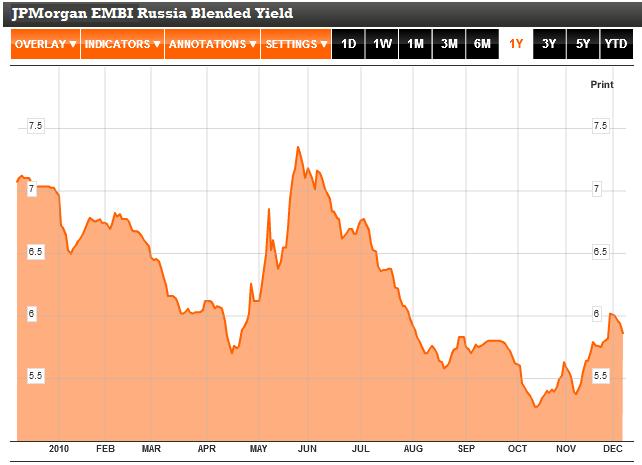
Next, the real returns of investing in Russia are currently negative. Russia’s Central Bank (Bank Rossii) continues to maintain the benchmark refinancing rate at a record-low 7.75%, and the 10-year yield on Russian bonds is even lower, at ~5%. This would seem to compare favorably with the 2.75% yield on comparable US Treasury Securities until you account for inflation, which is projected to top 8% for the year. While Ruble-denominated bonds pay a higher interest rate (7.75%), they also carry higher risk. For that reason, Russian yields and credit default swap spreads (which insure against default) are much higher in Russia than in other BRIC countries.

JPMorgan EMBI Russia Blended Yield Chart 2010

Meanwhile, Russian companies are taking advantage of low borrowing rates to engage in a reverse carry trade and invest in western countries: “Russian companies have announced $27 billion of foreign purchases this quarter, the most since the third quarter of 2008 and triple the amount in the last three-month period.” Finally, the reemergence of the EU fiscal crisis, combined with the skirmish in Korea has spurred a decrease in risk appetite. As one analyst summarized, “The whole of the emerging markets are on the back-foot at the moment and the ruble is no exception…it’s definitely risk off at the moment.”

As a result, Bank Rossii finds itself in a somewhat unique position among Central Banks of having to try to prop up its currency. Technically, the Rouble is pegged to a basket (consisting of 55% Dollars and 45% Euros), but pressure on it has been so intense that the range in which it is permitted to trade has been adjusted downward five times since the middle of October. To prevent it from declining further, Bank Rossii has been dipping into its $450 Billion stock of forex reserves, and selling foreign currency at the rate of $150 million per day. It insists that it will “allow” the Rouble to appreciate in 2011 in order to fight inflation, but that obviously depends on whether the current account shifts back to surplus.

What do investors think? According to a Bloomberg survey of currency analyst, “The Ruble will strengthen 4 percent versus the basket by the end of the first quarter of 2011. On the other hand, “Options traders are still bearish on the ruble with the currency’s one-week risk reversal rate — the premium of put options over calls — at 1.25 percent for the tenth straight day, from 0.5 percent at the end of October.” Non-deliverable forward contracts, meanwhile, reflect a weaker Ruble three months from now.

If the Bank Rosii fulfills analysts’ expectations and hikes rates in March, it will be step towards reinvigorating investor interest in Russia. More importantly, however, is that inflation is brought under control. Until that happens, the Ruble will remain the main standout in a sea of emerging market currencies that otherwise continues to outperform.

SocialTwist Tell-a-Friend
Posted by Linda Goin | in Emerging Currencies, News | 3 Comments »

Risk Aversion (Still) Positive for USD

Dec. 7th 2010

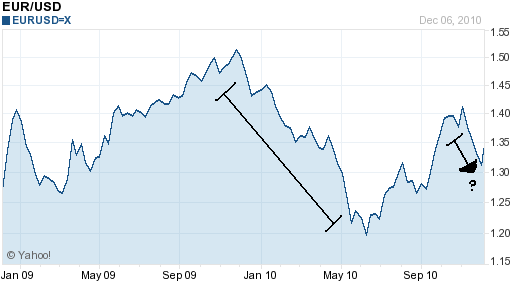
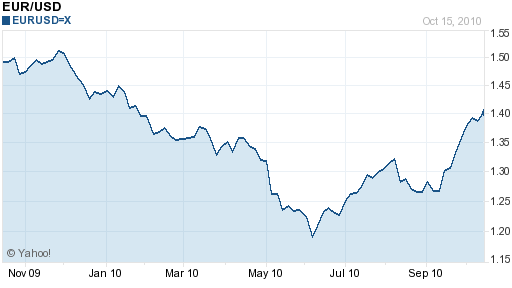
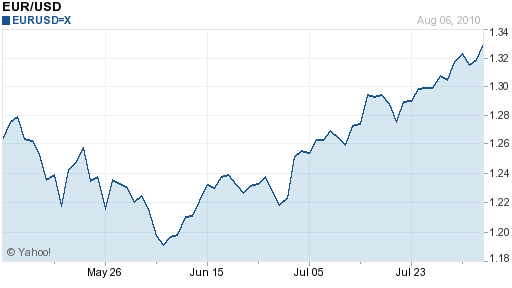
As one strategist recently put it, we seem to be witnessing Deja Vu in the forex markets. The US Dollar in general, and the USD/EUR currency pair in particular, are behaving exactly the same as one year ago: “The greenback rose back then…on a combination of strong U.S. November jobs numbers…and the triple downgrades of Greece later in the month by Fitch, S&P and Moodys.” This time around, a similar combination of US optimism and EU pessimism are once again buoying the Dollar.

Euro Dollar Chart 2009-2010
It all started about a month ago, when the EU sovereign debt crisis flared up again in the EU. Initially, investors were focused on the fiscal plight of Ireland, but quickly became nervous about the possibility that the crisis would spread to Portugal and even Spain, which would tax the finances/ability of the EU and put extreme pressure on the European Monetary Union (EMU). With this in mind, investors have fled the Euro, sending it down more than 7% – from peak to trough – against the Dollar.

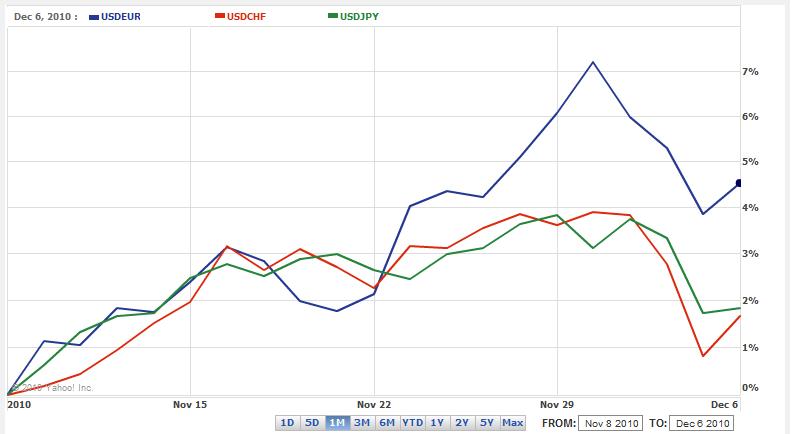
The skirmish between North and South Korea further added to the climate of heightened risk, and reinforced the position of the Dollar as the world’s safest currency, ahead of even the Swiss Franc and Japanese Yen: “Recent events just reinforce the underlying message that during times of turmoil, almost no matter what the source, the U.S. dollar is seen as a safe harbor for investors.” Basically, there is still nothing that can compare to US Treasury securities in terms of liquidity and security. In fact, demand for Dollars has become so acute in recent weeks that some analysts are already bracing for the (still-distant) possibility of another Dollar shortage, like the one that plagued the markets following the collapse of Lehman Brothers in 2008. In short, “The strong dollar thirst linked to dollar-funding needs is, as usual, supporting the dollar.”

Meanwhile, the markets are becoming less pessimistic about the impact of the Fed’s $600 Billion expansion of its Quantitative Easing Program (QE2) and consequently more optimistic about US growth prospects. Even before the drama in the EU and Korea, investors had already started to adjust their positions. Since mid-October, “Futures traders have slashed bets for a decline in the dollar against the euro, yen, Australian dollar, and Swiss franc, data from the U.S. Commodity Futures Trading Assn. show…Strategist forecasts for the dollar to weaken have all but disappeared.”

While the employment picture remains a dim spot, the economy is still growing. In a recent televised interview, Ben Bernanke declared that, “Another recession appeared unlikely.” He also added that QE3 is also a possibility if banks continue to hoard capital, eroding the effectiveness of QE2. The positive reaction of forex markets shows that investors are less concerned about inflation and more focused on whether QE2 will facilitate economic growth. It “absolutely can be dollar-positive if the markets decide that [it is] going to be part of the package that brings about a revival in economic growth,” summarized one analyst.

USD EUR CHF JPY Chart
If the markets continue to bet on (as opposed to against) QE2, and uncertainty persists in the EU, the Dollar will continue to rally and finish off the year in positive territory.

SocialTwist Tell-a-Friend
Posted by Adam Kritzer | in News, US Dollar | 1 Comment »

Euro-Watchers Pull About-Face

Dec. 4th 2010

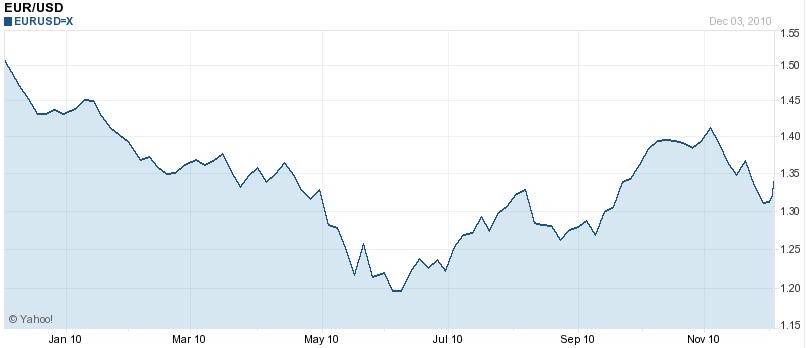
Only last month, the Euro was on top of the forex markets. Especially relative to its “G4″ competitors (Dollar, Yen, Pound) – all of which are plagued by economic uncertainty and loose monetary policies – the Euro was seen as a smart bet. In the last few weeks, however, the EU sovereign debt crisis resurfaced, and the Euro has plunged, losing 7.5% of its value against the Dollar. As a result, investors have pulled an about-face: instead of banking on the European Central Bank (ECB) to buoy the Euro through monetary restraint, they are now counting on it to hold the Euro together by adopting the same tactics as its counterparts.

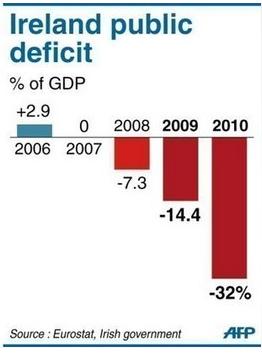
Before I explain what I mean here, I’d like to offer an update on the EU fiscal situation. In the last week, there were a handful of developments. First, Ireland accepted a tentative €85 Billion in aid from the EU/IMF, officially joining the ranks of an infamous club that also includes Greece. Still, it wasn’t clear whether such a bailout would also include Irish banks, which are seen as perhaps in deeper trouble than the Irish government. As a result, investors were unmoved, and S&P moved ahead with a cut to Ireland’s sovereign credit rating.

Ireland Public Deficit of GDP

Naturally, rumors began to circulate that Portugal was also preparing a formal bailout request. Said one trader, “In Portugal the kind of language you’re hearing is similar to what you heard in Ireland a few weeks ago.” Despite promises to the contrary, Portugal’s budget deficit has widened in 2010. Interest in its most recent bond issue was healthy, but at the highest interest rate since the Euro was introduced in 1999 and more than .5% higher than last month.

Ultimately, bailouts of Greece, Ireland, and Portugal can be managed. It is a default and/or preemptive rescue of Spain – the other PIGS member – that worries investors. Its economy represents more than 11% of the EU and any hiccup would seriously shake the foundations of the Euro: “It may well be that we are approaching the endgame of this part of the crisis as Spain is of such importance that one can only imagine that the EU will regard it as the line in the sand that cannot be crossed.” While Spain is working hard to cut its budget deficit to a still-stratospheric 9.3% in 2010, investors have balked. As a result, interest rates in its bonds have surged to a post-Euro high (relative to German bonds), and credit default swap spreads (which insure against the risk of default) have risen substantially.

The problem with the EU sovereign debt crisis – like most credit crises, for that matter – is that they tend to be self-fulfilling. As investors begin to doubt the ability of institutions (governmental and otherwise) to service their debts, they naturally demand greater compensation for the (perceived) increase in risk. This further inhibits that institution’s ability to repay its loans, which only makes funding more difficult to attract, and so on.

It is ironic on multiple levels then that even as investors abandon the debt of EU member countries, they are hoping that the ECB steps in to fill the void they create. As I alluded to the title of this post, this marks a stunning about-face from only a few months ago, when the Euro was rising against the Dollar because of the ECB’s commitment to a responsible monetary policy. Nowadays, the Euro rallies only on news that the ECB is maintaining or expanding its intervention. For example, the Irish banking sector is “increasingly more reliant on the ECB funding,” and as a result, “The euro edged up…as the European Central Bank continued buying Portuguese and Irish government bonds.”

Based on this change in investor mentality, it seems unlikely that the Euro will recover its losses anytime soon. Of course, the ECB has nearly unlimited resources at its disposal. German central bank chief Axel Weber declared confidently that, “An attack on the euro has no chance of succeeding.” However, the ECB can never hope to fully supplant the important role played by private capital, and besides, “What we are experiencing at present is not a speculative attack but a justified depreciation due to unsolved problems.”

Euro Dollar chart December 2010

There are still plenty of optimists who believe that the fear will soon die down and that higher interest rates will attract some of the yield-hungry investors that are currently focused on emerging markets. Goldman Sachs forecast “the euro will rise to $1.50 by year-end 2011 as big economies in the area continue expanding.”

I think the most realistic assessment is somewhere in between. On the one hand, it seems unlikely that the Spain will default on its debt at anytime in the near future or that the Euro will cease to exist. On the other hand, the fact that investors now see the ECB as a savior for following in the footsteps of the Fed implies that there is no reason for investors to buy the Euro against the US Dollar.

SocialTwist Tell-a-Friend
Posted by Adam Kritzer | in Euro, News | 3 Comments »

Asian Currencies Poised to Rise, but for Wrong Reasons

Dec. 2nd 2010

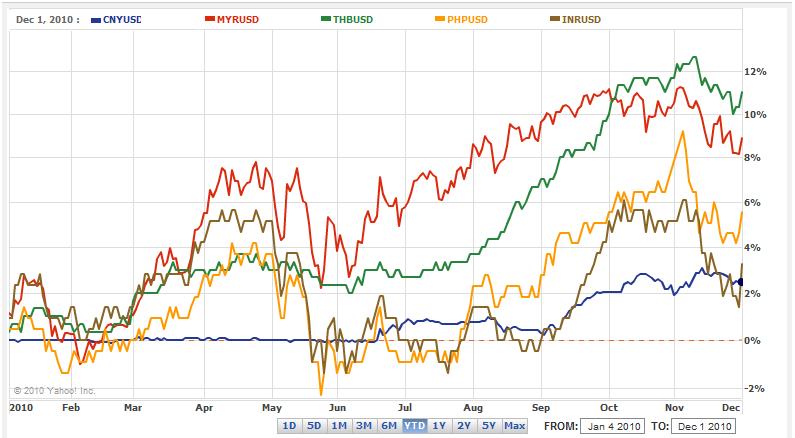
All things considered, Asian currencies have had an okay 2010 (and there’s still another month to go). After a modest first half, they started to rise in unison in June, and several are poised to finish the year 10% higher than where they began. While the last few weeks have seen a slight pullback, there is cause for cautious optimism in 2011.

Asian Currency Chart 2010
At this point, I think the rise in Asian currencies has become somewhat self-fulfilling. Basically, investors expect Asian currencies to rise, and the consequent anticipatory capital inflows cause them to actually rise, thereby reinforcing investor sentiment. For example, the co-head of emerging markets for Pacific Investment Management Company (PIMCO) is “investing in local currency debt and foreign exchange contracts in Asia on the basis that…emerging market currencies are bound to rise for…fundamental reasons.” Upon being asked to elaborate on such fundamentals, he answered lamely that, “One big driver for emerging markets in coming years will come from investors’ relatively low allocations to these fast-growing regions.”

When pressed for actual reasons, investors can glibly rattle off such strengths as high growth and low debt and wax bullish about the emerging market ‘story,’ but ultimately they are chasing yield, asset appreciation, and strengthening exchange rates. It doesn’t matter that P/E ratios for (Asian) emerging market stocks are significantly higher than in industrialized economies, or that bond prices are destined to decline as soon as (Asian) emerging market Central Banks begin lifting interest rates, or that Purchase Power Parity (PPP) already suggests that some of these currencies are already fairly valued. In a nutshell, they continue to pour money into Asia because that’s what everyone else seems to be doing.

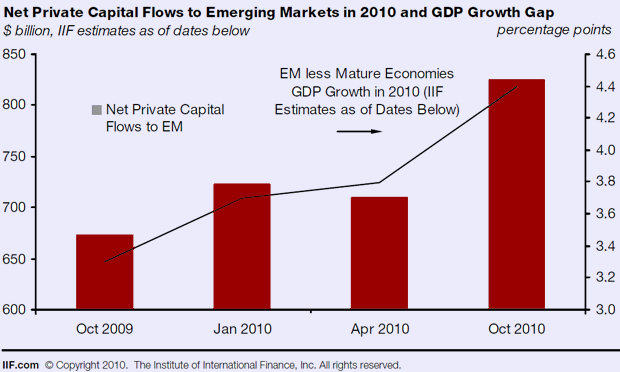
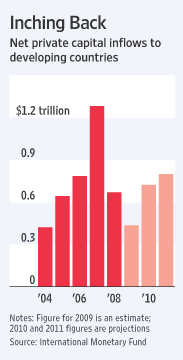
Personally, I think that kind of mentality should inspire caution in even the most bullish of investors. It suggests that if bubbles haven’t already formed in emerging markets, they probably will soon, since there’s no way that GDP growth will be large enough to absorb the continuous inflow of capital. According to the Financial Times, “Data suggest that emerging market mutual funds, including those invested in Asian markets, have received about 10 per cent of their assets in additional flows over the past four to five months.” Meanwhile, a not-insignificant portion of the $600 Billion Fed QE2 program could find its way into Asia, exacerbating this trend.

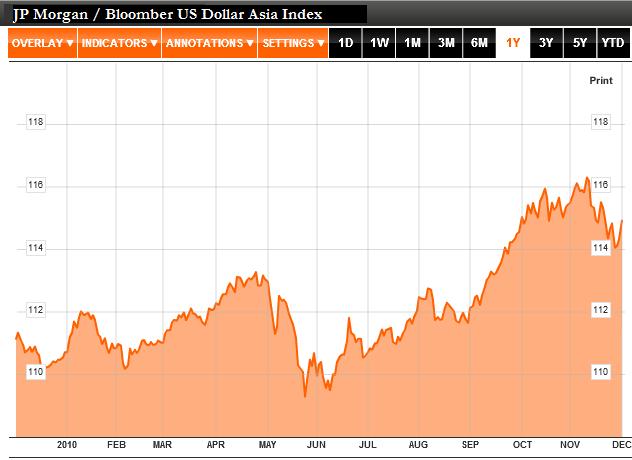
US Dollar Asia Index 2010
In addition, emerging markets in general, and Asia in particular, have always been vulnerable to sudden capital outflow caused by flareups in risk aversion. For example, Asian currencies as a whole (see the US Dollar Asian Currency Index chart above) have declined 2% in the month of November alone, due to interest rate hikes in China and a re-emergence of the EU sovereign debt crisis. The former sparked fears of a worldwide economic slowdown, while the latter precipitated a decline in risk appetite.

As a bona fide fundamental analyst, it pains me to say that emerging market Asian currencies can expect some (modest) appreciation over the next year, barring any serious changes to the EU fiscal and global economic situations. It seems that capital will continue to pour into Asia, which – rather than fundamentals – will continue to dictate performance.

SocialTwist Tell-a-Friend
Posted by Adam Kritzer | in Emerging Currencies, News | No Comments »

War = Good News for South Korea?

Nov. 30th 2010

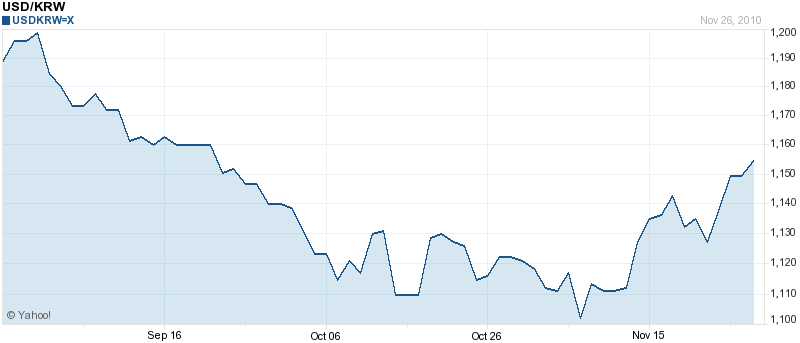
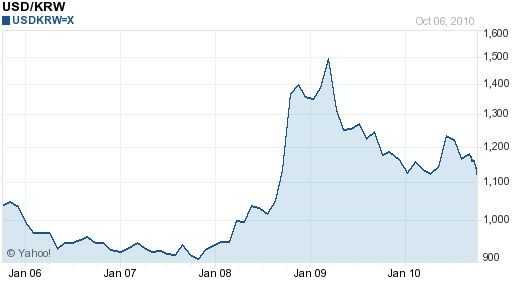
South Korea was in the midst of figuring out what to do with its appreciating Won when disaster struck, in the form of an unprovoked attack from North Korea. Combined with a worsening of the sovereign debt crisis in Europe, the news was enough to send the Won down 5% over the course of a couple weeks. From the standpoint of managing its currency, it looks like the (distant) prospect of war is actually a blessing in disguise.

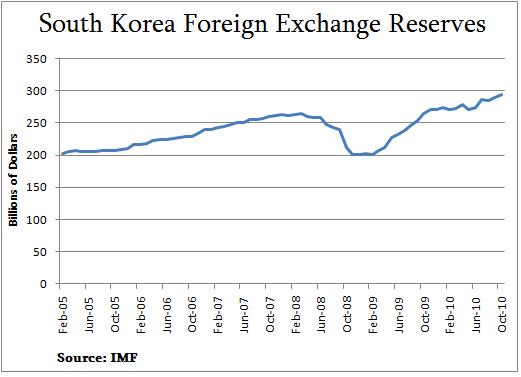
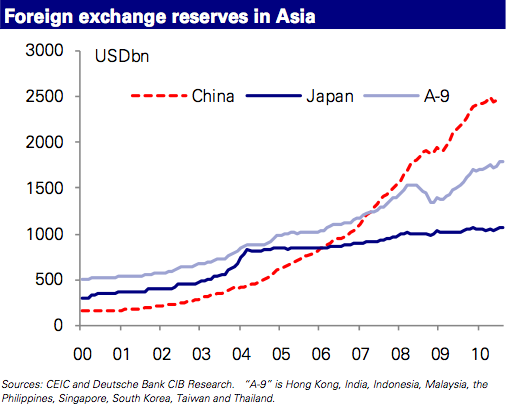
Over the last decade, South Korea has been one of the world’s largest serial interveners in currency markets. Over the last two years alone, as evidenced by the growth in its foreign exchange reserves, it has spent more than $100 Billion defending the Won. As the so-called currency war has intensified, so, too has the Bank of Korea intensified its efforts to hold down the Won, having spent more than $20 Billion since July towards this effort.

South Korea Forex Reserves 2005-2010
You could say then that South Korea’s hosting of the G20 Summit on November 15 put it in a slightly awkward position. Still, it was determined to make clear that it would continue to take steps to combat the rise in the Won. According to Shin Hyun-song, the special economic advisor to President Lee Myung-bak, “This means that countries can intervene in the currency market when the market is in disorder and when there is a gap between the market rate and underlying economic fundamentals.” Of course, fundamentals is hardly an objective notion in this case.

While the G20 predictably called on participants to “move toward a market-driven exchange rate system and to refrain from competitive devaluations,” it nonetheless also guided them towards “implementing policy tools for bringing excessive external imbalances down to sustainable levels.” The underlying message is that certain countries should curtail their reliance on exports and try to achieve more balanced growth.

Naturally, South Korea’s interpretation was that while direct intervention is now taboo, taxes and other capital controls are sanctioned. Thus, it has been reported that “the Korean government has been gauging its timing to launch further measures to tighten the financial market and protect it from volatile global capital movement..bank levies on non-deposit liabilities and taxes on foreign purchases of government bonds are both possible options.”

As I said, though, the South Korea now has some breathing room. Its Won depreciated rapidly in the minutes after the shelling of Yeonpyeong island, which killed four and wounded 20, was first reported. The fact that the US government immediately pledged its support and solidarity (by sending over an aircraft carrier) is not instilling confidence. One analyst indicated, “We see a strong chance of further Korean won weakness in the days ahead as more details emerge, particularly if public opinion in South Korea puts pressure on the government there to take a stronger stance.”

Korean Won / US Dollar Chart

Even before this episode, the EU sovereign debt crisis had spread to Ireland, and put Spain and Portugal at risk, too. As a result, the Dollar-as-safe-haven mindset re-emerged, and spurred some capital movement back to the US. In this context, the drama with North Korea only exacerbated the climate of risk aversion.

Ultimately, both the EU fiscal crisis and the tensions with North Korea will subside, which should cause the Won to resume its rise. (In fact, Korean exporters have come to view this as inevitable, and have taken advantage of the relatively favorable exchange rate to repatriate overseas earnings). At this point, you can expect the Bank of Korea to begin implementing capital controls and continue the face-off with currency markets.

SocialTwist Tell-a-Friend
Posted by Adam Kritzer | in News | 3 Comments »

US Dollar is Safe…For Now

Nov. 28th 2010

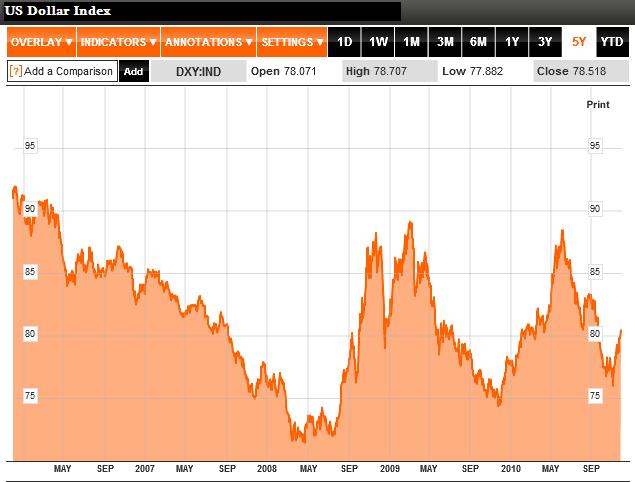
The Dollar is Crashing! The Dollar is Crashing! Such is the perennial claim of doomsday predictors, conspiracy theorists, gold bugs, etc. Those of you who read my blog regularly know that I often come to the defense of the Dollar. Given that it has risen by more than 5% over the last month and is currently hovering around its average value of the last five years, I think this position is worth reiterating.

US Dollar Index 2006 - 2010
In the months leading up to the expansion of the Fed’s Quantitative Easing Program (QE2), investors took an especially bearish view on the Dollar, precipitating a rapid and steep decline against most currencies. Analysts argued (somewhat contradictorily) that QE2 would be ineffective in the short-run and inflationary in the long-run, and that most of the new cash would be invested abroad – where returns are higher – rather than in the US.

Since the unveiling of QE2, however, the Dollar has rallied strongly. On the one hand, most economists remains skeptical that it will do much to lift GDP and boost employment. However, a parallel thread holds that this was only the ostensible motive for QE2, and that the real motive was to prevent the outbreak of another financial crisis and consequent economic downturn. Given that housing prices are headed downward and banks’ balance sheets are still weak, the Fed’s move reads more like a preemptive move to further shore up the financial system than an economic stimulus program.

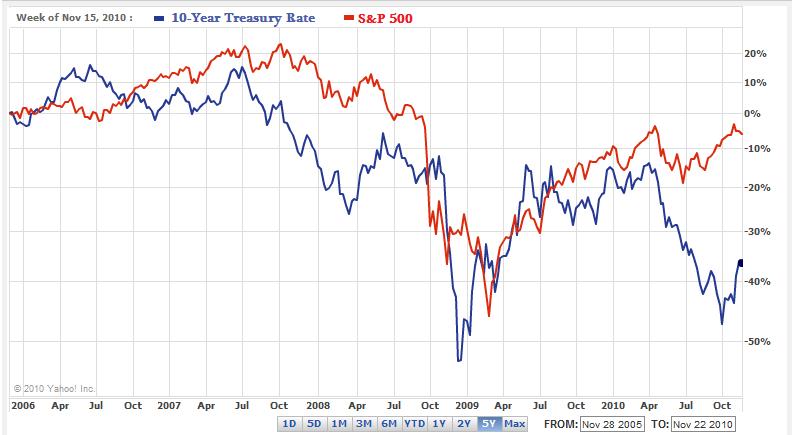
At the very least, this probably won’t hurt the Dollar, and certainly not to the extent that the market had priced in prior to QE2. While the stock market rally has stalled, the rise in Treasury Yields has not. The 10-Year rate is close to 3% for the first time in months, making it more attractive (and less costly) to hold capital in Dollar-denominated assets. The Dollar was also helped by the release of GDP data for Q3, during which the US economy beat expectations and grew by 2.5%.

10-Year Treasury Rate Vs. S&P 500 - 2006-2010
As a result, traders are reducing their Dollar-short positions. Analysts have revised their forecasts to reflect a stronger Dollar, based on the notion that “The dollar has found a bottom.” At this point, the main naysayers are “overwhelmingly found in the ranks of the opposition Republican party,” perhaps part of a cynical ploy to hurt both the economy and Barack Obama’s chances of being reelected.

To be sure, there may be other reasons for the Dollar’s rally, namely the growing turmoil in the EU. Evidence is mounting that the EU sovereign debt crisis is spreading, which has spurred both an increase in investor risk aversion and a decline in the Euro. Still, market chatter seems to be focusing less on the Dollar as safe-haven and more on the fact that the Dollar was merely oversold.

On a purchasing power parity (ppp) basis, the Dollar is starting to look cheap. If the opinions of Europeans, Canadian, Australian, and Japanese tourists are to be taken at face value, the US is cheaper than it has been for years. As one commentator summarized, “If the PPP figures are right, the U.S. dollar has more upside than the negative sentiment around it would indicate. If the greenback were to decline further, it would have to do so from an already undervalued situation.”

SocialTwist Tell-a-Friend
Posted by Adam Kritzer | in News, US Dollar | 2 Comments »

Interview with Kathy Lien: “Trade Defensively and Use a Stop”

Nov. 26th 2010

Today, we bring you an interview with Kathy Lien, the internationally published author, Director of Currency Research of FX360.com and GFT, and co-author of BKForex Advisor, one of the few investment advisory letters focusing strictly on the FX market. She is one of the authors of Investopedia’s Forex Education section and has written for Tradingmarkets.com, the Asia Times Online, Stocks & Commodities Magazine, MarketWatch, ActiveTrader Magazine, Currency Trader, Futures Magazine and SFO. Below, Kathy shares her thoughts on fundamental analysis versus technical analysis, rate hikes in China, forex intervention, and other subjects.

Read the rest of this entry »

SocialTwist Tell-a-Friend
Posted by Adam Kritzer | in Interviews, News | 2 Comments »

Emerging Market Currencies Still Have Room to Rise

Nov. 23rd 2010

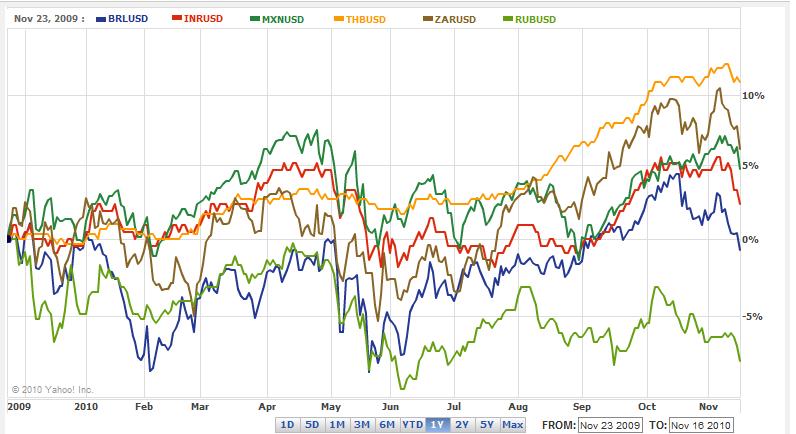
Emerging market economies must be whining about their currencies for a good reason. Why else would they spend billions intervening in forex markets and risk provoking a global trade war?

Emerging Market Currencies Chart 2009-2010
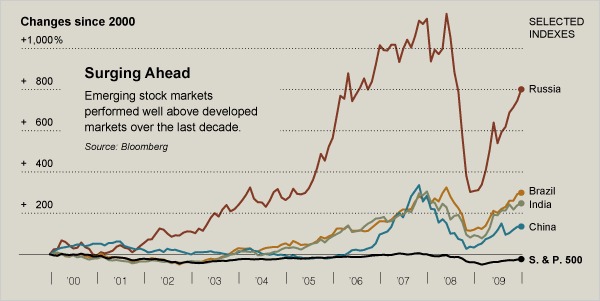
As it turns out, however, the rise in emerging market currencies has been greatly exaggerated. Over the last twelve months, the Brazilian Real is flat against the Dollar. The Korean Won has risen a mere 2%. The Indian Rupee has risen 4%, the Mexican Peso has appreciated 5%, and the standout of emerging markets – the Thai Baht – has notched a solid 10%. Impressive, but hardly enough to raise eyebrows, and barely keeping pace with the S&P 500. Not to mention that if you measure their returns against stronger currencies (i.e. not the Dollar) or on a trade-weighted basis, the performance of emerging market currencies in 2010 was actually pretty mediocre.

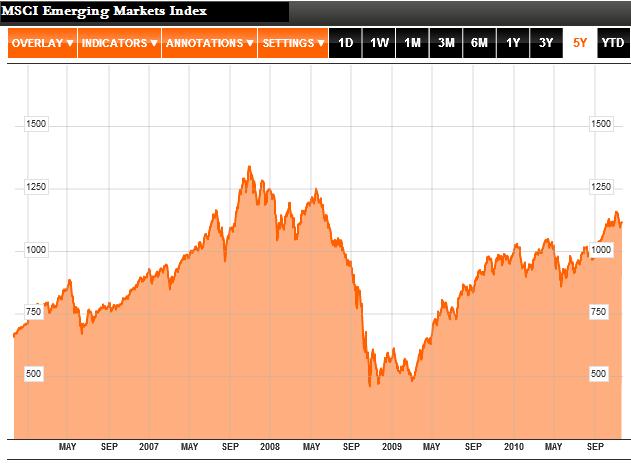
Perhaps that explains why so many analysts are still pretty bullish. Economic growth in emerging markets is showing no signs of abating: Standard Chartered Bank “expects emerging economies to account for 68 per cent of global growth by 2030 and forecasts China’s economy to expand at an annual average rate of 6.9 per cent over that period, even as the US and Europe grow at a much slower pace of 2.5 per cent.”

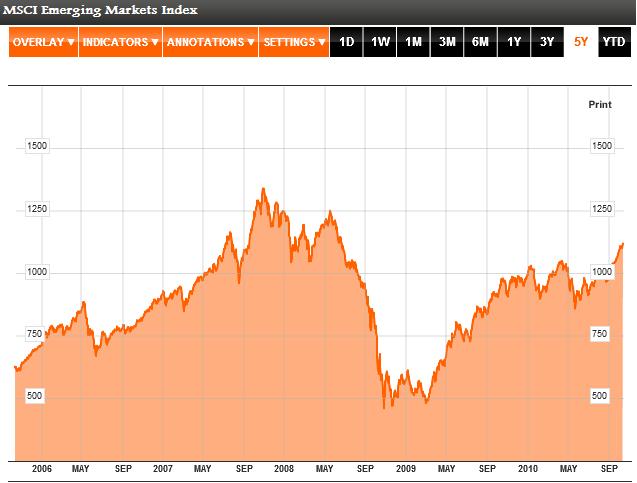
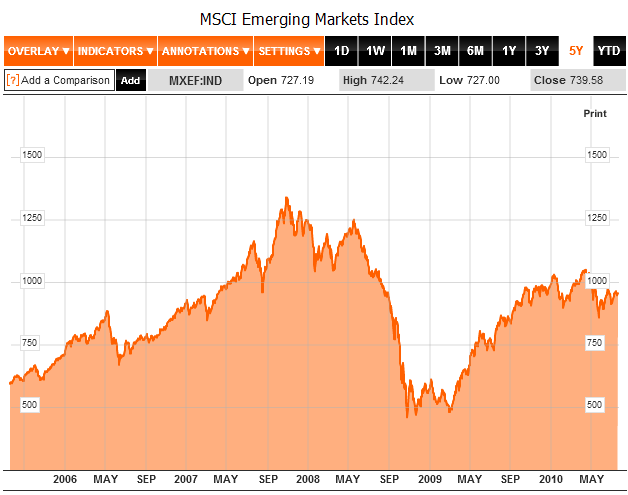
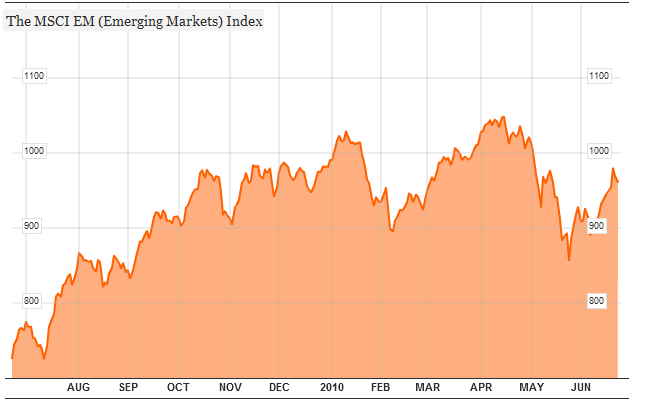
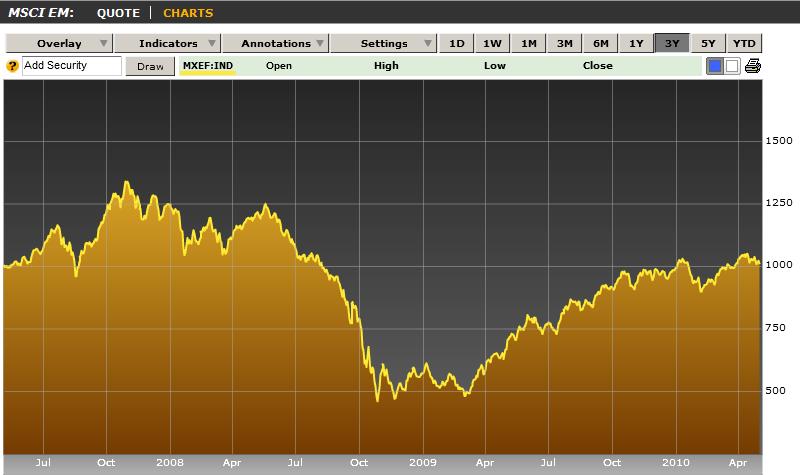
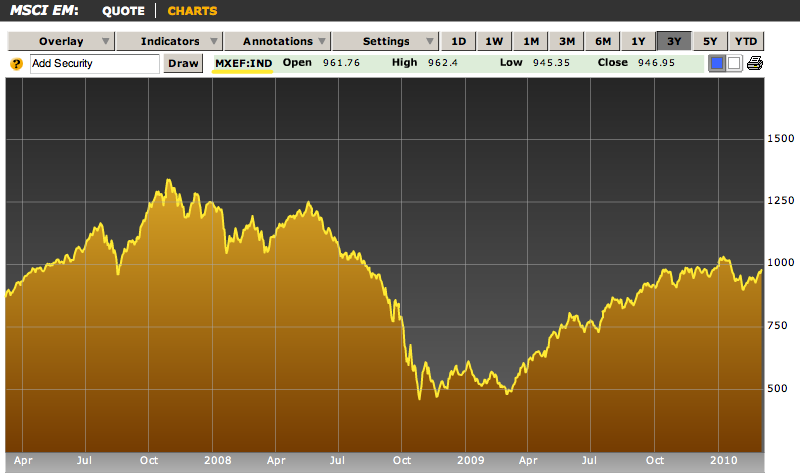
MSCI Emerging Markets Index 2007-2010

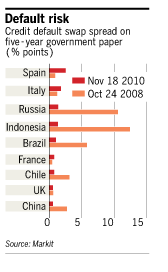
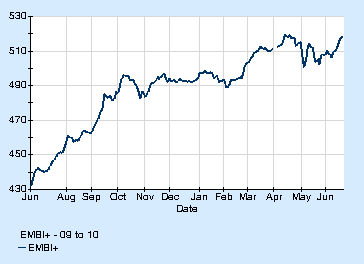
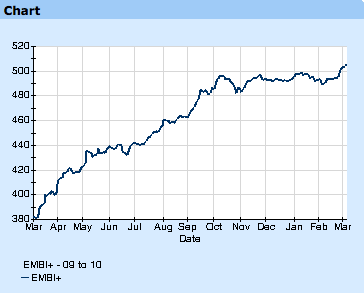
Stock prices (proxied by the MSCI Emerging Markets Index) and bond prices (proxied by the JP Morgan EMBI+ Index) are still rising. Moreover, as emerging market Central Banks (continue to) hike interest rates, returns on investment (and consequently, the attraction to investors) will rise further. In fact, if credit default swap spreads are any indication, the risk of default is perceived as being lowest in emerging market economies. That means that investors are being compensated for taking less risk with greater returns! It doesn’t hurt that – as Fed Chairman Ben Bernanke recently pointed out – investors are buoyed bu the belief that emerging market currencies will continue appreciating, providing an addition boost to returns.

It doesn’t look like the capital controls and other measures being adopted by emerging market economies will have a significant impact on slowing the inflow of foreign capital. Investors are already devising products to thwart the controls. So-called Global Bonds, for example, allow foreign investors to buy emerging market bonds without having to pay any special taxes, because they are settled in the home currency of the investor. Besides, investors with a long-term horizon can take solace that such taxes will become insignificant when allocated over a number of years.

Credit Default Swap Spreads - Emerging Markets Versus Industrialized Countries 2008-2010There are, however, reasons to be cautious, In the short-term, bad news and flare-ups in risk aversion invariably hit emerging market assets hardest. Regardless of what information can be gleaned from credit default spreads, the majority of investors still associate the US with safety and emerging markets with volatility. That’s why when news of Ireland’s financial troubles broke, emerging market currencies fell across the board, and the Dollar rallied.
In addition, rising interest rates could cause bond prices to fall, and stock-market valuations may not be supported by fundamentals: “Emerging markets on average recorded economic growth of about 4 percent over the past few years while companies only recorded profit growth half of that. In China over the past decade economic growth was about 10 percent, while company earnings growth was only about 2 percent.” There is also evidence that investors and companies from emerging market countries are taking advantage of their strong currencies to invest and buy abroad, reversing the flow of capital.

Personally, I am slightly bullish with regard to emerging market currencies. The figures I quoted at the beginning of this post make it clear that we are not yet in bubble territory. In addition, even if fundamentals in emerging markets are not quite as strong as foreign investors would like to believe, they are certainly a lot stronger than in industrialized economies. Regardless of if/when the currency war is resolved, the short-term prospects for emerging market currencies remain bright.

SocialTwist Tell-a-Friend
Posted by Adam Kritzer | in Emerging Currencies, News | No Comments »

A Return to the Gold Standard?

Nov. 21st 2010

In my last post, I explored the possibility that the role of the Chinese Yuan (CNY) will expand to the point that it could rival – or even overtake – the US Dollar as the world’s preeminent reserve currency. Ultimately, I concluded that the constraints on widespread foreign ownership of CNY assets are too great, and that as a result, the Dollar’s position is safe for the time being. What about the notion that all currencies are doomed? In this case, the biggest threat to the US Dollar won’t come from China, but rather from gold.

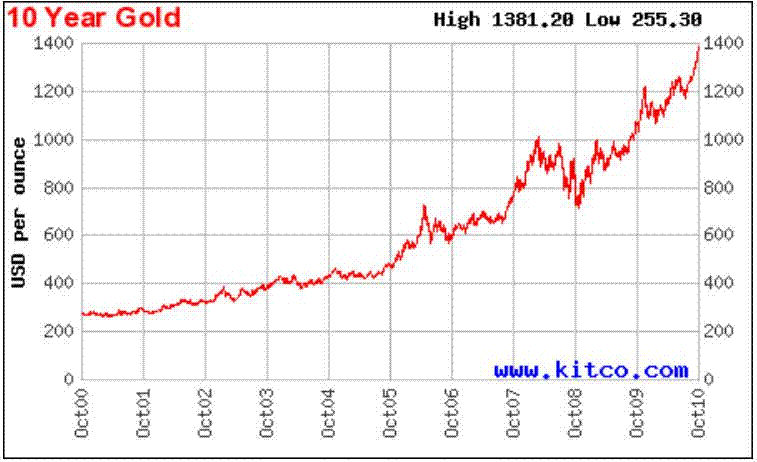
This possibility is no longer hypothetical. James Grant (of the eponymous Grant’s Interest Rate Observer) has for many years tried to advance the case for a return to the Gold Standard. In a much-discussed editorial in the NY Times, Grant reiterated the idea that Central Banker are increasingly out of touch with economic reality, and lack any checks on their ability to print money and debase their respective currencies. Grant singles out the Fed for its non-stop quantitative easing programs, which could lead to hyper-inflation and foment additional asset bubbles. At the very least, it will cause the Dollar to lose even more of its value.

Grant’s editorial coincided perfectly (perhaps deliberately) with a proposal by Robert Zoellick, president of the World Bank, to reform the global economic system, with the goal of reducing economic imbalances. While most of Zoellick’s ideas are common-sense, his proposal to “build a co-operative monetary system that reflects emerging economic conditions.” and “consider employing gold as an international reference point of…currency values” stood out. While his comments created a veritable firestorm, they were grounded firmly in the reality that gold prices are rising and faith in the current fiat monetary system is declining.

The theoretical advantages and disadvantages of the gold standard have been mooted ad nauseum, and I don’t want to rehash all of them here. In sum, a gold standard is believed to be promote long-term price stability, eliminate hyper-inflation, a check on government debt issuance, and a transfer monetary power from Central Banks to the people (via the markets). Downsides include short-term price volatility, a heightened possibility of deflation, and the repudiation of modern monetary policy. Given the fact that paper currency in circulation vastly exceeds the supply of gold, a transition to the gold standard would be difficult to implement and would probably cause a substantial rise in the price of gold.

Personally, I’m not convinced that a return to the gold standard would promote economic/financial stability any more than the fiat money system. For example, just as large financial institutions dominate the current system, so they would be likely to dominate any other system, leading to the same lack of transparency and democracy. In addition, gold can also be lent out (with interest), leading to a similar propensity for asset bubbles and economic imbalances of every kind.

Just like currencies have relative value today (in terms of other currencies, commodities, assets, labor, etc.), so does gold. In that sense, saying seven units of gold is enough to buy a house is not really that different from saying it costs 10 units of paper currency to buy that same house. For instance, if Chinese producers charge 1 gold coin for their widgets while American producers charge 2, it will still result in a trade imbalance that will only correct when the Chinese standard of living catches up to the US standard of living.

Finally, gold is arbitrary. Why not a platinum standard or an oil standard? Based on the scarcity of those resources, prices would vary accordingly, much as they do under the paper currency system. Not to mention that gold is incredibly unwieldy, which means that it would be digitalized and used electronically just like paper currencies.

You could argue that this is actually a benefit of the gold standard, since it would be compatible with the current economic system, but at least it would lead to financial stability. Maybe I’m in denial like Ben Bernanke, but I just don’t see gold as the solution.  Asset bubbles inflate, and then they collapse. Economic imbalances will persist for as long as they are allowed to. If emerging market exporters get tired of receiving Dollars for their wares, then they will stop accepting it, the Dollar’s value will crash, and the US economy will have to rebalance itself. In a perfect world, there would be no irrational exuberance. In reality, the current system will persist, and life will go on.

SocialTwist Tell-a-Friend
Posted by Adam Kritzer | in Gold, News | 6 Comments »

Chinese Yuan Will Not Be Reserve Currency?

Nov. 18th 2010

In a recent editorial reprinted in The Business Insider (Here’s Why The Yuan Will Never Be The World’s Reserve Currency), China expert Michael Pettis argued forcefully against the notion that the Chinese Yuan will be ever be a global reserve currency on par with the US Dollar. By his own admission, Pettis seeks to counter the claim that China’s rise is inevitable.

The core of Pettis’s argument is that it is arithmetically unlikely – if not impossible – that the Chinese Yuan will become a reserve currency in the next few decades. He explains that in order for this to happen, China would have to either run a large and continuous current account deficit, or foreign capital inflows into China would have to be matched by Chinese capital outflows.” Why is this the case? Simply, a reserve currency must necessarily offer (foreign) institutions ample opportunity to accumulate it.

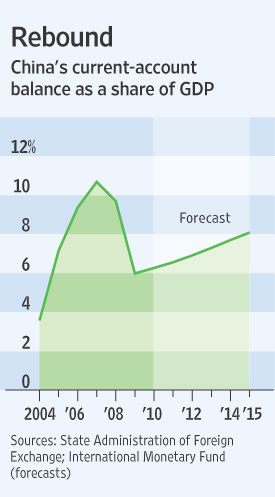
China Trade Surplus 2009 - 2010
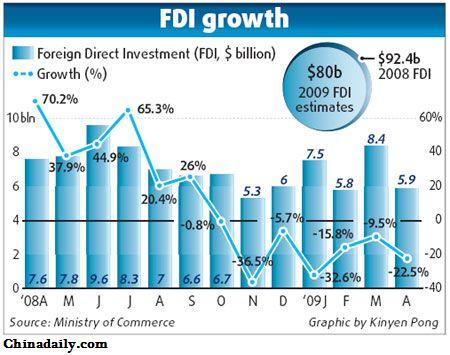
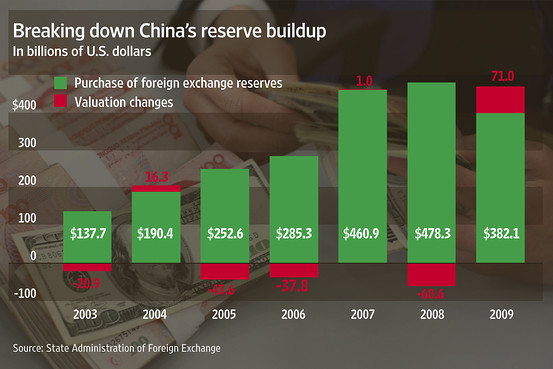
However, as Pettis points out, the structure of China’s economy is such that foreigners don’t have such an opportunity. Basically, China has run a current account/trade surplus, which has grown continuously over the last decade. During that time, its Central Bank has accumulated more than $2.5 Trillion in foreign exchange reserves in order to prevent the RMB from appreciating. Foreign Direct Investment, on the other hand, averages 2% of GDP and is declining, not to mention that “a significant share of those inflows may actually be mainland money round-tripped to take advantage of capital and tax regulations.”

For this to change, foreigners would need to have both a reason and the opportunity to hold RMB assets. The reason would come from a reversal in China’s balance of trade, and the use of RMB to pay for the excess of imports over exports, which would naturally imply a willingness of foreign entities to accept RMB. The opportunity would come in the form of deeper capital markets, a complete liberalization of the exchange rate regime (full-convertibility of the RMB), and the elimination of laws which dictate how foreigners can invest/lend in China. This would likewise an imply a Chinese government desire for greater foreign ownership.

China FDI 2009-2010

How likely is this to happen? According to Pettis, not very. China’s financial/economic policy are designed both to favor the export sector and to promote access to cheap capital. In practice, this means that interest rates must remain low, and that there is little impetus behind the expansion of domestic consumption. Given that this has been the case for almost 30 years now, this could prove almost impossible to change. For the sake of comparison, consider that despite two “lost decades,” Japan nonetheless continues to promote its export sector and maintains interest rates near 0%.

Even if the Chinese economy continues to expand and re-balances itself in the process (a dubious possibility), Pettis estimates that it would still need to increase the rate of foreign capital inflows to almost 10% of GDP. If economic growth slows to a more sustainable level and/or it continues to run a sizable trade surplus, this figure would rise to perhaps 20%. In this case, Pettis concedes, “we are also positing…a radical change in the nature of ownership and governance in China, as well as a radical redrawing of the role of the central and local governments in the local economy.”

So there you have it. The political/economic/financial structure of China is such that it would be arithmetically very difficult to increase foreign accumulation of RMB assets to the extent that the RMB would be a contender for THE global reserve currency. For this to change, China would have to embrace the kind of reforms that go way beyond allowing the RMB to fluctuate, and strike at the very core of the CCP’s stranglehold on power in China.

If that’s what it will take for the RMB to become a fully international currency, well, then it’s probably too early to be having this conversation. Perhaps that’s why the Asian Development Bank, in a recent paper, argued in favor of modest RMB growth: “sharing from about 3% to 12% of international reserves by 2035.” This is certainly a far cry from the “10 years” declared by Russia’s finance minister and tacitly supported by Chinese economic policymakers.

The implications for the US Dollar are clear. While it’s possible that a handful of emerging currencies (Brazilian Real, Indian Rupee, Russian Ruble, etc.) will join the ranks of the international currencies, none will have enough force to significantly disrupt the status quo. When you also take into account the economic stagnation in Japan and the UK, as well as the political/fiscal problems in the EU, it’s more clear than ever that the Dollar’s share of global reserves in one (or two or three) decades will probably be only slightly diminished from its current share.

SocialTwist Tell-a-Friend
Posted by Adam Kritzer | in Central Banks, Chinese Yuan (RMB), News, US Dollar | 1 Comment »

Euro Correction is Here

Nov. 16th 2010

You can think of this as a follow-up to my last post, entitled “Euro Due for a Correction,” in which I proclaimed that “investors got ahead of themselves when they pushed the Euro down 20% over the first half of 2010, but now they are in danger of making the same mistake, and are pushing the Euro too far in the opposite direction.” Since then, the Euro has indeed fallen 4%. In this case, however, I’m reluctant to toot my own horn, since there were other forces at work.

Euro USD 3 Month ChartNamely, he sovereign debt crisis has officially spread beyond Greece, and “Contagion is definitely back on the table.”  Of chief concern is Ireland, whose banking sector is in serious financial turmoil: “Irish banking losses are estimated at up to 80 billion euros ($109 billion), depending on the forecast used, or 50 percent of the economy. As long as housing prices continue to fall, these losses cannot be capped.” At this point, it’s unlikely that the banks can remain afloat without (additional) government help. The only problem is that the government has already raided its welfare fund, and it is projected that additional support would leave a gaping hole in the budget, equivalent to 32% in GDP. Allowing the banks to fail, meanwhile, would lead to economic losses of 50% of GDP.
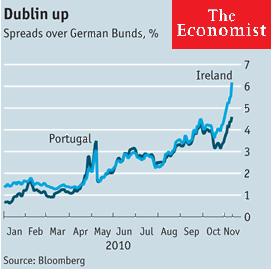
Portugal and Spain (rounding out the so-called PIGS countries) are also in trouble, with budget deficits of around 9% of GDP. Given that both countries are struggling economically, it is possible that austerity measures and budget cuts could backfire and worsen their respective fiscal situations. Like their Irish counterparts, Portuguese banks remain heavily reliant on access to cheap ECB credit in order to function. Spanish banks, meanwhile are plagued by distressed loans, which account for “5.6 percent of total Spanish bank loans — the highest level since 1996.”

Currently, their governments insist that they can get by without help from the European Commission. To be fair, they have managed both to issue new debt and refinance existing debt without serious difficulty. In addition, Ireland and Portugal have modest reserve funds which could tide them over for close to a year, if need be. The medium-term, however, looks less rosy.

Ireland Portufal Bond Yields 2010 - Sovereign Debt Crisis
If rising bond yields are any indication, these countries could be in serious trouble. Bond investors are not concerned about an EU bailout, which is seen as inevitable, at least for Ireland. After all, the European Financial Stability Facility that was created in May still has more than $500 Billion left in it. Rather, investors are concerned that they will be asked to take part in the bailout.

Germany, for example, is toughening its stance towards fiscally strained countries, and Angela Merkel has insisted that, “Highly indebted eurozone countries struggling to repay will be forced to restructure their debt in a process of ‘managed insolvency’ and that their creditors will need to take large ‘haircuts.’ ” Up until now, the EU has intimated that will provide a backstop against sovereign default, in order to assuage bond market investors.

This is changing, as German and French politicians insist that they are more beholden to their constituents/taxpayers than they are to their debt-ridden EU brethren.  Given that Germany is fiscally sound, it has pretty much nothing to lose (short of a breakup of the Euro) by playing hardball. In fact, it may actually benefit from scaring away investors, since a weaker Euro will strengthen its export sector.

Going forward, it seems safe to say that the Euro correction will continue, as investors continue to reevaluate their exposure to sovereign credit risk. According to the most recent CFTC Commitments of Traders report, “Investors last week slashed their bets in favor of the euro by 40% to a level not seen since early October.” Of course, given that the Dollar is plagued by its own set of problems, it’s unclear whether the EUR/USD will experience serious fluctuations. Against other currencies, however, the Euro will probably decline: “Those who want to go short euro should consider doing it on the crosses.”

SocialTwist Tell-a-Friend
Posted by Adam Kritzer | in Euro, News | 1 Comment »

Interview with Dollar Daze: Avoid Positions that Entail Currency Risk

Nov. 14th 2010

Today, we bring you an interview with Mike Hewitt of Dollar Daze, whose “belief is that the paper currencies of the world are presently undergoing a devaluation.” Below, Mr. Hewitt shares his thoughts on the US Dollar, Chinese Yuan, inflation, and why you should be paying attention to Gold and other commodities.

Read the rest of this entry »

SocialTwist Tell-a-Friend
Posted by Adam Kritzer | in Interviews, News | No Comments »

Canadian Dollar Reaches Parity…Again

Nov. 12th 2010

Last week, the Canadian Dollar became the second currency – after the Australian Dollar – to reach parity against the US Dollar. While the case for Loonie parity is not quite as strong as the Aussie’s, there is nonetheless reason to believe that it will continue trading at this level for the short-term.

CAD USD 5 Year Chart

It’s not hard to understand what’s driving the Loonie; the weak Dollar. As the Fed embarks on further monetary easing (QE2), investors are nervous that all of these new Dollars will be deployed in a speculative – rather than productive capacity. Emerging market currencies are particularly popular, with commodity currencies, such as the Canadian Dollar, not far behind.

According to Bank of Canada Governor Mark Carney, “The outlook for the Canadian dollar… ultimately reflects the economic fundamentals.” While he has threatened to intervene if currency markets are “disrupted” (i.e. if the Loonie rises to an unreasonable level), past history and the tone of Carney’s remarks suggests that the Bank of Canada will remain on the sidelines for the duration of the currency war.

From where I’m sitting, the Canadian Dollar (as with the New Zealand Dollar, the subject of my previous post), don’t deserve to benefit from the speculative wall of money that is flowing out of the US. The Canadian economy is projected to grow by only 1% in 2010, and after adjusting for the contraction in 2009, it is still the same size as it two years ago. Not to mention that the Canadian government issued a record amount of debt to shepherd the economy through the recession.

Most worrying is that Canada’s trade deficit is nearing a record high, and on an annualized basis is now approaching $30 Billion a year.  In addition, anecdotal stories suggest that Canadians are engaging in cross-border shopping and traveling abroad in great numbers to take advantage of relatively cheap prices. With the Canadian Dollar now at parity, these phen0omena are already becoming entrenched: “We would not anticipate much of an improvement in these trade patterns in the next couple of quarters,” said one economist.

Canada Balance of Trade

There are two observations that can be made here. First of all, while Canada is certainly a natural resource economy, the boom in commodity prices  really isn’t helping Canada in the same way that it is helping Australia, for example. That’s mainly because Canada’s principal market for commodity exports is the US, which remains weak. In contrast, the booming economies of China and Greater Asia ensure an expansive and growing market for Australian natural resources. Moreover, as evidenced by a growing trade deficit, exports of commodities are being offset by an increase in imports: “Economists at Bank of Montreal and Desjardins Financial say weak trade will carve as much as three percentage points from GDP growth in the third quarter.”

The second observation is that currency markets are self-correcting, and that is especially true in the case of the Canada. As the Loonie rises, Canadian exports become less competitive, and consumers (sometimes physically!) start importing more. At some point then, the Loonie will reverse its decline, and the trade deficit will shrink.

However, if you drill deeper into the numbers, you can see that Canada is running a sizable trade surplus with the US. That means that the Canadian Dollar probably has room to rise further (or the Dollar has room to fall further), before the bilateral trade deficit would even close to narrowing. On a trade-weighted basis (perhaps against the Euro), the Loonie has few sources of fundamental support. For what it’s worth, analysts from CIBC World Markets seem to agree: they see the Loonie declining more than 5% over the next six months as the uproar over QE2 gradually fades, and the data shows that only a modicum of the newly printed US Dollars found their way into Canada.

SocialTwist Tell-a-Friend
Posted by Adam Kritzer | in Canadian Dollar, News | No Comments »

New Zealand: No Forex Intervention

Nov. 10th 2010

Despite reaching a temporary stalemate, the currency war rages on, and individual countries continue to debate whether they should enter or watch their currencies continue to appreciate. Nowhere is that debate stronger than in New Zealand, whose Kiwi currency has fallen 37% against the US Dollar since its peak in early 2009, and over 15% since June of this year.

USD NZD 5 Year Chart
With most countries, the war cries are coming from the political establishment, who feel compelled to demonstrate to their constituents that they are diligently monitoring the currency war. This is largely the case in New Zealand, as Members of Parliament have argued forcefully in favor of intervention. Prime Minister John Key is a little more pragmatic: He “says his Government is concerned about the strength of our dollar, but is not convinced intervention would work…politicians who think intervention can happen without economic consequences, are fooling themselves.” Showing an astute understanding of economics, he pointed out that trying to limit the Kiwi’s appreciation would manifest itself in the form of higher inflation, higher interest rates, and/or reduced access to capital.

This is essentially the position of Alan Bollard, Governor of the Central Bank of New Zealand. He has insisted (correctly) that the New Zealand is being driven up, so much as its currency counterparts – namely the US Dollar – are being driven downward, by forces completely disconnected from New Zealand and way beyond its control. Thus, if New Zealand tried to intervene, it would quickly be overpowered (perhaps deliberately!) by speculators. Ultimately, it would end up spending lots of money in vain, and the Kiwi would continue to appreciate.

Mr. Bollard has pointed out that a stronger currency is not without its perks: such as lower (relative) prices for certain natural resources, such as oil. In addition, since New Zealand is largely a commodity economy, its producers are being compensated for an expensive currency in the form of higher prices for milk, wool, and other staple exports. While its other manufacturing operations have been punished by the expensive Kiwi, its economy is still relatively robust. Thanks to a series of tax cuts and the lowest interest rates in New Zealand history, GDP is forecast to return to trend in 2010 and 2011.

New Zealand Current Account Balance 2000 - 2014

New Zealand’s concerns are understandable, and there is an argument to be made for preventing the Dollars that are printed from the Fed’s QE2 from being put to unproductive purposes in New Zealand. At the same time, New Zealand is not such an attractive target for speculators. Its benchmark interest rate, at 3%, is relatively low compared to developing countries. Its current account balance is projected to continue declining, perhaps down to -8%, which means that the net flow of capital is actually out of New Zealand. In addition, while the Kiwi has appreciated against the US Dollar, it has fallen mightily against the Australian Dollar en route to a multi-year low.

Going forward, there is reason to believe that the New Zealand Dollar will continue to appreciate against the US Dollar as a result of QE2 and a general sense of pessimism towards the US. The same is true with regard to currencies that actively intervene to prevent their currencies from appreciating. Still, I don’t think the New Zealand Dollar will reach parity – against any currency – anytime soon, and after the currency fracas subsides, it will probably trend towards its long-term average.

SocialTwist Tell-a-Friend
Posted by Adam Kritzer | in Central Banks, Emerging Currencies, News | 2 Comments »

Currency War Will End in Tears

Nov. 8th 2010

The “currency war” is heating up, and all parties are pinning their hopes on the G20 summit in South Korea. However, this is reason to believe that the meeting will fail to achieve anything in this regard, and that the cycle of “Beggar-thy-Neighbor” currency devaluations will continue.

There have been a handful of developments since the my last analysis of the currency war. First of all, more Central Banks (and hence, more currencies) are now affected. In the last week, Argentina pledged to continue its interventions into 2011, while Taiwan, and India – among other less prominent countries – have hinted towards imminent involvement.

Of greater significance was the official expansion of the Fed’s Quantitative Easing Program (QE2), which at $600 Billion, will dwarf the efforts of all other Central Banks. In fact, it’s somewhat ironic that the Fed is the only Central Bank that doesn’t see its monetary easing as a form of currency intervention when you consider its impact on the Dollar and its (inadvertent?) role in “intensifying the currency war.”  According to Chinese officials, “The continued and drastic U.S. dollar depreciation recently has led countries including Japan, South Korea and Thailand to intervene in the currency market,” while the Japanese Prime Minister recently accused the U.S. of pursuing a “weak-dollar policy.”

Currency War Dollar Depreciation

As of now, there is no indication that other industrialized countries will follow suit, though given concerns that QE2 “at the end of the day might be dampening the recovery of the euro area,” I think it’s too early to rule anything out. While the Bank of Japan similarly has stayed out of the market since its massive intervention in October, Finance Minister Yoshihiko Noda recently declared that, “I think the [Yen's] moves yesterday were a bit one-sided. I will continue to closely monitor these moves with great interest.”

As the war reaches a climax of sorts, everyone is waiting with baited breath to see what will come out of the G20 Summit. Unfortunately, the G20 failed to achieve anything substantive at last month’s Meeting of Finance Ministers and Central Bank Governors, and there is little reason to believe that this month’s meeting will be any different.

In addition, the G20 is not a rule-making body like the WTO or IMF, and it has no intrinsic authority to stop participating nations from devaluing their currencies. Conference host South Korea has lamely pointed out that while ” ‘There aren’t any legal obligations‘…discussion among G20 countries would produce ‘a peer-pressure kind of effect on these countries’ that violated the deal.” Not to mention that the G20 will have no effect on the weak Dollar nor on the undervalued RMB, both of which are at the root of the currency war.

It’s really just wishful thinking that countries will come to their senses and realize that currency devaluation is self-defeating. In the end, the only thing that will stop them from intervening is to accept the futility of it: “The history of capital controls is that they don’t work in controlling foreign exchange rates.” This time around will prove to be no different, “particularly with banks already said to be offering derivatives products to get around the new taxes.” The only exception is China, which is only able to prevent the rise of the RMB because of strict controls for dealing with the inflow of capital.

In short, the “wall of money” that is pouring into emerging market economies represents a force too great to be countered by individual Central Banks. The returns offered by investing in emerging markets (even ignoring currency appreciation) are so much greater than in industrialized countries that investors will not be deterred and will only work harder to find ways around them. Ironically, to the extent that controls limit the supply of capital and boost returns, they will probably drive additional capital inflows. The more successful they are, the more they will fail. And that’s something that no new currency agreement can change.

SocialTwist Tell-a-Friend
Posted by Adam Kritzer | in Central Banks, News, Politics & Policy, US Dollar | No Comments »

Fed Surprises Markets with Scope of QE2

Nov. 4th 2010

For the last few months, and especially over the last few weeks, the financial markets have been obsessed with the rumored expansion of the Fed’s Quantitative Easing program (“QE2″). With the prospect of another $1 Trillion in newly minted money hitting the markets, investors presumptively piled into stocks, commodities, and other high-risk assets, and simultaneously sold the US Dollar in favor of higher-yielding alternatives.

Fed Balance Sheet 2010 QE2

On Wednesday, rumor became reality, as the Fed announced that it would expand its balance sheet by $600 Billion through purchases of long-dated Treasury securities over the next six months. While the announcement (and the accompanying holding of the Federal Funds Rate at 0%) were certainly expected, markets were slightly taken aback by its scope.

Due to conflicting testimony by members of the Fed’s Board of Governors, investors had scaled back their expectations of QE2 to perhaps $300-500 Billion. To be sure, a handful of bulls forecast as much as $1-1.5 Trillion in new money would be printed. The majority of analysts, however, New York Fed chief William Dudley’s words at face value when he warned, “I would put very little weight on what is priced into the market.” It was also rumored that the US Treasury Department was working behind the scenes to limit the size of QE2. Thus, when the news broke, traders instantly sent the Dollar down against the Euro, back below the $1.40 mark.

EUR-USD 5 Day Chart 2010

On the one hand, the (currency) markets can take a step back and focus instead on other issues. For example, yields on Eurozone debt have been rising recently due to continued concerns about the possibility of default, but this is not at all reflected in forex markets. During the frenzy surrounding QE2, the forex markets also completely neglected comparative growth fundamentals, which if priced into currencies, would seem to favor a rally in the Dollar.

On the other hand, I have a feeling that investors will continue to dwell on QE2. While the consensus among analysts is that it will have little impact on the economy, they must nonetheless await confirmation/negation of this belief over the next 6-12 months. In addition, all of the speculation to date over the size of QE2 has been just that – speculation. Going forward, speculators must also take reality into account, depending on how that $600 Billion is invested and the consequent impact on US inflation. If a significant proportion of is simply pumped into domestic and emerging market stocks, then the markets will have been proved right, and the Dollar will probably fall further. If, instead, a large portion of the funds are lent and invested domestically, and end up buoying consumption, then some speculators will be forced to cover their bets, and the Dollar could rally.

Unfortunately, while QE2 is largely seen as a win-win for US stocks (either it stimulates the economy and stocks rally, or it fails to stimulate the economy but some of the funds are used to foment a stock market rally anyway), the same cannot be said for the US Dollar. If QE2 is successful, then hawks will start moaning about inflation and use it as an excuse to sell the Dollar. If QE2 fails, well, then the US economy could become mired in an interminable recession, and bears will sell the Dollar in favor of emerging market currencies.

SocialTwist Tell-a-Friend
Posted by Adam Kritzer | in Central Banks, News, US Dollar | 1 Comment »

Currency Wars: Will Everyone Please Stop Whining!

Nov. 2nd 2010

I read a provocative piece the other day by Michael Hudson (“Why the U.S. Has Launched a New Financial World War — and How the Rest of the World Will Fight Back“), in which he argued that the ongoing currency wars are the fault of the US. Below, I’ll explain why he’s both right and wrong, and why he (and everyone else) should shut up and stop complaining.

It has become almost cliche to argue that the US, as the world’s lone hegemonic power, is also the world’s military bully. Hudson takes this argument one step further by accusing the US of using the Dollar as a basis for conducting “financial warfare.” Basically, the US Federal Reserve Bank’s Quantitative Easing and related monetary expansion programs create massive amounts of currency, the majority of which are exported to emerging market countries in the form of loans and investments. This puts upward pressure on their currencies, and rewards foreign speculators at the expense of domestic exporters.

Hudson is right that the majority of newly printed money has indeed been shifted to emerging markets, where the best returns and greatest potential for appreciation lies. Simply, the current economic and investing climate in the US is not as strong as in emerging markets. Indeed, this is why the (first) Quantitative Easing (QE) program was not very successful, and why the Fed has proposed a second round. While there is a bit of a chicken-and-egg conundrum (does economic growth drive investing, or do investors drive economic growth?) here, current capital flow trends suggest that any additional quantitative easing will also be felt primarily in emerging markets, rather than in the US. Not to mention that the US money supply has expanded at the same pace (or even slower) as the US economy over the long-term.

M3 Money Supply 2010

While the point about QE being ineffective is well-taken, Hudson completely ignores the strong case to be made for investing in emerging markets. He dismissively refers to all such investing as “extractive, not productive,” without bothering to contemplate why investors have instinctively started to prefer emerging markets to industrialized markets. As I said, emerging market economies are individually and collectively more robust, with faster growth and lower-debt than their industrialized counterparts. Calling such investing predatory represents a lack of understanding of the forces behind it.

Hudson also overlooks the role that emerging markets play in this system. The fact that speculative capital continues to pour into emerging markets despite the 30% currency appreciation that has already taken place and the asset bubbles that may be forming in their financial markets suggests that their assets and currencies are still undervalued. That’s not to say that the markets are perfect (the financial crisis proved the contrary), but rather that speculators believe that there is still money to be made. On the other side of the table, those that exchange emerging market currency for Dollars (and Euros and Pounds and Yen) must necessarily accept the exchange rate they are offered. In other words, the exchange rate is reasonable because it is palatable to all parties.

You can argue that this system unfairly penalizes emerging market countries, whose economies are dependent on the export sector to drive growth. What this really proves, however, is that these economies actually have no comparative advantage in the production and export of whatever goods they happen to be producing and exporting. If they can offer more than low costs and loose laws, then their export sectors will thrive in spite of currency appreciation. Look at Germany and Japan: both economies have recorded near-continuous trade surpluses for many decades in spite of the rising Euro and Yen.

The problem is that everyone benefits (in the short term) from the fundamental misalignments in currency markets. Traders like to mock purchasing power parity, but over the long-term, this is what drives exchange rates. Adjusting for taxes, laws, and other peculiarities which distinguish one economy from another, prices in countries at comparable stages of development should converge over the long-term. You can see from The Economist’s Big Mac Index that this is largely the case. As emerging market economies develop, their prices will gradually rise both absolutely (due to inflation) and relatively (when measured against other currencies).

Economist-Big-Mac-Index-July-2010
Ultimately, the global economy (of which currency markets and exchange rates represent only one part) always operates in equilibrium. The US imports goods from China, which sterilizes the inflows in order to avoid RMB appreciation by building up a stash of US Dollars, and holding them in US Treasury Bonds. Of course, everything would be easier if China allowed the RMB to appreciate AND the US government stopped running budget deficits, but neither side is willing to make such a change. In reality, the two will probably happen simultaneously: China will gradually let the RMB rise, which will cause US interest rates  to rise, which will make it more expensive and less palatable to add $1 Trillion to the National Debt every year, and will simultaneously make it more attractive to produce in the US.

Until then, politicians from every country and hack economists with their napkin drawings will continue to whine about injustice and impending economic doom.

SocialTwist Tell-a-Friend

China Diversifies Forex Reserves

Oct. 31st 2010

China’s foreign exchange reserves continue to surge. As of September, the total stood at $2.64 Trillion, an all-time high. However, it’s becoming abundantly clear that China is no longer content for Dollar-denominated assets to represent the cornerstone of its reserves. Instead, it has embarked on a campaign to further diversify its reserves, with important implications for the currency markets.

China Forex Reserves 2010

Despite China’s allowing the Chinese Yuan to appreciate (or perhaps because of it), hot money continues to flow in – nearly $200 Billion in the the third quarter alone. Foreign investors are taking advantage of strong investment prospects, rising interest rates, and the guarantee of a more valuable currency. In order to prevent the inflows from creating inflation and putting even more upward pressure on the RMB, the Central Bank “sterilizes” the inflows by purchasing an offsetting quantity of US Dollars and other foreign currency.

Since the Central Bank does not release precise data on the breakdown of its reserves, analysts can only guess. Estimates range from the world average of 62% to as high as 75%. At least $850 Billion (this is the official tally; due to covert buying through offshore accounts, the actual total is probably higher) of its reserves are held in US Treasury securities. It also controls a $300 Billion Investment Fund, which has made very public investments in natural resource companies around the world. The allocation of the other $1.5 Trillion is a matter of speculation.

Still, China has stated transparently that it wants to diversify its reserves into emerging market currencies, following the global shift among private investors. Investment advisers praise China for its shrewdness, in this regard: “The Chinese authorities are some of the smartest in the world. If you look at the fundamentals of a lot of these emerging markets, they are considerably better than developed markets. Who wants to be holding U.S. dollars at this stage?” However, these investments serve two other very important objectives.

The first is diplomatic/political. When China recently signed an agreement with Turkey to conduct bilateral trade in Yuan and Lira (following similar deals with Brazil and Russia), it was interpreted as an intention snub to the US, since trade is currently conducted in US Dollars. In addition, by funding projects in other emerging markets through a combination of loans investments, China is able to curry favor with host countries, as well as to help its own economy at the same time. The second is financial: by buying the currencies of trade rivals, China is able to make sure that its own currency remains undervalued. This year, it has already purchased more than $5 Billion in South Korean bonds, and perhaps $20 Billion in Japanese sovereign debt, sending the Won and the Yen skywards in the process.

China’s purchases of Greek and (soon) Italian debt serve the same function. It is seen as an ally to financially troubled countries, while its efforts help to keep the Euro buoyant, relative to the RMB. According to Chinese Premier Wen JiaBao, “China firmly supports Greece’s efforts to tackle the sovereign debt crisis and won’t cut its holdings of European bonds.”

For now, China remains deeply dependent on the US Dollar, and is still very vulnerable to a sudden depreciation it its value. For as much as it wants to diversify, the supply of Dollars and the liquidity with which they can be traded means that it will continue to hold the bulk of its reserves in Dollar-denominated assets. In addition, the Central Bank has no choice but to continue buying Dollars for as long as the RMB remains pegged to it. At some point in the distant future, the Yuan will probably float freely, and China won’t have to bother accumulating foreign exchange reserves, but that day is still far away. For as long as the peg remains in place, the Dollar’s status as global reserve currency is safe.

SocialTwist Tell-a-Friend
Posted by Adam Kritzer | in Central Banks, Chinese Yuan (RMB), News | 1 Comment »

Why is the Japanese Yen Still Rising?

Oct. 29th 2010

Most of today’s headlines regarding the Japanese Yen focus on one thing: Central Bank intervention. Basically, reporters have become focused on the likelihood of additional intervention in the currency markets by the Bank of Japan. However, this obsession has caused them to overlook the larger issue: Why is the Yen still rising?

JPY Versus USD Chart 1970 - 2010

I was prompted to ask this question after coming across the above chart, which tracks the historical performance of the Japanese Yen against the US Dollar. You can see that since 1970, the Yen has risen by a whopping 350% against the Dollar. It has doubled in value since 1990 and risen 14% since the start of the year, en route to a 15-year high. Over the same period (actually since 1980; I couldn’t find data from the 1970), Japan’s economy has expanded by an average annualized growth rate of 2.2%. Over the last 10 years, the average is a paltry .9%. The contradiction between fundamentals and reality could not be more stark!

In addition, investor risk appetite has been reinvigorated. During most of the last decade, carry trading caused the Yen to decline to 120 USD/JPY as investors borrowed Yen in bulk in order to purchase high-yielding assets. The credit crisis spurred a short squeeze (i.e. rapid unwinding of carry trade positions) in early 2007, and caused the Yen to rocket upward. If anything, we would expect the Yen to mirror its performance of a few years ago, as investors take advantage of low Japanese interest rates and rebuild carry trade positions in the Yen.

The recent run-up in emerging market currencies, global equities, commodities, and other risky assets would certainly seem to support a carry trade strategy. For its part, the Bank of Japan is also doing its best to create a healthy environment for carry trading by printing currency, easing monetary policy, and fighting to keep the Yen from rising. And yet, if indeed there are still carry traders (and there certainly are!), the current trend in forex markets suggests that they are very much outnumbered by those betting on the Yen’s rise.

It’s difficult to understand this phenomenon. Those that hold Yen earn a nominal return of near 0%. Long-term interest rates (proxied by 10-year government bonds) are only slightly higher – at 1% – and certainly too low to attract any foreign institutional interest. Besides, it’s well-known that 90% of Japanese government debt is held by domestic savers. Meanwhile, the Japanese stock market has stagnated for more than 2 decades, and the Nikkei average is lower than at any point since 1985 (except for a brief period following the dot-com bust. Japanese real estate is equally unattractive.

As a result, there are only two conceivable reasons for the Yen’s continued upward push. The first is fundamental/structural and is connected to Japan’s trade surplus. In spite of an appreciating currency, the Japanese export sector continues to be the lone bright spot in an economy with otherwise limited sources of growth. Compared to 2009, the trade surplus is up 83%, helped by a rise of 50% in September. It is on pace to top $100 Billion for the year. In this regard, foreigners that buy Japanese Yen do so because they must- for purposes of trade.

Japan inflation rate chart 1970 - 2010

The second source of demand for Japanese Yen is so-called safe haven flows. While the Japanese Yen is not a high-yielding currency, it is actually an excellent store of value. [This is one of the three primary functions that a currency should fulfill. The other two are medium of exchange and unit of account]. That’s because inflation in Japan is the lowest in the world, often to the point of being nil. Since 1970, the inflation rate has averaged only 3%, compared to 4.5% in the US. Over the last 15 years, inflation has been 0%. In other words, even if they are invested in low-yielding savings accounts, Japanese savers can ensure that 1 Yen today will probably still be worth 1 Yen 5 years from now. Foreign investors can take advantage of the same phenomenon, when they bet that the exchange value of the Yen will be equally stable.

On the one hand, it is somewhat surprising that the Yen has been able to thrive in the current “risk-on” investing climate. On the other hand, there is a parallel thread of risk-aversion that will always exist and gravitate towards safe-haven currencies, such as the Yen. In fact, it can be argued that this contingent of investors is as large as the risk-taking contingent, as evidenced by the inexorable appreciation of gold (if not also by the Yen). Insofar as inflation in Japan remains nil and the Japanese export sector proves it can be competitive regardless of exchange rates, demand for Yen will continue to confound the gloomy forecasts and rebuff the best efforts of the Bank of Japan.

SocialTwist Tell-a-Friend
Posted by Adam Kritzer | in Japanese Yen, News | No Comments »

Much Ado About Debt

Oct. 28th 2010

In addressing the financial/credit/economic crisis, governments around the world have lowered interest rates, bailed-out bankrupt financial insititutions, engaged in wholesale money printing, guaranteed debt, and pumped cash into their economies. However, while such programs may have had some mitigating impact on the crisis, they did little to address the underlying cause. Specifically, debt was merely moved from one institution – one balance sheet – to another. Most of the bad debt that was at the heart of the credit crisis is still outstanding; the only thing that has changed is who is responsible for repaying it.

In many cases, it is governments which have assumed ownership of this debt. Fannie Mae and Freddie Mac remain in a US government conservatorship. The Federal Reserve Bank owns more than $2 Trillion in US Treasuries and Mortgage Backed Securities. The European Union has agreed to collectively back more than $500 Billion in debt belonging to Greece and other unspecified “troubled” member states. The Japanese government has managed to pass off 90% of its sovereign debt onto its own citizens. The UK Treasury has printed money and lent it to the government of the UK. [The graphic below is actually interactive, and is worth a few minutes of perusing].

Global Debt by Country 2010

So what are the possibilities for dealing with this debt? In terms of government debt, the first is to hope that economies can grow faster than the debt, so that it becomes more manageable in relative terms and that one day it can be repaid. Another option is to raise taxes and/or cut spending, and use the extra funds to retire the debt. Given the current economic environment, the former possibility is unlikely. Industrialized economies continue to stall, and much of this growth is being funded with new debt. The latter option would amount to political suicide; any government that is politically naive enough to approve any austerity measures will be voted out of office at the next election. (With the election season about to begin, we won’t have to wait long for confirmation!)

The only alternative then is to reduce the real amount of debt through monetary inflation or currency depreciation. In the US, inflation is at a 50-year low. In Japan, it is non-existent. In the UK and the EU, prices are hardly growing. Monetary policymakers around the world are now actively trying to spur inflation (for reasons unrelated to the reduction of debt), but to no avail. Interest rates are already at rock bottom, and Central Banks have injected Billions of newly minted money into circulation without any impact on prices.

Currency devaluation is already taking place, but the main participants are emerging market economies (which are incidentally more concerned about export competitiveness than reducing the size of the debts). The Japanese Yen is nearing an all-time high, while the Euro has recovered from its spring lows. The British Pound is near its long-term average, while the US Dollar has declined only slightly on a trade-weighted average. In the end, since all of these countries are characterized by high levels of debt, it would be impossible for all of them to devalue their currencies. In addition, the nature of the Euro currency union precludes Eurozone countries from being able to lower their debts through currency devaluation.

The story is the same for private debt. For example, most of the real estate (commercial and residential) debt associated with the collapse of the housing market has yet to be written off. Financial institutions and investors continue to hold onto it with the hope that the real estate market will soon recover, such that the losses will never need to be recognized. While this strategy could vindicate lenders/investors over the long-term, it continues to have a devastating effect in the short-term since it forces the holders of debt to keep more cash on their balance sheets, where it won’t find its way into the global economy.

Euro Franc Dollar Yen 1990-2010 Real Exchange Rates

What are the implications for forex markets? Namely, it would seem to support the notion that emerging market currencies will continue to outperform the G4 currencies over the long-term. Over the near-term, it’s possible that G4 currencies will experience some appreciation, due both to the ebb and flow of risk appetite and the interventions of emerging market Central Banks on behalf of their currencies. Over the long-term, however, the only realistic alternative to default is currency devaluation, and at some point, the forex markets will have to come to terms with the fact that the G4 currencies need to decline. [Chart above courtesy of The Economist].

SocialTwist Tell-a-Friend

Currency War Devalues all Currencies…Except for Gold

Oct. 24th 2010

Have you ever heard currency cheerleaders rave about how unique forex is because there is never a bear market? Since all currencies trade relative to each other (when one falls, another must necessarily rise), it couldn’t be possible for the entire market to drop at once, as happens with other financial markets. The ongoing currency war might be turning this logic on its head, as currencies embark on a collective downward spiral. Profiting in this kind of market might involve exiting it altogether, and turning to Gold.

Gold Versus Global Currencies 2010

For those of you who haven’t been following this story, a handful of the world’s largest Central Banks are now battling with each to see who can devalue their currency the fastest. [Of course, this war is being couched in euphemistic terms, but make no mistake: it is indeed a form of battle]. The principal participants are emerging market economies, which worry about the impact of rising currencies on their export sectors. However, industrialized countries have also intervened directly (namely Japan) and indirectly (US, UK).

Among the major currencies, there are only a few that continue to sit on the side-lines, including the Euro (to a certain extent), Canadian Dollar, and Australian Dollar. For as long as the currency war continues, these currencies and the handful of emerging market currencies that have forsworn intervention will be the winners (at least from the point of view of speculators that deliberately bet on them).

Then there are those that believe all currencies will suffer, and that even the currencies that are still rising are actually depreciating in real terms (due to inflation). Those who harbor such beliefs will often try to short the entire currency market, usually by betting on commodities or heavy metals, of which Gold is probably the most prominent.

The price of Gold has risen more than 20% this year (in USD terms). Its backers claim that it is the ultimate store of value (where this derives from is unclear), and defend its lack of utility and inability to accrue interest by arguing that its appreciation is more than enough of a reason to own it. When you look at the performance of gold over the last five years, you begin to wonder if maybe they have a point.

Gold Prices 10 Year Chart 2000-2010
Interest in Gold as an investment has surged in the last couple years (and especially the last few months), as the currency wars have heated up and the Federal Reserve Bank contemplates an expansion of its Quantitative Easing program (dubbed” QE2″). On the one hand, the notion that the only way to defend against real currency devaluation is to own “alternative” currencies is well-founded. On the other hand, regardless of the fact that the Fed has already minted $2 Trillion in cash and that the US national debt is expanding by $1 Trillion per year, inflation in the US is low. In fact, it’s at a 50-year low, and at an annualized .9%, it’s practically non-existent. You would think that with Gold’s unending appreciation, we would be in the midst of hyperinflation, but that’s simply not the case.

In the short-term, then, there’s really not a strong fundamental basis for investing in gold. That’s not to say that it won’t continue to appreciate and that investors will continue to buy into it merely to benefit from what has become self-fulfilling appreciation. From where I’m sitting, though, there’s really no foundation for this appreciation. Consider, for example, that gold investors still have to convert their gold back into paper currency in order for it to to be “used;” otherwise, it offers no benefit to the owner except that it looks pretty (though most investors wouldn’t know, since they buy gold indirectly). Not to mention that if/when the Dollar stops depreciating, there really isn’t really a justification to buy gold as a short-term store of value.

Over the long-term, the picture is certainly more nuanced. I’m not going to explore the viability of fiat currencies here, but suffice it to say that, “Positioning for significantly higher gold prices over the long run demands a very bold strategic bet: that the global monetary system as we know it will completely break down and be replaced with a gold standard.” Regardless of the merits of this point of view, those that invest in Gold should at least understand that this is really the only justifiable reason to hold it. Those who are buying it because of the ongoing currency war will be disappointed.

SocialTwist Tell-a-Friend
Posted by Linda Goin | in Gold, News, Politics & Policy | 2 Comments »

Euro Due for a Correction

Oct. 21st 2010

Since touching a four-year low in June, the Euro has risen a whopping 19% against the Dollar – a veritable surge! One has to wonder, however, if perhaps the Euro hasn’t gotten ahead of itself in its race back upward.

The Euro’s nonstop rise has perplexed me. During the throes of the Eurozone Sovereign debt crisis, it seemed as if the Euro was headed back towards parity, if it even remained in existence! The European Commission’s $500 Billion bailout plan seemed to assuage the markets, but didn’t do much to mitigate against the risk of sovereign default. Besides, it looks like all of the austerity measures will be undone after the next election cycle. Opposition to further budgets is so vehement, and unemployment is so high (12% in Greece, 20% in Spain) that it will be difficult for leaders to stay in office if they continue to push an agenda that reduces their deficits.

Euro Dollar 1 Year Chart

As evidence that bond investors remain skeptical, consider that Greek debt still trades at a 700 basis point premium to German bonds. EU cheerleaders love to point to the fact that at-risk Eurozone countries are having no trouble tapping the credit markets, but that’s not really surprising when you consider the lofty returns that investors receive for buying bonds that are essentially backed by the good credit of the EU.

Even ignoring the fiscal problems of the EU, the economic picture is not pretty. “The Economist Intelligence Unit, in its just-released report…is forecasting that growth in Western Europe will reach only 1.1% next year, and at or below 1.7% at least through 2015, beyond which it wisely declines to look.” When you subtract out Germany – the engine of the EU economy -  GDP growth will be even more pathetic. And don’t even mention the peripheral economies, many of which are at serious risk for sliding back into recession.

Moreover, the European Central Bank (ECB) monetary policy is just as loose as in other industrialized countries. Through its quantitative easing program, the ECB has injected hundreds of billions of Euros into the banking system and credit markets. Jean Claude Trichet, President of the ECB, bristled at the idea of ending this support: “No! This is not the position of the Governing Council, with an overwhelming majority.This non-standard measure…was designed to help restore a more normal functioning of our monetary policy transmission mechanism.”

On the other hand, the ECB is sterilizing all of its market intervention, which means that most of the funds that it is injected into the economy will remain in the EU. Contrast this with the Fed’s quantitative easing program (which hasn’t been sterilized) and you begin to understand why the Euro has held up well. In addition, Eurozone inflation currently exceeds US inflation (at a 50-year low), which means that the ECB will hesitate before following the Fed in easing monetary policy further.

Still, I don’t think there is a strong foundation for the Euro’s rise. It’s understandable that the expansion of the Fed’s quantitative easing program (“QE2″) is making investors nervous, causing them to send cash out of the US as a preventative measure. However, this seems a little too much like the tail wagging the dog, since until QE2 is officially implemented, all anticipatory shifts in capital flows are purely speculative – not fundamental. And as a fundamental analyst, that concerns me.

I think investors got ahead of themselves when they pushed the Euro down 20% over the first half of 2010, but now they are in danger of making the same mistake, and are pushing the Euro too far in the opposite direction. According to the most recent Commitment of Traders report, investors are building up long positions in the Euro, to the point that trading is becoming lopsided. I’m not much for short-term technical analysis, but when the Relative Strength Index (RSI) and Moving Average Convergence Divergence (MACD) are both approaching 2-year highs, it tells me that a correction is coming.

SocialTwist Tell-a-Friend
Posted by Adam Kritzer | in Euro, News | No Comments »

QE2 Weighs on Dollar

Oct. 18th 2010

In a few weeks, the US could overtake China as the world’s biggest currency manipulator. Don’t get me wrong: I’m not predicting that the US will officially enter the global currency war. However, I think that the expansion of the Federal Reserve Bank’s quantitative easing program (dubbed QE2 by investors) will exert the same negative impact on the Dollar as if the US had followed China and intervened directly in the forex markets.

For the last month or so, markets have been bracing for QE2. At this point it is seen as a near certainty, with a Reuters poll showing that all 52 analysts that were surveyed believe that is inevitable. On Friday, Ben Bernanke eliminated any remaining doubts, when he declared that, “There would appear — all else being equal — to be a case for further action.” At this point, it is only a question of scope, with markets estimates ranging from $500 Billion to $2 Trillion. That would bring the total Quantitative Easing to perhaps $3 Trillion, exceeding China’s $2.65 Trillion foreign exchange reserves, and earning the distinction of being the largest, sustained currency intervention in the world.

The Fed is faced with the quandary that its initial Quantitative Easing Program did not significantly stimulate the economy. It brought liquidity to the credit and financial markets – spurring higher asset prices – but this didn’t translate into business and consumer spending. Thus, the Fed is planning to double down on its bet, comforted by low inflation (currently at a 50 year low) and a stable balance sheet. In other words, it feels it has nothing to lose.

Unfortunately, it’s hard to find anyone who seriously believes that QE2 will have a positive impact on the economy. Most expect that it will buoy the financial markets (commodities and stocks), but will achieve little if anything else: “The actual problem with the economy is a lack of consumer demand, not the availability of bank loans, mortgage interest rates, or large amounts of cash held by corporations. Providing more liquidity for the financial system through QE2 won’t fix consumer balance sheets or unemployment.” The Fed is hoping that higher expectations for inflation (already reflected in lower bond prices) and low yields will spur consumers and corporations into action. Of course, it is also hopeful that a cheaper Dollar will drive GDP by narrowing the trade imbalance.

QE2- US Dollar Trade-Weighted Index 2008-2010
At the very least, we can almost guarantee that QE2 will continue to push the Dollar down. For comparison’s sake, consider that after the Fed announced its first Quantitative Easing plan, the Dollar fell 14% against the Euro in only a couple months. This time around, it has fallen for five weeks in a row, and the Fed hasn’t even formally unveiled QE2! It has fallen 13% on a trade-weighted basis, 14% against the Euro, to parity against the Australian and Canadian Dollars, and recently touched a 15-year low against the Yen, in spite of Japan’s equally loose monetary policy.

If the Dollar continues to fall, we could see a coordinated intervention by the rest of the world. Already, many countries’ Central Banks have entered the markets to try to achieve such an outcome. Individually, their efforts will prove fruitless, since the Fed has much deeper pockets. As one commentator summarized, It’s now becoming “awfully hypocritical for American officials to label the Chinese as currency manipulators? They are, but they’re not alone.”

SocialTwist Tell-a-Friend
Posted by Adam Kritzer | in Central Banks, News, US Dollar | 3 Comments »

Betting on China Via Australia

Oct. 16th 2010

There are plenty of investors that think betting on China is as close to a sure thing as there could possibly be. The only problem is that investing directly in China’s economic freight train is complicated, opaque, and sometimes impossible. The Chinese government maintains strict capital controls, prohibits foreigners from directly owning certain types of investment vehicles, and prevents the Chinese Yuan from appreciating too quickly, if at all. For those that want exposure to China without all of the attendant risks, there is a neat alternative: the Australian Dollar (AUD).

Those of you that regularly read my posts and/or follow the forex markets closely should be aware of the many correlations that exist between currencies and other financial markets, as well as between currencies. In this case, there would appear to be a strong correlation between Chinese economic growth and the Australian Dollar. If the Chinese Yuan were able to float freely, it might rise and fall in line with the AUD. Since the Yuan is fixed to the US Dollar, however, we must look for a more roundabout connection. HSBC research analysts used Chinese electricity consumption as a proxy for Chinese economic activity (why they didn’t just use GDP is still unclear to me), and discovered that it fluctuated in perfect accordance with the Australian Dollar.

Australian Dollar and Chinese electricity consumption 1990-2008
Before I get ahead of myself, I want to explain why one would even posit a connection between China and the Aussie in the first place. There are actually a few reasons. First, Australia is economically part of Asia: “Today, 43 per cent of Australia’s total merchandise trade is with north Asia. A further 15 per cent is with Southeast Asia.” Second, Australia’s economy is driven by the extraction and sale of natural resources, of which China is a major buyer and investor: “In 2008-9, China was the biggest investor in the key resource sector with $26.3bn involvements approved, 30 per cent of the total.” Third, Chinese demand has come to dictate the prices of many such resources, causing them to rise continuously. Thus, Australia’s natural resource exports to countries other than China still draw strength (via high commodity prices) from Chinese demand.

As one analyst summarized, “China is buying raw materials from Australia in leaps and bounds, and that’s what’s driving that currency’s growth.” Sounds like an Open and Shut case. In fact, this presumed correlation has become so entrenched that any indication that China is trying to cool its own economy almost always prompts a reaction in the Aussie. To be sure, warnings that China’s annual legislative conference (scheduled for October 17) would produce a consensus call for a tightening of economic policy have made some forecasters more conservative. Still, as long as the Chinese economy remains strong, the Australian Dollar should follow.

It’s worth pointing out that the correlation between the Aussie and the Chinese economy doesn’t exist in a vacuum. For example, the Australian Dollar has also closely mirrored the S&P 500 over the last decade, which suggests that global economic growth (and higher commodity prices) are as much of a factor in the Aussie’s appreciation as is Chinese economic activity. The Aussie is also vulnerable to a decline in risk appetite, like the kind that took place during the financial crisis and flared up again as a result of the EU Sovereign debt crisis. During such periods, Chinese demand for commodities becomes irrelevant.

AUD USD 2006-2010
On the other hand, part of the reason the Australian Dollar has surged 10% since September and 20% since June is because other countries’ Central Banks (such as China) have increased their interventions on behalf of their respective currencies. Australia is one of a handful of countries whose Central Bank not only hasn’t actively tried to depress its currency, but whose monetary policy (via interest rate hikes) actually invites further appreciation. As the Aussie closes in on parity and Australian exporters and tourism operators become more vocal about the impact on business, however, the Reserve Bank of Australia (RBA) might be forced to act.

SocialTwist Tell-a-Friend
Posted by Adam Kritzer | in Australian Dollar, Chinese Yuan (RMB), News | 3 Comments »

Emerging Market “Wall of Money” Spurs Currency War

Oct. 14th 2010

According to Goldman Sachs (which if nothing else, is good at characterizing financial trends. Remember “BRIC?”), there is a “Wall of Money” that is already flooding emerging markets and will continue to do so for the foreseeable future.

MSCI Emerging Markets Chart 2006 - 2010

“The Institute of International Finance projected 2010 capital flows of $825 billion, up from $581 billion in 2009 and from the $709 billion that the trade group for global financial-services firms had projected for 2010 in April.” In hindsight, the outflow of capital from emerging markets that took place during the financial crisis will probably look like a blip, as risk appetite has already recovered to pre-crisis levels, and then some!

“The move into emerging markets has been led by stock investors, who will pour an estimated $186 billion into these countries this year, — fully three times the annual average of $62 billion generated between 2005 and 2009.” Emerging Market Bond funds, meanwhile, now routinely receive more than $1 Billion per week. Sovereign wealth funds are also starting to shift some of their assets into emerging market assets/currencies as part of their respective diversification strategies. As you can see from the chart below (courtesy of The Economist), Asia is by far the largest recipient of investment, followed by Latin America.

Emerging Markets Net Capital Flows, Forex Reserves
The continued shift of capital from the industrialized world into emerging markets as being driven both by economic fundamentals and the desire to earn a greater return on investment. “The IMF forecast this month that developing nations will expand 6.4 percent next year, outstripping growth of 2.2 percent among advanced economies.” Meanwhile, the ratio of foreign debt to GDP among developing nations has been cut to 26 percent, compared to 41 percent in 1999. And yet, even as analysts predict that emerging markets will account for 85% of global growth going forward, “emerging markets account for $3 trillion, or only 15 percent of market capitalisation of the benchmark MSCI world index.”

While it’s understandable, then, that investors would want to rectify this imbalance as quickly as possible, they need to realize that developing countries’ capital markets simply aren’t deep enough to absorb all of the incoming capital. In other words, an limited pool of capital is chasing a limited stock of accessible investments, and the result is that asset prices and exchange rates are climbing inexorably higher.

Analysts argue, “Some appreciation is due: a rise against rich-world currencies is both a natural consequence of the faster growth of emerging economies and a way to correct global imbalances.” But a 50% rise over five years (notched by a handful of currencies) does not represent some appreciation, but rather an explosion. This is precisely the sentiment echoed by many of the emerging markets, themselves, which have taken to using guerilla tactics to hold down their currencies. Since the latest phase of the “currency war” was ignited by Japan in September, every week has led to increasingly far-flung countries – Peru, Chile, Czech Republic, Poland, South Africa – reputedly contemplating intervention.

According to an interesting economic analysis, which scaled intervention to the size of the given country’s monetary base, South Korea and Taiwan have been among the most active participants in forex markets, while Thailand and Malaysia have been among the most restrained. This is born out by the sizable appreciation of both the Thai Baht and Malaysian Ringit over the last few years. However, I wonder if some economists will take issue with their assessment that Brazil and China have been relatively modest interveners.

Of course, this doesn’t make it any easier to forecast, since how a country behaved in the past isn’t necessarily indicative of how it will behave in the future. For example, Thailand just announced that it will not intervene, but Brazil will double its forex tax from 2% to 4%. Case in Point!

SocialTwist Tell-a-Friend
Posted by Adam Kritzer | in Central Banks, News | 1 Comment »

Japan Plots Next Yen Intervention

Oct. 13th 2010

Almost one month has passed since the Bank of Japan (BOJ) intervened in forex markets on behalf of the Japanese Yen. In one trading session, it spent a record 2.1249 trillion yen ($25.37 billion) to obtain a 3.5% jump in the Yen. Since then, the Yen has continued to appreciate, and now it seems like it’s only a matter of time before the BOJ intervenes again…and again and again.

USD JPY Forex Intervention

Prior to intervening, Japan’s main concern was that there would be a bitter backlash from the rest of the world. On the one hand, Japan’s fears were validated by accusations that it was engaging in “currency war.” It also received a mild rebuke from US policymakers, who fretted that its intervention would cause China to reconsider allowing the Yuan to appreciate.

Others were more forgiving, however, going so far as to excuse Japan’s actions as a necessary response to Korean and Chinese intervention. After all, given that Japan competes directly with these two countries for export market share, how could it sit by idly as they actively devalued their currencies. US Treasury Secretary Timothy Geithner let Japan completely off the hook by telling reporters that he didn’t think Japan “set the fire”for the current dynamic in forex markets.

Deutsche Bank(which created the chart below) added, “It must be frustrating for Japanese policymakers to see other Asian economics getting away with such persistent intervention to weaken their currencies. Perhaps the final straw was the Chinese purchases of JGBs [Japanese government Bonds] which some Japanese officials argue played a prominent role in the recent JPY appreciation.” In other words, not only was China holding down its currency against the Dollar, but now it had started to target the CNY/JPY exchange rate.

Forex Reserves in Asia, Japan Forex Intervention

At next week’s G7 meeting, Japan will try to achieve a formal permission slip for its program, by arguing that, ” ‘Our intervention isn’t the kind of large-scale operations that aim to achieve certain rate levels over the long term.’ September’s intervention was only ‘aimed at curbing excess fluctuations’ in the yen’s rates.” Depending on how the G7 responds (via its official statement), it may influence the likelihood of further intervention.

From an economic standpoint, Japan also doesn’t have much to fear. The only downside from printing money wholesale and using it to buy US Dollars is the risk of inflation. In Japan, however, this would be seen as a positive development, and is hardly a constraint to further intervention: “With Japan’s economy still in the grip of deflation, the authorities have the ability and the incentive to prevent further gains in the yen.” In fact, the Bank of Japan recently “slashed its overnight ratetarget to virtually zero and pledged to purchase 5 trillion yen ($60 billion) worth of assets in a fresh dose of economic stimulus.” As the Fed prepares to do the same [more on that later this week], the BOJ’s hope is that this time around, “The yen won’t be reflexively favoured by investors turning bearish on the greenback.”

Really, then, the only question is when the BOJ will intervene. The Japanese Yen has already fallen below 82 USD/JPY, disappointing analysts that predicted the point of intervention would take place at 83/84, near the point of last month’s intervention. That it has allowed the Yen to continue to slide is somewhat baffling in that it exposes the futility of its previous efforts. The BOJ claims that it isn’t embarking on a program on continuous intervention, but this is really the only chance it has of being successful for any length of time. The Swiss National Bank (SNB) established a “line in the sand” of 1.50 EUR/SWF and spent $200 Billion defending it. Where is the the BOJ “line in the sand?” 82? 80?

In theory, this should mean that the Japanese Yen appreciation will soon come to an end. Given the fact that every other major currency (with the exception of the Euro) is being either indirectly or competitively devalued, however, this is far from certain. If Japan is serious about holding down the Yen, it may have to formally declare war.

SocialTwist Tell-a-Friend
Posted by Adam Kritzer | in Japanese Yen, News | 1 Comment »

Passive Currency Investing Rises in Popularity

Oct. 9th 2010

Those who read the most recent Bank of International Settlements (BIS) Triennial Central Bank Survey of Foreign Exchange and Derivatives Market Activity know that daily forex turnover rose 20% over the last three years, to $4 Trillion. According to the official data, the vast majority of participants are financial institutions and the like, which would give the impression that overwhelming majority of trading is engaged in for speculative purposes. Anecdotal research, however, suggests that behind the scenes, it is “passive” foreign exchange trading that is making its presence known.

According to Deutsche Bank, ‘passive’ players – such as corporate treasurers who are looking to hedge currency risk or to facilitate their core business, not to make a profit – account for more than 50 per cent of currency flows.” By definition, these passive players are not out to make a profit, and exchange currencies only because it is necessary to simply conduct business.

This is not surprising since the number of confirmed exporters in the US rose 10% during the last year for which data is available. It is almost a given that the number of exporters in emerging markets is increasing an an even faster clip. As a result, corporate banking departments are fighting to keep up with demand for currency exchange/hedging by such businesses, which simply want the ability to know their own profit margins in advance, and can set prices accordingly. Big corporations are among the most reliable hedgers: “Companies lifted the amount of estimated 12-month forward earnings hedged to 34.3 percent on average in September…boosted by a 22 percentage point rise in the U.S. corporations’ hedge ratio to 55.7 percent, the highest on record.” Even Sovereign Wealth funds are reportedly interested in hedging their forex reserves.

If not for the enormous pool of passive participation in forex, it might be difficult for speculators to turn a profit. ” ‘The flows from passive players have only limited direct sensitivity to broader market and macro factors, so they can serve as counterparts to investment theme-driven flows,’ ” reports the Financial Times. Since these participants are disinterested in actual forex fluctuations – so long as they can lock in exchange rates using spot and futures transactions – it creates passive momentum for currency movement, and hence opportunities for speculators (including retail forex traders) to turn a profit.

In some ways, this is a free lunch to speculators. On the one hand, double-digit currency moves have become so common over the last few years as to become almost mundane, with some currencies routinely rising or falling by more than 5% a month. On the other hand, forex volatility has fallen over time (except during the financial crisis) and is lower compared to other asset classes. For example, “Annualised average daily volatility of the euro/dollar pair over the past decade, for example, is 140 per cent lower than the volatility in the EuroStoxx 50 over the same period.” In addition, “JPMorgan’s index of implied volatility on options for Group of Seven currencies dropped 13 percent in the third quarter, after jumping 22 percent in the prior three months.” This is amazing, since it implies that as uncertainty has risen, risk (aka volatility) has fallen.

Interest in forex is also rising among indirect investors, such as pension funds, mutual funds, and retail investors that seek exposure to currency through investment products. “In July, RBC Capital Markets published a survey of 102 asset managers…which revealed that 38 per cent say currency tops the list of asset classes they are most likely to move into over the next 12 months, ahead of equities and commodities.” On a related note, most investment advisers recommend that currencies should comprise 2-7% of every investment portfolio, regardless of objective and tolerance to risk. The number of forex investment “specialists” and related investment products appear to be rising to meet demand variously based on carry, momentum and value strategies.

At this rate, it looks like forex volume will set a fresh record in 2013, when the next round of data is released.

SocialTwist Tell-a-Friend
Posted by Adam Kritzer | in Investing & Trading, News | No Comments »

Korean Won Rises Despite Currency War

Oct. 7th 2010

The Bank of Korea is one of the major participants in the ongoing global currency war, intervening on behalf of the Won to the tune of $1 Billion per day! Meanwhile, the Korean Won has risen 5% in the last month, and 10% over the last three months, the highest in Asia. What a disconnect!

First of all, what’s behind the Korean Won’s rise? In a word, everything. At the moment, things couldn’t be going any better for the Korea Won. The economy is booming. The current account / trade surplus is on pace to surpass forecasts. The Central Bank has hiked its benchmark interest rate once already to 2.25%, and will probably hike again this month. In addition. even though Korean indebtedness is rising, “It is ranked 99th among 129 nations in terms of the ratio of public debt to the gross domestic product (GDP), which means the country’s balance sheet is healthier than most other nations in the world.” Added another analyst, “In this period where there’s a lot of concern about debtor nations, countries that are considered to have higher credit scores will benefit.”

While the Korean stock market has surged (13% this ear and 50% last year), it still remains 25% below its 2007 peak and is trading at valuations well below other Asian countries. It’s no wonder that foreign investors have been net buyers of Korean stocks: “Foreigners have bought more Korean shares than they sold every day for four weeks and net purchases for the year amount to some $13 billion.” It doesn’t hurt investors that the currency is appreciating and that interest rates are rising; at the moment, there really isn’t much downside from investing in Korea.

korea won usd 5 year chart
Meanwhile, the US (Federal Reserve Bank) is contemplating an expansion of its quantitative easing program, and other Central Banks may follow suit. Under the (now fading) paradigm of risk aversion, concerns of economic decline in the industrialized world would have been accompanied by a sell-off in emerging markets and capital flight to safe havens. As evidenced by the spike in the Korean Won and other emerging market currencies, such is no longer the case.

Enter the Bank of Korea (BOK). It is widely known that the South Korean economy is highly dependent on exports, which could be negatively impacted by a rising currency: “For every one percent gain of the won against the U.S. dollar, the nation’s export and gross domestic product decreases by 0.05 percent and 0.07 percent each.” Moreover, South Korea competes directly with Japan, which means the KRW-JPY exchange rate is of crucial importance to the Bank of Korea. Of course, both currencies had been appreciating at a similar clip. Once the Bank of Japan intervened, however, the BOK had no choice bu to double-down on its own efforts.

The Bank of Korea seems to appreciate that there is only so much it can do. Intervention is not cheap, and its foreign exchange reserves have since surged to $290 Billion. It is also not very effective, and the Korean Won has continued to rise. Finally, the currency intervention contradicts the BOK’s efforts to contain rising prices. By not raising interest rates and trying to hold its currency down, it risks stoking inflation. What’s more – South Korea is actually hosting this week’s G20 summit, at which currency intervention is expected to be a major topic of discussion. It would be awkward, to say the least, if Korea’s own currency intervention was broached.

Thus, it seems the Korean Won is destined to keep rising. It, too, is well below its 2007 peak, and there is scope for further appreciation. The BOK will continue to make token attempts at halting its rise, but at this point, the forces that is fighting against – bullish investors and other Central Banks – are too great.

SocialTwist Tell-a-Friend
Posted by Adam Kritzer | in Emerging Currencies, News | No Comments »

Currency War: Who are the Winners and Losers?

Oct. 6th 2010

On September 27, Brazilian Finance Minister, Guido Montega, used the term “currency war” to describe the series of recent Central Bank interventions in forex markets. While he may not have intended it, the term stuck, and financial journalists everywhere have run wild with it.

In the current cycle (dating back a couple years), more than a dozen Central Banks have entered the forex markets with the intention of holding down their respective currencies, both against each other and also against the US Dollar. What makes it a war is that the Central Banks are fighting to outspend and outdo each other. It is a War of Attrition, in that Central Banks will fight until they’ve exhausted all of their wherewithal, conceding defeat for their currencies. On the other hand, unlike in a conventional war, there aren’t any alliances, nor is there much in the way of little strategy. Central Banks simply buy large blocks of counter currencies and hope their own currencies will then depreciate on the spot market. In addition, since the counter currencies are almost always Dollars and/or Euros, the participants in this war are not even competing directly against each other, but rather against an enemy that isn’t doing much to fight back. [Chart belowcourtesy of Der Spiegel].

Unequal Competition- Global Trade and Currency Wars

The Swiss National Bank (SNB) was the first to intervene, and staged a one-year campaign over the course of 2009 to hold the Swiss Franc at 1.50 against the Euro. Ultimately, it failed when the sovereign debt crisis caused an exodus of Euro selling. The Bank of Brazil was next, although its interventions havebeen more modest; it seems to have accepted the ultimate futility of its efforts, and will seek to slow the Real’s appreciation rather than halt it. Last month, the Bank of Japan spent $20 Billion in one session in order to show the markets how serious it is about fighting the Yen’s rise. In fact, it was this intervention that sparked Montega’s comments about currency war. (The BOJ hasn’t intervened since). All along, the People’s Bank of China has continued to add to its war chest of reserves – currently $2.5 Trillion – as part of the ongoing Yuan-Dollar peg. And of course, there have been a handful of smaller interventions (South Korea, Singapore, Taiwan) and no shortage of rhetorical (Canada, South Africa) interventions, as well as indirect (US, UK) intervention.

That’s right- don’t forget that the Fed and the Bank of England, through their respective quantitative easing programs, have injected Trillions into the financial markets and caused their currencies to weaken. In a sense, all of the subsequent interventions have been effected in order to restore the equilibrium in the currency markets that was lost when these two Central Banks deflated there currencies through wholesale money printing. Since much of this cash has found its way into emerging markets (See chart below), you can’t blame their Central Banks from trying to soften some of the upward pressure on their currencies.

It’s still too early too early to say how far the currency war will go. The G7/G20 has announced that it will address the issue at its next summit, though it probably won’t lead to much in the way of action. Ultimately, politicians can’t do much more than shake their fingers at countries that try to hold down their currencies. In the case of the Yuan-Dollar peg, American politicians have tried to take this one step further by threatening to slap China with punitive trade sanctions, but this probably won’t come to pass and may disappear as an issue altogether after the November elections. As I reported on Friday, Brazil has taken matters into its own hands by taxing all foreign capital inflows, but this hasn’t had much effect on the Real.

Emerging Market Capital Inflows 2009-2010

That brings me to my final point, which is that all currency intervention is futile in the long term, because most Central Banks have limited capacity to intervene. If they print too much money to hold down their currencies, they risk stoking inflation. Of course China is the exception to this rule, but this is less because of the size of its war chest and more because of the mechanics of its exchange rate regime. For Central Banks to successfully manipulate their currencies on the spot market, they must fight against the Trillions of Dollars in daily forex turnover. Eventually, every Central Bank must reckon with this truism.

In terms of identifying the winners and losers of the currency war (as I promised to do in the title of this post, the Euro will probably lose (read: appreciate) because the ECB is not willing to participate. The same goes for the Swiss Franc, since the SNB has basically forsaken currency intervention for the time being. The Bank of Japan has deep pockets, and if the markets push the Yen back up above 85 Yen/Dollar, I wouldn’t be surprised to see it intervene again. With the Fed mulling an expansion of its quantitative easing program, meanwhile, the Dollar will probably continue to sink. And as for the countries that are doing the actual intervening, they might succeed in temporarily holding down the valuer of their respective currencies.  As capital shifts to emerging markets over the long-term, however, their currencies will soon resume rising.

SocialTwist Tell-a-Friend
Posted by Adam Kritzer | in Central Banks, News | 2 Comments »

Brazilian Real at 2-Year High Despite “Currency War”

Oct. 1st 2010

Brazil is beating the drumbeat of war. The forex variety, that is. According to the Finance Minister, “We’re in the midst of an international currency war, a general weakening of currency. This threatens us because it takes away our competitiveness.” By its own admission, Brazil will not be sitting on the sidelines of this war. Rather, it will do battle on behalf of its currency, the Real.

Brazil’s concerns are perhaps justified, since the Brazilian Real has surged to a 2-year high, and is amazingly not worth more than prior to the collapse of the Lehman Brothers and the ignition of the global financial crisis. (If anything, this shows just how far we’ve come in returning to stability). According to Goldman Sachs, the Real is now the most overvalued major currency in the world. This is confirmed by The Economist’s Big Mac Index, which shows that in Purchasing Power Parity (PPP) terms, Brazil is now the third most expensive country in the world, behind only Norway and Switzerland.

Economist Big Mac Index July 2010

It’s not hard to understand why the Real is soaring. Its benchmark Selic rate is 10.75%, with government bonds yielding an even higher 12%. Even after controlling inflation, this is the highest among major currencies. Its economy is booming; GDP is projected at 10% in 2010. As a result, capital flow inflows have returned to pre-credit crisis levels: “Net foreign-exchange inflows totaled $11.14 billion in the September 1-17 period, up from $2.11 billion in the first 10 days of the month, according to data released Tuesday by the country’s central bank.” The inflows have been driven by a $70 Billion stock offering by PetroBras, the (formerly) state-owned oil company. It is a record sum, and over 3 times bigger than the eye-popping $23 Billion the Agricultural Bank of China raised only a few months ago. “If the Petrobras deal had never happened, the real might currently be trading somewhere around 1.75 per dollar,” compared to 1.70 today. With other companies rushing to follow suit with debt and equity offerings, cash will probably continue to pour in.

As I said at the beginning of this post, the Bank of Brazil has several tools up its sleeve. It has already resumed “surprise daily auctions to buy excess dollars in the spot market” (suspended in 2006), in which investors can trade Dollars for Brazilian government debt. It is also proposing reverse currency swaps, which would serve a similar purpose. ” ‘The order is to buy, buy and buy,’ ” said a government source. It has purchased nearly $1 Billion in foreign currency in the month of September alone, and has pledged to deploy its $10 Billion Sovereign investment fund if necessary. Finally, there is talk of raising the tax rate (currently 2%) on all foreign capital inflows, though there is no real timetable for such a move.

Alas, while the government of Brazil is certainly sincere in its intentions to hold down the Real, it lacks the wherewithal. Its $1 Billion intervention in September was dwarfed by the $20+ Billion spent by the Bank of Japan in one day to hold down the Yen. Even controlling for the difference in the size of their respective economies, Brazil has still been thoroughly outspent. Its $10 Billion investment fund pales in comparison to the ~$1 Trillion forex reserves of Japan. In short, Brazil would be wise to avoid full-fledged engagement in currency war.

Real USD 5-Year Chart

Besides, the Real strength can better be seen in terms of weakness in the US Dollar and other G4 currencies. In this regard, Brazil’s measly purchases of US Dollars on the spot market probably won’t do much to counter the gradual exodus of cash from safe-havens back into growth currencies. Perhaps, it can take solace in the fact that the Real is so overvalued that it would seem to have no place to go but down.

SocialTwist Tell-a-Friend
Posted by Adam Kritzer | in Central Banks, Emerging Currencies, News | No Comments »

Bullish on the Euro?

Sep. 29th 2010

Wouldn’t life just be a little easier if the EUR/USD, the most important forex pair and bellwether of currency markets, could simply pick a direction and stick to it. It dove during the financial crisis, only to surge during the apparent recovery phase, fell during the sovereign debt crisis, and rose during the paradigm shift, then fell as risk appetite waned, only to rise again in September, en route to a 5-month high.

Euro Dollar 5 Year Chart 2006-2010
There are a handful of factors which currently underlie the Euro’s strength, which can all generally be explained by the fact that risk is “on” at the moment, and the markets are moving away from so-called safe haven currencies and back towards growth investments. Of course that could change tomorrow (or even 5 minutes from now!), but at the moment, risk appetite is high and the Euro symbolizes risk. Never mind how ironic it is, that growth in the EU is projected at 1.8% for the year while Rest of World (ROW) GDP will probably top 5%. All that matters is compared to the Dollar (and Yen, Pound, Franc to a lesser extent) the Euro is perceived as the currency of risk.

The Euro’s cause is also helped by the ongoing “currency wars,” which heated up last week with Japan’s entry into the game. Basically, Central Banks around the world are now competing with each other to devalue their currencies. In contrast, the European Central Bank (ECB) has decided to remain on the sidelines (in favor of fiscal austerity), which is forcing the Euro up (or rather all other currencies down). To make matters even worse, “The U.S. Federal Reserve indicated this summer that it may ease monetary policy further… often seen as printing money to pump up the economy.” As a result, “The euro looks set to keep on climbing in a trend that looks increasingly entrenched.”

There are certainly those that argue that the Euro’s recent surge reflects renewed confidence in the Eurozone economy and prospects for resolving the EU debt crisis. After all, most Euro members will reduce their budget deficits in 2010 and auctions of new bonds are once again oversubscribed. On the other hand, interest rates for the PIGS (Portugal, Italy, Greece, and Spain) have risen to multi-year highs, as investors are finally trying to make a serious effort at pricing the possibility of default.

Eurozone sovereign debt interest rates graph 2007-2010
In addition, the credit markets in the EU are barely functioning, and large institutions remain dependent on the ECB’s credit facilities for financing. Finally, it shouldn’t be forgotten that the only reason crisis was due to the massive support (€140 Billion) extended to Greece. When this program expires in less than three years, the fiscal problems of Greece (and the other PIGS) will be exposed once again, and a new (stopgap) solution will need to be proposed.

As every analyst has pointed out, none of the EU’s fiscal problems have been solved. EU members have certainly proven adept at resolving acute crises and the ECB certainly deserves credit for keeping credit markets functioning, but none has proposed a viable solution for repairing of member countries’ fiscal and economic health. Currency devaluation is impossible. Sovereign default is being prevented. That leaves wage cuts and increased productivity as the only two paths to equilibrium. The former could be accomplished through inflation, but the ECB seems reluctant to allow this to happen.

Eurozone Budget Deficits, GDP

For better or worse, the EU seems to have pushed these problems down the road, and if all goes according to plan, they won’t need to be revisited for 2-3 years. For now, then, the Euro is probably safe, and may even thrive. Short positions in the Euro are being unwound with furious speed and data indicate that there is still plenty of scope for further unwinding. Inflation remains subdued, economic growth is stable, and the ECB so far hasn’t voiced any disapproval of the Euro’s rise. While I promote this bullishness with the caveat that “traders have shown a willingness to smack the euro lower from time to time on the slightest news or rumor of downgrades to euro-zone sovereign or bank ratings,” the general Euro trend is now unquestionably UP.

SocialTwist Tell-a-Friend
Posted by Adam Kritzer | in Central Banks, Euro, News | 1 Comment »

RMB Appreciation Accelerates, but Dollar Peg Remains in Place

Sep. 27th 2010

The Chinese Yuan has touched a new high, at 6.69 USD/CNY. Given that the Yuan has still only risen about 2% since the peg was officially loosened in June -  with most of that appreciation taking place in the last couple weeks – there still remains intense pressure on China to do more.

Last week’s intervention by the Bank of Japan diverted a tremendous amount of attention towards the Yuan. In fact, many analysts have argued that it is only because of the Yuan-Dollar peg (itself, as well as the Chinese purchases of Yen assets that it engendered) that Japan was forced to act: ” ‘Countries see that getting involved in currency manipulation is a way to give themselves an advantage’…’China, their actions affected Japan, and Japan is affecting us.’ ” The Yen intervention could also force the G20 to re-focus its attention on the Yuan, and at least devote some discussion to it at the next summit.

CNY USD 1 Year Chart 2010

It should be noted that the two soundbites above both emanated from US Congressmen, which is important because the US government is currently mulling action on the Yuan currency peg. Politicians are growing tired by the Treasury Department’s repeated failure to call China a “Currency Manipulator,” which would require diplomatic talks and even trade sanctions. The Treasury will have an opportunity redeem itself in its next report on foreign exchange, due out on October 15, but it is expected that the report will either be delayed or released without adequately addressing the undervalued Yuan.

In fact, Treasury Secretary Geithner testified before Congress last week, and at least admitted that something needed to be done: “The pace of appreciation has been too slow and the extent of appreciation too limited. We have to figure out ways to change behavior.” However, this was only in response to acerbic criticism – (Senator Schumer told him, “I’m increasingly coming to the view that the only person in this room who believes China is not manipulating its currency is you.”) – and he ultimately failed to outline a timetable/blueprint for action. Despite the consensus among politicians (and President Obama) that the currency peg is harmful to the US economy, Geithner made it clear that the Treasury Department continues to favor unilateral action towards dealing with problem, without Congressional intervention. For now, then, politicians are probably relegated to saber-rattling and name-calling.

China’s response to this charade has been predictable. Trade representatives hinted that China wouldn’t bow to external pressure, and that any attempt at “punishment” would be met with countervailing actions. China also questioned the economics between arguments that the Dollar peg contributes to trade imbalance, calling such claims “groundless.” This position is actually supported by the notion that while the Yuan appreciated by 20% against the Dollar from 2005-2008, the US/China trade deficit actually widened.

In practice, China is likely to stick to its policy of gradual Yuan appreciation, or a few reasons. First of all, while Chinese policymakers know that they don’t need to wholly appease US politicians, they at least need to pretend that they are listening. It’s true that the US is dependent on Chinese products and its purchases of Treasury Bonds. However, it is arguably just as dependent on the US to buy its exports, which promotes employment and social stability, and it is keen to avoid a trade war if possible.

Second, a long-term appreciation of the RMB is actually in China’s best interest. If it wants to spur domestic consumption and promote more value-added manufacturing, it will need a more valuable currency. Outbound M&A, especially involving natural resource companies, will also be more economical if the Yuan is worth more. Also, if China has any serious ambitions of turning the Yuan into a global reserve currency, it will need to create capital markets that are deeper and more liquid, which it is currently unmotivated to do, lest it spur demand for Yuan by foreign institutional investors.

Finally, China should let the Yuan appreciate because it is financially gainful to do so. As I mentioned above, its trade surplus with the US has widened over the last few years as prices for its exports grow along with quantity. Meanwhile, prices for imports and prices paid for commodities and other natural resources have declined in Yuan-terms. For that reason, I think China will probably continue to stick its current policy, and allow the RMB to continue to slowly inch up.

SocialTwist Tell-a-Friend
Posted by Adam Kritzer | in Chinese Yuan (RMB), News, Politics & Policy | No Comments »

Thai Baht Rises to 13-Year High

Sep. 24th 2010

As I pack my bags and head to Thailand for a vacation (for forex research purposes…yeah right), I thought it would be appropriate to blog about the Thai Baht’s strength. The momentum behind the Baht has been nothing short of incredible, and as often happens in the forex markets, the currency’s rise is becoming self-fulfilling. It has already appreciated 8.5% over the last year en route to a 13-year high, and some analysts predict that this is just the beginning.

THB USD Baht Dollar Chart 2006-2010

The last time I travelled to Thailand, in 2004, the Baht was trading around 40 USD/THB, compared to the current exchange rate of 30.7. That’s pretty incredible when you consider that during the intervening time, Thailand experienced a military coup and related political instability, as well as a financial crisis that dealt an especially heavy blow to the world’s emerging market currencies. And yet, if you chart the Baht’s performance against the Dollar, you would have only the faintest ideas that either of these crises took place.

To be sure, the financial crisis exacted a heavy toll on Thai financial markets and the Thai economy. Stock and bond prices lurched downward, as foreign investors moved cash into so-called safe haven currencies, such as the US Dollar and Japanese Yen. However, the Thai economy was among the first to emerge from recession, expanding in 2009, and surging in 2010. “Compared with a year earlier, GDP rose 9.1%, while the economy grew 10.6% in the first half,” according to the most recent data.  Tourism, one of the country’s pillar industries, has already recovered, along with exports and consumption. Projected export growth of 27% is expected to drive the economy forward at 7-7.5% in 2010, according to both the IMF and Thai government projections. The consensus is that growth would have been even more spectacular (perhaps 1-2% higher) if not for the politcal protests, which were finally quelled in May of this year.

Thailand GDP 2008-2010

Despite concerns about risk and volatility, foreign investors are once again pouring funds in Thailand at a record pace. Over $1.4 Billion has been pumped into the stock market alone in the year-to-date. As a result, “Thailand’s benchmark SET Index has rebounded30 percent since May…helping send the SET to its highest level since November 1996.” Capital inflows are also being spurred by Thai interest rates, which are rising (the benchmark is currently at 1.75%), even while rates in the industrialized world remain flat.  At this point, the cash coming into Thailand well exceeds the cash going out, which remains low due to steady imports and restrictions on capital outflows by Thai individuals and institutions. This imbalance is reflected in the Central Bank of Thailand’s forex reserves, which recently topped $150 Billion, more than 50% of GDP.

Anticipation is building that Thailand will use some its reserves to try to halt, or even reverse the appreciation of the Baht. After last week’s intervention by the Bank of Japan, such intervention is now seen not only as being more acceptable, but also more necessary. Due to pressure from the Prime Minister, the Central Bank has convened at least one emergency meeting to determine the best course of action. So far, members can only agree that restrictions on capital flows and lending standards to exporters should be relaxed.

For what it’s worth, Thailand’s richest man has urged the Central Bank not to act: “The effort is likely fruitless as foreign capital is expected to incessantly flood into Thailand because of the country’s healthy economic recovery and export growth. The baht as a matter of fact should become even stronger should Thailand’s politics remain in normal condition.” He is supported by the facts, which show that the Thai export sector has held up just fine in the face of the rising Baht, though perhaps only because other Asian currencies have risen at a comparable pace.

If other Central Banks were to step up their intervention – (Deutsche Bank has argued, via the chart below, that all “Asian central banks have for many years been more or less persistently in the market “stabilizing” their currencies, but with a clear bias towards preventing USD depreciation in this region”) – the Bank of Thailand would probably have no choice but to follow suit.

Foreign Exchange Reserves, Central Bank Intervention in Asia 2000-2010

Otherwise, it might not be long before the Baht clears 30 USD/THB. My next post on the Baht, in 2015, will probably be in the form of a similar lamentation…

SocialTwist Tell-a-Friend
Posted by Adam Kritzer | in Exotic Currencies, News | No Comments »

Interview with Marc Chandler: “You Win Through Discipline.”

Sep. 21st 2010

Today, we bring you an interview with Marc Chandler, the global head of currency strategy for Brown Brothers Harriman. Previously he was the chief currency strategist for HSBC Bank USA and Mellon Bank. Marc is a prolific writer and speaker whose essays have been published in the Financial Times, Barron’s, Euromoney, Corporate Finance, and Foreign Affairs. He is also the contributing economic editor for Active Trader Magazine and to TheStreet.Com. Below, he shares his thoughts on fundamental analysis versus technical analysis, the false Euro rally, Japanese Yen intervention, and other subjects.

Read the rest of this entry »

SocialTwist Tell-a-Friend
Posted by Adam Kritzer | in Interviews, News | 2 Comments »

Keep an Eye on Central Banks

Sep. 20th 2010

From monetary policy to quantitative easing to forex intervention, the world’s Central Banks are quite busy at the moment. Even though the worst of the credit crisis has past and the global economy has moved cautiously into recovery mode, there is still work to be done. Unemployment remains stubbornly high, inflation is too low, and asset prices are teetering on the edge of decline. In short, Central Banks will continue to hog the spotlight.

On the monetary policy front, Central Banks have begun to divide into two camps. One camp, consisting of the Federal Reserve Bank, European Central Bank, Bank of England, Bank of Japan, and Swiss National Bank (whose currencies, it should be noted, account for the majority of foreign exchange activity), remains frozen in place. Interest rates in all five countries/regions remain at rock bottom, near 0% in most cases. While the ECB’s benchmark interest rate is seemingly set higher than the others, its actual overnight rate is also close to 0%. Meanwhile, none of these Banks has given any indication that it will hike rates before the end of 2011.

In the other camp are the Banks of Canada, Australia, Brazil, and a handful of other emerging market Central Banks, all of which have cautiously moved to hike rates on the basis of economic recovery. Among industrialized countries, Australia (4.5%) is now at the head of the pack, with New Zealand (3%) in a distant second. Brazil’s benchmark Selic rate, at 10.75%, makes it the world leader among (widely-followed) emerging market countries. It is followed by Russia (7.75%), Turkey (7%), and India (6.1%), among others. The lone exception appears to be China, which maintains artificially low rates to influence the Yuan. [More on that below.]

None of the industrialized Central Banks have yet unwound their quantitative easing programs, unveiled at the peak of the credit crisis. The Fed’s balance sheet currently exceeds $2 Trillion; its asset-purchase program has driven Treasury rates and mortgage rates to record lows. The same goes for the Banks of England and Japan, the latter of which has actually moved to expand its program in a bid to hold down the Yen. Meanwhile, many of the credit lines that the ECB extended to beleaguered banks and other businesses remain outstanding, and have even expanded in recent months.

Central Bank Credit Crisis Intervention 2007-2008

Central Banks have been especially busy in the currency markets. The Swiss National Bank (SNB) was the first to intervene, and as a result of spending €200 Billion, it managed to hold the Franc below €1.50. As a result of the EU sovereign debt crisis, however, the Franc broke through the peg and his since risen to a record high against the Euro. Unsurprisingly, the SNB has abandoned its forex intervention program. Throughout the past year, the Central Banks of Canada, Brazil, Thailand, Korea have threatened to intervene, but only Brazil has taken action so far, in the form of a levy on all foreign capital inflows. Last week, the Bank of Japan broke its 6-year period of inaction by intervening on behalf of the Yen, which instantly rose 3% on the move. The BOJ has pledge to remain involved, but the extent and duration is not clear.

Finally, the Bank of China allowed the Yuan to appreciate for the first time in two years, but its pace has been carefully controlled, to say the least. In the last few weeks, the Yuan has actually picked up speed, but critics insist that it remains undervalued. In addition, China has contradicted the Yuan’s rise against the Dollar through its purchases of Japanese bonds, which has spurred a rise in the Yen. This is both ironic and counter-productive to global economic recovery: “Since China is growing at 10%, it can afford to undermine exports and boost domestic demand by letting the yuan appreciate more rapidly against the dollar. But China doesn’t want to do that. In fact, although China’s State Administration of Foreign Exchange deregulated the currency market overnight, the measures, which allow some exporters to retain their foreign currency holdings for a year, should boost private demand for dollars, not yuan.”

The efforts listed above have undoubtedly moderated the impacts of the financial crisis and consequent economic downturn. However, the banks have found it impossible to engineer a convincing recovery, and at this point, there probably isn’t much more that they do can do. As a result, many analysts are now pinning their hopes on fiscal policy (despite its equally dubious track record). Perhaps, the title of this post should have been: Keep an Eye on Governments and their Stimulus Plans.

SocialTwist Tell-a-Friend
Posted by Adam Kritzer | in Central Banks, News | 1 Comment »

Hungarian Forint Touches Record Low

Sep. 19th 2010

Anyone who had bought emerging market currency(s) at the peak of the credit crisis in 2008 would have earned double digit annualized returns in the two years that have passed since then. There are only a handful of exceptions to this rule, and the most prominent one that I can think of is the Hungarian Forint. If you had bought the Hungarian Forint against the Swiss Franc (the base currency that most traders in the Forint look at, for reasons that I will explain below) in the fall of 2008, you would incur a loss of a 63% if you sold today. The Forint is down 11% in the last month alone. These are the kinds of numbers one might associates with mortgage-backed securities and credit default swaps, not currencies!

Swiss Franc CHF Hungarian Forint HUF 2010

So why is the Forint in the doghouse? Ironically, the answer is connected to mortgages. During the inflation of the housing bubble, Hungarians preferred to borrow in Swiss Francs, because interest rates were significantly lower than domestic Hungarian rates. This was not a mere trend; it was a full-blown phenomenon: “About 5.4 trillion forint($24.1 billion), or two-thirds of Hungary’s overall household credit, is denominated in foreign currencies. Of that, 82 percent is in Swiss francs, according to central bank data.” When the housing and credit markets were stable, noone bothered to examine currency risk. Given how much the Forint has fallen against the Franc, you can bet they are now.

As if the decline in housing prices wasn’t bad enough, consider that Hungarians that borrowed in Swiss Francs have now seen their mortgage payments/balances increase by more than 50%, depending on when they took out their loans. It goes without saying that even under the best of circumstances, it would be difficult to find the wherewithal – let alone the motivation – to repay such a loan. When you throw an economic recession into the mix, the prospects for repayment become even more bleak. As the Hungarian Forint has depreciated, loan defaults have risen, further stoking the Forint’s depreciation and loan defaults.

Alas, the Hungarian government’s program for solving this crisis is to punish the banks, both by allowing borrowers to delay repayment and by levying a massive tax – the highest on the EU – on all banks. While this might be helpful for bringing down the country’s budget deficit to the 3% mandated by the EU, it probably won’t do much for the economy. Speaking of the budget deficit, it has prompted S&P to warn of a possible cut in Hungary’s sovereign credit rating to junk-status.

Hungary’s cause hasn’t been helped by the breakdown of talks with the EU and IMF that would have supplied it with emergency funding. As if it wasn’t obvious from the Forint’s decline, investors are beginning to fear the worst and are slowly turning away from Hungary. The country’s benchmark stock market index has fallen 4% over the last six months. Meanwhile, foreign lenders are starting to balk at buying Hungarian debt without some kind of EU/IMF backstop, much like the one that was afforded to Greece: “Auction saleshave been a barometer of investor confidence in the country. On Sept. 2, Hungary sold 35 billion forint of 12-month Treasury bills, 15 billion forint less than planned, after receiving bids for 63.4 billion forint of the bills. Five days later, it sold 60 billion forint of three-month Treasury bills, 10 billion forint more than planned.”

At this point, all eyes are on the Hungarian government to simultaneously boost the economy and repair its budget deficit: “The rating agenciesare taking the same line as the markets and giving the government until local elections in October the benefit of the doubt, but if they don’t see then either a recommitment to the IMF program, or real concrete measures I think they move to cut the rating to junk.” If that were to happen, the self-fulfilling downward spiral in the Forint would probably continue unabated.

It makes you wonder: if the Greek Drachma were still around, how closely would it resemble the Forint?

SocialTwist Tell-a-Friend
Posted by Adam Kritzer | in Emerging Currencies, News | 3 Comments »

Japan Finally Intervenes in Forex Markets

Sep. 15th 2010

After months of speculation, the Bank of Japan (BOJ) has finally intervened in the currency markets. As the plummeted towards a fresh low against the Dollar, the BOJ swiftly entered the market, driving the Yen up 2% instantly. On the day, it finished 3% higher against the Dollar.

Over the last few weeks, Japan had been inching slowly towards intervention. [In fact, I was prepared to write a post yesterday about intervention being imminent, but that is neither here nor there...] The Finance Minister, Governors of the Central Bank, Members of Parliament, and even the Prime Minister himself had started to become increasingly vocal about the Yen’s un-halting rise, and the need to control it. It had already touched a 15-year high, and was only 4% away from it’s all-time low. With rhetorical intervention and its easy monetary policy failing to sway investors, the Bank of Japan sold an estimated $20 Billion worth of Yen on the open market.

BOJ Japanese Yen Intervention September 2010 

By no coincidence, the intervention was carried out only one day after a Parliamentary vote to see whether Naoto Kan would be replaced as Prime Minister. Having defeated Ichiro Ozawa and survived the challenge, Kan evidently was determined to make good on his promise to rescue the economy from the brink of another downturn. (Only a few days earlier, he admitted, “We’re conducting various talks, so other countries won’t say negative things when Japan acts. We’re studying now various scenarios, examining possible responses from markets when we take a decisive measure.”)

Reaction to the intervention has been mixed. On the one hand, the fact that the BOJ waited so long before stepping in is evidence that this measure was taken out of desperation. According to Billionaire investor George Soros, “Japan was right to act to bring down the value of the yen. ‘Certainly, they are hurting because the currency is too strong so I think they are right to intervene.’ ” Politicians and policymakers, on the other hand, were not so kind. One US Senator called the move “disturbing” and Jeane-Claude Trichet, President of the ECB, said it was “not…appropriate.”

From these snippets, then, it’s clear that the intervention is being conducted unilaterally and lacks any support from other Central Banks. Thus, if the BOJ is to continue selling the Yen, it will do so alone and perhaps even under the open contempt of other Central Banks. At the same time, it appears to have some credibility with investors, who may back off the Yen for the time being. That’s because the BOJ is trying to make owning the Yen as unattractive as possible, by driving down interest rates and attempting to spur inflation. Whether investors will take the hint and stop and return to using the Yen as a funding currency for the carry trade is still unclear. (Despite unraveling significantly over the last two years, the Yen carry trade may still exceed $500 Billion). Japan also has to contend with China, which has been putting upward pressure on the Yen by buying Japanese bonds.

For that matter, it’s not even clear whether the BOJ will continue to intervene. Perhaps it just wanted to send a message to investors by showing that it can weaken the Yen any time it wants. Besides, a protracted campaign to hold down the Yen would be expensive and doomed to failure over the long-term, as the BOJ learned the hard way in 2003-2004 and has probably been reminded of by the Swiss National Bank’s recent failure to weaken the Franc. On the other hand, the BOJ needs to show investors that it is serious, and a “shock and awe” intervention campaign is probably the only real way to achieve this.

Either way, I think it’s fair to say that those who bet on the Yen do so at their own peril. While I don’t think the Yen is suddenly going to return to 100 JPY/USD, the fact that my personal reserves are not nearly as vast as those of the Bank of Japan means I’m not inclined to bet on it…

SocialTwist Tell-a-Friend
Posted by Adam Kritzer | in Japanese Yen, News | No Comments »

The Trend is Your Friend

Sep. 11th 2010

Raise your hand if you’ve ever heard that expression before? Well, now there’s proof that this well-worn phrase is more than just a pointless platitude: “Royal Bank of Scotland Group indexes that track the performance of four of the most popular currency strategies show that the so-called trend style was the best-performing method, returning 7.3 percent this year through August.”

“Trend-Style” trading is also known as trend-following, and is just as it sounds. Traders identify one-way patterns in specific currency pair(s), and attempt to ride them for as long as possible. Given all of the big movements in currency markets this year, it’s no wonder that trend-following is the most popular. If you look at the 52 week trading ranges for the six most popular USD currency pairs, you can see that highs and lows are often as far as 20% apart. The EUR/USD pair, for example, fell 20% over a mere 7 months. Anyone who sold in December 2009 and bought to cover in June 2010 would have earned an annualized return of 35% without leverage! Even if you had captured only a couple months of depreciation would have yielded impressive returns. In addition, you could have traded the Euro back up from June until August and reaped a 60% annualized return. Best of all, both of these trends (down, then up) unfolded very smoothly, with only minor corrections along the way.

The Trend is Your Friend- USD/EURI’m sure serious technical analysts are rolling their eyes at the chart above, but the point stands that trend-following has never been easier and rarely more profitable than it is now. One fund manager summarized, “Trend-following investors are capturing the momentum in several big currency moves. You have so much uncertainty in the world now with regard to inflation or deflation, which typically makes currency markets and interest rates move. That is good for trend followers as it causes volatility, which typically creates good profits.” In other words, there is a tremendous amount happening in forex markets at the moment, and this is reflected in protracted, deep moves in currency pairs, which can change direction without notice and yet continue moving the opposite way for just as long. If you think this sounds obvious, look at historical data (5-10 years) for the majority of currency pairs: while trends have always been abundant, it was only recently that they began to last longer and became more pronounced.

The other three strategies surveyed by the Royal Scotland Group (“RSG”) were the Carry Trade, Value Trade, and Volatility Trade. Unfortunately, data was only offered for the carry trade strategy (confusingly referred to by RSG as the volatility strategy), which is down 5.9% in the year-to-date. The carry trade strategy involves selling a currency with a low yield and favor of one with a high yield, and profiting from the interest rate spread. In order for this strategy to be profitable, however, the long currency must either appreciate or remain constant. Thus, when volatility is high – as it has been over the last 2-3 years – this is a losing strategy.

We can only guess that a true volatility strategy probably would have been the second most profitable strategy. This strategy can be implemented through the use of long and short spot positions, as well as through trading in options and other derivatives. As I said, there is no shortage of volatility at the moment: “Since the collapse of Lehman Brothers in 2008, the dollar has seen record volatility against the euro…including six moves of at least 10%.” For traders that profit from volatility, the current uncertainty has created a windfall situation.

Volatility 2006-2010

However, it has made value trading – based on fundamentals and the notion of Purchasing Power Parity (PPP) – risky and unpopular: “The volatility also has made what would appear to be a straightforward bet against the dollar fraught with risk. Three factors tend to move currencies: the pace of growth, debt levels and interest rates. By those standards, the dollar should be falling against the currencies of emerging-market and commodity-producing nations.” Not only is this not the case (a decline in risk appetite has turned the Dollar into a safe-haven), but even betting on a protracted Dollar decline is itself risky because of surging volatility. One way around this is to trade a Dollar Index (by way of an ETF, for example) which is inherently less volatile (half as volatile, to be exact) than individual currency pairs.

That’s not to say that value trading isn’t profitable over the long-term. “Empirical evidence suggests that currencies…show a tendency to revert back toward PPP in the longer run.” Given current volatility/uncertainty, however, this strategy is unlikely to be profitable in the short run. Fortunately, uncertainty doesn’t negate opportunity, and traders should plot strategy accordingly.

SocialTwist Tell-a-Friend
Posted by Adam Kritzer | in Investing & Trading, News | 2 Comments »

Swiss Franc Touches Record High, Nears Parity

Sep. 9th 2010

In the year-to-date, the Swiss Franc has risen 3% against the Dollar, 15% against the Euro, and more than 5% on a trade-weighted basis. It recently touched a record low against the Euro, and is closing in on parity with the USD. Since the beginning of the summer, the Franc has rallied by an unbelievable 15% against the Greenback. I don’t think I’m alone in scratching my head in bewilderment wondering, What could possibly be behind the Franc’s rise?

CHF USD Chart

By this point, everyone is familiar with the safe-haven phenomenon. Basically, concerns of a double-dip recession have ignited a flare-up in risk aversion and spurred investors to shift capital into locales and investment vehicles that are perceived as less risky. Switzerland and by extension the Swiss Franc, have both benefited from this phenomenon: “Anxious investors searching for a haven from fears about the health of Europe’s banks, which knocked equities and sent peripheral eurozone government bond spreads higher, dumped the single currency. The Swiss franc benefited.” Enough said.

At the same time, the Dollar and Japanese Yen are also considered safe-haven currencies, and as you can see from the chart below, the three have hardly traded in lockstep. In other words, there must be something distinguishing the Franc. Economists point to a strong economy: “Gross domestic product rose 0.9 percent from the first quarter, when it increased 1 percent. ‘The underlying economics of Switzerland are very, very healthy. Concerns about deflation have subsided.’ ” The consensus is that the Swiss economy will expand by close to 2% on the year. However, this is hardly impressive, especially compared to other industrialized countries. In addition, Swiss interest rates remain low, which means the opportunity cost of holding the Franc is high. There must be something else going on.

CHF USD EUR JPY 2010
In fact, it looks like the Swiss Franc’s rise is kind of self-fulfilling. For most of 2009, the Swiss National Bank (SNB) spent nearly $200 Billion to artificially hold down the value of the Franc. During this period, the Franc remained stable against the Euro and depreciated against the Dollar and Yen. Having finally broken through the “line in the sand” of €1.50, however, the Franc is now appreciating rapidly. Why? Because the SNB no longer has any credibility. It lost $15 Billion (due to the Euro depreciation) trying to defend the Franc, and in hindsight, the mission was a complete waste of time. As a result, a fresh round of intervention is out of the question. The currency markets have also dismissed the possibility of new intervention, and it seems they are punishing the SNB (via the Franc) for even trying.

According to analysts, the markets have also come to see the Franc as a reincarnation of the Deutschmark, due to its “strong economy, massive foreign reserves, traditional haven status and close links with the German economy.” Those that fear a Eurozone collapse and/or want to make exclusive bets on Germany are now using the Franc as a proxy. I don’t personally understand the logic behind this strategy, but where perception is reality, it’s more important to understand that other investors see the connection rather than seeing the connection for oneself.

Going forward, there is mixed sentiment surrounding the Franc. One analyst warned clients, “I would be cautious about chasing it too far in the short term. There’s still a huge number of headwinds out there.” According to another analyst, “We expect the franc to remain strong throughout the decade.” Personally, I’m inclined to side with the former point of view. From a fundamental standpoint, there isn’t a whole lot to keep the Franc moving up and its recent surge is probably running on fumes. At the very least, I would expect a correction in the near-term.

SocialTwist Tell-a-Friend
Posted by Adam Kritzer | in News, Swiss Franc | No Comments »

CFTC Passes New Retail Forex Guidelines

Sep. 7th 2010

I have been covering the US Commodity Future Trading Commission’s (CFTC) efforts to revamp the regulatory structure that governs forex, since it was unveiled earlier this year. On August 30, the CFTC formally published the “final regulations concerning off-exchange retail foreign currency transactions. The rules implement provisions of the Dodd-Frank Wall Street Reform and Consumer Protection Act and the Food, Conservation, and Energy Act of 2008, which, together, provide the CFTC with broad authority to register and regulate entities wishing to serve as counterparties to, or to intermediate, retail foreign exchange (forex) transactions.”

Not only has the CFTC clearly established its authority to be the primary regulator of retail forex, but it has also laid out specific regulations. Chief among them is limiting leverage to 50:1 for major currency pairs, and 20:1 for “other retail forex transactions.” [It's not presently clear which specific currency pairs will be classified as major].  Remember that the original proposal (which, along with my endorsement, generated vehement protest) called for a decline in leverage to 10:1. Due to negative feedback from traders and brokerages, which ascribed malicious political motives to the changes and argued that it would move the entire industry offshore, the CFTC backed down and implemented only a modest decline in leverage. However, it’s important to note that the National Futures Association (NFA) as well as individual brokers will have discretionary power in setting leverage limits lower than 50:1. There will undoubtedly still be some opposition from traders, but I think we can all agree that the new rule represents a fair compromise.

As for the claim that traders would/will move their accounts offshore, this will become largely moot, since all brokerages, regardless of nationality, will be required to register with the CFTC and subject to its rules/oversight. Of course, those traders that are so inclined will still find a way to circumvent the rules by shifting funds “illegally” to unregistered brokers, but they do so at their own risk and will have no recourse in the event of fraud. As Forbes noted, “It seems these new rules will put a stop to Americans trading retail forex offshore to evade CFTC rules. That trend picked up the pace in recent years and it may need to be reversed quickly.”

Brokerages must register as either futures commission merchants (FCMs) or retail foreign exchange dealers (RFEDs).  These institutions will be required to “maintain net capital of $20 million plus 5 percent of the amount, if any, by which liabilities to retail forex customers exceed $10 million.” While this rule will raise the barriers to entry for potential forex start-up brokerages, it will protect consumers against broker bankruptcy. In addition, “Persons who solicit orders, exercise discretionary trading authority or operate pools with respect to retail forex also will be required to register, either as introducing brokers, commodity trading advisors, commodity pool operators (as appropriate) or as associated persons of such entities.”

One final rule change worth noting is quite interesting: brokerages must “disclose on a quarterly basis the percentage of non-discretionary accounts that realized a profit and to keep and make available records of that calculation.” This calculation will be useful both in and of itself, and also in identifying any significant discrepancies between competing brokers. For the first time, we will be able to see whether forex trading is currently profitable (i.e. whether those that profit are in the majority or minority) and whether/how this profitability metric changes over time, in response to particular market conditions.

The new rules go into effect on October 18.

SocialTwist Tell-a-Friend
Posted by Adam Kritzer | in Commentary, News | 4 Comments »

Australia Dollar Ebbs and Flows with Risk

Sep. 5th 2010

If you chart the course of the Australian Dollar over the last twelve months alongside the S&P 500, the overlap is jarring. You can see from the chart below that the two lines zig and zag in almost perfect unison. It would seem that there was a slight break in the second quarter of 2010, but even this is an illusion, since the Aussie and the S&P continued to rise and fall in the same patterns over that time period, differing only in degree of fluctuation.

Australian Dollar Versus S&P 500: 2009-2010
Since the S&P 500 is a pretty good proxy for risk it can be said that the Australian Dollar is a manifestation of investor risk appetite. When risk aversion was high, the S&P and the Aussie were low. When risk tolerance picked up, they rose. It’s funny how this came to be. It is probably best seen as a vestige from the credit crisis, whereby investors evenly divided assets into two classes: risky and safe. When you look at the performance of the Australian Dollar, it is pretty clear as to which side of the dividing line it was placed.

This is probably fair, since the Australian Dollar is a growth currency. According to the just-released Bank of International Settlements (BIS) Triennial Central Bank Survey of Foreign Exchange and Derivatives Market Activity, the Australian Dollar is now the world’s fifth most traded currency (behind only the G4: Dollar, Euro, Yen, & Pound), having usurped that position from the Swiss Franc. In 2010, it accounted for 7.6% (out of a total of 200%) of all trading volume, primarily as a result of trading in the USD/AUD currency pair, which was the fourth most popular in forex.

Investors have come to see the Australian Dollar in somewhat contradictory terms. It is both stable and liquid, but its economy is unpredictable and inflation is usually above average. The current economic situation was strong, with GDP growth projected to exceed 3% in 2010. Its benchmark interest rate (4.5%) is the highest in the industrialized world, and may touch 5% before the year is over. On the other hand, its political situation is currently uncertain, thanks to an election that produced a hung Parliament and the recent resignation of its Prime Minster. In addition, while its trade balance is currently in surplus, it fell in July thanks to decreased demand from China. Analysts wonder whether it isn’t entirely dependent on China (directly via exports and indirectly via high commodity prices) to generate positive GDP growth.

Australia Balance of Trade - 2009- July 2010
Ultimately, investors don’t care about any of this. They care only whether the global economy is stable and whether another financial/credit/economic crisis is likely to occur. Even though any such crisis will probably spare Australia, the Aussie is punished by even the whiff of crisis because Australia is perceived as being riskier to invest than the US, for example. “The Australian dollar is going to stay heavy. Markets don’t like uncertainty,” summarized JP Morgan.

Sadly, it’s currently not worth parsing the nuances of trade statistics and monetary policy, because it has no bearing on the Aussie, though at least this makes my job easier. For the time being, the Australian Dollar will tick up if it looks like the global economy (principally the US) will avoid a double-dip recession. Otherwise, it is in for the same rough stretch as the S&P.

SocialTwist Tell-a-Friend
Posted by Adam Kritzer | in Australian Dollar, Economic Indicators, News | 1 Comment »

Trading In Emerging/Exotic Currencies Increases

Sep. 2nd 2010

The long wait is over! The Bank of International Settlements (BIS) has just released the results from its Triennial Central Bank Survey of Foreign Exchange and Derivatives Market Activity, conducted in April 2010. The report contains a veritable treasure trove of data, perhaps enough to keep analysts busy until the next report is released in 2013. [Chart below courtesy of WSJ].

Daily Turnover in Forex Markets

First, the data confirmed earlier reports that average daily forex volume had surged to a record level in 2010: “Global foreign exchange market turnover was 20% higher in April 2010 than in April 2007, with average daily turnover of $4.0 trillion compared to $3.3 trillion. The increase was driven by the 48% growth in turnover of spot transactions, which represent 37% of foreign exchange market turnover. The increase in turnover of other foreign exchange instruments [consisting mainly of swaps and accounting for the majority of forex trading activity] was more modest at 7%.” In addition, for the first time, investors and financial institutions accounted for a larger share of turnover than banks, whose trading activity has remained roughly unchanged since 2004.

The composition of the turnover actually didn’t change from 2007, interrupting a shift which had been taking place over the previous 10 years. Specifically, the share of overall turnover accounted for by the so-called major currencies actually increased in 2010, from 172% to 175%. [Since there are two currencies in every transaction, total volume sums to 200%]. Growth in the G4 currencies (Dollar, Euro, Pound, Yen) was more modest, however, increasing from 154% to 155%. This reversal is probably attributable to the credit crisis, which drove (and in fact, continues to drive) investors out of emerging market currencies and back into safe haven currencies, namely the Dollar, Yen, and Pound. However, this theory is belied by the significant increase in Euro trading activity, which certainly hasn’t benefited from the recent trend towards risk aversion.

Forex Composition, Major Currencies Versus Emerging Currencies

While emerging currencies as a group accounted for a smaller share of overall activity, certain individual currencies managed to increase their respective shares. The Singapore Dollar, Korean Won, New Turkish Lira, and Brazilian Real all fit into this category. Still other currencies, such as the Indonesian Rupiah and Malaysian Ringgit, also managed impressive gains but account for such a small share of volume as to be insignificant when looking at the overall the picture. Those who were expecting even bigger growth should remember that it’s ultimately a numbers game: the amount of Ringgit it outstanding is dwarfed by the number of Dollars, so any gains that the Ringgit can eke out are impressive. In addition, when you consider that the overall forex pie is also increasing, the nominal increase in volume for these small currencies was actually quite large.

Growth in Emerging Currencies Forex Volume
The ongoing search for yield in all corners of the financial markets is likely to bring some of the more obscure currencies into the fold. “In June, I began getting questions about Uruguay, Vietnam and others,” said Win Thin, senior currency strategist at Brown Brothers Harriman in New York…investors often asked Mr. Thin questions about less-familiar currencies such as the Ukrainian hryvnia and Romanian leu.” In the same article, however, Mr. Thin cautioned that interest in such currencies is still probably lower than in 2007-2008, for a good reason. “It’s not like the Group of 10, or even the more liquid emerging market currencies where, if you decide you’ve made a mistake, you can get out.”

Due to the lack of liquidity and higher spreads, these obscure currencies aren’t really suitable for trading. Of course there will be a handful of institutional and even retail investors that want to make long-term bets on these currencies. They tend to be more aware of the risk and less sensitive to the higher cost and lower convenience. The overwhelming majority of traders, however, churn their portfolios daily, if not hundreds of times per day. A 10pip spread on the USD/MXN (Dollar/Mexican Peso) would be considered too high, let alone a 50 pip spread on any transaction involving the Ukrainian hryvnia.

In short, the majors will account for the majority of trading volume for the foreseeable future, regardless of what happens to the Euro. At the same time, that won’t prevent a handful of selected emerging currencies, such as the Chinese Yuan, Indian Rupee, Brazilian Real, and Russian Ruble from increasing their share. As liquidity rises and spreads decline, volume will increase, and their rising importance will become self-fulfilling.

SocialTwist Tell-a-Friend

Chinese Yuan has Hardly Budged

Aug. 31st 2010

The frequency of my reports on the Chinese Yuan is admittedly much higher than it used to be. Why? Call it disbelief. More than two months have passed since China revalued its currency, and after a rapid 1% appreciation, the RMB has actually fallen back. Today, it stands only .5% higher against the Dollar compared to June 18. On a trade-weighted basis, it is actually 2.3% lower. What is going on?!

Chinese Yuan Revaluation 2010

It can foremost be attributed to a disconnect between Chinese words and Chinese action. While The People’s Bank of China (PBOC) purportedly supports a stronger, flexible Yuan (“Adopting a more flexible exchange-rate regime serves China’s long-term interests as the benefits…far exceed the cost in reorganising industries and removing outdated capacities.”), in practice, it has prevented the currency from budging. On numerous occasions since supposedly allowing the RMB to appreciate, it has intervened in the forex markets through various shadow dealers to prevent this very outcome.

In fact, China has increased its purchases of South Korean and Japanese sovereign debt, ostensibly as part of its diversification strategy, but more likely to put upward pressure on those currencies. “Data from Japan’s Ministry of Finance show that China bought a net 1.73 trillion yen ($20.3 billion) of Japanese government bonds in the first half of this year, compared with a net sale of 5.9 billion yen ($69 million) a year earlier. That strong demand has been a key factor strengthening the yen in recent weeks.” This could have broad implications, since in the last quarter, China accumulated $81 Billion in new forex reserves, and seems intent on further diversifying out of US Dollar-denominated assets.

China Diversifies Forex Reserves
China’s general obstinacy towards in dealing with the Yuan is baffling to market observers, especially given the trade surplus of nearly $30 Billion in June, its largest since January of 2009. In fact, China can be seen moving backwards. It recently inaugurated a pilot program that will allow exporters to hold offshore accounts of foreign currency, which might be expected to relieve some of the upward pressure on both the Yuan and on China’s foreign exchange reserves: “If you don’t force firms to surrender their foreign-exchange proceeds, then they won’t be exchanged for renminbi, which is a source of appreciation pressure.” In this way, China can both limit speculative capital inflows (even by domestic investors) and inflation.

Foreign governments, led by the US, are still threatening action. Senators and Congressmen continue to harp on the issue (it is election season, after all), and are still threatening to slap a tariff on all Chinese imports. However, their efforts are being undermined by both the Department of Treasury (which refuses to label China a “currency manipulator”) and the Department of Commerce, which recently determined that the application of a broad-based tariff on all Chinese imports would violate its mandate.

I have always been cynical about China’s forex policy, on the basis that it is self-interested and disingenuous, and I think the fact that it remains pegged to the USD confirms that sentiment. In the end, China won’t bow to international pressure. It will only allow the Yuan to appreciate after it has determined that its economy won’t be negatively impacted, and even then, the pace will be glacial.

SocialTwist Tell-a-Friend
Posted by Adam Kritzer | in Chinese Yuan (RMB), News | No Comments »

Emerging Market Currencies Flat in 2010

Aug. 29th 2010

The recovery that emerging markets (their economies and financial markets) have staged since the lows of 2008 is impressive. In most corners of the financial markets, all of the losses have been erased, and securities/currencies are trading only slightly below there pre-credit crisis levels. Even compared to twelve months ago, in 2009, the performance of emerging market currencies holds up well. In the year-to-date, however, most of these currencies have appreciated only slightly, thanks to a particularly weak month of August.

Emerging Market Currencies

The MSCI emerging market stock index is currently down 2.5% since the start of the year. You can see from the chart above that most emerging market currencies tend to track this index pretty closely, rising and falling on the same days as the index. Interestingly, emerging market stocks appear to be much more volatile than emerging market currencies. You can also see that while the Malaysian RInggit has started to separate itself from the pack, the others have moved in lockstep with each other and are all about even for the year.

On the other hand, emerging market debt – as proxied by the JP Morgan Emerging Market Bond Index (EMBI+) has been unbelievably strong. Prior to the slight correction in the last couple weeks, the index has risen a whopping 20% over the last twelve months. On the surface, this disconnect between stocks and bonds would seem to be an anomaly, or even a contradiction. After all, if investors are only lukewarm about emerging market currencies and stocks, what reason would there be for them to get so excited about bonds.

jp morgan embi+ 2010

If you drill a little deeper, however, it all starts to make sense. Due to a weak appetite for risk, 2010 has been a favorable year for bonds, at the expense of stocks. I would have assumed that poor risk appetite would also have helped G7 financial markets, at the expense of the emerging markets, but you can see from the chart below (which shows the MSCI emerging markets stock index closely tracking the S&P 500) that this simply isn’t the case. On the contrary, this same dynamic is playing out simultaneously in emerging markets. “Today, we are favoring emerging-market debt over emerging-market equities because the debt provides us with a better risk-adjusted return,” summarized one portfolio manager.

S&P 500 versus MSCI emerging markets 2010

When it comes to debt, emerging markets have actually outperformed G7 debt, in spite of the current risk-averse climate. “Funds investing in emerging-market local-currency debt have attracted $16.9 billion of net inflows so far, more than triple the record annual intake of $5 billion recorded in 2007.” The logical basis for this shift is surprisingly straightforward: “When we look at government debt, we’re always comparing and contrasting the yields versus the fundamentals. I just don’t know why you would want those low yields from a Treasury bond in the developed world when you can get much higher yields — and in our estimation, an improving economic story — in Indonesia, Malaysia or Brazil.”

In other words, why would you want to earn 2.65% from a country (US) whose national debt is close to 100% of GDP, when you could earn double or triple that rate from investing in the sovereign debt of countries whose Debt-to-GDP ratios are sustainable?!  In addition, when it comes to investing in debt, the lack of volatility in emerging market currencies can bee seen as a plus, since it prevents the interest rates from becoming diluted. To be fair, fundamentals don’t represent the whole story: “After 2008, you really have to take liquidity into consideration. Emerging markets are going to be some of the first to freeze up in a crisis.”
Government Bond Yields Inflation 2010
In fact, some analysts are already starting to question whether the markets haven’t gotten ahead of themselves in this regard, and that perhaps we are due for a big correction: “Come September, when trading resumes in earnest, we’ll find out if the cozy emerging markets world we have experienced over the past few months was summer laziness or strong conviction.” With vacations ending and traders set to return to their desks, we won’t have to wait long to find out.

SocialTwist Tell-a-Friend
Posted by Linda Goin | in Emerging Currencies, News | 1 Comment »

“Risk-On, Risk-Off”

Aug. 26th 2010

It sounds like a play on words, based on the Karate Kid refrain, Wax-On Wax Off, and for all I know it was. Still, I rather like this characterization – coined by a research team at HSBC – of the markets current performance. Moreover, you’ll notice from the placement of that apostrophe that I’m not just talking about forex markets, but about the financial markets in general.

What we mean is that when risk appetite is high, credit markets and equities and high-yielding currencies tend to rally together. When risk appetite fades, “those assets fall and government bonds and safe-haven currencies, including the U.S. dollar, the Swiss franc and, in particular, the Japanese yen rally.” Data from Bloomberg News confirms this phenomenon: “The 120-day negative correlation between Intercontinental Exchange Inc.’s Dollar Index and the Standard & Poor’s 500 Index was at 42.4 percent today, and has been mostly above 40 percent since June 2009.”

Skeptics counter that this correlation is tautological. Anyone can point to a stock market rally and declare that “Risk is Back On.” In addition, it’s not wholly unsurprising that there are strong correlations between low-risk currencies and low-risk assets, and between high-risk currencies and high-risk assets. According to HSBC, however, this time is different.

US Dollar Versus S&P

For example, models suggest that the recent decline in volatility should have caused these relationships to break down. That they defied predictions and remained strong suggests that we have witnessed a significant paradigm shift. In the past, “Rising correlations are also tied to weak macroeconomic conditions.” At the moment, this could hardly be more true, with global economic growth flagging.

Statisticians love to teach the dictum, Correlation does not imply causation. Nonetheless, I think that in this case, I’d wager to say that the equity and credit/bond markets are driving forex, rather than the other way around. Consider as evidence that, “[Retail] Investors withdrew a staggering $33.12 billion from domestic stock market mutual funds in the first seven months of this year,” and shifted this capital into bonds. While this wouldn’t in itself be enough to drive the Dollar higher, it epitomizes the steady shifts that have been taking place in capital markets for nearly a year, broken only by the S&P/Euro rally in the spring (which now appears to have been an aberration).
Investors Shift Money from Stocks to Bonds
In fact, these shifts are once again creating shortages of Dollars: “This week, two banks bid at the European Central Bank’s weekly dollar liquidity providing auction – the first time there have been any bids since May – suggesting that they could not raise dollars in the market.” This suggests that demand for the Dollar could continue to grow.

Some analysts have suggested that the low-yielding US Dollar is already on its way to becoming a funding currency for carry traders, but I think this is wishful thinking. The HSBC report supports this conclusion, “A weakening of the ‘risk on-risk off’ paradigm is likely only once macro conditions are improved in a sustainable way…Currency performance will likely be tied to the ebb and flow of the perception of risk for some months to come.” In short, until there is solid proof that the global economy has emerged from recession (even if ironically it is the US which is leading the pack downward), the Dollar will probably remain strong.

SocialTwist Tell-a-Friend
Posted by Adam Kritzer | in Investing & Trading, News, US Dollar | No Comments »

Pound Rally Runs out of Steam

Aug. 24th 2010

The rally in the Pound, which lifted it 10% from trough to peak, appears to be fizzling. The Pound is already down 3% in the last two weeks, and is trending downward. It now stands at a four-week low against the Dollar.

Looking back at the Pound’s two-month rise, it’s not hard to understand why it was unsustainable. You can see from the charts below that there was a strong correlation with the Euro and the S&P 500 over the same period of time. This suggests that the Pound rally was less a product of changing fundamentals and more due to a sudden decrease in risk aversion.

British Pound, Euro, S&P 500 Correlation

By no coincidence the rally in equities, the Euro, and a handful of other proxy vehicles for risk, all came to and end at the same time as the Pound. In a nutshell, the markets are back to focusing on fundamentals. Namely, the risk of a double-dip recession, combined with a lack of resolution in the Eurozone debt crisis is causing investors to think twice about making bets that entail any kind of risk.

In this regard, the Pound is especially vulnerable. On the economic front, the UK economy only grew by 1.1% in the second quarter, with economists predicting only modest growth for the year. According to an economist for the Bank of England, “It would be ‘foolish’ to rule out a renewed downturn.” Evidently, his bosses agree: “The Bank of England last week said growth will be weaker than it forecast in May, citing “continuing fiscal consolidation and the persistence of tight credit conditions.”According to a recent poll, almost half of British households are pessimistic about the country’s economic prospects in the near-term: “The proportion of pessimists is marginally lower than in July, but is higher than in any other month since March last year.”

Ironically, the efforts of the British government to curb spending and cut the deficit are perceived as making matters worse. Since these measures won’t be offset by lowered taxes, they will directly lead to lower economic growth. Given that both the Pound and UK bond prices are rising (implying an increased risk of default), I think this reinforces the point I made last week about the markets not caring at all in this economic climate about increasing national debt.

The icing on the cake is inflation. A British think-tank made headlines by predicting that the UK economy will emerge from recession next year, “But once recovery is under way, he thinks, then the Bank of England’s quantitative easing scheme, which pumped £200 billion into the economy in the wake of the credit crunch, will have terrible consequences.” Specifically, the think-tank is forecasting inflation of 10% and a benchmark interest rate of 10%.

British Pound September 2011 Futures
For now, this remains a distant prospect, and analysts are focusing on the fact that the economy will probably re-enter recession before it can officially exit from it. As for the Pound, forecasts are not optimistic: “Bears in a Bloomberg survey of strategists outnumber bulls 29 to 12, while TD Securities in Toronto, the most-accurate forecaster in the six quarters ended June 30, has the lowest estimate, predicting sterling will depreciate 15 percent versus the dollar by year-end.” According to the most recent Commitments of Traders report, institutional investors were still net long the Pound as of August 10. Futures prices, meanwhile, have moved in lockstep with spot prices, which suggests that futures traders are still waiting for more data before they weigh in on the Pound.

Personally, I’m having a tough time coming up with a prediction. I tend to agree with the characterization of “the foreign exchange markets post-crisis as a beauty parade with ugly contestants.” In other words, all of the major currencies are currently plagued by poor fundamentals. It’s hard to say that the Pound is in better or worse shape than the Dollar or the Euro. Still, given the way that markets have been trading, a return to (global) recession would not be kind to the Pound.

SocialTwist Tell-a-Friend
Posted by Adam Kritzer | in British Pound, News | 1 Comment »

CAD: Steady as She Goes

Aug. 21st 2010

The Canadian Dollar was supposed to be one of the “hot” currencies of 2010. Given that it’s now exactly where it started the year, I think it’s safe to say that this isn’t the case. On the one hand, it would seem that the markets are still confused about how much the CAD should be worth, as Adam recently pointed out. An alternative interpretation is that investors believe the Loonie should trade near parity with the US Dollar; it has hovered just above that mark since breaching it in April.

CAD USD 1 Year
The Canadian Dollar has benefited from strong fundamentals, especially compared to the US. Inflation is low and the economy is stable. “The International Monetary Fund (IMF) recently said that Canada is likely to be the first of the seven major industrialized democracies to return to a budgetary surplus status by 2015.” 2010 GDP growth is projected at 3.3%, compared to around 2.5% in the US.

Canada-GDP-Growth-Rate-Chart-2006-2010

For this reason, “Pacific Investment Management Co. founder Bill Gross said he favors Canada…he’s ‘in awe’ of countries such as Canada that have a low debt-to-gross-domestic- product ratio and solvent financial institutions. ‘North of the border’ has become a ‘preferable destination’ to what he sees in the U.S.” As a result, analysts have started to look beyond commodities, historically seen as the cornerstone of Canada’s economy. When the price of oil collapsed in May, the Loonie hardly budged. Given that Canada’s balance of trade is negative in spite of its commodity exports, maybe in focus is justified.

CAD Versus Oil Prices 2010
The Loonie is also benefiting from a positive interest rate differential with the US. Thanks to two consecutive rate hikes by the Bank of Canada (BOC) – which was the first G7 Central bank to tighten – Canada’s benchmark rate now exceeds the Federal Funds Rate by .5%. If the BOC fulfills expectations and hikes rates again at its meeting on September 8, this differential will widen further. In fact, it could continue expanding well into 2011, since the BOC is well ahead of the Fed in its monetary policy cycle. Here, again, the contrast with the US is self-evident: “The Canadian central bank has been raising interest rates, and has signaled that it will continue to raise interest rates. And with the Fed’s decision today reaffirming its dovish position, the interest rate differential will continue to favor increasingly Canada, and higher interest rates in Canada will continue to favor Canadian dollar strength.”

Bank of Canada 2000-2010 Interest Rate Hike Forecast

Throughout the rest of the summer, the Loonie will likely remain rangebound. Most traders are on vacation and trading volume is low. Besides, risk appetite is currently weak. When the markets return to full swing in September, I expect the Loonie will experience in a surge in volatility. In fact, investors are already starting to adjust their positions, with the most recent Commitment of Traders report showing an increase in Net Longs, bringing the total to $4.2 Billion.

There is certainly a basis for predicting continued strength, but I think much depends on how commodity prices perform. As I pointed out above, the Loonie remains somewhat decoupled from commodities. That it nonetheless got a boost from strong wheat prices and the $40 Billion takeover bid for Potash Corp by mining giant BHP Biliton shows that investors still view Canada as a resource economy. If the global economy avoids a double-dip recession, commodities prices will probably recover and the Loonie will probably rise slowly towards parity. On the flip-side, the Loonie would be one of the big losers of a global slide back into recession.

SocialTwist Tell-a-Friend
Posted by Linda Goin | in Canadian Dollar, News | 2 Comments »

Intervention Looms as Yen Closes in on Record High

Aug. 20th 2010

It was only a few weeks ago that I last wrote about the possibility of intervention on behalf of the Japanese Yen, and frankly, not a whole lot has changed since then. On the other hand, the Japanese Yen has continued to appreciate, the Japanese economy has continued to deteriorate, and the Bank of Japan has continued to ratchet up its rhetoric. In short, whereas intervention once loomed as a distant prospect, it has now become a very real possibility

1y Yen Dollar Chart

Last week, the Yen touched touched 84.73 (against the Dollar), the strongest level since July 1995. In the year-to-date, it has appreciated 10%. There are a handful of analysts, including the anointed Mr. Yen, who believe that the Yen will rise past its all-time high of 79.75, recorded in April 1995. At the same time, analysts caution that Yen strength is better interpreted as Dollar weakness, and that its overall performance is much less impressive: ” ‘Against a broader range of currencies, particularly in real terms, the yen is far less strong than it looks against the US$ in isolation.’ ”

As the global economic recovery has faded, so has investor appetite for risk. The Japanese Yen has been a big winner (or loser, depending on your point of view) from this sudden sea change. Investors are dumping risky assets and piling back into low-yielding safe havens, like the Yen and the Franc. Ironically, the US Dollar has also benefited from this trend, but to a lesser extent than the Yen. It’s not entirely clear to me why this should be the case. As one analyst observed, “The zero-yielding currency of a heavily indebted, liquidity- and deflation-trapped economy should hardly be the go-to currency of the world.” At this point, it’s probably self-fulfilling as investors flock to the Yen instinctively any time there is panic in the markets.

Some of the demand may be coming from Central Banks. The People’s Bank of China, for example, “has ramped up its stockpiling of yen this year, snapping up $5.3 billion worth of the currency in June, Japan’s Ministry of Finance reported Monday. China has already bought $20 billion worth of yen financial assets this year, almost five times as much as it did in the previous five years combined.” Given that “a one percentage point shift of China’s reserves into yen equals a month’s worth of Japan’s current account surplus,” it wouldn’t be a stretch to posit a connection between the Yen’s rise and China’s forex reserve “diversification.” Officially, China is trying to diversify its foreign exchange reserves away from the Dollar, but the Yen purchases also serve the ulterior end of making the Japanese export sector less competitive.

In this sense it is succeeding, as the economic fundamentals underlying the Yen could hardly be any worse. “Real gross domestic product rose 0.4% in annualized terms in the April-June period, the slowest pace in three quarters…GDP grew 0.1% compared with the previous quarter.” This was well below analysts’ forecasts, and due primarily to a drop in consumption. Exports increased over the same period, causing the current account surplus to widen, but it wasn’t enough to prevent GDP growth from slowing. Meanwhile, unemployment is at a multi-year high, and deflation is threatening. With such persistent weakness, it’s no wonder that China has officially surpasses Japan as the world’s second largest economy.

China Passes Japan in GDP, 2005-2010

The Yen is a convenient scapegoat for these troubles. The Japanese Finance Minister recently declared: “Excessive and disorderly moves in the currency market would negatively affect the stability of the economy and financial markets. Therefore, I am watching market moves with utmost attention.” It is rumored that the government has convened high level meetings to try to build support for intervention, such that it could apply political pressure on the Bank of Japan and cajole it into intervening. “With regard to problems such as the strong yen or deflation, we want to cooperate with the Bank of Japan more closely than ever before.”

In the end, domestic politics are a paltry concern compared to the backlash that Japan would receive from the international community if it were to intervene: “Any U.S.-endorsed intervention would be interpreted in Beijing as hypocrisy. How can the U.S. criticize China for intervening in support of a weaker currency, Chinese officials would ask, while it does so itself in support of a weaker yen?” In other words, there is no way that any country would support the Bank of Japan because such would make it less likely that China would allow the Yuan to further appreciate.

For this reason, many analysts still feel that the possibility of intervention is low. According to Morgan Stanley, however, there is now a 51% chance of intervention, based on its forex models. From where I’m sitting, it’s basically a numbers game. As the Yen rises, so does the possibility of intervention. The only question is how high it will need to appreciate before a 51% probability becomes a 100% certainty.

SocialTwist Tell-a-Friend
Posted by Adam Kritzer | in Central Banks, Japanese Yen, News | 1 Comment »

US National Debt and the US Dollar

Aug. 18th 2010

Pessimists love to point to the surging US National Debt as an indication that the Dollar will one day collapse. And yet, not only has the US Dollar avoided collapse , but is actually holding steady in spite of record-setting budget deficits. That being the case, one has to wonder: As far as the forex markets are concerned, does this debt even matter?

In attempting to answer this question, it makes sense to start by asking whether investors in general care about perennial budget deficits and an-ever increasing national debt. A rudimentary examination suggests that they don’t. Treasury Bond Yields have been falling slowly over the last 30 years. In fact, this fall has accelerated over the last two years, to the point that US Treasury Yields touched an all-time low in 2009, and are currently hovering close to those levels. As of today, the 10-year Treasury rate is an astonishingly tiny 2.7%.

US 10-Year Treasury Rate 1960-2010

Of course, everyone knows that this most recent drop in Treasury rates is not connected to the creditworthiness of the federal government, but rather an increase in risk aversion engendered first by the credit crisis and second by the EU Sovereign debt crisis. The Federal Reserve Bank and other Central Banks should also receive some of the credit, thanks to their multi-billion Dollar purchases. Still, the implication is that US Treasury securities are the safest investment in the world and that a default by the US government is seen as an unlikely outcome. Thus, investors are willing to accept meager returns for lending to the US.

While demand has remained strong in spite of record issuance of new debt, the structure of that demand has undergone a profound shift. Less than 20 years ago, the overwhelming majority (~85%) of Treasury Bonds were held by domestic investors. In 2010, that proportion had fallen to about half. The largest individual holders of US debt are no longer US institutional investors, but Central Banks, namely those of China, Japan, and Oil Exporting countries. Due to the continued expansion of its quantitative easing program, The Federal Reserve Bank has also become a major buyer of US Treasuries.

US Federal Debt Held by Foreign Investors
It’s tempting to dismiss these purchases as unrepresentative of overall market sentiment, since Central Banks have objectives different from private investors. What matters, though, is that ultimately, such Central Banks would not continue lending to the US government is they thought there was a real possibility of not being repaid. To illustrate this point, consider that the People’s Bank of China (PBOC) actually jettisoned nearly $100 Billion in Treasury debt over the last year as part of a restructuring of its foreign exchange reserves. However, it still has $840 Billion in its possession.  In contrast, the Bank of Japan increased its reserves over the same time period by a similar amount.

As for the forex markets’ assessment of the US debt situation, this is difficult to isolate. There appears to be a relatively stable correlation between the Dollar (vis-a-vis the Euro) and long-term US interest rates, as exemplified by the Euro rally and simultaneous fall in US interest rates. One explanation for the fall in the Dollar, then, could be that falling interest rates made it an attractive funding currency for a carry trade strategy. On the other hand, there would also appear to be an inherent contradiction here, since a rising Euro is an indication of increased risk tolerance and, thus, should be accompanied by a sell-off in US Treasury bonds and rising yields. That in reality, rates fell as the Euro rose confounds our efforts means any correlation is probably dubious.

US Dollar and US 10-Year Rate

You don’t need me to tell you that in the short-term, the skyrocketing US debt is of zero concern to the forex markets. There is simply too many other issues on the radar screens of investors for them to make a meaningful attempt at assessing the likelihood of default. Such concerns might become more pronounced in the long-term, but it seems kind of silly to incorporate them into present forecasts. Even if the Eurozone debt crisis were to resolve itself and the global economy managed to avoid a double-dip recession, some other crisis or development – especially one more concrete and immediate than the distant possibility of a US debt default – would materialize. In short, it will be many years before the US debt problem becomes serious enough as to warrant serious consideration by the forex markets.

SocialTwist Tell-a-Friend
Posted by Adam Kritzer | in Central Banks, News, US Dollar | 3 Comments »

Safe Haven Trade Returns

Aug. 13th 2010

I shouldn’t have been so complacent in declaring the paradigm shift in forex markets, whereby risk aversion had given way to comparative growth and interest rate differentials. While such a shift might have been present – or even dominant – in forex markets over the last couple months, it appears to have once again been superseded by the so-called safe haven trade.

In hindsight, it wasn’t that the interplay between risk appetite and risk aversion had ceased to guide the forex markets, but rather that they had been deliberately been put on the backburner. In other words, it’s now obvious that investors have remained vigilant towards the possibility of another crisis and/or an increase in risk/volatility.

How do I know this is the case? This week, there was a major correction in the markets, as diminished growth prospects for the global economy led stocks down, and bonds and the Dollar up. If investors were truly focused on growth differentials, the Dollar would have declined, due to a poor prognosis for the US economy. Instead, investors bought the Dollar and the Yen because of their safe-haven appeal.

EUR-USD Versus S&P 500

What exactly was it that produced such a backlash in the markets, sending both the DJIA and the Euro down by 2% apiece in less than one trading session? First, the most recent jobs report confirmed that unemployment is not falling. Then, the Commerce Department released trade data which showed that the recovery in US exports has already leveled off. This sent economists scrambling to adjust their forecasts for 2010 GDP growth: “After downward revisions to other economic data like inventories and the export figures, even that 2.4 percent annual rate is now looking too rosy — and may even be as low as 1 percent.”

To top it all off, the meeting of the Fed Reserve Bank confirmed investors’ worst fears as the Fed warned of continued economic weakness and voted to further entrench its quantitative easing program. According to the official FOMC statement: “The pace of recovery in output and employment has slowed in recent months. Household spending is increasing gradually, but remains constrained by high unemployment, modest income growth, lower housing wealth, and tight credit…Bank lending has continued to contract….the pace of economic recovery is likely to be more modest in the near term than had been anticipated.”

The Fed also indicated slowing inflation, which set off a debate among economists about the once-unthinkable prospect of defaltion. While the consensus is that deflation remains unlikely, investors are no longer automatically inclined to give the Fed the benefit of the doubt: “The Fed’s determined effort to build up its inflation-fighting credibility over the past few decades may be working against it here.”

It was no wonder that the markets reacted the way they did! Cautious optimism has now given way to unbridled pessimism: “Given the uneven rebound in the United States, and now signs that the world’s other economic engines are slowing, economists say Americans may confront high unemployment and lackluster growth for some time to come.” Ironically, if such an outcome were to obtain, it could provide a boost for the Dollar, and even for the Yen.

SocialTwist Tell-a-Friend
Posted by Adam Kritzer | in Economic Indicators, News, US Dollar | 1 Comment »

SNB Leads Downward Pressure on Euro

Aug. 12th 2010

Since the beginning of this week, the Euro has retreated 3% against the US Dollar, including a 2% dip in Wednesday’s trading session, alone. Is it possible that the Euro rally was too good to be true, or is this correction only temporary?

euro USD 5 day chart
Earlier this week, Adam reported that China (via the institution that manages its foreign exchange reserves) was at least partially responsible for the Euro rally. If/when China desire to swap Dollars for Euros has been sated, the Euro rally could theoretically lose steam. At this point, it’s too early to call the end of the rally, since its steady appreciation has been marked by a handful of short-lived corrections. However, if this is indeed the start of a U-Turn, hindsight might show that it was inevitable that it would occur at this level.

As an aside, the kinds of back-and-forth swings that have become commonplace in forex markets may be attributable to large-scale investors, such as Central Banks. As currencies (or other securities, for that matter) decline, investors will often take advantage of low prices and enter the market. When prices rise, these same investors (joined by long-term investors) will often take profits and sell. As a result, it is hard for currencies to rally continuously without any kind of correction.

Back to the Euro, there are a handful of Central Banks who are making their presence known on this front. On several occasions over the last few weeks, the Central Bank of Switzerland (SNB) has unloaded massive quantities of Euros. If you recall, the SNB amassed nearly €200 Billion over the previous year, as part of a massive buying spree aimed at holding down the value of the Franc. Given that the Franc has appreciated by more than 15% against the Franc this year, it’s perhaps unsurprising that the SNB is throwing in the towel. (Oddly, it waited until Euros were cheap before it started selling).

EUR CHF 1 Year Chart

Analysts from Morgan Stanley foresees a similar trend: “Central banks are likely to let their euro holdings slide as a percentage of the total, reflecting lingering concerns about the euro zone’s fiscal outlook…’We do not expect that central banks will provide as much support for euros as in the past. They have prevented the euro from depreciating more rapidly… but they are unlikely to stop its depreciation.’ ” The implication is clear: the Euro is facing (passive) pressure on multiple fronts.

In fact, the kinds of back-and-forth swings that have become commonplace in forex markets may be attributable to large-scale investors, such as Central Banks. As currencies (or other securities, for that matter) decline, investors will often take advantage of low prices and enter the market. When prices rise, these same investors (joined by long-term investors) will often take profits and sell. As a result, it is hard for currencies to rally continuously without any kind of correction.

While it’s true that the average daily turnover of the global forex markets now exceeds $4 Trillion, the majority of this represents the rapid opening and closing of positions by the same group of traders. Only a small portion of this actually represents meaningful changes in portfolio allocation. Thus, when the SNB or the Central Bank of China buys or sells €15 Billion, it can seriously alter the course of the Euro, even though it would seem to represent an insubstantial portion of trading volume. Thus, market participants (especially amateurs) are advised to watch these market movers for signs of changes in their respective portfolios, because they will often signal the direction of the market.

For example, from 2002 to 2009, “The euro’s weighting in global reserves rose to 28% from 23%, according to International Monetary Fund data,” and over the same time period, the Euro rose 50% against the US Dollar. It’s possible that the Euro’s appreciation drove Central Bank purchases of the Euro, rather than the other way around. The truth is probably that the two trends reinforced each other. Given that Central Bank reserves are once again rising, any changes in portfolio allocation could have significant implications for the forex markets.

SocialTwist Tell-a-Friend
Posted by Amy Cottrell | in Central Banks, Euro, News | 1 Comment »

China Currency Revaluation: More Than Just the Yuan at Stake

Aug. 9th 2010

I concluded my last post (Euro Recovery: Paradigm Shift Confirmed) by musing about how interesting it is that nobody has taken credit for predicting/profiting from the sudden reversal in forex markets, whereby the Euro has surged and the Dollar has tanked. Two days later, I think I can offer an explanation: China.

That’s right. The force behind the sudden sea change might not be private investors, which up until the spike entrenched itself as a full-fledged connection, remained firmly behind the declining Euro. Instead, it seems quite reasonable that China – via its sovereign wealth fund, which is charged with investing its foreign exchange reserves – might be the responsible party.

That China is buoying the Euro would make sense on a couple fronts. First of all, it would explain the mysterious silence behind the rally. China is naturally secretive in pretty much everything it does, especially in the way it conducts currency policy and manages its forex reserves. That China hasn’t even formally announced, let alone bragged about, “diversifying” its reserves, makes perfect sense.

More importantly, that China is responsible also makes sense from a strategic standpoint. China has long spoken about its intentions to change the allocation of its forex reserve holdings, and in hindsight, its timing was perfect. In the beginning of June, the Euro stood at a multi-year low, and the price of US Treasury Bonds stood at a multi-year high. Thus, China’s sovereign wealth fund was able to simultaneously lock in some profits from lending to the US and dissipate risk by swapping US assets for those denominated in Euros and Yen. “China has already bought $20 billion worth of yen financial assets this year, almost five times as much as it did in the previous five years combined.” [Analysts have noted that buying Yen also achieves the peripheral end of making Japanese exports less competitive relative to those from China].

Moreover, China can achieve this diversification without influencing the value of the Yuan, since Dollars can be exchanged directly for Yen and Euros. That is important, since the RMB is still effectively pegged to the Dollar. Speaking of which, the Yuan has hardly budged since its 1% revaluation in June. On a trade-weighted basis, it has actually fallen.

China's Current-Account Balance as a Share of GDP 2004-2015
Pressure continues to mount on China to allow the RMB to appreciate. As a result of the 1% nudge in June, speculative hot money is now flowing into China at an increasing rate, because investors are “thematically looking for ways that they can participate in the currency markets in China.” They are supported by the IMF, which most recently called on China to re-balance its economy away from exports and towards trade. Its report included predictions that China’s currency account / trade surplus will continue to rise, seemingly for as long as the RMB remains undervalued. Due to pressure from China, however, it removed precise figures on the recommended extent of said revaluation.

According to a consensus of analysts, China’s exports were probably lower in the month of July, which could give the Central Bank pause in allowing the RMB to rise too much too soon. Instead, it has announced that it will make a more sincere effort to tie the Yuan to a basket of currencies, rather than just the Dollar. ” ‘The yuan should be kept stable at a reasonable and balanced level overall, while it may have two-way moves against particular currencies,’ Hu [XiaoLian, Deputy Governor] said, adding that the composition of the central bank’s currency basket should be mainly based on trade weightings.”

USD CNY 3 Month Chart
Going forward, then, the Yuan will probably remain basically stable against the Dollar. As China moves towards a trade-weighted peg, however, it is conceivable that it will continue to buy Euros (and Yen, for spite) against the Dollar. As this could have a confounding effect on currency markets, traders should plan accordingly.

SocialTwist Tell-a-Friend
Posted by Adam Kritzer | in Chinese Yuan (RMB), Euro, News | 5 Comments »

Euro Recovery: Paradigm Shift Confirmed

Aug. 7th 2010

In early July, when the Euro rally was (in hindsight) just getting under way, I reported on the apparent paradigm shift in forex markets, whereby risk-driven trades that benefited the Dollar were giving way to trades driven by fundamentals, which could conceivably favor the Euro. Since then, the Euro has continued to rally (bringing the total to 12% since the beginning of June), confirming the paradigm shift. Or so it would seem.

Euro fundamentals are indeed improving, with an improvement in the German IFO Index, which measures business sentiment, seen as a harbinger for recovery in the entire Eurozone economy. To be sure, Spain and Italy, two of the weakest members, registered positive growth in the most recent quarter. Contrast that with the situation across the Atlantic, where a growing body of analysts is calling for a double-dip recession with a side of deflation. The Fed has certainly embraced this possibility, and seems set to further entrench – if not expand – its quantitative easing program at its meeting next week.

eur USD 1 year chartAs a result, investors are rushing to reverse their short EUR/USD bets. What started as a minor correction – and inevitable backlash to the record short positions that had built up in April/May – has since turned into a flood. As a result, shorting the Dollar as part of a carry trade strategy is back in vogue. According to Pi Economics, “The dollar carry trade may now be worth more than $750bn, approaching the size of the yen carry trade at its peak in 2004-07.”

Naturally, all of the big banks were completely caught off guard, and are rushing to revise their forecasts, with UBS calling the Euro “exasperating” and HSBC comparing the USD/EUR to a “lunatic asylum.” An analyst at the Bank of New York summarized the frustration of Wall Street: ” ‘I’ll put my hands up on this—I have had a difficult time trying to call the market. The last time I remember it being this hard was in 2001 to 2002.’ ”

In this case, hindsight is 20/20, and if it wasn’t the stress tests that buoyed the Euro, it must be the acceptance that an outright sovereign default is unlikely. Personally, I’m not really sure what to think. There isn’t anyone who has come out to say I told you So, in the context of the Euro rally, which means it’s ultimately not clear who/what is driving it, and who is profting from it. In fact, you can recall that many hedge fund managers referred to shorting the Euro as the trade of the decade. It’s certainly possible that some of these investors took their profits from the Euro’s 20% depreciation in ran. It’s equally possible that investors are once again behaving irrationally.

The latter is supported by volatility levels which are gradually falling. Still, something smells fishy. A rally in the Euro only a few months after analysts were predicting its breakup is hard to fathom, even in these uncertain times. A columnist from the WSJ may have unwittingly hit the nail on the head, when he mused, “So, unless a European bank goes belly up or some other stink bomb explodes in the region’s debt markets, the old-fashioned relationship between [economic] data and currencies looks set to persist.”

To borrow his terminology, a stink bomb is probably inevitable. That’s not to say that investors aren’t focused on fundamentals; on the contrary, any stink bomb would probably directly harm the currency with which it is associated, rather than radiate through forex markets based on some convoluted sorting of risk . The only question is where the stink bomb will explode: the EU or the US?

SocialTwist Tell-a-Friend
Posted by Adam Kritzer | in Euro, Investing & Trading, News, US Dollar | 4 Comments »

Fed Mulls Options for Next Week’s Meeting

Aug. 5th 2010

Next week, the Open Market Committee (OMC) of the Federal Reserve Bank will hold its monthly meeting. Even without checking futures prices, it’s obvious that the probability of an interest rate hike is nil. [In fact, the odds of a rate hike in November have already converged to 0%]. Why, then, are investors keenly awaiting the outcome of the meeting?

Cleveland Fed August 2010 Meeting Outcomes
In a nutshell, they will be watching for two things. The first is any changes in the statement released at the close of the meeting. According to James Bullard, President of the St. Louis Fed, “If any new ‘negative shocks’ roiled the economy, the Fed should alter its position that interest rates would remain exceptionally low for ‘an extended period.’ ” If the OMC determines that the prospects for continued economic recovery are good, and/or the inflation hawks get their way, we could see subtle – but meaningful – changes to statement.

More importantly, the Fed must make a decision regarding the other tools in its monetary arsenal. Of immediate concern is what to do with the more than $200 Billion in mortgage bonds (representing less than 20% of the Fed’s total purchases of MBS) that mature in the next six months. The original plan was to allow the securities to mature and take no new action, as part of a gradual exit from the credit markets. As a result of changing economic conditions, however, the Fed is debating rolling the cash over into new mortgage securities or Treasury Bonds.

Assets on the Federal Reserve's Balance Sheet

Inflation hawks (at the Fed) are skeptical and have vowed to press for the start of the unwinding the Fed’s portfolio. They have the support of traders in the MBS market, who insist that, ” ‘The MBS market currently does not need added Fed support.’ ” Meanwhile, “Treasury-market participants suggest the central bank should use the money to support small businesses or commercial real estate.”

Analysts are divided as to what the Fed will do. According to Nomura Securities, “We expect the Fed to at least stop the passive contraction of its balance sheet.” According to another analyst, “The temptation to jump from a decision to maintain the balance sheet’s size at current levels to a new round of easing is understandable but probably premature.” Based on the economic data, both sides have legitimate cases. On the one hand, the economy is still in recovery mode. On the other hand, unemployment remains stubbornly high, and certain leading indicators would seem to suggests a return to recession, which means there is pressure for the Fed to act. ["Since Fed officials last met in June, data on consumer confidence and spending have softened and job data haven't improved. But overall financial conditions have improved somewhat, with a rebounding stock market"].

Currently, it is expected that the Fed won’t hike rates until the end of 2011. In addition, while it probably isn’t ready to embark on a fresh round of quantitative easing, it is more likely than not that it will channel the cash from the expiring bonds back into the markets. As far as forex markets are concerned, the Dollar will remain unmoved if the Fed conforms to these expectations. Dovishness – such as an expansion of quantitative easing – will almost certainly hurt the Dollar, while the flip side – exiting the credit markets and/or hinting towards rate hikes – would give the Greenback a solid boost.

Dollar Index Spot 1-Year Chart 2010

SocialTwist Tell-a-Friend
Posted by Adam Kritzer | in Central Banks, News, US Dollar | 1 Comment »

Interview with Roland Manarin: “Don’t Try to Beat the Market”

Aug. 3rd 2010

Today, we bring you an interview with Roland Manarin, founder of Manarin Investment Counsel and Manarin-On-Money. Below, he shares his thoughts on risk management and the EU Sovereign Debt Crisis, among other topics.

Read the rest of this entry »

SocialTwist Tell-a-Friend
Posted by Adam Kritzer | in Interviews, News | 2 Comments »

Japanese Yen: Intervention is Imminent?

Aug. 1st 2010

I last mused about the possibility of Japanese Yen intervention in June (Japanese Yen: 90 or 95?): “It seems that anything between 90 and 95 is acceptable, while a drop below 90 is cause for intervention.” Since then, the Japanese Yen has fallen below 86 Yen per Dollar (the USD/JPY pair is now down 7% on the year), and analysts are beginning to wonder aloud about when the Bank of Japan (BOJ) will step in.

The BOJ last intervened in 2004. Given both the price tag ($250 Billion) and the fact that in hindsight its efforts were futile, it appears somewhat determined to avoid that route if possible. In addition, any intervention would have to be implemented unilaterally, since the goal of a cheaper Yen is not shared by any other Central Banks. As if that were not enough, the cause of intervention would be further contradicted by improving reports on the economy and by higher-than-forecast earnings by Japanese exporters, both in spite of the strong Yen.

JPY USD 1 Year Chart 2010

Finally, the Bank of Japan would be wise to consider that it is impossible to calculate an ideal exchange rate, since prior to intervening in 2004, it declared that ” ‘a dollar at ¥115.00 is the ultimate life-and-death line for Japanese exporters.’ ” Six years later, the Yen is 25% more expensive, and Japanese exporters appear to be doing just fine. On the other hand, “If the yen keeps rising, BOJ officials may become more concerned over whether exports will really continue to grow and prop up the economy.”

Analysts remain mixed about the likelihood/desirability of intervention. Most admit that as with the last time around, it would be an exercise in futilty, since “the yen’s gain isn’t being driven by speculation,” and investors would probably be willing to buy any Yen that the Central Bank sells. Instead, the BOJ will probably continue to pursue a policy of vocal intervention, which can be equally effective and much less expensive.

Government officials – at least the ones with any jurisdiction in currency issues – have remained reticent on the topic of intervention. That’s not to say that they couldn’t be swayed by pressure from the Minister of Trade and others, which have repeatedly voiced their irritation over the Yen’s strength.

Ultimately, trying to predict whether intervention will take place is probably just as futile as any intervention, itself. Still, 85 is a level of obvious psychological importance, as is 84.83, the 14-year high set last November. If the Yen drifts below that, one would expect the Bank of Japan to at least make a token effort to depend the Yen. Even if the economy can withstand a weaker Yen, it will nonetheless benefit from a stronger Yen, and regardless of what the BOJ says, that is what it would like to see.

SocialTwist Tell-a-Friend
Posted by Adam Kritzer | in Central Banks, Japanese Yen, News | 3 Comments »

Boom Time for Forex

Jul. 30th 2010

It has been three years since the Bank of International Settlements’ last report on foreign exchange was released. Since then, analysts could only speculate about how the forex market has evolved and changed.

The wait is now over, thanks to a huge data release by the world’s Central Bank, which showed that daily trading volume currently averages $4.1 Trillion, a 28% jump since 2007. Trading in London accounted for 44% of the total, with the US – in a distant second – claiming nearly 19%. Japan and Australia accounted for 7% and 5%, respectively, with an assortment of other financial centers splitting the remainder.

This data is consistent with a recent survey of fund managers, which indicated a growing preference for investing in currencies: “Thirty-eight per cent of fund managers said they were likely to increase their allocations to foreign exchange, while 37 per cent named equities and 35 per cent commodities. Currency was most popular even though this was the asset class where managers felt risks had risen most over the past 12 months.” In short, the zenith of forex has yet to arrive.

There are a few of explanations for this growth. First, there are the inherent draws of trading forex: liquidity, simplicity, and convenience. Second, investors are in the process of diversifying their portfolios away from stocks and bonds, which have underperformed in the last few years (on a comparative historical basis). As investors brace for a long-term bear market in stocks and low yields on bonds for the near future (thanks to low interest rates), they are turning to forex, with its zero-sum nature and the implication of a permanent bull market. Additionally, programmatic trading and risk-based investing strategies are causing correlations in the other financial markets to converge to 1. While there are occasional correlations between certain currencies and other securities/commodities markets, the forex markets tend to trade independently, and hence, represent an excellent vehicle for increasing diversification in one’s portfolio.

There is also a more circumstantial explanation for the rapid growth in forex: the credit crisis. In the last two years, volatility in forex markets reached unprecedented levels, with most currencies falling (and then rising) by 20% or more. As a result, many fund managers were quite active in adjusting their portfolios to reduce their exposure to volatile currencies: “The volume growth was really a result of the volatility and the fact that you had real end users actively hedging their exposures.” Another contingent of “event-driven” investors moved to increase their exposure to forex, as the volatility simultaneously increased opportunities to profit. Moreover, these adjustments were not executed once. With a succession of mini-crises in 2009 and 2010 (Dubai debt crisis, EU sovereign debt crisis) and the possibility of even larger crises in the near future, investors have had to monitor and rejigger their portfolios on a sometimes daily basis: “If you have a big piece of news, such as the Greek debt crisis, there’s more incentive to change your position,” summarized one strategist.

What are the implications of this explosion? It’s difficult to say since there is a chicken-and-egg interplay between the growth in the forex market and volatility in currencies. [In theory, it should be that greater liquidity should reduce volatility, but if we learned anything from 2008, it is that the opposite can also be the case]. As I wrote last week, I think it means that volatility will probably remain high. Investors will continue to adjust their exposure for hedging purposes, and traders will churn their portfolios in the search for quick profits.

It will also make it more difficult for amateur traders to turn profits trading forex. There are now millions of professional eyes and computers, trained on even the most obscure currencies. As if it needed to be said, forex is no longer an alternative asset.

SocialTwist Tell-a-Friend
Posted by Adam Kritzer | in Investing & Trading, News | No Comments »

How About Those Stress Tests…

Jul. 27th 2010

What’s the deal with those stress tests? It sounds like the setup for a Jerry Seinfeld joke, and given the way the tests were viewed by the markets, it might as well have been. According to the EU, the tests were a tremendous success. According to investors, the results were irrelevant at best, and patently misleading at worst.

The stress tests were first proposed last month as a way to gauge the health of the EU banking sector; it was hoped that the results would demonstrate the soundness of the banking system and mollify investors. Since then, momentum continued to build in the markets, as investors engaged in meta-speculation about the potential impact of the stress tests.

In the days leading up to the test, there was a mixture of apprehension and uncertainty. One trader warned: “No one seems to want to hold too much risk heading into the release of the European bank stress tests….A great deal of caution should be exercised…as the results of the stress tests are made public. There is definitely the potential for a huge swing in either direction…as there could be a freight train coming down the tracks.” The Euro traded sideways, capping an impressive 8% rally that began in June.

Euro Dollar 3 month chart
On Monday, the tests were finally conducted: “EU regulators scrutinized 91 of the bloc’s banks to assess whether they have enough capital to withstand a recession and sovereign-debt crisis, with a Tier 1 capital ratio of 6 percent as a floor. Regulators tested portfolios of sovereign five-year bonds, assuming a loss of 23.1 percent on Greek debt, 12.3 percent on Spanish bonds, 14 percent on Portuguese bonds and 4.7 percent on German state debt.” Officially, only 7 banks failed the tests – 5 in Spain, 1 in Germany, 1 in Greece – with a combined capital shortfall of €3.5 Billion.

When the news was initially released, the Euro sea-sawed – first rising, then falling – and analysts rushed to ascribe sometimes-contradicting sentiments. First, there was “concern,” then came “relief.” From where I was sitting, the markets’ reaction was basically somewhere between a shrug and a yawn. First of all, investors saw the tests for the charade that they essentially were. The only reason that EU regulators were willing to conduct them publicly was because they knew that the results would be positive. As I wrote above, it was intended in advance that the tests would “mollify investors.”

On a related note, the tests were not nearly strict enough: “Analysts were instantly dismissive of the tests, saying the bar was too low. ‘The prospect of an outright sovereign default, which is what has worried markets most, has not even been considered.’ “  Instead of examining the possibility of bonds becoming worthless and irredeemable, the tests only assumed modest losses.” By this standard, argue investors, it’s no wonder that virtually every bank was able to pass.
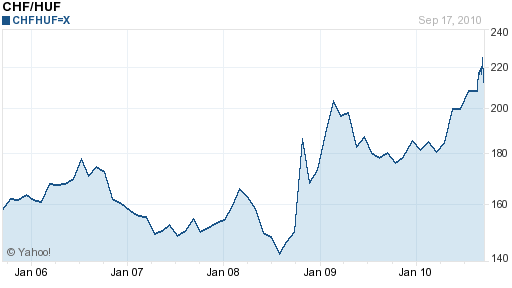
Ultimately, gauging the success of the stress tests will require waiting few weeks. Unlike currency, stock, and bond markets – which can and did offer instant feedback on the news – it will probably take some time before the impact is fully reflected in the money markets. In other words, while an uptick in the Euro, shares of bank stocks, and sovereign bond prices should all be seen as symbols of confidence, the real test is whether investors will be willing to lend directly to banks, at reasonable rates (proxied by 3-month Euro LIBOR, on display below).

3-month EURO LIBOR 2006-2010
In fact, that test could come quite soon, as the ECB continues to recall the hundreds of Billions of Euros in loans that it made to commercial banks. If LIBOR rates remain steady and the markets remain liquid, then the stress tests can be called a success. If private investors balk and/or the ECB is forced to extend its lending program, however, the tests will be seen in hindsight as a waste of time.

SocialTwist Tell-a-Friend
Posted by Adam Kritzer | in Central Banks, Euro, News | No Comments »

Forex Volatility to Remain High

Jul. 24th 2010

With the onset of the Eurozone sovereign debt crisis this year, volatility levels in forex (as well as in other financial markets), surged to levels not seen since the height of the credit crisis. While volatility has subsided slightly over the last few months, it still remains above its average for the year, and significantly above levels of the last five years.

The spike in volatility was easy enough to understand. Basically, the possibility of a default by a member of the EU or even worse, a breakup of the Euro created massive uncertainty in the markets, spurring the flow of capital from regions and assets perceived as risky to those perceived as safe havens. As you can see from the chart below, this trend has begun to reverse itself, but still remains prone to sudden spikes.

5 Year Forex Currency Volatility Chart
While the crisis in the EU seems to have (temporarily) settled, investors are attuned to the possibility that it could flare up again at any moment. A failed bond issue, a higher-than-forecast budget deficit, political stalemate, labor strikes – all signal a failure to resolve the crisis, and would surely trigger a renewed upswing in volatility and sell-off in risky assets.

The same goes for (unforeseen) crises in other regions, affecting other currencies. Muses one analyst: “Next week? Who knows. One strong candidate is for flight out of the yen as investors start to fear there won’t be enough domestic demand for mountains of Japanese debt and foreign buyers will insist on much higher yields. Another might be that Swiss banking exposure to insolvent east European households causes another banking crisis.” Don’t forget about the UK and US, both of which have hardly put the recession behind them, and whose Trillions in debt represent powder kegs waiting to explode.

It will be months or years before these latent crises even begin to manifest themselves, let alone achieve some kind of resolution. As a result, many analysts predict that volatility will remain high for the foreseeable future: “Big and sudden currency market moves shouldn’t come as a surprise, whatever the direction…Higher market volatility should follow on from greater macroeconomic volatility. Increased economic fluctuations increase uncertainty. And there’s no question macroeconomic volatility has risen.”

In addition, there is no way for governments for Central Banks to alleviate these crises due to the “Trillema of International Finance.” Greg Mankiw, Harvard Economics Professors, explains that in prioritizing an independent monetary policy and open capital markets have forced many countries to forgo exchange rate stability: “Any American can easily invest abroad…and foreigners are free to buy stocks and bonds on domestic exchanges. Moreover, the Federal Reserve sets monetary policy to try to maintain full employment and price stability. But a result of this decision is volatility in the value of the dollar in foreign exchange markets.” While the Euro has eliminated exchange rate fluctuations between members of the Eurozone, meanwhile, there is nothing that the ECB can (or desires to) do to minimize volatility between the Euro and outside currencies.

From the standpoint of forex strategy, there are a couple of lessons that can be learned. First of all, the carry trade will remain underground until volatility returns to more attractive levels. Until then, the potential gains from earning a positive yield spread will be offset by the possibility of sudden, irascible currency depreciation. Second, growth currencies – despite boasting strong fundamentals – will remain vulnerable to sudden declines. That doesn’t mean that they should be avoided; rather, you should simply be aware that small corrections could easily turn into multi-month weakness.

SocialTwist Tell-a-Friend

Emerging Markets Continue to Shine

Jul. 21st 2010

After a slight respite following the culmination of the Eurozone debt crisis, emerging markets financial markets are back to the their former selves, with stocks, bonds, and currencies all performing well.

The rally is being driven by two principal factors. First, investors came to the gradual realization that the trend towards risk aversion had reached extreme proportions. Given that the crisis in the EU has been fairly limited both in scope and extent (at least so far), it made little sense to punish emerging markets. If anything, emerging markets should have been the financial safe havens: “Debt-to-GDP ratios in the developed world are about double those in emerging markets, and they’re growing. This makes emerging markets interesting because you’re picking up incremental spread and in return you’re actually taking less macroeconomic risk.”

Other analysts see a certain futility in targeting a risk-averse strategy: “It’s not that people suddenly think emerging markets are a lot safer, it’s that they’re realising risk is everywhere and they can’t just assume the developed world is safe.” In other words, some investors are wondering whether it doesn’t make sense to focus less on risk – which  has become increasingly random – and more on return. In this aspect, emerging market investments of all kinds are more attractive than their counterparts in the developed world.

The second source of momentum for the rally is a long-term shift in capital allocation. Thanks to foreign demand, Emerging Market “borrowers, including governments and companies, have raised almost $300bn (£200bn) to date, up 10 per cent on the same period in 2009.” A microcosm of this surge can be seen in US mutual funds: “Emerging market equity funds…posted combined inflows of more than $3 billion for the week ended July 14, while emerging market bond funds took in $745 million, bringing their year-to-date inflows to an all-time high of $18.5 billion.”

Across all sectors, money is pouring into emerging markets at an even faster pace than before the credit crisis. This time around, however, analysts argue that it is justified by fundamentals: “Economies in the developing world are slated to grow 6.3% this year and are expected to maintain a similar growth rate through 2013, according to the International Monetary Fund. Advanced economies are seen expanding around 2.4% annually over the same time period.” The Brazilian economy alone expanded at an annualized rate of 9% in 2010 Q1, the fastest rate in 15 years!

Emerging market investors share the confidence of foreign investors, and it seems the flow of funds will primarily be one-way. According to a recent survey, “Just 19 per cent of Brazilians, 15 per cent of Indians and 11 per cent of Chinese…said they anticipated increasing cross-border investment.”

MSCI Emerging Markets Index 2006-2010
At this point, the only thing that could derail emerging markets is if investors get too ahead of themselves. According to Citigroup, “Developing-nation shares will rally 20 percent to 25 percent by the end of this year as the world economy avoids a double-dip recession and attractive valuations lure investors.” That would bring share prices past the current level and dangerously close to the pre-credit crisis highs of 2008. The JP Morgan Emerging Market Bond Index (EMBI+) has already shattered its previous record, and given the current spread of only 300 basis points to US Treasuries (which themselves are trading near all-time lows), one has to wonder if investors aren’t at risk of re-entering bubble territory.

JP Morgan EMBI+ July 2010
If for whatever reason investors get spooked, it could spark the same capital flight that followed the bankruptcy of Lehman Brothers, in which emerging market and commodity currencies alike fell 30-50% over a duration of mere months. While no one is predicting a similar outcome this time around, I think prudence and caution are nonetheless advisable.

SocialTwist Tell-a-Friend
Posted by Adam Kritzer | in Emerging Currencies, News | 1 Comment »

Reflecting on the Chinese Yuan Revaluation

Jul. 19th 2010

Today marks the one-month anniversary of China’s decision to remove the Yuan’s peg to the Dollar, and allow it to float. Now that the news has had a chance to wend its way through the financial markets, I think it’s time both to reflect and to forecast.

Over the last month, the Chinese RMB has appreciated by slightly less than 1% against the Dollar, although most of that jump took place in the day that followed the June 19 announcement. After the initial excitement faded, a sense of disappointment set in as it became clear that China had no intention of allowing the RMB to appreciate rapidly: “The subsequent appreciation of the yuan against the dollar is likely to be small, perhaps just a few percent over the remainder of the year.” In fact, futures prices reflect only an additional 1.5% appreciation over the next 12 months.

RMB USD June 2011 Futures

Due both to its slow speed and small scope, the revaluation could conceivably benefit the Chinese economy. That’s because in the short-term, a more expensive currency will mean higher prices paid for exports. The quantity of exports is unlikely to decline, such that total export revenues could actually increase. According to one analyst, “With Chinese imports, there are no substitutes in the short term. Maybe in 10 years, importers will have a choice, but right now they will just have to pay more. No other country…can build a manufacturing base and all the infrastructure that you need — transportation, energy, the entire value chain to the final good — takes many years.” As if on cue, China’s trade surplus expanded in June, in spite of the revaluation of the Yuan.
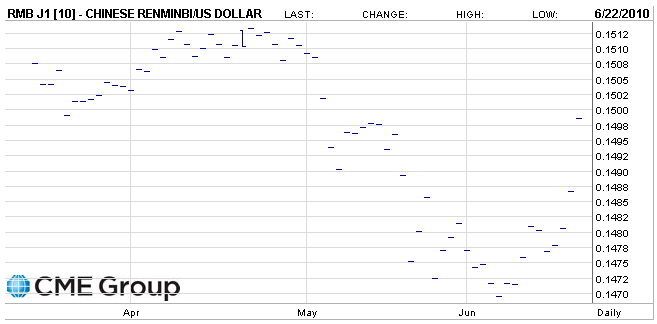
China Trade Balance 2004-2010

As a result, American manufacturers and other vested interests have announced that they will continue to lobbythe US government to pressure China on the currency issue, on the basis that the undervalued RMB is eroding both the US economy and the labor market. Argued the director of the Peterson Institute for International Economics, “The case for a substantial increase in the value of the renminbi is thus clear and overwhelming. An appreciation of 25% to 40% is needed to cut China’s global [account] surplus even to 3% to 4% of its GDP. This realignment would produce a reduction of $100 billion to $150 billion in the annual U.S. current account deficit.” It might also help to restore the estimated 1.4 million jobsthat have been lost due to China’s forex policy. According to analysts, however, political infighting make it unlikely that any new law or punitive tariffs will be imposed anytime soon.
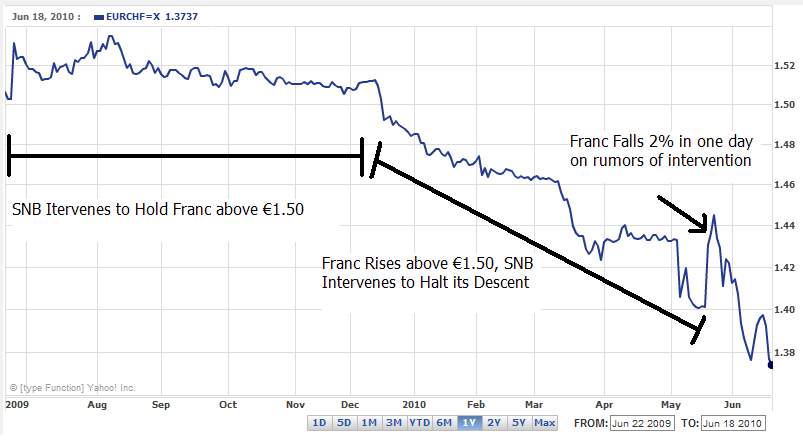
At the very least, China will continue to make the Yuan more flexible, so that one day it can float freely. It has already moved to facilitate trade settlement in Yuan, and analysts expect ” ‘more than half of China’s total trade flows, primarily bilateral trade with emerging markets, to be settled in renminbi in the next three to five years.’ ” China is also making it more attractive for foreign investors to hold Yuan, by loosening controls that govern Chinese capital markets and creating new investment vehicles that will cater directly to foreigners. In the mean time, holding RMB is pretty unattractive given both “the hassle of getting money in and out of China” and the low rates offered by Chinese money market funds.

USD CNY 5 year chart

As for the impact on the rest of the forex market, I think that commodity currencies and growth currencies could come out ahead. The move signals an implicit confidence in the global economic recovery and can perhaps be seen as a harbinger for high commodity prices: In addition, it will “provide a boostto U.S. exports, employment, earnings and growth, reinforcing the case for growth sustainability at a time when investors are more fearful than they were in April.” The US Dollar, on the other hand, could emerge as one of the big losers. Already, China’s forex reserve growth has slowed to the weakest pace in 11 years. This trend will probably continue, since smaller purchases of Dollars will be required to maintain the floating peg. In fact, the Euro’s recovery against the Dollar has coincided mysteriously with the revaluation of the Yuan. While this is probably just a coincidence, it is nonetheless symptomatic of a declining role for the Dollar as the world’s reserve currency. But that is a topic for another day…

SocialTwist Tell-a-Friend
Posted by Adam Kritzer | in Chinese Yuan (RMB), News | No Comments »

Euro Rally: Temporary or Permanent?

Jul. 17th 2010

Since the beginning of June, the Euro has rallied by an impressive 8% against the US Dollar, and by comparable margins against other currencies. The question on every one’s minds, of course, is whether this represents a temporary pullback or a permanent correction.

EUR USD 3 months 2010
The arguments in favor of the former are pretty strong. Namely, EUR/USD bearish sentiment had expanded to such an extreme level that a pullback – temporary or permanent – was basically inevitable. From this standpoint, what we have seen unfold over the last month-and-a-half is a classic short squeeze. Basically, those who were short the Euro were forced to cover their positions when it started to rally, which in turn triggered more selling, and ultimately, a self-fulfilling rally. As a result, “The difference in the number of wagers by hedge funds and other large speculators on a decline in the euro compared with those on a gain dropped to 38,909 on July 6, compared with record net shorts of 113,890 on May 11.”

Due to its sudden rise, the Euro became a much less attractive funding currency for carry traders. It helps that other Central Banks are delaying interest rate hikes, which means it’s difficult to turn a solid profit (on a risk-adjusted basis) from shorting the Euro. In addition, the markets have started to turn their attention to economic fundamentals in the US, which had been edging out the Euro in one of the perennially important rivalries in currency markets. In short, it suddenly became obvious to traders that the economic and fiscal conditions in the US are at best equal to those in the EU.

Finally, there was an implicit acknowledgement among the EU leadership that the so-called sovereign debt crisis is actually in many ways a banking crisis. This admission came in the form of stress-tests on 91 of the EU’s largest banks, designed to determine their exposure to sovereign debt and placate investors. After all,  “It was German and French banks that led the way in lending to Greece or Spain.” This misjudgement has spurred such banks to set aside Billions in potential losses and vastly curtail their lending activities.

Unfortunately, investors are skeptical that the stress tests will be stringent enough, seeing them as a mere publicity stunt: “While the EU have tried to counter these suspicions by promising to publish the result of stress tests, the market is fearful that stress tests will force some banks into writing down losses on non-performing loans.” By extension, investors are still equally concerned about the possibility of a sovereign debt default, even one that it is only partial.

In other words, the consensus is that despite the EU’s best efforts to tackle the crisis, it still has yet to enact meaningful structural reforms, opting instead for short-term stopgap solutions. According to The Economist, “The debate about how to save Europe’s single currency from disintegration is stuck…because the euro zone’s dominant powers, France and Germany, agree on the need for greater harmonisation within the euro zone, but disagree about what to harmonise.” There remains a lack of agreement over whether the economically and fiscally weaker members of the EU will be allowed to remain members, and if so, what if anything will be done to keep them in line.
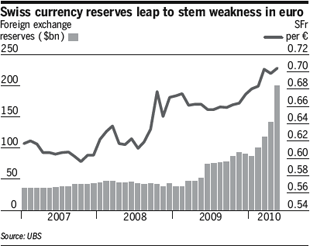
EU Public Debt

As you can see from the chart above, time is quickly running out. For the majority of EU countries, debt is now rising faster than GDP. From the standpoint of many investors, default seems like the most likely outcome since such countries lack the political muster to reduce their budget deficits, nor can they devalue their debt  through currency depreciation, due to the common currency.

Thus, the consensus (for now) is that the Euro’s run will soon come to an end. According to Citigroup, “The euro will resume its decline and head toward the $1.10-$1.15 range. ‘The market has digested a lot of the bad news about the euro. There’s no great optimism.’ ” Meanwhile, BNP Paribas “expects the euro to fall to parity by the end of 2010—one euro per dollar—a level it hasn’t seen since December 2002…[and] drift to 97 cents before hitting bottom in the third quarter of 2011.”
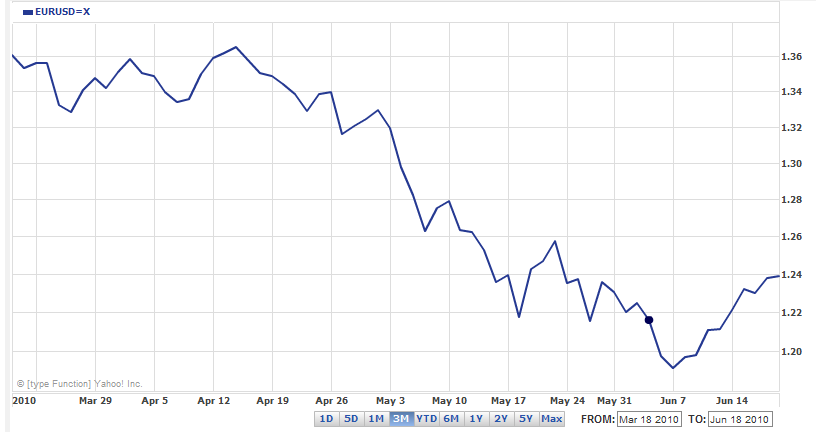
SocialTwist Tell-a-Friend
Posted by Adam Kritzer | in Euro, News | 3 Comments »

Japanese Yen and the Irony of Debt

Jul. 13th 2010

Since my last update in June, the Japanese Yen has continued to creep up. It has risen a solid 5% in the year-to-date against the Dollar, 12% against the Pound, and an earth-shattering 20% against the Euro. It is closing in on a 15-year high of 85 Yen/Dollar, and beyond that, the all-time high of 79. According to the Chicago Mercantile Exchange, “Long positions in the yen stand at $5.4bn. This is the highest level since December 2009 and represents the biggest bet against the dollar versus any currency in the market.”
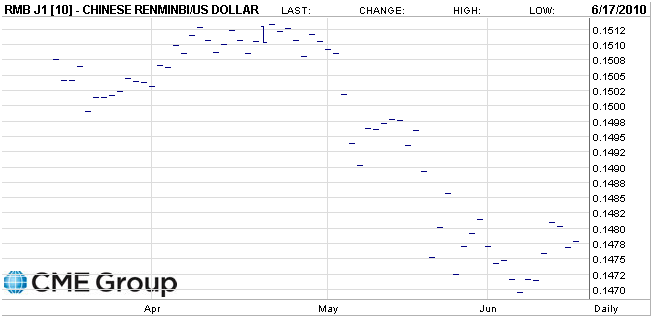
usd-jpy 1 year chart
As to what’s propelling the Yen higher, there is very little mystery. Two words: Safe Haven. “The yen’s attractions lie in its status as a haven from the turmoil that has engulfed financial markets as, first, the eurozone debt crisis unfolded and, then, fears about a double-dip recession have intensified.” To be sure, there are a handful of currencies that are arguably more secure and less risky than the Yen. The problem is that with the exception of the Dollar, none of them can compete with the Yen on the basis of liquidity. In addition, thanks to non-existent inflation in Japan and low interest rates in other countries, there is very little opportunity cost in simply holding Yen and simply taking a wait-and-see approach.

According to some analysts, interest rate differentials will probably remain narrow for the foreseeable future: “Global bond yields will fall, reducing the incentive of yen-based investors to place funds abroad.” In fact, thanks to low interest rate differentials, the Yen is not even the target funding currency for carry traders. Suffice it to say that investors are not bothered by the fact that Japanese monetary policy is extraordinarily accommodative and that Japanese long-term interest rates are the lowest in the world. For those who are concerned about rising interest rate differentials, consider that this probably won’t become a factor until the medium-term.
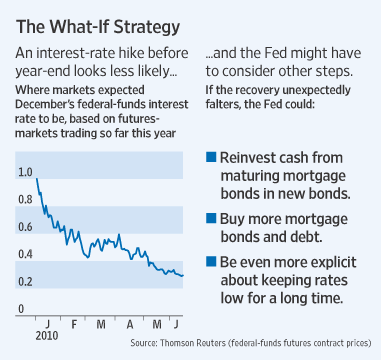
On the fundamental front, there are a couple of risks for the Yen. First of all, there is the stalled Japanese economic recovery and the possibility that the strong Yen could further erode the competitiveness of Japan’s export sector, the mainstay of its economy. Yen bulls respond to this by noting both that Japan’s economic recovery has already stalled for 25 years and that should the Yen’s rise actually crimp economic growth, the Central Bank would probably intervene. By all accounts, “The government will continue to keep a close eye on the yen.”

A greater concern, perhaps, is Japan’s massive debt. Near $10 Trillion, public debt is already 180% of GDP, and is projected to grow to 200% over the next few years. Total public and private debt, meanwhile, is by far the highest in the world, at 380% of GDP. The Japanese government is planning to implement “austerity measures,” but political stalemate and election pressures will make this difficult to achieve.  All three of the rating agencies have issued stern warnings, and downgrades could soon follow. Here, Yen bulls retort that as unsustainable as this debt might appear, the majority (90%) of it is financed domestically, through the massive pool of savings. The remaining 10% is eagerly soaked up by foreign investors, who view the debt as a more attractive alternative to cash and stocks. [This is the great irony that I alluded to in the title of this post - that more debt is viewed positively as "liquidity" and does nothing to hurt the Yen].

Japan Public Debt 1980 - 2010

Speaking of which, the Japanese stock market has risen by only 5% this year, and some analysts are predicting that a long bull market is inevitable. Adding to the fervor, Central Banks have begun to build their positions in the Yen, for the first time in 10 years. It seems everyone is excited about the Yen, even economists: “Within the developed economy space, Japan looks relatively good as an economy that’s likely to be growing faster than Europe or America, and it’s generally considered to have low risk of capital flight.” In other words, the consensus is that there is a very low chance of a “Greek-like debt crisis.”

At this point, the Yen can only be toppled by Central Banks: either foreign Central Banks will hike interest rates and make the Yen unattractive in contrast, or the Bank of Japan will intervene directly to prevent it from rising further.

SocialTwist Tell-a-Friend
Posted by Adam Kritzer | in Central Banks, Japanese Yen, News | 3 Comments »

US Apathetic about Dollar

Jul. 11th 2010

Recently, it struck me: the US does not care about the Dollar. If you look at fiscal and monetary policy, there is actually a remarkable degree of consistency. Both reflect a clear disregard for the conditions that are necessary for a strong currency.

This might seem ridiculous, given the Dollar’s amazing performance of late. It has appreciated healthily against almost all of the world’s major currencies, and is also more valuable on a trade-weighted basis. Bear in mind, however, that this rise is entirely a function of the (perceived) crisis in Europe. It speaks not to any strength in the Dollar, but rather to weakness in other currencies. In fact, as I wrote earlier this week (“US Dollar Paradigm Shift“), as investors have returned their gaze to the fundamentals, the Dollar has suffered.

Without drilling into the nuts and bolts of US fiscal policy, consider that the US budget deficit will exceed an unthinkable $1 Trillion for a second year in a row. The national debt is now growing much faster than GDP, and servicing it is consuming an ever-increasing share of the budget. With concerns looming of a double-dip recession, meanwhile, tax revenues will probably stagnate, even regardless of what happens to spending. In short, US budget deficits are going to continue to be a fact of life for the immediate future.

Monetary Policy is equally disastrous. The Fed is pre-occupied with keeping interest rates low and with promoting an economic recovery. $2 Trillion of newly-minted money is still flowing through the system, and it’s unclear when it will be siphoned out. There are a few inflation hawks on the Fed’s Board of Governors, but they lack the power to effect a short-term change in monetary policy.

The Bank for International Settlements (BIS), G20, and a pair of economists, among others, have all sounded alarm bells, calling such policies foolish and unsustainable. According to the BIS, “Keeping interest rates very low comes at a cost—a cost that is growing with time. Experience teaches us that prolonged periods of unusually low rates cloud assessments of financial risks, induce a search for yield and delay balance-sheet adjustments.”
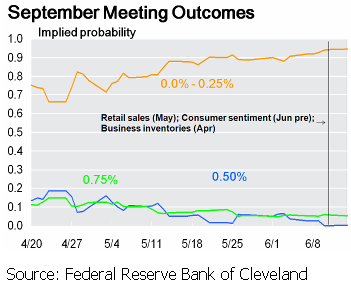
In short, there is a clear consensus that perennial budget deficits and low rates are wrongheaded at best, and disastrous at worst. From the standpoint of currency markets, what matters in the short-term are interest rates, and what matters in the long-term is inflation. The Dollar is in an unfavorable position on both fronts. Interest rates are currently near 0% – the lowest in the world – and easy monetary policy and high government debt increase the likelihood of inflation in the wrong-term.

In light of this notion, the only logical conclusion is that the Dollar simply plays no role in the formulation of government and Central Bank decision-making. Since the inception of the credit crisis, this was a luxury that could be afforded, as safe-haven capital poured into the US. If/when the crisis abates, this capital will probably depart, as investors are forced to consider the fundamentals.

SocialTwist Tell-a-Friend
Posted by Adam Kritzer | in Central Banks, News, US Dollar | 2 Comments »

New Zealand Dollar Thriving in Obscurity

Jul. 9th 2010

It’s understandable that forex investors basically ignore New Zealand. Its economy is around 10% the size of its neighbor Australia, its currency is less liquid, and spreads are higher. Given that its performance closely tracks the Australian Dollar, meanwhile, why pay it any attention?

NZD AUD 1 year

To be sure, the new currencies from Down Under trade in virtual lockstep, having strayed by only a few cents in either direction from their trading mean over the last year. Since the beginning of May, however, the Kiwi has staged an impressive rally, rising 8% against the Aussie in a matter of weeks. Perhaps, there is something worth analyzing after all!

According to most analysts, the sudden rise is largely a product of risk-appetite. Specifically, as the EU sovereign debt crisis stalls, investors are relaxing, and gradually moving capital back into growth currencies, like the New Zealand Dollar. In fact, the Kiwi recently rose to a one-month high on the same day that Spain successfully completed a bond auction.
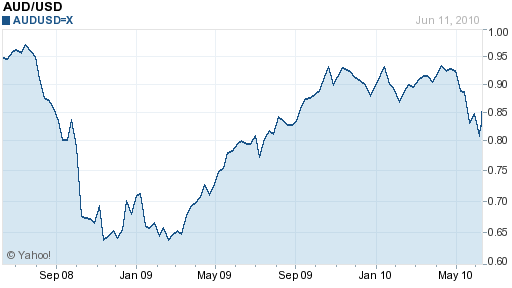
For proof of this phenomenon, one need look no further than the close relationship between the NZD/USD rate and US stocks, as proxied by the S&P 500. You can see from the chart below that they have largely tracked each other over the last 12 months. This relationship seems to have intensified over the last few weeks, as the New Zealand Dollar sometimes takes its cues directly from releases of US economic data.

NZD USD 1 year

However, New Zealand economic fundamentals are also playing a role, perhaps even the dominant role. According to one analyst, “The NZ dollar had now recovered nearly all its losses of late May…Domestic fundamentals had contributed relatively more to the NZ dollar’s recent recovery than had the mild improvement in the global backdrop.” Unlike Australia, which has been racked by political disruptions and concerns over an economic slowdown by its largest trade partner (China), New Zealand continues to coast at a healthy pace.
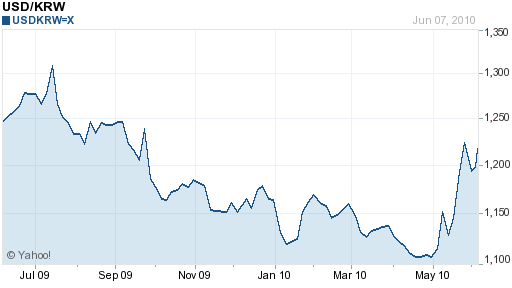
Moody’s forecasts that New Zealand’s economy will expand by 2.4% in 2010, and “assuming a healthy global economy, New Zealand’s recovery should evolve into a self-sustaining expansion during 2011 and 2012.” This should set the stage for near-term rate hikes, beginning with an expected 25 basis point hike on July 29. Analysts project that the benchmark rate will reach 3.75% by the end of 2010, and 5% in 2011. Widening interest rate differentials, combined with the ongoing recovery in risk appetite, could turn the Kiwi into a popular carry trade currency.

Given that the Central Bank of Australia is also projected to further hike rates, it seems the Aussie will join the Kiwi in its upward march, and that the two currencies will continue to trade in lockstep. Options traders might try to construct a low volatility strategy, such as a short straddle or selling covered calls against the pair. For currency traders that prefer the Aussie, meanwhile, the New Zealand Dollar could serve as an attractive hedge.

Then again, it’s possible that both currencies could fade, especially if the EU debt crisis intensifies, and/or the global economic recovery stalls. In short, “The near-term outlook is…uncertain due to prevailing risk aversion that may weigh on the commodity currency universe.”

SocialTwist Tell-a-Friend
Posted by Adam Kritzer | in Australian Dollar, Emerging Currencies, News | No Comments »

US Dollar Paradigm Shift

Jul. 7th 2010

Since the inception of the financial crisis, the Dollar has been treated as a safe haven currency. Simply, when there was a surge in the level of risk-aversion, the Dollar rose proportionally. When risk aversion gave way to risk appetite, the Dollar fell. It was as simple as that.

Lately, this notion has manifested itself in the EUR/USD exchange rate, with the Euro embodying risk, and the Dollar embodying safety. In fact, a carry trading strategy has unfolded along these lines and made this phenomenon self-fulfilling: traders have taken to reflexively selling the Dollar when news is good and selling the Euro when news is bad.

EUR USD July 2010

In recent weeks, this approach appears to be changing. It started with the US stock market, which began to decline, even as the Dollar was still rising. Investors had started to worry about the housing market stalling, the exhaustion of the government stimulus effect, and worst of all, the possibility of a double-dip recession. The most recent data “showed U.S. gross domestic product in the first quarter grew more slowly than expected…The U.S. GDP numbers came after some weaker-than-expected housing numbers and a dovish Federal Reserve, all of which drove U.S. Treasury yields lower and prompted investors to reassess their dollar positions.”

From my point of view, it is not the possibility of a prolonged recession that is itself noteworthy (though this is surely cause for concern), but rather that the currency markets are paying attention it. To be sure, news of the EU sovereign debt crisis continues to dominate headlines and influence investor psychology. Barring any unforeseen developments, however, this crisis probably won’t evolve much further in the short-term, and it’s logical that investors should turn their attention back to the data.

As a result, “The popular risk-related trade on the euro ‘that was prevalent in the first half of this year appears to have derailed for the time being as market players increasingly focus on comparative fundamentals once again,” summarized one trader. In fact, the Dollar has fallen by 5% over the last month, both against the Euro and on a trade-weighted basis.

DXY 2010

Over the long-term, analysts are divided over which narrative will determine the EUR/USD rate. It would seem that until there is some resolution to the sovereign debt crisis (whether positive or negative), an air of uncertainty will continue to hang over the Euro such that it remains an apt funding currency for a carry trade strategy. US capital markets are the world’s deepest, most liquid, and most stable, and in times of crisis will probably continue to attract risk-averse capital.

On the other side are those who argue that the US will shed its safe-haven status and become a growth currency. According to this line of thinking, the US economy will outperform the EU, Japan, and Britain – its peers/competitors in the Top Tier of currencies.
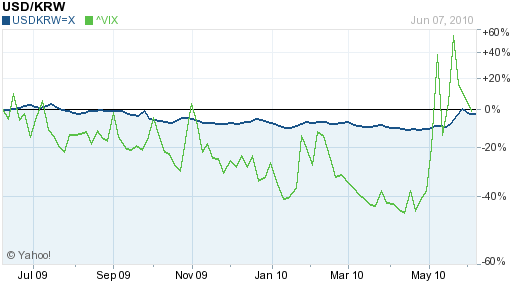
“The euro zone has been stricken by crisis over the debts of its weaker members. Japan will only emerge slowly from deflation and the U.K. has to deal with its record high budget deficit over the next few years,” argued one analyst.

As a result, “The dollar will return to a pattern seen in the early 1980s and late 1990s, when it appreciated as stocks rose…The likelihood that the dollar performs strongly rather than weakly when investors are risk-seeking will signify a major change in the currency markets.” Under this paradigm, the Japanese Yen and the Swiss Franc would probably become even further entrenched as safe-haven currencies.

Finally, it’s worth pointing out that such a paradigm shift wouldn’t necessarily be good for the Dollar. If the US is indeed able to put the recession behind it, then a renewed focus on growth fundamentals would send the Dollar higher. If the Double-Dip materializes, however, Dollar bulls will probably find themselves hoping that the Dollar can retain its safe haven status.

SocialTwist Tell-a-Friend
Posted by Adam Kritzer | in Commentary, Euro, News, US Dollar | 1 Comment »

Markets Confused about Canadian Dollar

Jul. 2nd 2010

On a trade-weighted basis, the Canadian Dollar (aka Loonie) has appreciated nearly 10% in 2010. At the same time, it has fallen 8% against the Dollar since the beginning of May. This contradiction is reflected in an explosion in volatility: “CAD has been very volatile – the average intraday spread between the high and low in CAD over the last 21-years has been 83 points; over the last month it has been 182 points.” How can we make sense of this uncertainty, and which trend is ultimately more representative?

CAD USD 1yr

On the one hand, the Loonie continues to be thought of as a commodity currency whose rise and fall is closely linked to fluctuations in the prices of certain raw materials. “It’s not just about oil any more, but also natural gas – whose price has carved out a bottom – and precious metals, which command a 13-per-cent share of the TSX’s market cap versus less than 1 per cent for the S&P 500,” observed one analyst. From this standpoint, it’s perhaps not surprising that a 7.2% drop in the Raw Materials Index was matched by a proportional drop in the value of the Loonie.

On the other hand, the Loonie is being punished by the Eurozone debt crisis and the consequent flight to safe haven currencies: “The Canadian dollar is following the risk aversion tones of the market.” While the Loonie might have otherwise been “been closer to parity” then, it’s understandable that the so-called “panic trade” is holding it down.

In light of the Eurozone debt crisis, however, one might have predicted that commodity currencies would rally, since they are perceived as being backed by something more tangible than government fiat. In fact, some analysts believe that the comparatively modest decline in the Loonie implies that this is indeed the case: “It was fascinating to see the Canadian dollar only correct down to 92 cents during this most recent round of global financial turbulence and flight-to-safety. That is a far cry from the correction down to 78 cents following the Lehman aftershock, not to mention the move down to 62 cents after the tech wreck a decade ago.”
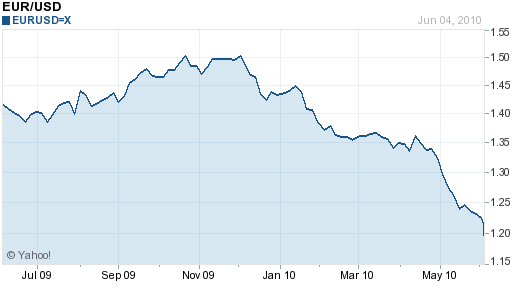
The same analyst pointed out that the notion of the Canadian Dollar as a safe-haven currency is further justified by Canada’s strong fiscal condition. It is trimming its spending, cutting taxes, and may even reduce its national debt. Meanwhile, it’s financial system remains robust, as evidenced by the fact that none of its banks have required government bailouts. Thus, Canadian sovereign debt has continued to appreciate in spite of the crisis across the Atlantic. In short, “The federal government actually deserves the triple-A credit rating that it receives on its debt.”

Going forward then, the near-term performance of the Loonie will depend both on the EU sovereign debt crisis and commodities prices, which in turn are high sensitive to (perceptions of) the global economy. In this latter aspect, there is tremendous uncertainty. The Canadian economy did grow at 6% last quarter. However, “The fear is that weaker U.S. data is posing a risk to the Canadian economy. And the G-20 is really focused on fiscal restraint as opposed to supporting growth. That probably isn’t good for the growth currencies.”

Furthermore, there are implications for the Bank of Canada, which has already embarked on a tightening of monetary policy. It raised its benchmark interest rate – becoming the first industrialized economy Central Bank to do so – to .5% in June, and there is a 45% chance that it will do so again in July. The futures markets are currently pricing in a benchmark rate of 1.25% by year end. Ultimately, “The extent and timing of any additional withdrawal of monetary stimulus would depend on how the outlook for economic activity and inflation evolves.”

For now, interest rate hikes are largely beside the point as investors remain firmly focused on the EU fiscal crisis: “People are taking risk off heading into the summer, to reassess,” summarized one trader. A resolution of the crisis, would surely send the Loonie back towards parity. In the interim, Canada’s strong fundamentals will ensure that it won’t fall much further, poised to strike when the time comes.

SocialTwist Tell-a-Friend
Posted by Adam Kritzer | in Canadian Dollar, Central Banks, News | No Comments »

Emerging Markets Rally, Despite Eurozone Debt Crisis

Jun. 29th 2010

It looks like emerging market investors took my last post (“Investors” Shouldn’t Worry about the Euro) to heart, since emerging markets (EM) have continued to rally in spite of the Euro’s woes. To be sure, EM stocks, bonds, and currencies all dipped slightly in May when the crisis reached fever pitch, but they have since recovered their losses and are once again en route to record highs.

MSCI Stock Index 2010

That’s not to say that that surge in risk-aversion wasn’t justified. In fact, investors are continuing to punish the Eurozone as well as a handful of other risky areas. However, analysts have concluded that in the case of emerging markets as a whole, this mindset doesn’t really make sense.
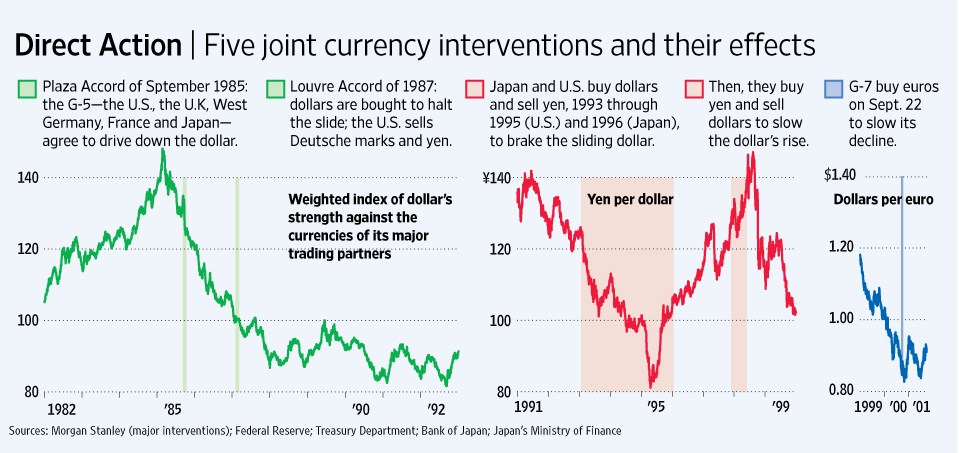
Simply, the fiscal and economic condition of is stronger than in developing countries. Whereas previously crises were known to originate in developing countries and spread to industrialized countries, this latest series of crisis turned that notion on its head. The credit and housing crises were largely the product of speculation in the West, and the sovereign debt crisis originated in Europe. While it’s possible that investor concern would self-fulfillingly cause the crisis to spread to emerging markets, any impact would probably be muted.
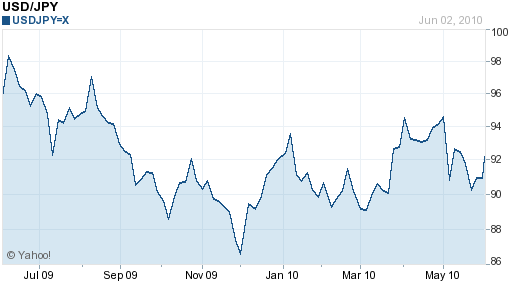
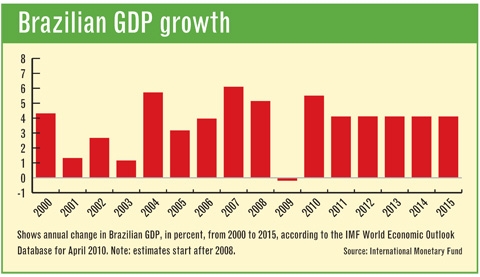
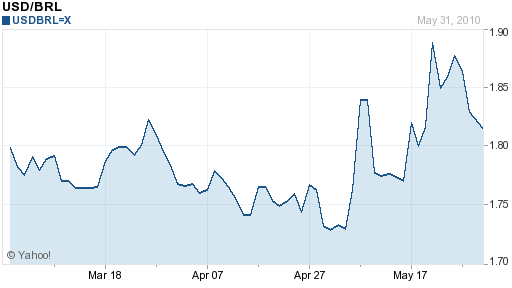
There is recognition that emerging market balance sheets are strong and the debt to GDP ratio is below 40 per cent compared to the western world, where it is over 100 per cent in many countries,” summarized one analyst. “The vast majority of emerging market countries ‘have the tools to tackle inflation and will succeed, having reasonable independence from their central banks,’ ” added another.

Thus, the funds continue to pour in. “Net inflows into emerging market debt totalled $30.6bn (£20.7bn, €25bn) from the beginning of the year to late May compared with $33bn for the whole of 2009.” Here’s another sign of EM confidence: “IPOs in developing countries raised $29.3 billion this quarter, almost three times the amount in industrialised nations.” Meanwhile, the MSCI Emerging Market Stock Index has just finished its strongest rally since 2005, and the JP Morgan Emerging Market Bond Index (EMBI+) is closing in on another record high. This is frankly incredible when you consider that around half of the countries with the largest weightings in the index have experienced debt crises of varying severity over the last decade.

EMBI+ bond index 2010
As far as forex investors are concerned, the confidence in EM capital markets should also extend to currencies. The carry trade is heating up (thanks to the cheap Euro), and will probably only expand as EM Central Banks move to raise interest rates to combat inflation, as alluded to above. If the Eurozone debt crisis intensifies, then you can expect some kind of pull-back. As with recent retracements, however, it will be only temporary.
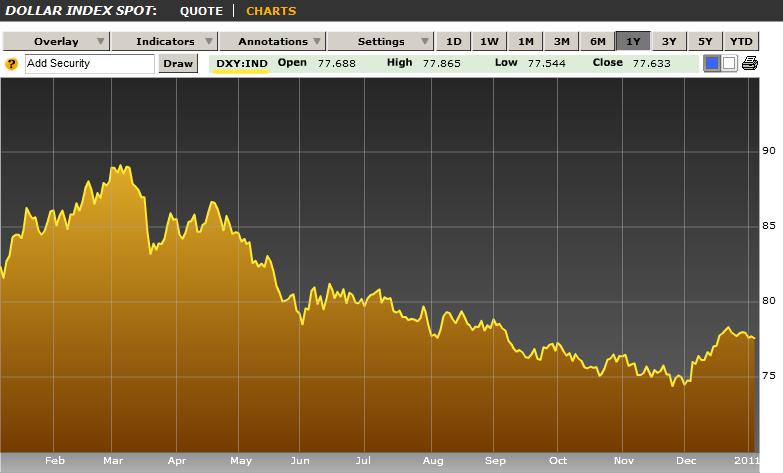
SocialTwist Tell-a-Friend
Posted by Adam Kritzer | in Emerging Currencies, News | 2 Comments »

“Investors” Shouldn’t Worry about the Euro

Jun. 26th 2010
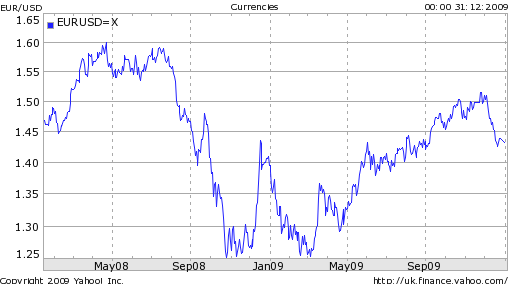
With today’s post, I want to take off my currency trader hat and put on my investor hat.

You might be tempted to argue: But wait, these two aren’t mutually exclusive. Isn’t it possible to wear both hats? While it’s theoretically plausible for a trader to take a long-term view of the markets based on fundamental analysis, I don’t think it’s likely in practice. In the end, a good investor will always have a longer time horizon than a good currency trader. In short, someone who bought shares in Apple 20 years ago is now probably a millionaire. Someone who went long the USD 20 years ago has probably since lost his investment due to inflation.

But seriously, currency traders must a