Forex Blog: Currency Trading News & Analysis.

Marketplace

  • Forex
  • Advertise here

Features

Search Forex Blog

Helpful Links

Contact

Archive for the 'Chinese Yuan (RMB)' Category

Chinese Yuan Inches Towards Reserve Currency Status

Jun. 8th 2009

The last week brought a few more developments in China’s quest to turn the Yuan into a viable reserve currency. Don’t get me wrong - I used the term “inches” in the title of this post for a reason - the Yuan will not supplant the Dollar anytime soon, if ever. Still, China deserves credit for their resolve on forcing the issue, as well as for providing an alternative to the Dollar monopoly.

An important boost came from Russia’s Finance Minster, who suggested that, “This could take 10 years but after that the yuan would be in demand and it is the shortest route to the creation of a new world reserve currency,” as long as it was accompanied by economic and exchange rate liberalization. The Head of the World Bank, Robert Zoellick, agreed: “Ultimately, that’s a good thing. And ultimately it’s good if you’ve got, I think, some multipolarity of reserve currencies to create, to make sure that people manage them well.”

These soft endorsements were precipitated by comments from  a top Chinese banker that companies should start to issue bonds denominated in Yuan. “Guo Shuqing, the chairman of state-controlled China Construction Bank (CCB), also said he is exploring the possibility of issuing loans to trading companies in yuan, allowing Chinese and foreign companies to settle their bills in yuan rather than in dollars.” This would serve two ends simultaneously; not only would Chinese capital markets be strengthened, but the Chinese Yuan would benefit from the increased exposure. Already, “HSBC and Standard Chartered have both said they are preparing to issue bonds denominated in yuan” and international monetary institutions might not be far behind.

Conspiracies aside, the Chinese Yuan will become a reserve currency when it is ready to become a reserve currency. I’m sure this seems self-evident, but it’s important for China (and China watchers) not to get ahead of itself. It doesn’t make sense for risk-averse investors to hold a currency that is still essentially pegged to the US Dollar and that isn’t fully convertible. If there’s no pretense that the Yuan fluctuates in accordance with market forces, and if investors aren’t guaranteed the ability to withdraw RMB if need be, what possible reason would they have to hold it in the first place?

Summarizes one columnist, “China would have to gradually make the yuan convertible on the capital account; it needed a more liquid foreign exchange market; its bond markets and banking system needed to be more developed; and there had to be proper monitoring of cross-border capital flows.” The importance of having functioning capital markets cannot be understated. Simply, investors and Central Banks buying Yuan would not want to simply invest in paper currency; instead they would want stocks and bonds that trade transparently.

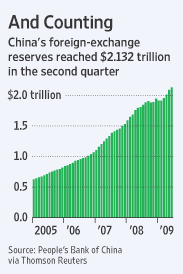
Currently, foreign investors are limited to savings accounts and investing/lending to firms that record earnings opaquely and are ultimately subject to the whims of the Central government. This system has functioned well in the past, only because investors were betting generally on the Yuan’s appreciation, and not necessarily on specific opportunities within China. If China wants the Yuan to be a serious contender with the Dollar, it needs to give investors more and better options. Ironically, if China had taken these steps in the past, it wouldn’t have found itself with $2 Trillion worth of Dollar assets that it is desperately trying to dispose of.

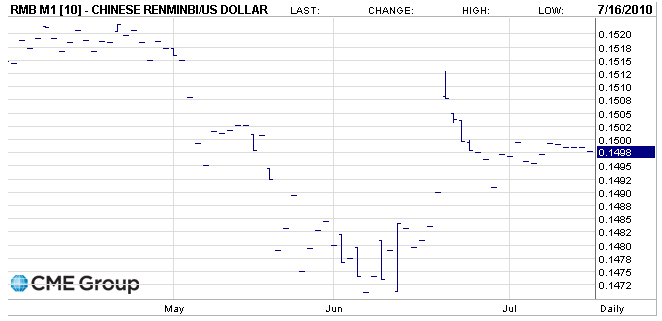
rmb-usd-chart

SocialTwist Tell-a-Friend

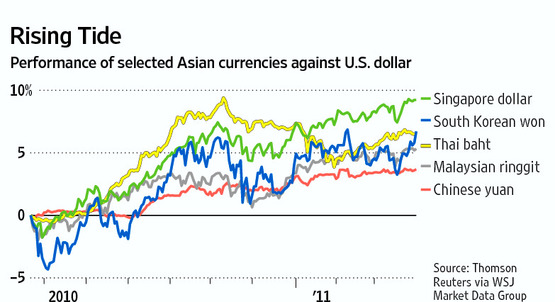
Asian Currencies Rally for Third Straight Month

May. 22nd 2009

According to a recent Reuters poll, investors are increasingly bullish on emerging market Asian currencies, including the Taiwan dollar, Indonesian rupiah, Singapore dollar, Malaysian ringgit, Philippine peso, South Korean won, and Indian rupee. The Thai Baht wasn’t covered by the poll, but given its strong performance over the last few months, it seems safe to include it in the bunch.

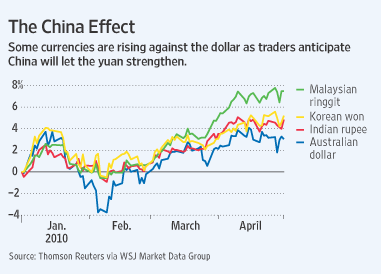
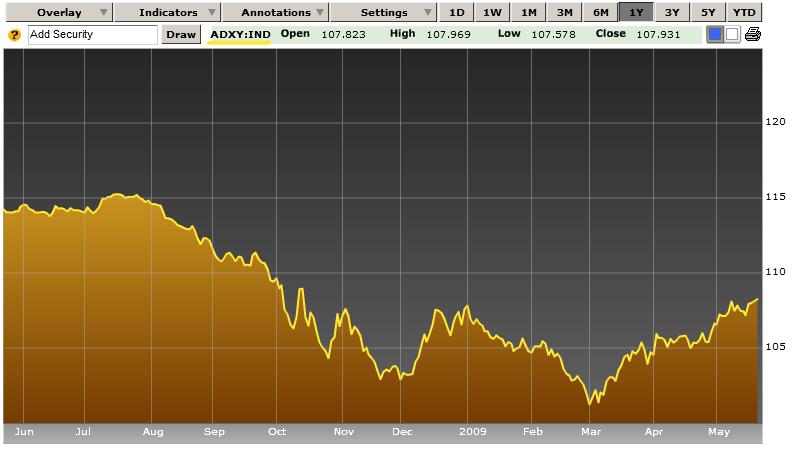
This uptick in sentiment is somewhat unspectacular, since “The Bloomberg-JPMorgan Asia Dollar Index, which tracks the 10 most-active regional currencies,” has now risen for almost three consecutive months [See chart below]. Leading the pack are the Taiwan Dollar and South Korean Won, which recently touched five-month and seven-month highs, respectively. “The Korean currency has climbed 28 percent since reaching an 11-year low of 1,597.45 in March.”

asian-currencies-rise

Investors are now pouring money back into Asia at rapid clip. “Asia ex-Japan received $933 million in the week ended May 20, the most among emerging-market stock funds, bringing the total this year to $6.9 billion.” Meanwhile, the “The MSCI Asia Pacific Index of regional stocks climbed 22 percent this quarter” while Chinese stocks are up 45% since the beginning of 2009.

But it’s unclear - doubtful is a better word - whether this rally is supported by economic fundamentals. One commentator summarized this contradiction as follows: “Improved sentiment has led to a massive resurgence in flows to emerging markets, irrespective of the underlying data, which remains weak. Investors are going out of dollars to riskier markets, riskier currencies.”

Let’s drill down into some of the data. Chinese exports fell 15% in April. Japan’s economy contracted 15% in the most recent quarter. Singapore’s exports are down 20% on an annualized basis. The South Korean economy is projected to shrink by 2% this year. The Central Bank of Thailand just cut its benchmark interest rate to an unbelievable 1%. The only bright spot economically is Taiwan, which is benefiting both from improved economic ties with China and a healthy current account surplus. I suppose everything is relative, as “developing Asian economies will grow 4.8 percent in 2009, even as the world economy contracts 1.3 percent” according to the International Monetary Fund.

The notion that the rally is not rooted in fundamentals is shared by the region’s Central Banks, which clearly realize that economic recovery will be much more difficult in the face of currency appreciation. One analyst argues that, “Until the signs of global economic recovery become more convincing, central banks will unlikely tolerate significant currency appreciation.” The Central Banks of South Korea, Taiwan, and Indonesia have already actively intervened to hold their currencies down, while Malaysia and Singapore (discussed in a Forexblog post last week) have also intervened for the sake of stability.

As a result, this rally could soon begin to lose steam. “A ‘correction’ in regional currencies is ‘appropriate’ following recent gains,” said one analyst. Another has called the rally “overdone.” Still, Central Banks and economic data pale in comparison to capital flows and risk/reward analysis. In short, these currencies (and other investments) will continue to find buyers for as long as there are those hungry for risk. Citigroup, whose “Asia-Pacific foreign-exchange volume may rise about 10 percent from the first quarter,” is bullish. A representative of the firm declared: “Fund managers are still ’sitting on lots and lots of cash’ so the pickup in volumes will continue.”

SocialTwist Tell-a-Friend

China’s Gold Holdings Surge 76% over Six Years

Apr. 29th 2009

Based on the title, you’re probably groaning: ‘Wait, I thought this was supposed to be a forex blog?” Bear with me, however, as this subject is extremely pertinent to forex.

Last week, it was revealed that China has been clandestinely adding to its gold reserves since 2003, to the extent that its holdings increased by 76%, to approximately 1,050 tons. The news initially sent a ripple through forex and commodities markets, which were overwhelmed by the figures involved. After analysts had a chance to gather some perspective, however, the markets relaxed. You see, although the increase seems tremendous in size, it is quite small in relative terms.

It is relatively small compared to other countries: “This places China fifth in the world, ahead of Switzerland’s 1040 tons but behind the U.S. ranked first with 8,133 tons, followed by Germany (3,412 tons), France (2,508 tons) and Italy (2,451 tons).”

It is relatively small given the six-year duration of accumulation: “I think as soon as people realized it’s not a year-on-year increase, or a quarter-on-quarter increase, people realized it should not have that big an impact.”

It is small relative to China’s mammoth $2 Trillion forex reserves: “As a proportion of foreign exchange reserves, which have risen five-fold over the same period, gold now stands at a tiny 1.6 percent, versus 1.7 percent in 2003.”

On some level, the development has at least some symbolic importance, as it demonstrates that it cannot be taken for granted that China will simply continue to plow its (dwindling) trade surplus into Dollar-denominated securities, or even currencies in general. This is underscored by the suspicious timing of the announcement; China essentially waited six years before revealing its buildup in gold, probably in order to coincide with the uproar surrounding the Dollar’s role as global reserve currency. In other words, even though China’s gold purchases in and of themselves don’t amount to much, the Central Bank of China is trying to send a message that it will defend itself against “the depreciation risk of some foreign currencies.”

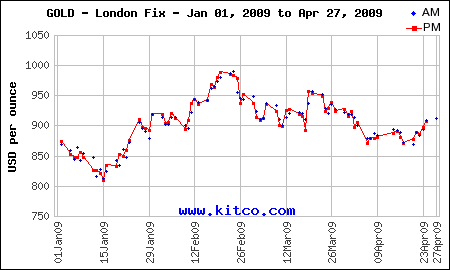
The announcement also explains the recent buoyancy of gold prices. Historically, there existed an inverse correlation between gold and the Dollar. This correlation has all but broken down as a result of the credit crisis, and for the first time a strong Dollar has been accompanied by high gold prices. Part of the reason may be increased buying activity by Central Banks, including the Bank of China: “The physical market remained well-bid by an unknown buyer despite bullion prices spiking to levels that normally cooled demand…Purchases were made in Shanghai, traders said, in an effort to absorb domestic production and lessen the impact of bullion prices on global markets.”

gold-prices

SocialTwist Tell-a-Friend

China is Still Not a Currency Manipulator

Apr. 15th 2009

There was tremendous speculation surrounding today’s release of the US Treasury’s semi-annual report to Congress on exchange rates. Considering that Treasury Secretary Geithner accused China unequivocally of currency manipulation during his confirmation hearing in January, it would seem that an official condemnation was inevitable.

Alas, the report once again exonerated China: “In the current Report, Treasury did not find that any major trading partner had manipulated its exchange rate for the purposes of preventing effective balance of payments adjustment or to gain unfair competitive advantage.” The press release accompanying the report made a point of justifying the decision to exclude China: “First, China has taken steps to enhance exchange rate flexibility….Second, the Chinese currency appreciated by 16.6 percent in real effective terms between the end of June 2008 and the end of February 2009….Even so, Treasury remains of the view that the renminbi is undervalued.”

There was certainly a political calculus that went into the decision. There has been a great deal of talk recently regarding China’s growing unease over its US investments, and its consequent willingness to contribute to funding the upcoming US budget deficits. Asks one analyst rhetorically, “If the Obama administration encourages the Chinese government to keep rolling their dollars into US Treasury bonds, then how can the Chinese do this without stabilizing the exchange rates?”

There is also mounting economic evidence that China is no longer manipulating the Yuan, at least not to the same extent as before. China’s foreign exchange reserves, which it must accumulate as part of its efforts to depress its currency, are growing at the slowest pace in nearly a decade. In the first quarter of 2009, its reserves grew by only $7 Billion, compared to an increase of $150 Billion in the first quarter of 2008. This can be explained as follows: “China’s first-quarter trade surplus shrank 45 percent from the previous three months and foreign direct investment tumbled as the global recession choked off demand.” According to another economist, “Inflow through buying properties and speculation was a big part of foreign exchange increase in the past few years, and we are seeing a bit of unwinding as new money is not coming in.”

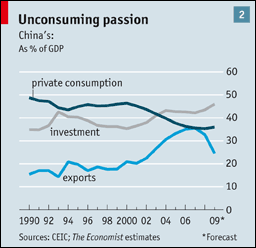
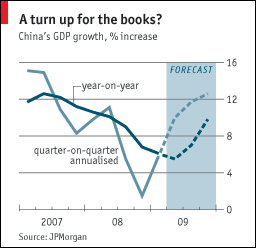
On the other hand, there are signs that China’s economic stimulus plan has begun to trickle down to the bedrock of the economy. The Chinese money supply expanded by a record 25.5% in March, as a result of a six-fold increase in lending. Today’s release of GDP figures revealed that “By March the economy was gaining more speed, with the year-on-year increase in industrial production rising to 8.3% from an average of 3.8% in the previous two months. Retail sales were 16% higher in real terms than a year ago, and fixed investment has soared by 30%.” In short,  it looks like the increase in investment and government spending will at least partially offset the projected 10% decrease in 2009 exports. [Chart below via The Economist].

china GDP forecast

SocialTwist Tell-a-Friend
Posted by Adam Kritzer | in Central Banks, Chinese Yuan (RMB) | 3 Comments »

Chinese Yuan Vies for Reserve Status

Apr. 1st 2009

Having appealed unsuccessfully to the G20 to create a viable reserve currency, China is now taking matters into its own hands, by pushing the Chinese Yuan as a viable alternative.

Earlier this week, it signed a $10 Billion+ swap agreement with Argentina, involving an exchange of Argentine pesos for RMB. The agreement is ostensibly designed to benefit Argentina, whose economy has been hit hard from the global credit crisis: “The peso has been weakening slowly but consistently since mid-2008, when a major farm strike here spooked investors and led many Argentines to trade in their pesos for dollars.” By guaranteeing a large quantity of RMB - which is generally considered undervalued- China is effectively providing the peso with more solid backing.

In actuality, the swap was probably proposed by China in order to demonstrate its sincerity in seeing the Dollar replaced as reserve currency. Especially among developing countries and/or Asian countries, many of which represent major trading partners, China is keen to increase the supply of Yuan. One analyst wrote that ” ‘We expect more agreements with other emerging market countries will be in the pipeline,’ as the swaps will help ‘Chinese slumping exports by making access to finance easier.’ ” Accordingly, the swap agreement with Argentina represented the sixth bilateral currency agreement signed by China in recent months. The other five countries are Belarus, South Korea, Hong Kong, Malaysia, and Indonesia, with the total nominal swap value of nearly $100Billion ($650 Billion RMB).

China is also moving to make the Yuan fully convertible, such that it can be exchanged freely both inside and outside China. It is intended that Chinese banks and exporters, for example, will now be able to accept payment directly in foreign currencies, rather than first being forced to convert them into RMB. In addition, the government “will triple the amount of domestic securities that overseas funds can buy under the qualified foreign institutional investors program to $30 billion” in order to make it easier for foreigners to invest directly in China.

While the moves announced so far are too small to make any meaningful waves in the forex world, investors seem generally supportive of China’s efforts. Remember that only two years ago, hedge fund manager Jim Rogers famously announced that the RMB was due to appreciate 500% over the next couple decades and subsequently moved much of his personal savings into RMB-denominated bank accounts.

A recent note by Citigroup analysts perfectly encapsulates this sentiment: “In the longer term, we think it is China’s strategic economic and political interest to promote the broader use or internationalization of CNY. While the internationalization of CNY has a very long way to go, we see China as using the global crisis as an opportunity to take early steps.” Of course, China itself is conscious that such a process will require decades to complete, but it remains cautiously optimistic: “It’s not really up to China to determine this. It’s up to the market…The best the government can do is to permit yuan-denominated trade. And then it’s up to the market to decide whether it wants to use that.”

SocialTwist Tell-a-Friend
Posted by Adam Kritzer | in Central Banks, Chinese Yuan (RMB) | 7 Comments »

Despite Shrinking Forex Reserves, China will Continue to Hold US Treasuries

Mar. 23rd 2009

Since Chinese Premier Wen Jiabao (as the ForexBlog reported here) expressed doubts about China’s US loans and investments two weeks ago, the markets have been awash in speculation. In hindsight, it seems that the announcement was a political ploy, rather than a harbinger for a policy change. With a few qualifications, therefore, it seems to safe to conclude that China’s foreign exchange reserves will not undergo any serious changes in the near-term.

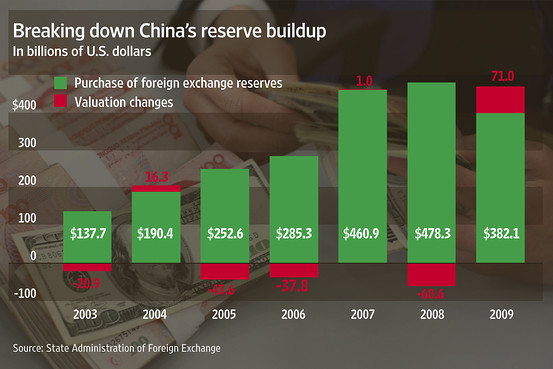
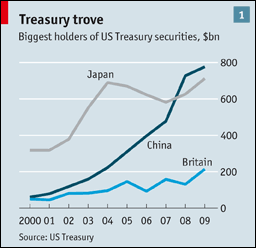
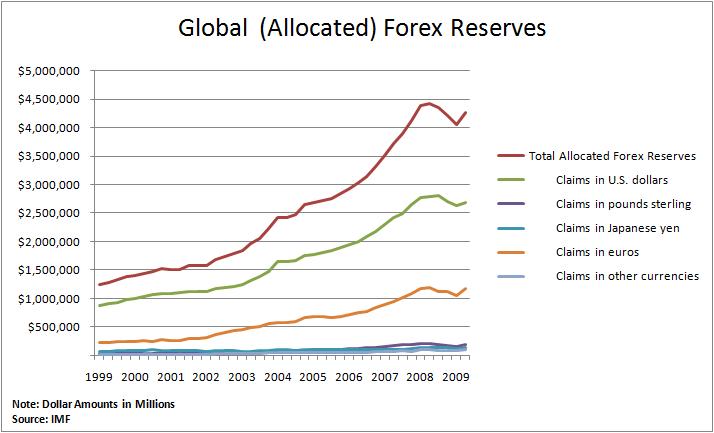
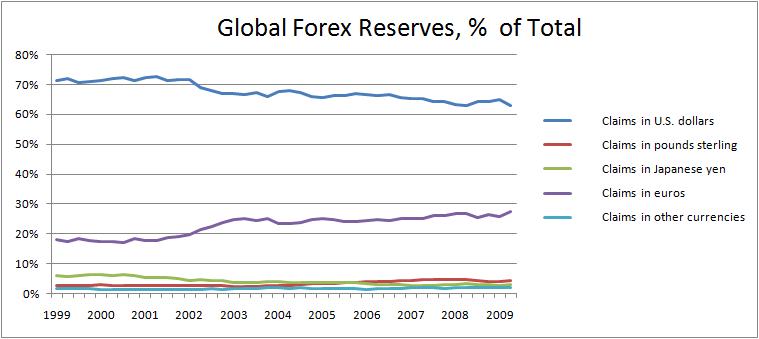
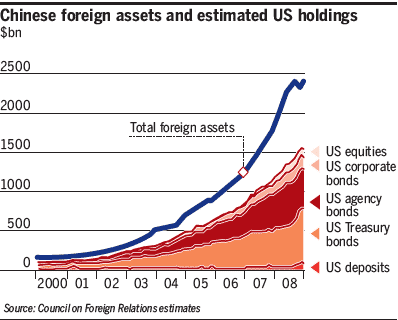
Motivated both by politics and pragmatism, “China’s top foreign-exchange official said the nation will keep buying Treasuries and endorsed the dollar’s global role. Treasuries form ‘an important element of China’s investment strategy for its foreign-currency reserves,’ she said at a briefing in Beijing today. ‘We will continue this practice.’ ” The economic fortunes of China and the US have become increasingly intertwined over the last decade, such that China has come to depend on exports to the US to drive economic growth, while the US simultaneously depends on China to fund its fiscal and current account deficits. As a result, “about two-thirds of China’s nearly $2 trillion in reserves is parked in dollar assets, primarily U.S. government and other bonds.”

china-forex-reserve-compositionEven ignoring the potential political fallout from forex reserve diversification, such a move doesn’t really make practical sense. First of all, there isn’t a buyer sufficiently capitalized to relieve China of its US Treasury burden. “If China decided to sell off some of its U.S. Treasury holdings, it would scarcely be able to dump that in large blocks. And a partial selloff would surely lead to a slump in the Treasury market, eroding the remaining value of China’s portfolio.”
In addition, there doesn’t currently exist a viable alternative to US Treasury securities, nor to investing in the US, for that matter. China’s attempt at diversifying into corporate bonds and equities was extremely ill-timed, having been implemented just prior to the puncture of the real estate and stock market bubbles. Including the collapse in the value of its high-profile investments in the Blackstone Group and Morgan Stanley, total paper losses are estimated at a whopping $80 Billion. Investments in other currencies and markets, meanwhile, probably would have yielded similarly poor returns. The market for gold- mulled by some as a theoretical alternative- is even more volatile and “not large enough to absorb more than a small proportion of China’s reserves.”

As a result, China’s forex reserve diversification strategy is likely to proceed along two lines: change in duration of loans, and investments in natural resources. “The risk of short-term national debt is comparatively more controllable. China increased its holding of short-term US bonds by $40.4 billion, $56 billion, and $38 billion in September, October and November, respectively. At that time, China began to sell long-term government debt.” Through its affiliates meanwhile, China’s Central Bank is cautiously making stealthy forays into natural resources; see its recently-acquired a $20 Billion stake in Rio Tinto, an aluminum company, as evidence of this strategy.

Of course, China has announced tentative support for loaning money to the IMF and backing an ‘international’ reserve currency that would serve as an alternative to the Dollar. Given that this is probably many years away, however, it has little choice but to continue to hold Treasuries and the like. In the words of a high-ranking Chinese official: “We are in the middle of a crisis right now, and the priority for foreign exchange reserves is to minimize losses.”

SocialTwist Tell-a-Friend
Posted by Adam Kritzer | in Central Banks, Chinese Yuan (RMB), US Dollar | 4 Comments »

China Maintains “Stable” Yuan, at Least Against USD

Mar. 21st 2009

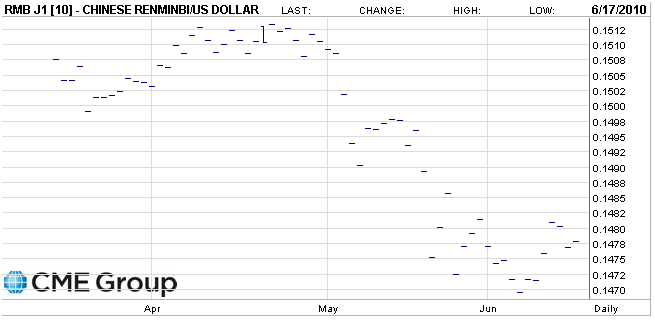
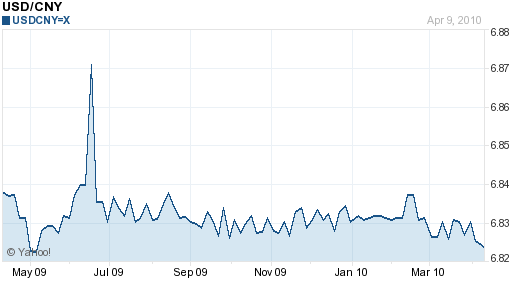
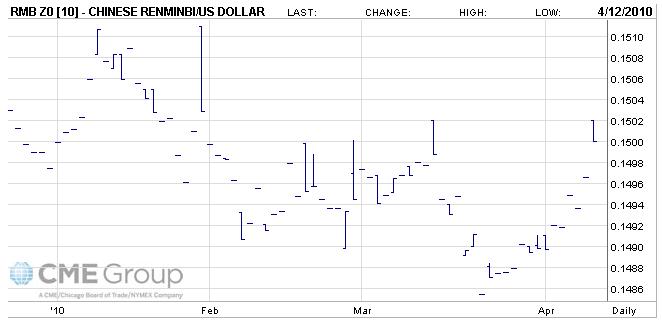
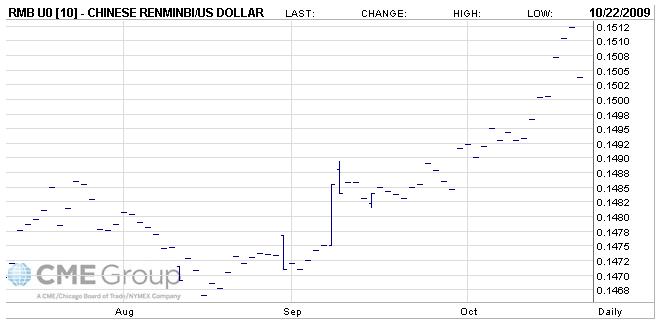
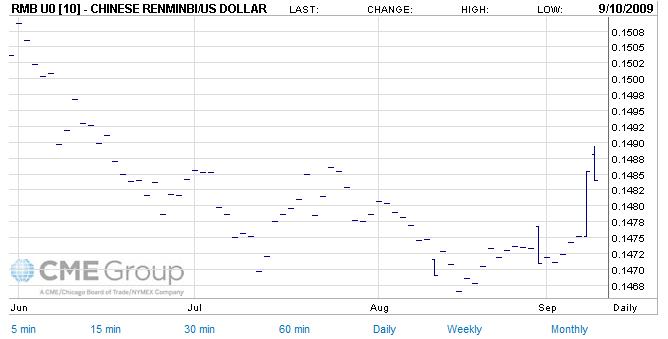
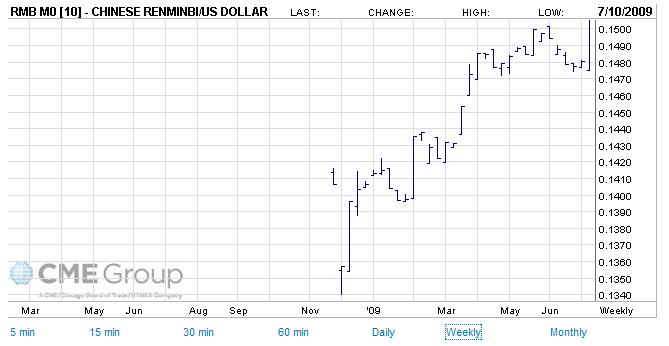
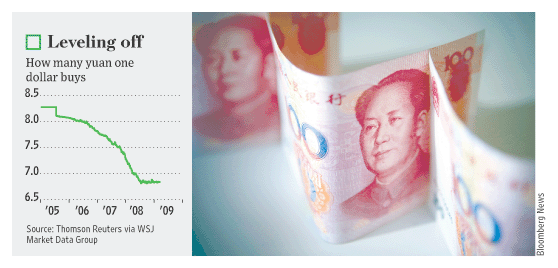
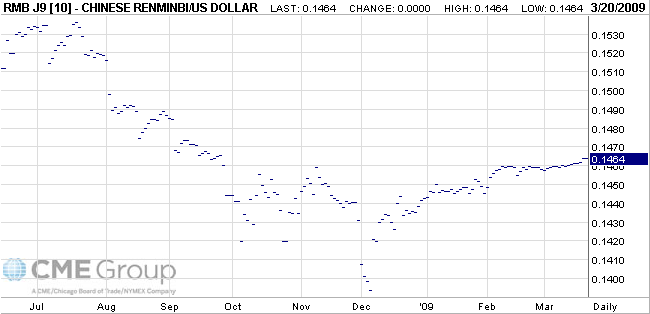
China seems to have fulfilled its promise of a stable currency, given that the Yuan/Dollar exchange rate is one of the few bastions of stability in forex markets. One Dollar trades for approximately 6.83 CNY, about the same as it did last summer. Futures prices, meanwhile, reflect a mean expectation that one year from now, the exchange rate will dip only slightly, to 6.86 CNY/USD. [The inverse is depicted in the chart below].

rmb-usd-futures-prices

In fact, there is even evidence that China is fighting market forces by trying to prop up the value of the Yuan. “‘ If this were a market-determined exchange rate, it would now be weakening, because the overall balance of payments looks to be in deficit, but it is not weakening,’ said [one economist]. ‘The implication is that authorities must be selling their dollar reserves in order to stabilise the USD-CNY exchange rate.’ ” Of course, it’s difficult to determine for sure, since the decline in China’s forex reserves that constitutes the basis for this claim could also have been caused by paper-losses on depreciating investments.

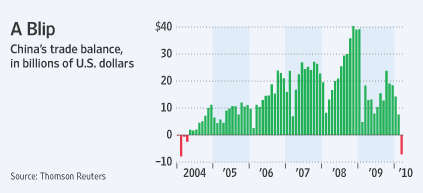
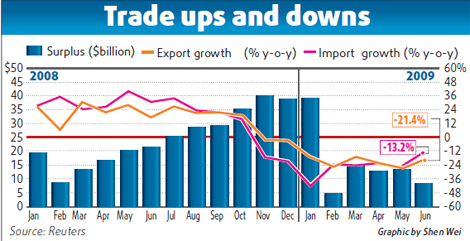
Within China, there is a core group of academics that continues to insist that China should depreciate its currency in response to deteriorating economic conditions. After all, China’s trade “surplus narrowed in February to $4.8 billion from about $40 billion in each of the previous three months, and in all likelihood will fall for the first time in five years in 2009.” Meanwhile, economists estimate that GDP growth could slow to 6%, a far cry from the 13% chalked up in 2007, and well below the government’s goal of 8%.

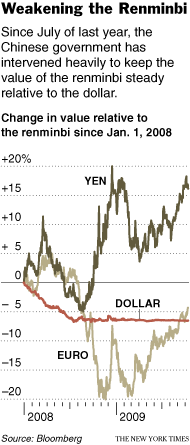
Some Chinese analysts also take issue with the notion of a ’stable’ currency. ” ‘The stability we expect is not only stability against the USD, but against all currencies,’ said MoC researcher Li Jian. ‘What is stability? Now the RMB is stable against the USD, but is appreciating against the euro, Australian dollar and the yen, so RMB’s exchange rates against these currencies are not stable.’ ” This is an important distinction, since China’s trade rivals are mostly nearby Asian countries- not the US. “Since July, the yuan is up 33% against the Korean won and up 12% against the Singapore dollar, for example. This has made Chinese exports relatively less competitive while spurring more imports and thereby providing somewhat of a boost to other economies.”

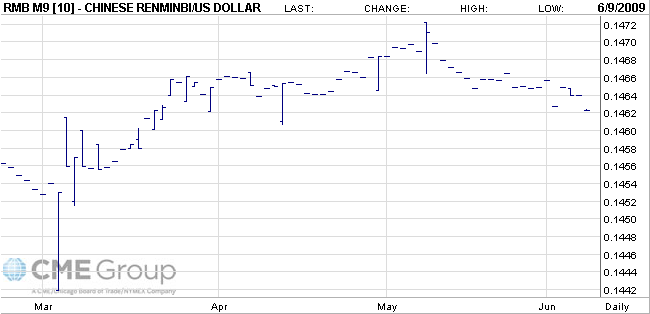
In the US, meanwhile, there are still policymakers that insist that the Yuan is undervalued, and the Treasury Department may brand China as a “currency manipulator” in its next semi-annual report. In the end, “with China holding its currency stable against the dollar even as its trade position has weakened, Washington’s long-standing argument that Beijing is keeping the yuan unjustifiably low is losing weight.”

chinese-yuan-is-leveling-off-against-usd

SocialTwist Tell-a-Friend
Posted by Adam Kritzer | in Chinese Yuan (RMB) | 2 Comments »

China Looking to Buy Oil & Diversify from US Treasuries

Mar. 3rd 2009

US Treasury yields have been held low across the short-term and long-term due in part to a lack of appealing investment opportunities in a deflationary period, while the Federal Reserve announced in January the possibility of buying long-term US government Treasury bonds to help hold down long-term interest rates (and thus mortgage rates), hoping for a slow controlled decent in housing prices.

At the other end of the spectrum, the US government has been bailing out every large financial institution willing to accept a few billion here or there, and running the printing presses in overdrive.

Chart of U.S. Money Supply Growth

Eventually this will lead to inflation, as explained by John Williams last August:

Excess supply of a commodity or product usually is reflected in downside pressure on its price, and the same is true for money. Excessive supply of money leads to its debasement, to a decline in its value that otherwise is known as inflation. Where money supply generally is an underpinning of economic activity, it also is the ultimate determinant of prices and inflation. At present, near-record high annual growth in the broadest U.S. money measure M3 is suggesting a significant inflation problem in the year ahead.

The Chinese have nearly 2 trillion Dollars in their reserves, with roughly 2/3 of them being denominated in US Dollars. Seeing their own economy slow, and the coming risk of inflation, the Chinese government is looking to shift some of their reserves away from US Dollars to hard commodities, particularly oil. Marketwatch reports:

China is considering plans to tap its foreign reserves to buy crude oil as part of a push to diversify holdings from U.S. Treasurys, according to a published report.

With the U.S. issuing massive amounts of government bonds to finance economic stimulus measures, Chinese officials are looking to hedge against the risk of Treasury prices dropping.

China, which has been building up a national oil stockpile since 2004, aims to amass 100 million barrels by next year as a first step, the Japanese business daily Nikkei reported.

This may just be jawboning to try to slow down the US printing presses, but if it is more than that, it could have a significant effect on the perceived value of the US Dollar, especially in light of the current $1.75 trillion US deficit - a full 12.3% of the projected 2009 GDP. If foreigners lose confidence in the US Dollar, inflation and interest rates will certainly move sharply off their historic lows as the risk of “risk free” US treasuries is revealed and repriced.

SocialTwist Tell-a-Friend

Asia Forms Forex Pool

Feb. 25th 2009

After nearly six months of currency depreciation, the nations of Asia have finally been spurred to action. Japan, China, and South Korea have joined together with the 10 ASEAN economies to form a $120 Billion pool of foreign exchange reserves, which contributors can tap into to protect their currencies. The goal is to prevent capital flight and currency weakness from engendering the same kind of financial crisis that only 10 years ago ravaged Asia. Fortunately, this time around, the 13 countries possess a combined $3.6 Trillion in reserves, which can be deployed in forex and securities markets in order to restore investor confidence. Ironically, the bulk of these reserves belong to China and Japan (who are also funding a large portion of the forex pool), both of whose currencies remain strong in spite of the crisis. Bloomberg News reports:

The fund is aimed at ensuring central banks have enough to shield their currencies from speculative attacks such as those that depleted the reserves of Indonesia, Thailand and South Korea during the 1997-1998 financial crisis.

Read More: Asia Agrees on Expanded $120 Billion Currency Pool

SocialTwist Tell-a-Friend

Yuan Revaluation is in China’s Interest

Feb. 21st 2009

While China remains committed, in rhetoric at least, to a flexible Chinese Yuan that rises and falls in accordance with market forces, its actions suggest otherwise. Beginning in the second half of 2008, China stopped allowing the Yuan to appreciate, for fear that a more expensive currency would exacerbate the domestic effects of the credit crisis by making exports less competitive. What China fails to realize however, is that a more valuable Yuan is not only conducive to global economic stability, but also to its own economic well-being. In fact, the artificially cheap Yuan may have actually worsened the economic downturn in China, because de-incentivized the creation of a domestic economic base. Now that overseas demand has dried up, it is left feeling the consequences of this neglect. The San Francisco Chronicle reports:

With China far too dependent on export-driven growth, it is now extremely vulnerable to the current steep decline in global export demand. Unless that structural imbalance is fixed, China’s long-term growth prospects are as bleak as those of the United States.

Read More: Undervalued currency helps, hurts U.S. economy

SocialTwist Tell-a-Friend

Chinese Yuan: Up or Down?

Feb. 13th 2009

Speculation surrounding the Chinese Yuan has been mounting for months, beginning with a sudden halt to the currency's appreciation and continuing with the insinuation of the Obama administration that China is a currency manipulator. In the context of falling exports and a sagging economy, meanwhile, the Chinese Ministry of Finance has issued a research report encouraging the Central Bank to allow the currency to appreciate. Despite the Central Bank's insistence that it wants a "stable" currency, futures prices indicate a mean expectation that in fact, the Yuan will be nudged downward over the next twelve months. On the other side of the equation are financial analysts, who collectively forecast a slightly stronger Yuan, with one bullish analyst projecting a 3.5% appreciation in 2009, on the basis of selectively culled economic data. Bloomberg News reports:

“The consensus around China has been weak growth and falling reserves. The recent data challenges both views. Lending looks good, money supply looks good, and the PMI balanced to slightly bad from very bad levels.”

Read More: Citigroup Is Bullish on Yuan, Bets for 6.60 Year-End

SocialTwist Tell-a-Friend

US Must be Careful with Chinese Yuan Issue

Feb. 3rd 2009

It appears Timothy Geithner, recently-appointed US Treasury Secretary, was not exaggerating when he declared that the Obama administration intends to address China's currency policy. No less than President Obama himself rrecently called Hu JinTao, President of China, to inform him likewise. Unfortunately, the administration does not exactly have support from political and economic analysts. They argue that not only is the Yuan's "true" value debatable, but also that now is not an opportune time to pursue this issue, due to current economic circumstances. Givent that the Yuan has been permitted to appreciate almost 20% in the last four years and that the Chinese accumulation of forex reserves has begun to slow, perhaps Obama's prodding could even backfire. Bloomberg News reports:

There’s also a be-careful-what- you-wish-for angle here: If China tomorrow let the yuan trade freely in markets, it’s more likely to drop in value than surge. So-called hot money may flee, global companies may repatriate profits and Chinese savers might buy overseas assets.

Read More: China Tells Obama What to Do With His Yuan Views

SocialTwist Tell-a-Friend
Posted by Adam Kritzer | in Chinese Yuan (RMB), Politics & Policy | No Comments »

US Treasury Spurns China

Jan. 28th 2009

During his confirmation hearings, Treasury Secretary Geithner indicated that the Obama administration consensus is that China is manipulating the Yuan. China predictably refuted the charges, and indicated that it will not be bullied into submission by the US when managing its currency. Thus began a heated back-and-forth between US and Chinese economic officials, with the forex markets caught awkwardly in the middle. Geithner apparently doesn't realize that his position also carries important diplomatic responsibilities, namely helping the US government to pay its bills by ensuring a steady demand for US Treasury securities abroad. Offending the most reliable foreign lender, accordingly, is probably not the best strategy to fulfilling this role. Moreover, Geithner's testimony couldn't have occurred at a worse time, given the planned expansion of US debt and the simultaneous leveling off of China's forex reserves. The implications for the Dollar couldn't be clearer. Forbes reports:

China has been a major purchaser of America's official debt in recent years. If it were to stop…Geithner would likely find his Treasury paper having to offer higher yields to draw investors, putting new pressure on the American budget.

Read More: China Speaks, U.S. Debt Market Listens

SocialTwist Tell-a-Friend

Obama Could Step up Pressure on Yuan

Jan. 22nd 2009

While much has been written about the forex implications of the Barack Obama Presidency, most of the commentary has focused on the Dollar, at the expense of reporting on other currencies. The Chinese Yuan, to name one such currency, could soon find its fate tied closely to Obama; it has been widely speculated that he will compensate for the reticence of his predecessor by formally labeling China a currency manipulator and pressuring its to allow the RMB to appreciate at a faster pace. Timothy Geithner, who is set to be confirmed as the next Treasury Secretary, has echoed similar sentiments. It is unclear whether such a sentiment would achieve the necessary legislative support required to levy punitive sanctions against China in order to force it into submission. Given the current global economic climate, however, it seems unlikely that China would comply. Marketwatch reports:

In fact, China itself has every reason to avoid both depreciation and appreciation of its currency. The latter could further weigh on already drooping exports, and the former could lead to capital outflows from the country, at a time it can least afford this.

Read More: Investors await Obama's signals on China's yuan

SocialTwist Tell-a-Friend
Posted by Adam Kritzer | in Chinese Yuan (RMB), Politics & Policy | No Comments »

China’s FX Reserves Fall

Dec. 30th 2008

Anyone curious about whether China is intentionally allowing the RMB to depreciate, need look no further than the Central Bank's latest forex reserve figures, which registered a decline for the first time in nearly six years. At the same time, Chinese trade figures indicate that exports fell for the first time in seven years, which limits the government's ability to build up new reserves. As a result of the credit crisis, it's conceivable that the Central Bank will continue to spend down its reserves in order to provide a boost to its faltering economy. US President-elect Obama will have to deal with such forces if he wishes to successfully take on China's currency policy. Otherwise, the RMB currency could appreciate in 2009, bucking its trend over the last few years.

Read More: China's forex reserves fall

SocialTwist Tell-a-Friend
Posted by Adam Kritzer | in Central Banks, Chinese Yuan (RMB) | No Comments »

Investors Uncertain about RMB

Dec. 11th 2008

Only a few weeks ago, investors had made significant bets that China would reverse its official policy of RMB appreciation. Futures prices indicated that investors collectively expected the currency to depreciate over 7% against the Dollar over the next year, as part of a comprehensive Chinese policy to boost the faltering economy. Since then, however, the RMB recorded its biggest one-day rise since the currency peg was abandoned three years ago, and investors subsequently scaled back their bets.

While it's unclear what caused the sudden change in sentiment, there are a few factors which probably contributed. First is Treasury Secretary Henry Paulson's recent visit to China, in which he encouraged China to continue to permit the the Yuan to appreciate. In addition, high-ranking Chinese economic policy-makers have indicated that market forces will increasingly determine the valuation of the Yuan. Finally, there is the recent election of Barack Obama, a long-standing critic of what he believes to be the undervalued RMB. Bloomberg News reports:

"Any attempt to devalue the currency is likely to be met with considerable opposition from China’s trading partners." The new U.S. administration under President-elect Barack Obama "will be less tolerant of the 'crawling peg' appreciation policy," said one analyst.

Read More: Yuan Forwards Advance Most Since Peg as China Seeks Stability

SocialTwist Tell-a-Friend

Will China Fund US Deficit?

Dec. 8th 2008

When all is said and done, the US government will have injected trillions of dollars into the economy, in the form of bailouts, guarantees, economic stimuli, etc. Whether it will have the desired effect is debatable. The question that no one seems to be asking is, "How is the government going to finance such exorbitant spending?" It appears that China, which has become of of the largest holders of US government debt, will continue to participate- not necessarily because it wants to, but because it doesn't have a choice. China's economy remains heavily reliant on the export sector to drive growth. Because its exchange rate regime does notpermit the RMB to fluctuate freely, the proceeds from the consequent trade surplus must be invested abroad, rather than domestically. For both symbolic and economic reasons, it seems the bulk of the surplus will continue to be invested in the US, probably in safer assets like US Treasury Securities. This is certainly good news for deficit hawks and Dollar bulls. The Wall Street Journal reports:

Even if China wanted to invest outside the U.S., it couldn't. If China recycled its foreign currency into, for instance, the European Union or Japan, it would effectively force those trading partners to run large trade deficits with China, which neither can absorb.

Read More: China Will Keep Buying U.S. Government Debt

SocialTwist Tell-a-Friend
Posted by Adam Kritzer | in Central Banks, Chinese Yuan (RMB), US Dollar | No Comments »

Could the RMB Fall?

Dec. 2nd 2008

Since China revalued the Yuan in July 2005, it was considered a foregone conclusion that the currency would continue appreciating at a steady clip. The global credit crisis, generally, and the Chinese economic downturn, specifically, has turned that assumption on its head. Last week, the RMB declined by the biggest margin since the revaluation, prompting speculation that China will adopt a currency policy diametrically opposed to that which it has pursued over the last few years. The move also coincided with the annual China-US trade summit, attended by none other than Treasury Secretary Henry Paulson. The new consensus among currency traders (proxied by futures contracts) is that the Yuan will depreciate slightly over the next two years, as China moves to provide a boost to its export sector. Given that the currencies of most of China’s Asian neighbors have fallen by double digits over the last year, the Yuan may have to fall sharply in order to maintain competitiveness. The Wall Street Journal reports:

the Chinese currency hasn’t experienced a large devaluation in at least a decade. Such a move would go against the realities of geopolitics and against signals that Beijing is more focused on boosting domestic consumption than on stimulating exports.

Read More: Will China Finally Try Wielding Its Yuan?

SocialTwist Tell-a-Friend
Posted by Adam Kritzer | in Chinese Yuan (RMB), Politics & Policy | No Comments »

US to Continue to Pressure China Over RMB

Nov. 21st 2008

After rising nearly 20% over the last three years, the RMB has virtually stopped appreciating against the US Dollar, perhaps as a result of the credit crisis. At the same time, the US exports sector- previously one of the few bright spots of the sagging economy- has begun to stall. US Politicians have taken note, and are now renewing their efforts to persuade China to allow its currency to rise further. They are also agitated about China’s perpetually growing forex reserves (currently estimated at $2 Trillion), which are increasingly being deployed in sensitive areas. Meanwhile, the Chinese economy is growing at the slowest pace in years, and the Chinese government is resorting to desperate measures to prop it up. In short, allowing the RMB to rise, while placating US policymakers, is tantamount to economic suicide, and hence unlikely.

While other sovereign wealth funds have existed for nearly 50 years without controversy, "China appears far less likely than other nations to manage its sovereign wealth funds without regard to political influence that it can gain by offering such sizable investments."

Read More: US panel urges action on China currency, investing

SocialTwist Tell-a-Friend

China’s FX Reserves Near $2 Trillion

Oct. 22nd 2008

Last week, China revealed that in the most recent quarter, its economy grew at the slowest pace in nearly five years. It also revealed that its foreign exchange reserves crossed $1.9 Trillion, due to a record monthly trade surplus. How can this seeming contradiction in economic peformance be reconciled? In my opinion, the Chinese economy will continue to slow as a result of a generalized post-olympics slowdown and falling export demand brought on by the global economic crisis. The consequent collapse in risk appetite will bear negatively on investing in Chinese assets. Its stock market has already lost 50% of its value this year, and foreign direct investment (which is more difficult to monitor) is certainly sliding. In other words, there will be less foreign capital for the Central Bank to soak up, and less pressure on the RMB to appreciate. AFP reports:

The various factors at play could actually be causing some capital outflows as troubled foreign firms and investors may need the money overseas.

Read More: China’s forex reserves pass 1.9 trillion dlrs: central bank

SocialTwist Tell-a-Friend
Posted by Adam Kritzer | in Central Banks, Chinese Yuan (RMB), US Dollar | No Comments »

Central Bank of China Battles Over Yuan

Sep. 10th 2008

Over the last couple years, the Central Bank of China has built up a treasure trove of foreign exchange reserves ($1.8 Trillion at last count), as part of its effort to hold down the Yuan, or at least slow its appreciation. Unfortunately, these reserves have depreciated significantly-10% per year in real terms- as the Yuan has risen relative to the Dollar. These reserves may slide further in real terms, as the credit crisis diminishes the value of the mortgage securities that comprise almost 20% of its portfolio. In order to
shore up its capital position, the Bank may be forced to accept an infusion of capital from China’s Finance Ministry and halt the appreciation of the Chinese Yuan. The New York Times reports:

China finds itself hemmed in. If it were to curtail its purchases of dollar-denominated securities drastically, the dollar would likely fall and American interest rates could soar.

Read More: Main Bank of China Is in Need of Capital

SocialTwist Tell-a-Friend
Posted by Adam Kritzer | in Central Banks, Chinese Yuan (RMB) | No Comments »

China’s Fores Reserves Boost Dollar

Sep. 3rd 2008

Everyone has a theory to explain the Dollar’s explosive rally, which has yet to run out of steam. A recent one identifies a shift in China’s forex reserve policy as a driving force. Apparently, in an ostensible effort to clamp down on inflation, the Central Bank of China is resorting to draconian measures. One rule change, which was executed with both speed and lack of media coverage, requires commercial banks to hold a larger portion of their reserves in Dollars, rather than Chinese Yuan. In addition, such banks face new restrictions on foreign debt, which is designed to turn them into net buyers of Dollars. Analysts suggest that this policy represents a roundabout attempt to slow the appreciation of the Chinese Yuan. If they are correct, than surely the Central Bank of China has succeeded, for the currency has virtually ceased in its interminable upward march against the Dollar. This upshot suggests that the goal of the Central Bank was not to fight inflation, but rather to avoid a post-Olympic economic slowdown. The Telegraph reports:

They are now more worried about growth than overheating, and you are seeing that play out in the currency markets. There has been a remarkable change of view."

Read More: Beijing swells dollar reserves through stealth

SocialTwist Tell-a-Friend
Posted by Adam Kritzer | in Central Banks, Chinese Yuan (RMB), US Dollar | No Comments »

Yuan Could Fall

Aug. 21st 2008

Almost all of the speculation surrounding the Chinese Yuan is aimed at predicting the point at which the currency will stop rising. Will it stop at 6.5? 6? 5? 1? But what if the currency has already peaked, at least temporarily? The Central Bank of China is now openly airing its concerns about a slowing economy, which it believes is more problematic than the country’s surging inflation rate. Accordingly, it will probably relax interest rates and slow the appreciation of the currency, in order to give businesses and exporters the leverage they need to keep the economy going. In fact, the Central Bank already announced a $50 Billion plan to prop up ailing capital and property markets. Such measures are likely to further stoke the fires of inflation, at a time when prices are already rising at the fastest pace in a decade. The futures markets have been quick to take note, and expectations for Yuan appreciation are falling accordingly. Bloomberg News reports:

[Futures contracts] suggest the yuan will reach 6.6060 per dollar in the next 12 months, an advance of 3.8 percent from the current exchange rate. Two weeks ago the contracts, predicted an advance of 5.3 percent. At the start of last month, they priced in a 6 percent rise.

Read More: Dollar Bottom Against Yuan Gets Louder in China Bet

SocialTwist Tell-a-Friend
Posted by Adam Kritzer | in Chinese Yuan (RMB), Politics & Policy | No Comments »

Yuan Could Fall

Aug. 20th 2008

Almost all of the speculation surrounding the Chinese Yuan is aimed at predicting the point at which the currency will stop rising. Will it stop at 6.5? 6? 5? 1? But what if the currency has already peaked, at least temporarily? The Central Bank of China is now openly airing its concerns about a slowing economy, which it believes is more problematic than the country’s surging inflation rate. Accordingly, it will probably relax interest rates and slow the appreciation of the currency, in order to give businesses and exporters the leverage they need to keep the economy going. In fact, the Central Bank already announced a $50 Billion plan to prop up ailing capital and property markets. Such measures are likely to further stoke the fires of inflation, at a time when prices are already rising at the fastest pace in a decade. The futures markets have been quick to take note, and expectations for Yuan appreciation are falling accordingly. Bloomberg News reports:

[Futures contracts] suggest the yuan will reach 6.6060 per dollar in the next 12 months, an advance of 3.8 percent from the current exchange rate. Two weeks ago the contracts, predicted an advance of 5.3 percent. At the start of last month, they priced in a 6 percent rise.

Read More: Dollar Bottom Against Yuan Gets Louder in China Bet

SocialTwist Tell-a-Friend
Posted by Adam Kritzer | in Chinese Yuan (RMB), Politics & Policy | No Comments »

China Adjusts Forex Rules

Aug. 11th 2008

As the Chinese Yuan has appreciated over the last three years, and even in the decade leading up to the sudden revaluation, a tremendous amount of speculative "hot money" poured into China. Periodically, the government and Central bank have attempted to stem some of these inflows by creating deliberately unfavorable conditions for foreigners to invest in China. Witness the unnaturally low interest rates and the one-way convertibility of the Chinese Yuan. Now, with inflation running at a 10-year high, the government is becoming more serious in its efforts to clamp down on some of the factors that are driving demand. As a result, it altered its system for governing forex and will increase its oversight over the entities and businesses that import capital into China. If executed properly, much of the upward pressure on prices, and the RMB itself, could be relieved. Reuters reports:

NEW RULES: China operates "a managed float exchange rate system based on supply and demand".

OLD RULES: China has "a single exchange rate system" with the central bank announcing the yuan’s value against major currencies on a daily basis.

Read More: China’s new forex rules

SocialTwist Tell-a-Friend
Posted by Adam Kritzer | in Chinese Yuan (RMB), Politics & Policy | No Comments »

China May Dip Into Reserves

Jul. 29th 2008

Yesterday, the Forex Blog reported that Central Banks and Sovereign Wealth Funds appear to be losing confidence in the Dollar. To follow up with a specific example, a high-ranking Chinese policymaker recently suggested that China should move spend some of its reserves since they are rapidly losing value in RMB terms. The official offered that a portion be used to purchase foreign energy assets, in order to mitigate against both the falling Dollar and rising oil. There is clearly a trend among institutional holders of Dollars to use the currency to purchase US assets. Witness the recent (separate) sales of the Chrysler and GM Buildings to Middle Eastern buyers. With nearly $2 Trillion in foreign exchange reserves, however, China is in a class by itself, and any indication of its frustration with the Dollar should be taken very seriously.

Read More: China Considering Using Forex Reserves

SocialTwist Tell-a-Friend
Posted by Adam Kritzer | in Central Banks, Chinese Yuan (RMB), US Dollar | No Comments »

Chinese Yuan Appreciation to Slow

Jul. 16th 2008

In the year-to-date, the Chinese Yuan has already appreciated 6.5% against the USD, the fastest pace since the currency was famously revalued three years ago. This upward pressure has been built largely on the continuing inflow of speculative "hot money," which was itself built on the expectation of further interest rate hikes, ostensibly needed to tame inflation. However, the Central Bank of China recently indicated a slight shift in its monetary policy, backing away from fighting inflation in favor of promoting economic growth. At least until after the Olympic Games conclude, China will henceforth ignore inflation, so as not to precipitate a slowdown that could jeopardize the Games. The Futures markets have been quick to react, and the consensus expectation for 1-year RMB appreciation has fallen from 10% to 5.4%. Bloomberg News reports:

Once the Olympics are out of the way, the vigil on inflation may have to resume. But unless China gets flooded by speculative flows, a one-shot revaluation will remain off the table.

Read More: China Won’t Stamp Out Inflation, Revalue Yuan

SocialTwist Tell-a-Friend
Posted by Adam Kritzer | in Central Banks, Chinese Yuan (RMB) | No Comments »

RMB may Accelerate Post-Olympics

Jul. 1st 2008

The first half of 2008 has come to a dramatic end, and it’s official: China’s stock market was the world’s worst performer, finishing down 48%. Ironically, some analysts believe this may be a harbinger for a faster appreciation of the Chinese Yuan. While the global credit crisis cannot be completely disentangled from the Chinese macroeconomic picture, certain conclusions can be drawn that are specific to China. In a nutshell, the party may be over. Inflation has surged to a 10-year high, economic growth is slowing, and stocks are facing a prolonged bear market. The Chinese government will likely continue to bide its time so as not to disrupt the Olympics. After the conclusion of the games, however, the Central Bank may begin aggressively hiking rates in order to tame inflation. While this would adversely affect economic growth, it would cause the RMB to appreciate. Forbes reports:

Maybe that’s what Shanghai’s decline is really telling us, that the China miracle may be losing some of its luster, as China tries to make the transition from a low-cost exporter to a leading provider of 21st century goods and services.

Read More: China Bulls Get Shanghaied

SocialTwist Tell-a-Friend
Posted by Adam Kritzer | in Chinese Yuan (RMB) | No Comments »

China’s Forex Reserves Near $2 Trillion

Jun. 5th 2008

When China’s foreign exchange reserves breached the $1 Trillion mark in November 2006, it was a momentous occasion. Over the following 18 months, however, analysts yawned as the reserves nearly doubled in size. In the month of April, alone, China added an astounding $75 Billion to its stockpile, bringing the total to $1.76 Billion. Analysts attribute this sudden increase to a massive inflow of hot money, as investors seek to profit from both the Yuan’s inevitable appreciation and the widening interest rate spread between China and the US. The Central Bank of China also recently announced the official 2007 trade numbers, which reveal a 49% increase in the country’s current account surplus, to $370 Billion. By no coincidence, this news caused the highest daily appreciation in the Chinese Yuan in more than three months. Bloomberg News reports:

China has allowed a 2.6 percent gain over the past three months, making it Asia’s best performer among the 10 most-active currencies in the region outside Japan.

Read More: Yuan Gains Most in 3 Months on Efforts to Curb Trade Surplus and China’s forex reserves hit 1.76 trillion dollars: report

SocialTwist Tell-a-Friend
Posted by Adam Kritzer | in Central Banks, Chinese Yuan (RMB) | No Comments »

US Treasury: China Still Not Manipulating RMB

May. 23rd 2008

In its semiannual report to Congress, the US Treasury Department once again did not cite China as a currency manipulator. For as long as the Forex Blog has been covering this issue, various interest groups have been pressing the Bush administration on this issue, since the label of currency manipulator would entitle Congress to level punitive trade sanctions. The premise of their argument remains that an artificially cheap RMB is responsible for the decline of the US manufacturing sector and the burgeoning trade deficit, which topped $250 Billion in 2007.

The Treasury Department, under the leadership of Henry Paulson, insists that the best way to handle the situation is through dialog. In its report, it noted that the RMB has already appreciated over 18% since China’s government revalued it in 2004. However, with the Presidential election looming, the RMB could become a major political issue. Already, both Hilary Clinton and Barack Obama have announced their intention to co-sponsor a bill that would impose trade sanctions on countries (i.e. China) that are deemed to undervalue their currency. In the end, politicians will continue to whine in vain to appease their constituents, and the RMB will continue climbing at its brisk, current pace of 7% per year.

Read More: US declines to cite China as a currency manipulator

SocialTwist Tell-a-Friend
Posted by Adam Kritzer | in Chinese Yuan (RMB), Politics & Policy | No Comments »

Chinese Exporters Dump Dollar

May. 8th 2008

The anecdotal evidence that China is diversifying its forex exposure away from the Dollar continues to mount. To date, most of the focus has centered around the Central Bank of China, which is passively diversifying its reserves into European and higher-risk assets. Apparently, Chinese exporters are also getting nervous about the impact of a falling Dollar on their respective bottom lines. The RMB has risen 11% since the beginning of 2007, which means Chinese companies now receive 11% less on sales to destinations abroad than they did for equal-priced goods in 2007. As a result, some companies have taken to quoting prices in Euros or to adjusting Dollar-denominated prices every few months. Other companies are building assumptions of a more valuable RMB into their profit models, and setting prices accordingly. The New York Times reports:

“We are gradually increasing our emphasis on the domestic market until we can forget about the export market, because the profit margins on exports are so thin,” [said one exporter].

Read More: Some Chinese Exporters Prefer Euros to Dollars

SocialTwist Tell-a-Friend
Posted by Adam Kritzer | in Chinese Yuan (RMB), Euro, US Dollar | No Comments »

RMB at Record Low

Apr. 11th 2008

The lack of fanfare not withstanding, the Chinese Yuan, or RMB, continues to appreciate against the USD. This week, it crossed the psychologically important barrier of 7 RMB/Dollar, a level last seen in the 1990’s. Since its revaluation nearly three years ago, the Yuan has risen 16% against the Dollar, a rate which appears to be growing exponentially given the 4.5% rise already notched in 2008. Due to the Dollar’s continued weakness against all of the major currencies, the RMB has actually fallen against the Euro over the same period. Most analysts reckon the Yuan will continue appreciating, perhaps to 6.5 by year-end. The New York Times reports:

"The appreciating renminbi is a signal the Chinese government is sending to the export companies to switch away from the U.S. and other overseas markets and turn toward the domestic market."

Read More: Yuan Hits Milestone Against Dollar

SocialTwist Tell-a-Friend
Posted by Adam Kritzer | in Chinese Yuan (RMB), Politics & Policy | No Comments »

Commentary: Yuan et al Must Appreciate

Feb. 25th 2008

Although the Chinese Yuan is ostensibly allowed to fluctuate in value, the reality is that the size of its fluctuations and the pace of its appreciation are tightly controlled by China’s Central Bank.  Since its currency is still effectively fixed to the Dollar, China is severely curtailed in its ability to conduct monetary policy and must closely mirror US policy.  Same goes for the rest of Asia, excluding Japan. While US monetary policy was relatively tight, as it has been for the last five years, this necessity didn’t cause too many problems; most of these economies would have kept interest rates high irrespective of the US.

Since the Fed began loosening monetary policy over the last six months, however, many of the emerging economies in Asia, especially China, have been forced into a bind.  On the one hand, lowering interest rates is exacerbating the problem of inflation.  On the other hand, they want to keep their currencies stable so as not to limit economic growth.  In short, Central Banks must determine which is more important: fighting inflation or promoting growth. According to some economists, these economies are so strong, having grown by nearly 10% collectively last year, that they can afford to slow down, if it will result in greater price stability.  But the only way to stabilize prices is to drastically raise interest rates, which will put even greater pressure on their currencies to appreciate.

In addition, the Central Banks of Asia have amassed a staggering $4 Trillion in foreign exchange reserves.  In the past, this has been a neutral, sometimes profitable activity.  Since the Fed began cutting rates, the interest rate differential has been turned upside-down such that Central Banks are now losing money on each unit of local currency they sell in exchange for Dollars.  According to one analyst, over $160 Billion has been lost since July 2006, and those losses will mount with each additional intervention.

Read More: Fed’s Lower Rates Pressure China to Strengthen Yuan

SocialTwist Tell-a-Friend

China’s Trade Surplus Expands Further

Feb. 20th 2008

China’s trade surplus grew 22.6% year-over-year for the month of January, on top of export growth of 26.7%.  If there is any silver lining to what many policymakers would consider bad news, it is that growth in imports is slightly outpacing growth in exports.  Unfortunately, that is unlikely to allay the critics, and there are still many of them. The argument remains unchanged- that China is not allowing its currency to rise fast enough.  On paper, however, the Yuan has appreciated by 15% since China officially de-pegged it from the Dollar in July 2005.  In addition, the G7 failed to scold China in its annual meeting, which suggests that economic policymakers are becoming less concerned with China’s forex policy.  Ironically, the revaluation of the Yuan is probably boosting the value of of China’s exports in the short-term, because other countries are now paying more for the same quantity of imports.  AFP reports:

The International Monetary Fund…urged the Chinese government to loosen the reins on the yuan. "We encourage a faster pace of appreciation that would be helpful for addressing China’s key economic challenges and would also contribute to preserving global economic stability."

Read More: China’s trade surplus rises 22.6 percent in January

SocialTwist Tell-a-Friend

China is Earning Negative Carry

Feb. 8th 2008

China’s foreign exchange reserves currently approximate $1.5 Trillion, the majority of which is denominated in USD.  Moreover, the Central Bank of China earns interest on every Dollar it adds to its reserves but must also pay interest on every RMB note that it must issue to offset the Dollars. Since the Fed began easing monetary policy, the amount of carry (the difference between what the Central Bank receives on Dollars and pays on RMB) earned by the Central Bank has completely inverted, such that it now loses 250 basis points on average for each Dollar exchanged for RMB. 

Based on the rate at which China is currently accumulating reserves, this amounts to between $5 Billion and $10 Billion per month, depending on which method of accounting is utilized. Furthermore, this trend has been exacerbated because China is accumulating reserves at a faster rate than its economy is growing. Some analysts have speculated that this could turn into a major political issue, with important implications for the RMB/Dollar exchange rate. The Financial Times reports:

The renminbi has started to appreciate more rapidly in recent months, rising at an annualised rate of about 20 per cent, compared with 6-7 per cent over the whole of 2007.  In the longer-term, say economists, China will have no choice but to allow its currency to appreciate faster, even in the face of entrenched domestic resistance.

Read More: Beijing starts to pay for forex ‘sterilisation’

SocialTwist Tell-a-Friend
Posted by Adam Kritzer | in Central Banks, Chinese Yuan (RMB), US Dollar | No Comments »

Chinese Yuan Accelerates Upwards

Jan. 19th 2008

When Henry Paulson was appointed Secretary of the US Treasury last year, he made China and its purportedly undervalued currency a cornerstone of his economic plan. Lo and behold, several months ago, the Yuan suddenly accelerated in its upward path against the Dollar, rising at an annualized rate of 14%. Currency futures are now pricing in an 8% rise in 2008, while several economists are forecasting a 10% increase.  Ironically, there are still American policymakers who think the Yuan is appreciating too slowly, as well as Chinese policymakers who reckon it is increasing too rapidly.  Accordingly, the current pace probably represents a fair compromise.  Besides, inflation is threatening the US, so a slow appreciation would enable the economy to adjust to higher prices in the long term.  While China also faces rising inflation, it doesn’t want to send investors the message that the movement of its currency is uni-dimensional, which would encourage further inflows of speculative capital.  The Economist reports:

But Chinese policymakers have stressed the need for gradual adjustment.
To show that the currency is not just a one-way bet, the PBOC may try to nudge the yuan a bit lower in coming days.

Read More: Revaluation by stealth

SocialTwist Tell-a-Friend

China’s Forex Reserves Roar Past $1.5 Trillion

Jan. 16th 2008

On January 24 last year, the Forex Blog reported with great fanfare that China’s forex reserves had breached the epic milestone of $1 Trillion. [In hindsight, it turns out that the psychologically important barrier was broken several months earlier, but that is beside the point].  Less than one year later, China’s forex reserves reached another important threshold, soaring past $1.5 Trillion. It appears that new reserves are being accumulated at  an exponential rate, having increased $460 Billion last year and over $30 Billion in the month  of December alone. By no coincidence, China’s 2007 trade surplus of $262 Billion shattered the previous record and is expanding at a comparably supersonic pace.

Most analysts reckon that the country is locked in a vicious cycle: when its trade surplus grows, its forex reserves grow proportionately. Moreover, the lopsided trade imbalance th\at China maintains with most of the world ensures that the demand for Chinese Yuan exceeds the supply. In the short run, a more expensive currency equates to higher prices paid for its exports which only increases the trade surplus and forex reserves further, and exerts still more pressure on the currency to appreciate.  Meanwhile, as the Yuan rises, the value of China’s forex reserves, which are denominated predominantly in USD, falls.  What a conundrum indeed! Xinhua News reports:

The value of Chinese RMB against the US dollars has appreciated by over six percent in 2007. The central parity rate of the RMB was 7.2672 to the US dollar on Friday.

Read More: Forex reserve tops $1.53 trillion

SocialTwist Tell-a-Friend

The Record Rise of the Chinese Yuan

Dec. 28th 2007

Earlier this week, the Chinese Yuan recorded its highest one-day increase in value in the two years since it was famously revalued against the Dollar.  The currency rose nearly .4% and prompted renewed speculation that China’s Central Bank will either widen the trading band to .8% or will generally allow the currency to appreciate faster.  In fact, the political and economic consensus continues to maintain that the Yuan is not appreciating rapidly enough.  While it rose over 6% against the Dollar, for example, it actually lost value to several of the world’s major currencies.  Furthermore, its decline against the Dollar is less impressive when China’s skyrocketing inflation rate and burgeoning trade surplus are taken into account.

There are still a few analysts who are bucking the trend and arguing that the Yuan is fairly valued.  This notion is supported by a recent World Bank analysis, which updated its calculation of China’s purchasing power and reduced its PPP-equivalent GDP in the process. However, this opinion is echoed by only a small group of analysts, and an overwhelming majority continues to call for and anticipate a further appreciation of the Yuan.  Bloomberg News reports:

Forward contracts show traders are betting on an 8.7 percent advance in the yuan to 6.7344 per dollar in the next 12 months. The median estimate of 28 analysts surveyed by Bloomberg News is for a rate of 6.88 by the end of 2008.

Read More: Yuan Rises Most Since End of Peg as China Seeks to Curb Prices

SocialTwist Tell-a-Friend
Posted by Adam Kritzer | in Chinese Yuan (RMB), Politics & Policy | No Comments »

China off the Hook…Again

Dec. 21st 2007

Since even before the dawn of the Forex Blog, commentators have been speculating that the US Treasury Department would officially brand China as a "currency manipulator" in its semi-annual report to Congress.  Such a label is important because it would enable the US to levy tariffs and other economic penalties against China.  However, another report has been issued, and one more time the Treasury Department glossed over China’s de facto control over the Yuan. The report did criticize China for failing to appreciate the RMB rapidly enough, since the 12% gains it has racked up over the last two years have been largely offset by inflation.  The report also referred to China’s widening trade surplus and accompanying growth in foreign exchange reserves.  US politicians, however, are less than pleased, and are preparing to take matters into their own hands.  The Associated Press reports:

"In refusing to brand China as a currency manipulator, which is so obvious, the Administration gives Congress no choice but to act on its own. This report is the strongest case possible for our legislation," said [one high-ranking Senator] Schumer.

Read More: US stops short of accusing China of currency manipulation

SocialTwist Tell-a-Friend
Posted by Adam Kritzer | in Chinese Yuan (RMB), Politics & Policy | No Comments »

OECD: Chinese Yuan Still Too Low

Dec. 13th 2007

The Organization for Economic Cooperation and Development (OECD) recently issued a report on the Chinese Yuan, which thoroughly assessed the currency’s appreciation since it was “revalued” over two years ago.  While the Yuan has technically risen over 10% against the USD, the OECD concluded that in real terms, the currency has actually fallen. The official rate of inflation hit 6.5% this year, and international economists reckon the true figure is probably much higher. Furthermore, the
government recently revised its estimate for full-year GDP growth to 11.4%, which means price levels may rise further, eating into the real value of the RMB.  In fact, the OECD estimates that the Yuan remains undervalued by as much as 40% and views the “solution” as a combination of tighter monetary policy and looser exchange rate policy.  The Associated Press reports:

While the report did not directly criticize China’s foreign exchange controls, it noted that efforts to tighten money supply to counter inflation were not having much impact.

Read More: OECD Says China Grip on Yuan Too Tight

SocialTwist Tell-a-Friend
Posted by Adam Kritzer | in Chinese Yuan (RMB), Politics & Policy | No Comments »

China Trade Surplus Sets New Record

Dec. 10th 2007

Despite, or perhaps because of the appreciating Yuan, China’s trade surplus with the US is growing by 50% on an annualized basis, and is set to surpass $250 Billion for the year.  In theory, the more expensive Chinese currency should reduce US dependence on Chinese exports and narrow the trade imbalance.  In practice, the US is actually importing a greater quantity of goods and services from China and is also paying higher prices because of the appreciating Yuan.  Ironically, the US Treasury Secretary is scheduled to discuss this matter with his Chinese counterpart next week, and is expected to pressure China to appreciate the RMB even faster against the Dollar. Unfortunately, China’s hands are partially tied as a result of an agreement it already signed with the EU, under which it promised to appreciate the RMB against the Euro. Bloomberg News reports:

Under the current regime, the yuan is allowed to move as much as 0.5 percent against the U.S. dollar every day, from the previous limit of 0.3 percent. "There will be a broadening of the trading band again in the next few months," said one analyst.

Read More: China Trade Surplus Probably Held Near Record, Fueling Tension

SocialTwist Tell-a-Friend
Posted by Adam Kritzer | in Chinese Yuan (RMB), Politics & Policy | No Comments »

EU Joins US in Calling for Yuan Revaluation

Dec. 1st 2007

In the campaign to pressure China into revaluing the Yuan, the US has by far been the loudest voice.  However, the rapid decline of the USD may have unintentionally earned the US a new ally in its fight: the EU.  Since the Chinese Yuan is essentially pegged to the USD, and the USD has declined against the Euro, the law of triangular arbitrage is such that the Euro has actually appreciated significantly against the Chinese Yuan.  EU officials are no longer standing by idly, since the exchange rate is beginning to deal serious harm to its balance of trade.  In fact, the EU now occupies third position on the list of countries with the largest trade deficits with China.  Because of the nature of China’s exchange rate regime, however, China’s ability to control the relationship of the Yuan with both the Euro and the USD will be difficult, if not impossible.  The Bangkok Post reports:

Given the fact that about 70% of China’s $1.4 trillion in foreign reserves are dollar-denominated assets and the majority of foreign trade transactions are cleared in US dollars, China has focused more on the RMB-dollar rate.

Read More: A tale of two currencies

SocialTwist Tell-a-Friend
Posted by Adam Kritzer | in Chinese Yuan (RMB), Euro | No Comments »

Why China Should Not Dump the Dollar

Nov. 15th 2007

In fact, China may have to increase its exposure to the dollar, according to the comments of Brad Setser of the Council of Foreign Relations: "In my mind, so long as China resists more rapid appreciation of the renminbi versus the dollar, it’s rather difficult for China to diversify in any meaningful way against the dollar. If China really started to diversify away from the dollar, I think it’s a big enough player that it would put downward additional pressure on the dollar."

And additional downard pressure on the USD should be what China is trying to avoid. China, being the largest exporter to the U.S. does not want to see appreciation of its currency against the USD, as that would make its goods more expensive (and therefore less competitive) in America.

In fact, Setser goes on to say that in order to prevent the USD from sliding even further downward against the RMB, China would have to not only retain its present stock of USD, but in fact buy even more.

Read more: Can China Dump the Dollar?

SocialTwist Tell-a-Friend
Posted by Adam Kritzer | in Chinese Yuan (RMB), US Dollar | No Comments »

China talks up Diversification

Nov. 7th 2007

A high-ranking official in China’s government recently gave a speech urging the Central Bank to (continue to) diversify its vast holdings of foreign exchange, currently estimated at $1.4 Trillion and rising.  The speech was atypical in its level of directness, as Chinese officials tend to speak with a certain degree of circumspection if
they think there is any possibility that their comments will reach the public. Specifically, he advocated making a play on the current volatility in forex markets, by selling “weak currencies” in favor of “strong currencies.”  In fact, the most recent data shows that China is already doing just that: its holdings of US government bonds have declined
even as its reserves have risen.  The Financial Times reports:

Although he later tried to play down his comments, saying he had not been speaking in an official capacity, the damage was done.

Read More: Dollar sinks to new lows

SocialTwist Tell-a-Friend
Posted by Adam Kritzer | in Central Banks, Chinese Yuan (RMB), US Dollar | No Comments »

Chinese Yuan Reaches Milestone

Oct. 29th 2007

The Chinese Yuan has crossed the psychological barrier of 7.5 RMB/USD, a level last seen nearly a decade ago.  The currency’s appreciation has been gradual but visible, not withstanding the cries of western bureaucrats.  By all accounts, the Yuan will continue rising, though not at the same pace as its trade surplus, which is projected to jump from $177 Billion in 2006 to $300 Billion in 2007.  Predictions regarding the extent of the appreciation range from 20% to 400%, the implication being that it depends who you ask. But the general consensus is clear: the Yuan is pointing upwards.  Bloomberg News reports:

Non-deliverable forward contracts show traders are betting the yuan will reach 7.0070 in 12 months, a gain of 6.9 percent from the spot rate, and 6.95 by the end of 2008.

Read More: Yuan Gains Past 7.5 for First Time in Decade as Surplus Widens

SocialTwist Tell-a-Friend
Posted by Adam Kritzer | in Chinese Yuan (RMB) | No Comments »

US Presses China to Revalue

Oct. 24th 2007

You have to admire the US for its persistence in pressuring China to appreciate the Yuan, though it’s not as if anyone seriously expected it to back off. Fresh from the recent G8 conference and enjoying the spotlight of the media, US Treasury Secretary Hank Paulson called in China to put its money where its mouth is, and relax its hold on the Yuan. Paulson expressed dissatisfaction with the pace at which the Chinese currency has appreciated - approximately 10% since 2005.  He even insinuated that there would be repercussions for the US-China trade relationship if this demand was not at least partially fulfilled.  To add insult to injury, he warned that US public opinion of China is already at a low point, in the wake of the quality control issues with Chinese exports and the subsequent recalls.  Reuters reports:

“While we are trying to lower barriers to trade, there is a risk that some in China are stepping away from long-standing policies of closer global economic integration — policies which have been a source of China’s incredible growth.”

Read More: Paulson wants faster China yuan rise

SocialTwist Tell-a-Friend
Posted by Adam Kritzer | in Chinese Yuan (RMB), Politics & Policy | No Comments »

Europe Asks China to Revalue Yuan

Oct. 10th 2007

Evidently frustrated by the Euro’s appreciation against the USD, a group of EU ministers has turned its attention to China, calling on it to allow the Yuan to appreciate against the Euro.  While the Yuan has appreciated nearly 10% against the USD over the last two years, it has actually decreased in value against the Euro.  As a result, the EU trade deficit has set a fresh record nearly every month. Unfortunately, the Yuan basically remains pegged to the USD, and since the USD is depreciating faster against the Euro than against the Chinese Yuan, the law of triangular arbitrage dictates the Euro must be appreciating against the Yuan.  It appears China’s hands are tied.  Bloomberg News reports:

“I can assure you China will continue to adopt a reform oriented policy on its exchange-rate mechanism,” said a Chinese Foreign Ministry spokesman. “But these
adjustments have to be done gradually and in line with the market.”

Read More: EU Calls on China to Let Yuan Appreciate Against Euro

SocialTwist Tell-a-Friend
Posted by Adam Kritzer | in Chinese Yuan (RMB), Euro | No Comments »

China Launches Forex Investment Arm

Oct. 3rd 2007

After much delay, China finally launched the bureau charged with diversifying its $1.4 trillion foreign exchange reserves. The agency will be capitalized with $200 billion and will invest in assets slightly more risky than US treasury securities. Most currency analysts view diversification as tantamount to the sale of dollar-denominated assets, but in practice, this may entail only the movement of funds into riskier dollar-denominated assets. In fact, the investment arm’s opening move was a $3 billion investment in The Blackstone Group, an American financial conglomerate. Dollar bulls can hold off on worrying just yet.

Read More: China’s trillion-dollar kitty is ready

SocialTwist Tell-a-Friend
Posted by Adam Kritzer | in Central Banks, Chinese Yuan (RMB) | No Comments »

Trade data supports Yuan appreciation

Sep. 13th 2007

That the balance of trade between the US and China is becoming more and more lopsided in favor of China should come as no surprise to anyone.  In fact, economists yawned when the August trade data revealed a 33% jump in the Chinese trade surplus.  As a result, many are beginning to argue that China can allow the Yuan to appreciate at a faster pace against the Dollar, since it is obvious that China’s export sector will not be materially affected by a stronger Yuan.  In addition, China now exports more goods and services to the EU than to America, yet another statistic which supports the notion that China can allow its currency to appreciate against the Dollar (the implication here being that the Euro-Yuan exchange rate should be more important to China at this point).  Finally, China’s inflation rate is now hovering around 6.5%, its highest level in over a decade.  A more valuable Yuan would presumably make imports less expensive, thus lowering prices across the board for Chinese consumers. Bloomberg News reports:

The Chinese currency is selling for about 7.51 to the dollar. It has risen almost 6 percent against the U.S. currency in the past year while falling more than 3 percent against the euro, leaving the overall competitiveness of China’s exports little changed.

Read More: Rising Euro Is What China Needs to Dump Dollar

SocialTwist Tell-a-Friend

China to Float the Yuan?

Jul. 16th 2007

Since it was freed from its fixed exchange rate regime two years ago, the Chinese Yuan has appreciated nearly 9% against the USD. While the Yuan’s exchange rate is clearly managed by the Chinese government, many commentators agree that its rise has given off the aura of a floating currency. One economist thinks China will cement this perception the conclusion of the Beijing Olympics-to be held in 2008-and allow the currency to float freely, at which point it could surge by as much as 10% against the USD. Evidently, China is growing tired of the lack of control it has over its domestic economy due to its exchange rate policy and is clearly overwhelmed by the need to continue growing its forex reserves (which now stand at $1.33 trillion) in order to control the Yuan. Bloomberg News reports:

“They have to adopt a free-float system; it’s not a question of whether they will, but a question of when. After the Olympics, the new leadership will be firmly in place.”

Read More: Yuan May Trade Freely After Olympics, UOB’s Suan Says

SocialTwist Tell-a-Friend
Posted by Adam Kritzer | in Chinese Yuan (RMB), Politics & Policy | No Comments »

How to Value a Currency

Jun. 25th 2007

With the US government doggedly clinging to the notion that China is manipulating its currency and insisting that the communist country be punished accordingly, it bears asking “how can we determine that a currency (in this case the Yuan) is in fact undervalued, and if so, by how much.  One notable economist has laid out three general techniques for “valuing a currency,” which may prove useful to all of you amateur economists.

First, there is the concept known as “purchasing power parity,” which suggests that a pair of currencies should fluctuate in value relative to each other based on changes in their respective interest rates and inflation. Second, there is the notion of a “sustainable” or “fundamental equilibrium” exchange rate which brings a country’s current account into balance- neither deficit nor surplus.  Third, historical exchange rate data can be regressed against various economic indicators (productivity, employment, etc.) in order to distill the select few that had the most direct effect on the currency in the past. The most current economic data can then be plugged into the resulting equation and tested against actual exchange rates.  However, while economists agree that these techniques are the most theoretically sound, they ignore the fact that currencies today seem less tied to the laws of plain economics than they do to financial economics- capital flows.

Read More: Misleading misalignments

SocialTwist Tell-a-Friend

Commentary: What to do about the Chinese Yuan?

May. 27th 2007

The Chinese Yuan refuses to die as a topic of conversation among forex speculators. In theory, the currency is among the world’s most prosaic; since its famous “revaluation” by the Chinese government nearly two years ago, the Yuan aka RMB has appreciated at a leisurely pace, roughly equivalent to 3% per year. Last week, the CCP took a step further in liberalizing its currency system by widening the band in which the Yuan is permitted to fluctuate, to .5% daily.

However, this did little to appease foreign diplomats and American politicians, who contend that the Yuan remains vastly undervalued, and that the Chinese government is guilty of currency manipulation. Two American Senators, Lindsey Graham and Charles Schumer, are still threatening to introduce a latent piece of legislation into Congress, which would slap a 27.5% tariff on all Chinese imports, unless the CCP promptly increases the value of the Yuan. (The 27.5% represents an average of the high and low estimates, 40% and 15%, respectively, of the extent of the Yuan’s undervaluation relative to the USD.) For its part, China maintains that not only is the currency fairly valued, but also that it will not be pressured into hastening the Yuan’s rate of appreciation. So, two questions need to be answered: Is the Yuan undervalued and if so, should China allow it to appreciate at a more rapid pace?

The first question is probably the trickier of the two to answer. Economists use admittedly crude techniques to value currencies. One method involves a calculation of purchasing power parity (PPP), which dictates that currencies should adjust in value relative to each other in inverse proportion to their respective price levels. In the case of the Yuan, PPP analysis suggests that the Yuan may be undervalued by as much 50%. However, this is to be expected; since income levels in China are vastly lower than in the US, one would expect prices to be lower, irrespective of exchange rates. Other methods used to estimate the fundamental value of the Yuan involve sophisticated statistical analysis, producing estimates of undervaluation ranging from 0% to 50%. In short, it appears as though the Yuan remains marginally undervalued, but the extent of which remains guesswork.

Upon concluding that the Yuan is undervalued, should China be expected to allow the currency to fluctuate more freely (i.e. appreciate)? It depends on who you ask.  American officials argue that the revaluation of the Yuan represents a crucial piece of the drive to reduce the burgeoning US trade deficit. However, upon closer examination, this notion is revealed to be false since most of China’s exports to the US are themselves repackaged products from other parts of Asia. Further, a sudden revaluation of the Yuan would likely result in the relocation of Chinese production to facilities to other low-wage countries, thus doing little to stem the US trade deficit. From China’s point of view, its economy is helped by an artificially cheap currency in that its export sector receives an indirect subsidy. However, it is constrained in its ability to conduct monetary policy as well as in its need to accumulate massive forex reserves, both of which would be relaxed in the event of a revaluation.

Not withstanding that China’s stubbornness mean it will not be bullied into appreciating its currency, it is probably in everyone’s best interest if it capitulates. My prediction, for what it’s worth, is that China will ultimately allow the RMB to appreciate at a slightly faster pace against the USD, probably somewhere in the neighborhood of 5% a year.

SocialTwist Tell-a-Friend
Posted by Adam Kritzer | in Chinese Yuan (RMB), Commentary | No Comments »

China’s Forex Arm Begins Investing

May. 22nd 2007

China’s Central Bank recently made waves in forex markets when it created several state-owned organization charged with investing a portion of China’s $1.2 Trillion in forex reserves.  Scant additional information was released until last week, when it was revealed that the first major investment would be a $3 Billion stake in The Blackstone Group, which is planning an Initial Public Offering.  While it should be clear that China is taking its plan to diversify its reserves seriously, the news should come as a partial relief to Dollar Bulls, because in this case, the diversification will not involve the sale of USD.

Read More: Blackstone details float as China
takes $3bn stake

SocialTwist Tell-a-Friend
Posted by Adam Kritzer | in Central Banks, Chinese Yuan (RMB), US Dollar | No Comments »

China Increases Yuan Trading Band

May. 20th 2007

In a sop to western policymakers, China recently announced that it would widen the Chinese Yuan’s daily trading band, from .3% to .5%.  In theory, this means the Yuan will now be permitted to fluctuate by up to .5% per day against the USD.  In practice, however, the Yuan’s daily rate of appreciation probably won’t exceed .05%, and only then on an especially volatile day.  Two years ago, China revalued the Yuan and since then, the currency has appreciated at an annualized rate of 3%.  However, the west was not mollified, and continued to pressure China relentlessly to allow the Yuan to appreciate further.  Unfortunately for the west, this latest policy change is unlikely to have any practical impact on the valuation of the Yuan, as analysts are predicting the currency will appreciate by only another 3% this year.  Bloomberg News reports:

The yuan never moved the maximum permitted under the previous limit. It moved 0.13 percent from the daily reference rate on April 16, the most this year, according to Bloomberg data.

Read More: Yuan Rises to Highest Since July 2005 on Wider Trading Band

SocialTwist Tell-a-Friend
Posted by Adam Kritzer | in Chinese Yuan (RMB), Politics & Policy | No Comments »

China’s forex reserves surpass $1.2 Trillion

Apr. 12th 2007

Last fall, China’s reserves officially surpassed the $1 Trillion mark, a watershed event that would have been nearly unthinkable several years ago.  This week, China announced that its reserves now exceed $1 Trillion, having grown by almost 40% year-over-year and showing no signs of slowing.  Most of the increase can be attributable to growth in China’s trade surplus, which now exceeds $40 Billion, on a quarterly basis.  China has already delegated the management of $250 Billion of its reserve to a state agency; perhaps this latest development will compel it to further delegate active management of the reserves.  Xinhua News reports:

Continuous growth of forex reserve has in fact increased the pressure on appreciation of the Chinese currency, which in turn has exerted greater pressure on value preservation of China’s forex reserves, which are estimated to reach 2.9 trillion U.S. dollars in 2010.

Read More: China’s forex reserve tops 1.2 trillion USD

SocialTwist Tell-a-Friend
Posted by Adam Kritzer | in Central Banks, Chinese Yuan (RMB) | No Comments »

BOJ spurs carry trade

Apr. 10th 2007

To no one’s surprise, the Bank of Japan has announced that it would maintain Japanese interest rates at the current level of .25%.  Carry traders seized upon the opportunity to continue borrowing Yen at near-record lows, and selling the Japanese currency in favor of higher-yielding alternatives.  In fact, the news was met with such gusto that the Euro was almost immediately propelled to an all-time high against the Yen, which continues to plumb the depths of forex disfavor.  At this point, analysts and economists are feeling fairly certain that Japanese interest rates will remain at current levels in the near-term, a sentiment which supports the viability of the carry trade. Forbes reports:

One analyst commented: “with BoJ expectations stable, currency market volatility subsiding and risk aversion abating, carry trades are recovering, keeping the yen under pressure.” He sees no immediate catalyst for a yen recovery.

Read More: Euro hits record high against yen as carry trades continue

SocialTwist Tell-a-Friend
Posted by Adam Kritzer | in Chinese Yuan (RMB), Japanese Yen | No Comments »

China reconsiders reserve diversification

Apr. 1st 2007

China, which recently unveiled plans to set up an agency under the aegis of the state that would manage the country’s surging forex reserves, is having second thoughts of sorts.  While the plan to more actively manage its reserves remains on coarse, the likelihood that this result in diversification has been somewhat diminished.  Estimates of the fraction of China’s reserves held in USD-denominated assets fall in the 70% range, which means that any decline in the USD could have multi-billion dollar ramifications for the value of China’s reserves.  And surely diversification would put tremendous downward pressure on the USD, which means China would likely experience the offsetting of gains from diversification with the relative decline in the value of its USD-denominated assets.  Forbes reports:

“Everyone knows that they should try to cut their US dollar assets. But, of course, if China wanted to make such a move, a big cut, our losses would be large as well. That would be very difficult to do.”

Read More: China diversification away from dollar would mean forex losses

SocialTwist Tell-a-Friend
Posted by Adam Kritzer | in Central Banks, Chinese Yuan (RMB), US Dollar | No Comments »

China raises interest rates

Mar. 18th 2007

China’s Central Bank, in an effort to rein in the nation’s runaway economy, recently raised the country’s benchmark lending rate by 27 basis points. With most countries, an increase in interest rates would propel the country’s respective currency upward in value, as risk-averse investors would bring capital to that country’s bond markets. In the case of China, however, monetary policy tends to have a pretty negligible effect on the currency, primarily because the Yuan remains pegged to a basket, and its appreciation is being carefully managed by the government.

Read More: China announces 0.27 percentage point increase in key interest rates

SocialTwist Tell-a-Friend
Posted by Adam Kritzer | in Central Banks, Chinese Yuan (RMB) | No Comments »

China FX Firm to Manage $200 Billion+

Mar. 13th 2007

Several months ago, China announced that it would sponsor the creation of several state-owned investment firms that would be charged with managing China’s ever-growing stock of foreign exchange reserves. This week, China unveiled further details, indicating that the first one of these investment firms will be capitalized with $200-250 Billion in assets. This firm will use the proceeds of a bond offering for such an amount to buy forex reserves directly from China’s Treasury, with the explicit goal of earning a return in excess of the interest it must pay on the bonds. In order to achieve this, the firm will almost be forced to invest in non-USD denominated assets, which would surely exert downward pressure on the USD. The Shanghai Daily reports:

The State Administration of Foreign Exchange will run the daily operation of the country’s forex reserves, while the new forex investment company, under the State Council, will run the investment side.

China FX Firm to Manage $200 Billion+

The State Administration of Foreign Exchange will run the daily operation of the country’s forex reserves, while the new forex investment company, under the State Council, will run the investment side.

Read More: China’s 1st forex firm to issue US$200b bonds

SocialTwist Tell-a-Friend
Posted by Adam Kritzer | in Chinese Yuan (RMB), Investing & Trading | No Comments »

China to actively manage forex reserves

Feb. 11th 2007

China recently announced plans to begin actively managing its foreign exchange reserves, currently valued at more than $1 Trillion. Concurrent with this announcement, China formally created The State Foreign Exchange Investment Company, which will initially be capitalized with more than $200 Billion. Another Chinese investment company will be given $100 Billion. These steps represent the culmination of several years of intense speculation that China would make more of an effort to manage its burgeoning reserves in order to maximize returns. Whether these two investment companies intend to diversify the reserves by investing in non-US assets is anyone’s guess, but at the very least, the US cannot be certain that China will continue to support the USD through its purchase of US Treasury bonds, which offer minimal yields.

Read More: China to set up firm for managing forex reserves

SocialTwist Tell-a-Friend
Posted by Adam Kritzer | in Chinese Yuan (RMB), US Dollar | No Comments »

China’s reserves surpass $1 Trillion

Jan. 24th 2007

The unthinkable has happened: China’s foreign exchange reserves have surpassed the historic level of $1 Trillion. Since the late 1990s, when China was continuously inundated with foreign direct investment, it has been forced to remove the foreign currency from circulation in order to mitigate the risk of inflation. Now, China has found itself in the unenviable position of managing the world’s largest cash reserves. As everyone knows by now, most of these reserves are held in USD-denominated assets, a phenomenon that has heretofore provided support for the USD while thoroughly muddling US bond markets. Imagine the effect on US capital markets if China decreased its USD holdings and invested the proceeds in its own economy. The Gulf News reports:

The composition of China’s reserves is secret, but economists believe about 70 per cent is in US Treasury bills, much of the rest in euros and a small amount in yen. Purchases of assets in other currencies are believed to be growing as the bank diversifies its holdings.

Read More: China in dilemma over forex reserves

SocialTwist Tell-a-Friend
Posted by Adam Kritzer | in Central Banks, Chinese Yuan (RMB) | No Comments »

Declining Yuan hurts Chinese Exporters

Jan. 15th 2007

Since China revalued the Yuan in July 2005, the currency has appreciated by over 6% against the USD. Having since moved past the Hong Kong Dollar, the currency is showing no signs of slowing down. American politicians and trade representatives could not be happier. Their Chinese counterparts, on the other hand, are peeved. Many Chinese exporters have been forced to lower their prices in order to offset the rising yuan and maintain their competitiveness in overseas markets. Such exporters are complaining to anyone who will listen that a more expensive yuan is already eating into their profits. While China’s government prizes stability, it has not yet given any indication that it will halt the appreciation of the yuan in order to placate such malcontents. The Associated Press reports:

“When they started out on this process, they knew that some people would be hurt,” said Rothman. “If they can see the results are necessary to put the economy on a sounder footing long-term, then they can deal with the pain.”

Read More: China’s exporters suffering as currency rise

SocialTwist Tell-a-Friend
Posted by Adam Kritzer | in Chinese Yuan (RMB), Economic Indicators | No Comments »

Yuan nears parity with HKD

Jan. 4th 2007

Ignited by the threat of American trade sanctions and diplomatic pressure, the Chinese Yuan is now soaring against the USD. Last summer, it cleared through the psychological hurdle of 8 Yuan/USD and is now barreling towards 7.8. While this doesn’t strike most people as a significant milestone, the 7.8 barrier represents parity with the Hong Kong Dollar. Having traded below the HKD for nearly 13 years, the Yuan is now only weeks or even days away from overtaking its Hong Kong rival. In many ways, this event is symbolic of the broader economic Chinese economic explosion and its probable outstripping of the Hong Kong economy. Some analysts are predicting that when parity is breached, Hong Kong will immediately move to tie its currency to the Yuan, while others believe that the event will pass without much fanfare. The Financial Times reports:

Hong Kong-owned factories in China, long spoiled by renminbi-US dollar currency stability, are less than enthusiastic about the consequences of a stronger renminbi.

Read More: HK braces itself as renminbi nears parity

SocialTwist Tell-a-Friend
Posted by Adam Kritzer | in Chinese Yuan (RMB), Politics & Policy | No Comments »

Yuan appreciation would benefit Baht, says Thailand

Dec. 29th 2006

Last week, the Central Bank of Thailand implemented a series of draconian capital controls, designed to prevent foreign speculators from pouring funds into Thai capital markets and contributing to the appreciation of the Baht, which has been furious this year. Realizing this would ultimately be an inadequate means of grounding the Baht, Thailand has since added that an appreciation in the Chinese Yuan would take some of the upward pressure off of the Baht. Because the Yuan is effectively pegged to the USD, countries that run trade surpluses with the US and also have flexible exchange rate regimes (such as Thailand) must shoulder the brunt of the USD decline. The Wall Street Journal reports:

The Bank of Thailand [has since] removed capital controls on foreign investments specifically destined for the stock market. Controls on other investments remained in place.

Read More: A Rising Yuan Would Aid Baht, Thai Minister Says

SocialTwist Tell-a-Friend
Posted by Adam Kritzer | in Central Banks, Chinese Yuan (RMB) | No Comments »

China to copy Singapore model of FX management

Dec. 26th 2006

Having recently surpassed the $1 Trillion mark and showing no signs of abating, China’s swollen forex reserves are in dire need of some serious management. China’s de facto pegging of the Yuan to the USD has forced it to segregate its foreign exchange reserves rather than inject them back into its economy. Meanwhile, a 100 basis point decrease in US interest rates costs China as much as $10 Billion annually in lost returns. As a result, China is now considering copying Singapore’s enormously successful model, in which Temasek, a government-funded company, makes billion-dollar investments in enterprises around the world. Whether a Chinese version of Temasek would lead to more or less USD-denominated investments is anyone’s guess, as Forbes reports:

China funded a study trip around Asia earlier this year looking at how various governments manage their reserves, including Singapore. The massive growth of China’s foreign exchange reserves has triggered calls for their holdings to be diversified and put to better use.

Read More: China considering Temasek-like vehicle for forex management

SocialTwist Tell-a-Friend
Posted by Adam Kritzer | in Chinese Yuan (RMB), Politics & Policy | No Comments »

Economist Urges Asia to accept fall of USD

Dec. 12th 2006

Last week, a well-respected Japanese economist publicly urged Asian nations to take joint action in accepting the fall of the USD against their respective currencies. He encouraged them to fight the temptation to intervene in forex markets, because such could potentially cause massive instability. Most Asian nations would lose on two fronts of the USD continued to decline; their economies would suffer due to less competitive exports, and their USD-denominated reserves would become relatively less valuable. However, it seems that most of these countries could withstand a 20% decline in the USD, despite any negative short term fallout. The New York Times reports:

“It would be very difficult to achieve such coordination. However, we have seen Asia coordinate in some areas where they normally compete, such as when India and China bid for foreign energy assets.”

Read More: Leading Asian Economist Urges Joint Action on Dollar

SocialTwist Tell-a-Friend
Posted by Adam Kritzer | in Chinese Yuan (RMB), Japanese Yen, US Dollar | No Comments »

China to better manage forex reserves

Dec. 11th 2006

As China’s FX reserves soar past the $1 Trillion mark, the country may begin taking the management of these reserves a little more seriously. In the past, China merely issued Yuan to those in possession of foreign currency, and then proceeded to remove the currency from circulation and stash it in risk-free investments overseas. Now, however, China’s reserves are so gargantuan that it risks losing out on billions in potential profits by failing to intelligently invest and diversify its holdings. As one would expect, reconfiguring these reserves would involve not only investing in different types of securities, but also in many different currencies, steps which have serious implications for world forex and capital markets. AFX News reports:

The finance ministry [could] issue 200-400 bln yuan worth of bonds with maturities of at least 10 years. The bond proceeds can be used to buy foreign currencies from the central bank which may then be invested in overseas markets.

Read More: China needs new institution to manage part of huge forex reserves

SocialTwist Tell-a-Friend
Posted by Adam Kritzer | in Central Banks, Chinese Yuan (RMB) | No Comments »

HKD could peg to Yuan

Nov. 26th 2006

Over the last few months, the Chinese Yuan has picked up its pace of acceleration, to such an extent that it is now rising by an annualized rate of 7%. This has spurred two points of speculation: first, for how long will the Yuan continue to rise at this pace and second, will Hong Kong link its Dollar currency (HKD) to the Yuan? The answer to both questions is ‘probably not.’ The Yuan’s current rise is probably a conciliatory gesture to carping foreigners. With regard to the second question, Hong Kong is probably not likely to peg its currency to the Yuan because currency stability is important to its position as one of the world’s foremost financial hubs. In addition, Hong Kong is not subject to the level of international pressure that plagues its counterpart, so there is no real incentive for it to link its currency to the rising Yuan. The Economist reports:

As Hong Kong and mainland China become more economically and financially integrated, it seems inevitable that the Hong Kong Dollar will eventually be replaced by the Yuan. However, a merger will not make sense until the Yuan becomes fully convertible.

Read More: Yuan for all, all for yuan

SocialTwist Tell-a-Friend
Posted by Adam Kritzer | in Chinese Yuan (RMB), Investing & Trading | No Comments »

Yuan Revaluation to Continue

Nov. 6th 2006

Chinese governmental officials have been somewhat quiet about the Chinese Yuan of late, perhaps not wanting to incite certain American politicians that are trying to lead the passage of a tariff on Chinese imports. In a recent press conference, officials broke the silence by hinting that the Yuan would witness an “accumulated slight revaluation”- meaningless rhetoric which translates roughly into ‘business as usual.’ In other words, barring some unforeseen economic or financial developments, forex traders can probably expect a 2-3% appreciation of the Yuan in 2007.

Read More: China Says Yuan to Continue `Accumulated Slight Revaluation’

SocialTwist Tell-a-Friend
Posted by Adam Kritzer | in Chinese Yuan (RMB), Investing & Trading | No Comments »

China: forex reserve diversification is difficult

Oct. 10th 2006

Last week, I wrote a commentary piece on the implications of the burgeoning global stock of forex reserves, the most pressing of which is the risk that the USD will plummet when/if countries decide to diversify their reserves into other currencies. Perhaps in response to my posting, an advisor to China’s Central Bank commented today that diversification would be a difficult task. He identified the Japanese Yen and the Euro as viable alternatives, but insisted that because the US was China’s primary trade partner, it makes sense for China to hold its reserves in USD-denominated assets. If the USD falls, as many expect it will, China will compensate by allowing the Yuan to depreciate proportionately. Forbes reports:

“If there’s a hard landing in the US and the dollar plunges, and we maintain a managed floating system, the yuan will fall along with the US dollar.”

Read More: China forex regime suitable, 2 pct yuan rise too small

SocialTwist Tell-a-Friend
Posted by Adam Kritzer | in Central Banks, Chinese Yuan (RMB) | No Comments »

China’s forex reserves on track to reach $1 trillion

Sep. 20th 2006

This month, the locomotive that is China’s stockpile of forex reserves surged ahead, to $954 Billion, with economists now predicting that the $1 Trillion mark will be breached in October. Export-dependent countries-notably China and Japan- have accumulated gargantuan reserves over the last decade, as an alternative to allowing their currencies to appreciate. In most countries, Central Banks take the currency that foreigners used to pay exporters, and allow it to circulate in the economy. China and Japan have instead taken to hoarding their reserves in order to decrease demand and thud hold down the value of the Yuan and Yen, respectively. The Asia Times Online reports:

More foreign-exchange reserve demands more hedging money in local currency, which may weaken the controlling capacity of China’s monetary policy, impose pressure on the appreciation of the yuan, and exacerbate foreign-trade frictions.

Read More: China’s mushrooming forex reserves

SocialTwist Tell-a-Friend
Posted by Adam Kritzer | in Central Banks, Chinese Yuan (RMB) | No Comments »

Commentary: RMB’s appreciation is tied to inflation

Sep. 14th 2006

A couple weeks ago, I posted on this very subject- that the value of the Chinese Yuan is largely tied to inflation and interest rate differentials. With this week’s commentary piece, I wish to further expound upon this theory, because it appears to really carry weight. Most traders who have an opinion on the Chinese Yuan base their forecasts for the Yuan’s appreciation on political developments: how much diplomatic pressure the world will apply to China and how much China will capitulate on this most delicate of economic issues. A Stanford economist, however, has demonstrated that political guesswork might not be necessary, by connecting the Yuan’s appreciation to several important economic indicators.

Let me explain. There are two closely related theories in classical economics which attempt to account for changes in the relative value of currencies: interest-rate parity and purchasing power parity. The theories hold that the relative value of a nation’s currency should move inversely with price levels and interest rates, respectively. The reasoning is straightforward enough: the return on risk-free investments denominated in two different currencies should be equal in order for the markets to clear. However, as in many areas of economics, the gap between theory and reality in currency markets is significant, for high interest rates often attract risk-averse foreign investors instead of repelling them, which ultimately leads to the currency increasing in value.

In contrast, the Stanford economist seems to have established that the laws of parity seem to be holding in the case of the Chinese Yuan. It turns out the China-US inflation and interest rate differentials have almost perfectly mirrored the movement of the Yuan in the past year. As growth in the US began to drive inflation, the Fed raised interest rates to the extent that they currently exceed Chinese rates by over 3.5%- the precise amount by which the Chinese Yuan has appreciated against the USD this year! This phenomenon indicates that the Central Bank has allowed the Yuan to appreciate only so much as to offset the value by which the USD has been eroded by inflation. Coincidence? Probably Not. In short, we should expect the Yuan to appreciate only by the amount that American price and interest rate levels exceed those of China.

SocialTwist Tell-a-Friend
Posted by Adam Kritzer | in Chinese Yuan (RMB), Commentary | No Comments »

China and Japan discuss currency appreciation

Sep. 10th 2006

For the first time, officials from China’s Central Bank will meet publicly with their counterparts in Japan, a nation that knows a thing or two about currency appreciation. Over 20 years ago, the world’s industrialized nations signed the Plaza Accord Agreement, which laid out a plan for devaluation of the USD against the Japanese Yen. The purpose of the agreement was to help the US stem its current account deficit and simultaneously emerge from an economic recession. [Note the similar circumstances which currently surround the attempt by the US to depreciate the USD against the Yuan.] Anyway, the result of the agreement was a Japanese recession, and ultimately, an asset price bubble which continues to plague Japan to this day. Chinese officials hope to learn from Japan’s travails and avert a similar economic implosion.

Read More: China seeks to learn from mistakes of 1985 Plaza Accord

SocialTwist Tell-a-Friend

China’s forex reserves near $1 trillion

Sep. 6th 2006

China’s foreign exchange reserves may soon surpass the mystical threshold of $1 trillion. This month, they soared to $950 Billion, as China’s current account surplus was promptly reinvested in foreign securities. If China allowed the new Yuan to circulate in the money supply, the result would be double-digit inflation. Instead, China holds all of the surplus yuan in the form of foreign currency, a habit which exerts severe upward pressure on the yuan and may soon overwhelm China’s monetary system to the point where it has no choice but to allow the yuan to appreciate. China Daily reports:

“We will take comprehensive measures to avoid further significant growth in the foreign exchange reserves,” said the vice president of China’s Central Bank.

Read more: China forex reserves hit $954.5 billion

SocialTwist Tell-a-Friend
Posted by Adam Kritzer | in Central Banks, Chinese Yuan (RMB) | No Comments »

Chinese Yuan may mimic rate differentials

Aug. 30th 2006

While interest rate differentials have been closely linked to relative values of the USD, Euro, and Japanese Yen, most people never figured the hot topic would ever be applied to the Chinese Yuan. After all, few international investors seriously care about interest rates in China, right? One economist, however, has established a strong relationship between the China-US interest rate differential and the value of the Chinese Yuan. Specifically, he figures that the Yuan’s annual appreciation will equal or come close to equaling the difference in American and Chinese interest rate levels. His reasoning is that those who invest in Chinese assets require a return equal to the yield on comparable US investments. Since American interest rates are currently 3.3% above Chinese interest rates, he theorizes that the Yuan will appreciate 3.3% this year to make up the difference. The Wall Street Journal reports:

The bottom line is that China’s Central Bank must carefully watch inflation and interest rates in the U.S. when formulating its own exchange-rate-based monetary policy.

Read More: The Yuan and the Greenback

SocialTwist Tell-a-Friend
Posted by Adam Kritzer | in Central Banks, Chinese Yuan (RMB) | No Comments »

RMB trading becomes more volatile

Aug. 21st 2006

Charting the value of the Chinese Yuan (RMB) against the USD reveals the currency is appreciating at a snail’s pace. When you add volatility to the chart, the story becomes less black-and-white. Over the last six months, the RMB has begun to test the limits of the .3% daily trading band imposed on it by China’s Central Bank. Now, the currency routinely gains or loses .2% in a single day. While the gains have largely been offset by losses, this is still a positive development because it shows China is slowly moving towards a point in which the Yuan is allowed to freely fluctuate against the USD. China is certainly not going to capitulate to western interests by drastically revaluing its currency; rather, it will continue to move slowly and test the waters, until it is clear that China’s economic and financial infrastructure can accommodate a floating currency. The Economist reports:

[HSBC] puts weight on a recent statement by …the central bank’s monetary policy committee, that China could cope with an annual appreciation of 5%. That’s slower than America would like—but about as fast as it can expect.

Read more: China’s currency- Ups and downs

SocialTwist Tell-a-Friend
Posted by Adam Kritzer | in Chinese Yuan (RMB), Investing & Trading | No Comments »

Commentary: Chinese Yuan remains undervalued

Aug. 1st 2006

With my first commentary piece, I would like to address several issues concerning the Chinese Yuan. Let me begin by saying there is a tremendous amount of information and a wide array of often-conflicting opinions surrounding the Chinese Yuan. The problem with most financial analysts is that they often fail to grasp the big picture: in this case, the determinants of the Chinese Yuan’s value are multifarious, and take in financial, economic, and political factors, which most analysts fail to consider.

As most of you are probably aware, the Chinese Yuan has appreciated over 3.5% in the last year, including the 2.1% revaluation that the Chinese government effected last July. Many economists insist the Yuan is still undervalued by 35%, a figure that politicians love to quote. Analysts have also backed this estimate and incorporated it into their models that predict the Yuan will appreciate by 5% this year. You can look at RMB currency futures for proof that this is indeed the consensus forecast.

Both of these figures are ill-conceived and downright misleading. First of all, while the Yuan could clearly stand to appreciate, the extent to which it’s undervalued is probably closer to 10-15%. A true estimate of the Yuan’s fair value must make adjustments for inflation in order to account for differences in purchasing power. As China’s economy has expanded, inflation has grown at a proportional rate, eroding the value of the Yuan. At this point, China’s ability to produce cheap goods is probably more closely related to a surplus of unskilled labor and free capital, than to an undervalued currency.

Secondly, and just as important, is the fact that China will likely continue to appreciate the Yuan at its own pace. On several occasions, Chinese political leaders have invoked an ancient Chinese proverb when discussing the revaluation of the Yuan. The proverb states that one should take small steps in this type of situation. Whether China is genuinely nervous about revaluing or whether it simply wants to keep benefiting from an undervalued currency is anyone’s guess. What is not debatable is China’s stubbornness, reflected in its refusal to bow to western pressure when shaping its economic policy. In short, when an analyst tells you that the Yuan will appreciate by more than 3% this year, you should react with skepticism.

SocialTwist Tell-a-Friend
Posted by Adam Kritzer | in Chinese Yuan (RMB), Commentary | No Comments »

Yuan picks up steam

Jul. 31st 2006

In the last two months, the Chinese Yuan has soared by nearly .6% against the USD. Compare that with the 1.2% that the Yuan appreciated in the prior 10 months, and an interesting picture begins to emerge: is China finally relaxing its control over the Yuan, allowing its value to be determined by market forces? The short answer is ‘no,’ but the long answer is ‘yes.’ Specifically, the last two months represent a sop to international economists and western politicians, who have hinted that China’s failure to continue ‘revaluing’ its currency would bring about negative consequences for its economy. While China is nowhere near letting the Yuan float freely against the basket of currencies it is currently pegged to, the last two months were certainly a small step in that direction. The Shanghai Daily News reports:

“The central bank is likely to follow up with …faster yuan appreciation through widening the yuan/dollar trading band, said the chief economist at Goldman Sachs Asia.

Read More: Yuan growth picks up in time to tackle trouble

SocialTwist Tell-a-Friend
Posted by Adam Kritzer | in Chinese Yuan (RMB), Investing & Trading | No Comments »

China is urged to diversify reserves

Jul. 26th 2006

China’s foreign exchange reserves are currently the largest in the world; analysts are predicting they may soon surpass one trillion dollars. The majority of the reserves have long been parked in USD-denominated assets, mostly Treasury securities. Because the RMB is slowly appreciating against the USD, when China converts these securities back into Yuan, it will incur massive losses. Further, the longer it waits-assuming the Yuan continues to appreciate in value-the larger China’s losses will be. For this reason, China’s National Bureau of Statistics is recommending for it to begin transferring some of its holdings into assets denominated in other currencies and mitigate its foreign exchange risk. Since China’s reserves are so large, any move away from the USD would have significant fallout in forex markets.

The National Bureau of Statistics warned against the exchange risk associated with tying too much money up in assets denominated in a single currency which threatens to steadily decrease the value of the reserves

Read More: China urged to switch out of dollars

SocialTwist Tell-a-Friend
Posted by Adam Kritzer | in Chinese Yuan (RMB), US Dollar | No Comments »

US offers incentive for Yuan revaluation

Jul. 24th 2006

This month marks the one-year anniversary of China’s revaluation of its currency. At the time, commentators and economists predicted China would continue to incrementally revalue its currency, and gradually move towards a market-based exchange rate. In reality, the Yuan has appreciated by less than 1.5% against the USD, and American business interests are once again calling for blood. The American political establishment has responded by introducing a new strategy, one that involves offering China a greater role on the geopolitical stage in return for dismantling the de facto peg to the USD. Specifically, the US may help China negotiate a larger share in the International Monetary Fund (IMF), so that it will have a greater ability to influence decision making. The Wall Street Journal reports:

The IMF has been trying to get China-and by extension South Korea, Taiwan, and some other Asian nations that track China’s exchange rate- to reduce their reliance on weak-currency driven exports.

Read More: U.S. Plots Deal Over Yuan Revaluation

SocialTwist Tell-a-Friend
Posted by Adam Kritzer | in Chinese Yuan (RMB), Politics & Policy | No Comments »

China Raises Reserve Requirement

Jul. 21st 2006

Earlier today, China announced that the minimum amount that banks must place with the central bank will be increased by 0.5% beginning August 15. This reserve requirement increase caused the yen to reach its one-week high against the USD. It came as a disappointment to Washington however that there was no further discussion of yuan flexibility, but it is likely that this debate will heat up in the coming weeks and months. Forbes reports:

Bank of New York currency analyst Neil Mellor noted that Ba Shusong, an influential government economist said today that China needs to widen the yuan’s trading band to help control excess liquidity.

A further widening of the trading band ‘could easily come within the next few weeks,’ Mellor reckoned.

Read more: Yen gains against dollar as China raises reserve requirement

SocialTwist Tell-a-Friend
Posted by Adam Kritzer | in Chinese Yuan (RMB), Japanese Yen, US Dollar | No Comments »

Assessing China’s Forex Regime Change

Jul. 6th 2006

A year ago, China adjusted the yuan by 2.1% versus the dollar and allowed it to float within tight bands. Still, US economists believe that the yuan remains grossly undervalued and want it to be able to float more freely. The US trade deficit with China hit $202 billion last year, perhaps largely due to the yuan being so undervalued. Wei Benhua spoke at a press conference in Paris earlier today and indicated that China still needs more time to assess the yuan reform. According to Wei, via the Gulf Times, the management of forex reserves are carried out under three guidelines:

First is to maintain the liquidity of reserves. We need to have liquid reserves. The second principle is the safety of our reserves — we want to be very secure. The third is profitability. After you meet the first requirements, you want as much profit as possible.

Read more: China needs time to assess forex reform, official says

SocialTwist Tell-a-Friend
Posted by Adam Kritzer | in Chinese Yuan (RMB) | No Comments »

Senators Criticize Snow for Letting China off the Hook

May. 18th 2006

Last week, the Treasury Department released its semi-annual report on exchange rates. The report stopped short of accusing China of being a “currency manipulator”. Now, Secretary John Snow is under fire from Congress. Finding China’s currency to be intentionally overvalued against the USD most likely would have triggered talks between the US and China and possibly led to economic sanctions. By not making such a claim, the Treasury has invited criticism from Sens. Charles Schumer and Lindsey Graham, who are sponsoring legislation that would impose high tariffs on China should it fail to adjust its currency. Most economists believe that the Chinese yuan is overvalued by anywhere between 15% to 40% against the dollar. The Washington Post reports:

Sen. Charles Schumer, D-N.Y., said Treasury’s report last week that declined to brand China as a currency manipulator was “a technical and legalistic dodge.” “China is a manipulator,” Schumer said at a Senate Banking Committee hearing, “and the administration is afraid to say so.”

Read more: Sens. Criticize Treasury on China Currency

SocialTwist Tell-a-Friend
Posted by Adam Kritzer | in Chinese Yuan (RMB) | No Comments »

US: China not a currency manipulator

May. 11th 2006

The eagerly awaited semi-annual Treasury report on exchange rates has finally been released, and the results may have serious implications. Many members of Congress, among others, had been hoping the US would use the report to officially label China a currency manipulator, which would justify the use of trade sanctions and other economic penalties. Instead, while admitting it was concerned about widening economic balances engendered by China’s artificially low exchange rate, the Treasury Department stopped short of formally accusing China of currency manipulation. The report may provide the impetus to propel a bill, which would punish China economically, through Congress. The New York Times reports:

They [Senators Schumer and Graham] can be expected to challenge the Treasury report’s conclusion, but they have also kept their bill calling for tariffs on hold while watching how China responds.

Read More: China Not Manipulating Currency, U.S. Says

SocialTwist Tell-a-Friend
Posted by Adam Kritzer | in Chinese Yuan (RMB), Politics & Policy | No Comments »

Congress wants Yuan revaluation in 2006

May. 9th 2006

Earlier this year, US Senators Charles Schumer and Lindsey Graham proposed a bill that would slap a 27.5% tariff on all Chinese imports, in the event that China failed to revalue the Yuan in a timely manner. After meeting with senior Chinese banking officials, however, the Senators agreed to postpone voting on the bill. This week marked another about-face, as they publicly announced that the bill would be reintroduced at the end of the year if China does not allow the Yuan to appreciate 7-10%, in a demonstration that they take US relations seriously. The Washington Post reports:

“My hope is that between now and the end of the year you will have a revaluation somewhere in the double-digit area,” said Sen. Lindsey Graham.

Read More: Senator wants China revaluation by end-2006

SocialTwist Tell-a-Friend
Posted by Adam Kritzer | in Chinese Yuan (RMB), Politics & Policy | No Comments »

China hikes interest rates

May. 1st 2006

China caught investors by surprise last week, when it raised its benchmark interest rate for the first time in years, to 5.85%. Foreign banks applauded the move as emblematic of China’s broader effort to allow market forces to play a larger role in the economy. China must tread carefully, however, as the Yuan-USD peg severely constrains its ability to conduct monetary policy. If China’s Central Bank wishes to raise rates further (to rein in growth and inflation), it may have to allow the Yuan to appreciate at a faster pace, so as not to invite an influx of speculative capital. Reuters reports:

U.S. officials will consider all of the steps China has taken to retool its economy when assessing the nation in a semiannual report on whether U.S. trading partners manipulate exchange rates to gain unfair trade advantage.

Read More: U.S. calls China interest rate increase “positive”

SocialTwist Tell-a-Friend
Posted by Adam Kritzer | in Central Banks, Chinese Yuan (RMB) | No Comments »

G7 calls for Yuan flexibility

Apr. 26th 2006

The G7 Industrialized nations recently called on China to afford the Yuan increased flexibility. Many pundits likened the comments to similar exhortations made several years ago (regarding increased Euro flexibility). After that announcement, the USD declined over 10% against most major currencies within one year’s time. Will a similar fate befall the USD this time around? It seems likely, as the G7’s comments may ultimately pave the way for equally serious words of encouragement by America’s Treasury Department, in its semiannual currency report. AME Info reports:

For the very first time ever, China has been mentioned directly by the G7, reflecting their increased concern over the past few months.

Read More: Dollar Slides as Pressure Increases on China to Revalue- Will it Matter?

SocialTwist Tell-a-Friend

WTO advises China to revalue

Apr. 24th 2006

Last week, the World Trade Organization (WTO) became the most recent addition to the chorus of voices calling for revaluation of the Yuan. The most prominent advocates of Yuan revaluation, which include the United States, European Union, Japan, and the International Monetary Fund had previously invoked the correction of global imbalances as the prime justification for reform. The WTO, in contrast, is encouraging revaluation on the grounds that it will enable China to conduct an independent monetary policy and control inflation. The Financial Express reports:

The yuan on Wednesday rose the most against the dollar since a revaluation in July, following speculation that pressure from US President George W Bush and strengthening Asian currencies will force China to allow faster gains.

Read More: WTO urges China to make its currency more flexible

SocialTwist Tell-a-Friend
Posted by Adam Kritzer | in Chinese Yuan (RMB), Politics & Policy | No Comments »

China eliminates forex quotas

Apr. 20th 2006

This week, China announced it would officially do away with caps on capital outflows. Previously, a business or retail investor wishing to exchange Yuan for foreign currency had to petition the government to do so. Moreover, the amount of currency that could be exchanged was capped at a low value. With this latest move, China has signaled that it is ready to move towards a floating currency system, in which individuals would be free to buy and sell as much Chinese currency as they wished. In the short run, this should help to reduce some of the upward pressure on the Yuan. Xinhua News reports:

The government…made it easier for individuals and firms to buy foreign currency and invest abroad, including allowing domestic banks to invest in financial products outside the mainland.

Read More: Nation to abandon forex quotas for investments

SocialTwist Tell-a-Friend

Markets assume gradual Yuan increase

Apr. 17th 2006

This week, Hu JinTao, Prime Minister of China, will visit the United States for the first time since he assumed power. As you probably guessed, the Yuan will be a hot topic of conversation between Chinese and American officials. It bears mentioning that American politicians continue to call for a 25% increase in the value of the Yuan, as economists feel the Yuan is undervalued. However, forex markets reflect slightly different expectations with regard to the path of the Yuan. Specifically, Yuan currency futures indicate investors believe the Yuan will only appreciate 2.8% this year. Non-deliverable Yuan forward contracts, which serve a similar purpose, have priced in a 3.1% gain. While there remain a few analysts that believe the Yuan will rack up double digit gains against the USD this year, the majority of traders expect the Yuan to continue appreciating gradually. Reuters reports:

JP Morgan…expects the dollar to fall to 7.00 yuan by the end of this year, but admits that the market is pricing in less than a 2 percent chance of this occurring.

Read More: Currency markets bet on small yuan appreciation

SocialTwist Tell-a-Friend

EU calls for Yuan appreciation

Apr. 10th 2006

It’s official: the US is no longer alone it its exhortation of China to further revalue the Yuan. In a press conference held earlier this week, the Finance Minister of Austria (the nation that currently holds the rotating presidency of the EU) suggested that the Yuan must be allowed to appreciate. He argued that such a step was not only in the long-term of interest of China, but would also help correct global economic imbalances. His calls for revaluation closely mimicked those of the US, with one notable difference. The Finance Minister insisted that the Yuan revaluation should be accomplished gradually, whereas American politicians would like to see it take place in one swift motion. AFX Limited reports:

The EU Commission reportedly backs a more gradual approach because of concerns that sudden yuan adjustment could weaken the dollar against the euro.

Read More: EU presidency’s Grasser, ADB’s Kuroda seek gradual move to flexible Yuan

SocialTwist Tell-a-Friend
Posted by Adam Kritzer | in Chinese Yuan (RMB), Politics & Policy | No Comments »

China’s forex reserves to grow by $100 Billion

Apr. 5th 2006

While the last few months have witnessed rising talk of forex reserve diversification, China seems intent on preserving the status quo. Representatives from China’s Central Bank recently announced that the nation’s foreign exchange reserves, which are already the largest in the world, would likely grow by at least $100 Billion in 2006. This is due both to the soaring current account surplus and the vast sums of foreign capital that continue to be invested in China. Further, the bulk of these new reserves will likely be held in USD-denominated assets, which are valued for their liquidity. Forbes reports:

Xinhua quoted Cao as saying that it would be unwise for China to sell off its dollar assets because they are still the most reliable assets in the world.

Read More: China forex reserves to rise by at least 100 bln usd in 2006

SocialTwist Tell-a-Friend
Posted by Adam Kritzer | in Central Banks, Chinese Yuan (RMB), US Dollar | No Comments »

China’s forex reserves largest in world

Mar. 29th 2006

It was probably inevitable: China’s foreign exchange reserves are now the largest in the world, having recently surpassed $850 Billion. The reserves are both a product of China’s massive current account surplus and the $100 Billion+ that the nation attracts in foreign investment each year. Further, experts do not expect China to slow its accumulation of reserves, which may reach $1 Trillion by the end of the year. As the majority of China’s forex reserves are held in USD-denominated assets, any slight appreciation of the Yuan causes a relative depreciation in the value of its reserves. Rediff.com reports:

China’s forex reserves maintained an upward growing trend and would be beneficial to maintain the nation’s and its enterprises’ external credit and the stability of financial structure and to prevent and resolve international financial risks.

Read More: China’s forex reserves = $853.7 billion!

SocialTwist Tell-a-Friend
Posted by Adam Kritzer | in Chinese Yuan (RMB), Politics & Policy | No Comments »

US Senators visit China to discuss Yuan

Mar. 24th 2006

Earlier this week, US Senators Charles Schumer and Lindsey Graham concluded a trip to China, during which they met with top-level Chinese officials to discuss economic issues. The most important item on their agenda, naturally, was to press China to further revalue the Yuan. In less than a week, in fact, the Senate is set to vote on whether Schumer’s bill, which calls for a 27.5% tariff to be levied on all Chinese imports, should be advanced. Evidently, Senators Schumer and Graham left the talks satisfied, indicating that the Yuan should likely break through a level of psychological importance in the near future. The China Daily reports:

Premier Wen Jiabao said eight days ago that the range for the yuan’s fluctuation would be widen. But there will not be a one-off revaluation like the one in July, he said.

Read More: US must grasp reality of China forex policy

SocialTwist Tell-a-Friend
Posted by Adam Kritzer | in Chinese Yuan (RMB), Politics & Policy | 1 Comment »

China may widen Yuan trading band

Mar. 13th 2006

In a recent interview, the always-coy Chairman of China’s Central Bank hinted that China may widen of the band in which the Chinese Yuan is permitted to move. The current band allows the Yuan to fluctuate +/- .3% per day, although in practice, the currency rarely moves by more than .01% per day. The Chairman was adamant, however, that China would not execute another one-off revaluation of the Yuan, like it did last summer. Rather, the RMB will continue to appreciate gradually, so as not to shock the global economy. Reuters reports:

Chinese officials have recently pledged to gradually increase the yuan’s flexibility by making better use of its daily trading band rather than doing another one-off revaluation.

Read More: China c. bank says it might widen yuan trading band

SocialTwist Tell-a-Friend
Posted by Adam Kritzer | in Chinese Yuan (RMB), Politics & Policy | No Comments »

US may label China ‘currency manipulator’

Feb. 24th 2006

Since China famously revalued the Yuan last summer, trade lobbyists and protectionists have continued to urge the Bush administration to pressure China on its exchange rate policy. In a sign that it may be bowing to popular demand, the US Treasury Department recently announced it may officially label China a ‘currency manipulator,’ in its biannual report to be released in April. The label would provide a basis for trade and economic sanctions. Chinese officials have considered the possibility of such an accusation, but continue to maintain that the Yuan will be adjusted at China’s pace. This is not surprising, as China’s exchange rate policy is determined at the highest level of political decision-making. The Wall Street Journal reports:

Chinese exchange-rate policy will be guided not by politics but by calculations on how any changes will affect domestic growth. “Nobody thinks” the U.S. will label it a currency manipulator, which would require formal talks with China on the issue.

Read More: China Holds Line on Yuan Policy Despite Risk of `Manipulator’ Tag

SocialTwist Tell-a-Friend
Posted by Adam Kritzer | in Chinese Yuan (RMB), Politics & Policy | No Comments »

Interest rate differentials stabilize Yuan

Feb. 13th 2006

Over the last few years, so-called ‘hot-money’ has poured into China, as investors sought to capitalize on a revaluation of the Chinese Yuan. In order to prevent these capital inflows from exerting severe upward pressure on the Yuan, China’s Central Bank was forced to turn around and buy USD. Since the US began raising interest rates, however, inflows of hot-money have declined, as the opportunity cost of waiting for a revaluation has increased. As a result, representatives from China’s Central Bank were excited to announce that managing the de-facto Yuan peg has become easier, much to the dismay of Western policy-makers. Bloomberg News reports:

The U.S. Treasury refrained from naming China a currency manipulator in a twice-yearly review of trading partners’ exchange-rate policies released on Nov. 28. The next report is due April 15.

Read More: U.S. Interest Gap Keeps Yuan Stable, Central Banker Says

SocialTwist Tell-a-Friend
Posted by Adam Kritzer | in Central Banks, Chinese Yuan (RMB) | No Comments »

China: all signs point to more flexible Yuan

Feb. 9th 2006

This week witnessed several important developments in China’s efforts to eventually allow the Chinese Yuan to float freely. First, China announced it may soon allow interest rates to fluctuate in accordance with market forces, rather than rigidly controlling rates. In response, one of China’s largest banks announced the completion of China’s first ever interest rate swap agreement, which serves as a proxy for expectations surrounding future interest rates. These developments are important because higher interest rates would surely put strong upward pressure on the Yuan. Meanwhile, the Yuan has continued to appreciate in forex markets (albeit slowly), and is on pace to breakthrough 8.05 RMB/USD next week.

Read More: China launches RMB interest rate swap transaction

SocialTwist Tell-a-Friend
Posted by Adam Kritzer | in Chinese Yuan (RMB), Politics & Policy | No Comments »

US continues to pressure China

Jan. 30th 2006

At this week’s World Economic Forum, which is being held in Davos, Switzerland, China has predictably held center stage. Not all of the attention has been positive, however, as the US has used the Forum as an opportunity to lambaste China for its stubborn to further revalue its currency. Since last July, the Yuan has appreciated 2.5%, which is much less than what Western policymakers had hoped for. While senior US Treasury officials publicly rejected applying pressure to China via tariffs and other trade sanctions, they were adamant that China move forward on its plans to appreciate the Yuan, as it now has the financial infrastructure to support a more flexible currency regime. Reuters reports:

Economists at a session on the global economy in Davos, however, pointed out that the United States and China have a symbiotic relationship and that U.S. pressure for rapid revaluation might be misplaced.

Read More: Pace of China yuan reform takes center stage

SocialTwist Tell-a-Friend
Posted by Adam Kritzer | in Chinese Yuan (RMB), Politics & Policy | No Comments »

A case against Yuan revaluation

Jan. 25th 2006

On paper, the case for a revaluation of the Chinese Yuan seems rock solid: China’s forex reserves have swollen to $800 Billion, its annual trade surplus exceeds $100 Billion, and its exports have soared. However, delve deeper into the figures, and a vastly different picture emerges. First, the country’s forex reserves are largely the result of ‘hot money,’ inflows of foreign capital hoping to instantaneously capitalize on a Yuan revaluation, rather than long term investment in capital projects. In addition, China’s trade surplus is increasingly a story of slowing imports, rather than growing exports. As investment in fixed capacity has declined, so has the demand for equipment and machinery, much of which is imported. In addition, while China’s trade surplus with the US exceeded $200 Billion in 2005, China runs a deficit with most other countries it trades with. The Economist reports:

So the balancing act, for the [Chinese] authorities, is to keep up the expectation of a revaluation through talk and an exchange rate that crawls up fractionally—by another percent or two here or there.

Read More: Strange happenings along the China coast

SocialTwist Tell-a-Friend
Posted by Adam Kritzer | in Chinese Yuan (RMB), Economic Indicators | No Comments »

OTC Yuan trading system takes shape

Jan. 23rd 2006

Last year, over $300 Billion in currencies were traded via China’s foreign exchange market. 98% of this trade, however, involved China’s official interbank market, in which buyers and sellers are matched up in a centralized system. This will soon change, however, as China prepares to open the new market, in which currency trading will be facilitated by 13 banks, including five that are foreign. The Central Bank will continue to set the so-called parity price and control the Yuan exchange rate via calculated intervention. However, as part of the new system, private market-makers will have more discretion in setting prices, which could spur further Yuan appreciation. AFX News limited reports:

One analyst noted that current prices are not necessarily indicative of future trends on the two markets. “The key thing is now is they’ve got a market. People are going to push the envelope a little bit and…test the limits a little bit more,” he said.

Read More: China mulls upper tier of market makers in new OTC market

SocialTwist Tell-a-Friend
Posted by Adam Kritzer | in Chinese Yuan (RMB), Investing & Trading | 1 Comment »

Correction: China may not diversify reserves

Jan. 14th 2006

Last week, officials from China’s Central Bank announced that they would “actively explore more effective ways to utilize [forex] reserve assets.” Many analysts interpreted this remark as an explicit signal that China would begin ‘diversifying’ its foreign exchange reserves, by holding fewer USD and more of other currencies. However, as the speculation began to reach fever pitch, the same group of officials announced that their previous statement had been misinterpreted. In fact, existing USD reserves play a vital role in helping China maintain its peg to the USD. Accordingly, any ‘diversification’ will only affect new reserves. The Daily Times reports:

“The general trend is that every country wants to diversify its reserves. No one is willing to put all of their eggs in one basket and it is impossible for China to put all its forex reserves, which exceed $800 billion, in one currency.”

Read More: China unlikely to sell dollar reserves

SocialTwist Tell-a-Friend
Posted by Adam Kritzer | in Central Banks, Chinese Yuan (RMB), US Dollar | 1 Comment »

Change in Yuan trading rules may spur appreciation

Jan. 5th 2006

Earlier this week, the Bank of China issued permits to several foreign and domestic banks, which enable them to serve as market-makers for the Chinese Yuan. Yesterday, the Bank of China further explained the new system, stating that the Yuan’s daily opening price would be calculated based on an average of spot rates offered by 13 market-makers. While the Bank of China, through its forex reserves, could still technically manipulate the value of the Yuan, this latest development makes it more likely that the Yuan will be allowed to appreciate in 2006. In fact, futures markets have priced in a 4.3% appreciation for the entire year. Some currency strategists are even more bullish, as the Financial Times reports:

We remain convinced further renminbi strength is highly likely,” said Thomas Stolper, global markets economist at Goldman Sachs, who sees the renminbi rising 9 per cent to Rmb7.34 to the dollar by the end of 2006.

Read More: Renminbi expected to rise after new trading rules

SocialTwist Tell-a-Friend

China begins OTC Trading in Yuan

Jan. 4th 2006

In a move that is sure to turn a few heads, China will soon allow over-the-counter trading in its Yuan currency. In addition, several domestic banks and a few foreign banks have been awarded market-maker status in the new system, which legally enables them to buy and sell Yuan to market participants. Previously, only large financial institutions were permitted to trade the Yuan, via the interbank market. While the Yuan will still be prevented from fluctuating by more than .3% per day, critics of China’s fixed currency regime have hailed the move as a step towards a floating currency. The Financial Express reports:

Effective from Jan. 4, the central bank would authorise the China Foreign Exchange Trade System to announce the central parity of the yuan exchange rate against the dollar, the euro, the Japanese yen and HK dollar at 0115 GMT each day.

Read More: China to kickstart yuan OTC trade, market-maker system

SocialTwist Tell-a-Friend
Posted by Adam Kritzer | in Chinese Yuan (RMB), Investing & Trading | No Comments »

China revises GDP figures

Dec. 20th 2005

Several weeks ago, Chinese officials suddenly announced they had reason to believe China’s economy is much larger than past GDP figures indicate, and they immediately began amassing data and building models to prove their point. Yesterday, the same group of officials released a revised set of GDP figures, which raised the value of China’s economy by 17% and catapulted the country into 6th place in global nominal GDP rankings. Apparently, past GDP calculations had grossly underestimated the size of China’s booming service sector, which represents 41% of China’s economy. In addition, the new GDP figures reveal that fixed asset investment is actually at a sustainable level. In short, China’s economy is both larger and more structurally sound than previously believed. The Financial Times reports:

The new, more rosy picture of economic strength could fuel calls from the US for China to revalue significantly its currency, which critics say is being held at a level that grants an unfair trade advantage.

Read More: China revises size of economy up by 17%

SocialTwist Tell-a-Friend
Posted by Adam Kritzer | in Chinese Yuan (RMB), Economic Indicators | No Comments »

China may widen trading band on Yuan

Dec. 15th 2005

In theory, the Chinese Yuan can fluctuate (read appreciate) by .3% per day. In reality, the Central Bank allows the currency to appreciate by less than .01% per day, which has limited the Yuan’s net appreciation against the USD to only .4% since the 2.1% revaluation in July. As a result, the G8 governments are clamoring with renewed vigor for China to further revalue. In fact, a rumor has been circulating that China will widen the Yuan’s daily trading bands to 1%, which would enable the currency to appreciate faster. Many analysts expect the Central Bank to announce such a move before the Chinese New Year on January 29th. Bloomberg News reports:

“Given the track record of the Chinese government preferring to announce key policy changes ahead of long holidays, it’s convenient for the market to anticipate the next key move on the renminbi could come in the later half of January,” said one analyst.

Read More: Currency Strategists: China to Let Yuan Gain Faster, UOB Says

SocialTwist Tell-a-Friend
Posted by Adam Kritzer | in Chinese Yuan (RMB), Politics & Policy | 2 Comments »

Timetable for Yuan revaluation estimated at 1-2 years

Dec. 12th 2005

A leading adviser to China’s Central Bank recently confirmed what many analysts have suspected for months: a revaluation of the Yuan or RenMinBi will likely take place over the course of the next 1-2 years. The advisor publicly warned Chinese firms to make the necessary adjustments, in order to prevent the revaluation of the Yuan from severely harming their prospects for success. While not indicating the size of the revaluation, Yu Yongding hinted that it would be significant, in order to help China rein in its burgeoning trade surplus. Reuters News reports:

He said China’s big current account surplus, just like the large U.S. current account deficit, fundamentally reflected savings-investment imbalances in the two countries. “The rise in the renminbi’s exchange rate will definitely have an impact on China’s trade surplus.”

Read More: China firms told to prepare for stronger yuan

SocialTwist Tell-a-Friend
Posted by Adam Kritzer | in Chinese Yuan (RMB) | No Comments »

US fails to mention China in currency Report

Nov. 29th 2005

The US Treasury Department finally released its annual currency report; which contained a notable absence: China. Politicians and lobbyists were outraged that the Bush Administration did use the report to formally accuse China of manipulating its currency. Senators Schumer and Graham are already threatening to reintroduce a bill that would slap a 27.5% tariff on all imports from China. Secretary of the Treasury, John Snow, tried to brush off criticism that the administration was being too soft on China, by publicly urging China to move forward on plans to continue adjusting the Yuan, which has appreciated only .3% in the last four months. The Associated Press reports:

We are looking to Congress,” Tonelson said. “It is clearer than ever that America’s domestic manufacturers cannot count on any help from the White House to remedy this totally unacceptable situation.”

Read More: U.S. criticized over China currency report

SocialTwist Tell-a-Friend
Posted by Adam Kritzer | in Chinese Yuan (RMB), Politics & Policy | No Comments »

China inches towards further revaluation

Nov. 25th 2005

Perhaps in response to recent pressure from American politicians and the IMF, the Central Bank of China made another push towards floating the Yuan by introducing foreign exchange swaps. Swaps function like futures, by enabling partied to buy and sell currencies at a fixed exchange rate on a fixed date in the future. In this case, the Central Bank has agreed to buy USD one year from now at a rate of 7.85 Yuan/USD. Investors and analysts are speculating that the swaps lend explicit insight into where the Central Bank believes the Yuan will be in one year. Non-deliverable forward contracts, which indicate collective investor expectations for the future value of the Yuan, are currently priced at 7.78 Yuan/USD. The China Daily reports:

Late Thursday, China’s State Administration for Foreign Exchange announced it would also introduce a new currency trading system allowing interbank market members to trade directly with each other.

Read More: Central bank pushes foreign exchange reform

SocialTwist Tell-a-Friend
Posted by Adam Kritzer | in Chinese Yuan (RMB), Investing & Trading | No Comments »

IMF presses China on Yuan

Nov. 24th 2005

Last week, this correspondent reported that American politicians, frustrated by their inability to convince China to further revalue the Yuan, were planning on using the IMF as a vehicle for applying pressure to China. Yesterday, the IMF fulfilled this request during a conference call with Chinese officials. IMF representatives referred to the Yuan’s marginal .33% rise since the July revaluation in their plea for China to allow its currency to respond to market forces. Apparently, the IMF has been working closely with Chinese officials since 1999 on issues related to foreign exchange. The organization now feels China has the necessary infrastructure in place to support a more flexible Yuan. Reuters News reports:

“Greater exchange rate flexibility would contribute to rebalancing the composition of economic growth…and potentially raising consumption by boosting households’ real income,” said the director of the IMF’s Asia-Pacific department.

Read More: IMF presses China; says yuan movements too limited

SocialTwist Tell-a-Friend
Posted by Adam Kritzer | in Chinese Yuan (RMB), Politics & Policy | No Comments »

US to pressure China via IMF

Nov. 21st 2005

Despite its best efforts, the US has not any success in convincing China to further appreciate the Yuan, since the monumental revaluation in July. Meanwhile, American politicians are toying with the idea of legislating a tariff on all Chinese imports, and trade groups are lobbying for the Treasury Department to officially label China a ‘serial currency manipulator.’ Lately, however, those in favor of Yuan revaluation have embarked on a new strategy, by attempting to enlist the help of the IMF (International Monetary Fund) in applying economic and diplomatic pressure to China. They are suggesting the IMF use its clout to hold a special economic consultation with Chinese officials, and demonstrate that it is in the best interest of everyone that China further loosens the Yuan. The Wall Street Journal reports:

“Movement to a market based exchange rate would be in [China’s] interests,” Deputy Treasury Secretary Robert Kimmit said in an interview. “It would also serve our-and global- interests.”

Read More: Bush Team Urges IMF to Press China for Strengthening of Yuan

SocialTwist Tell-a-Friend
Posted by Adam Kritzer | in Chinese Yuan (RMB), Politics & Policy | No Comments »

Bush to urge China to revalue Yuan

Nov. 12th 2005

Next week, George Bush will visit China as part of his week-long junket to Asia, in which it is expected he will personally urge Hu Jintao, Prime Minister of China, to continue revaluing his nation’s currency. Bush is under pressure from unions and trade lobbyists, who allege China’s artificially cheap currency is responsible for the outsourcing of millions of jobs. American politicians are demanding that Bush give China an ultimatum: either revalue, or face the consequences, in the form of tariffs and other trade restrictions. In addition, the Treasury Department was supposed to release a report on currencies last month, in which China would likely be labeled a ‘currency manipulator,’ but has delayed the release of the report until after Bush returns from his visit.

“I will remind him that this government believes they should continue to advance toward market-based evaluation of their currency for the sake of the world, not just for the sake of bilateral relations,” Mr. Bush told a group of Asian reporters this week.

Read More: Bush to Press China on Yuan in Visit

SocialTwist Tell-a-Friend
Posted by Adam Kritzer | in Chinese Yuan (RMB), Politics & Policy | No Comments »

China to limit currency hedging

Oct. 25th 2005

In a move designed to quash speculation that China will continue to revalue its currency, Chinese financial regulators have enacted new rules to limit indirect hedging of the Yuan. Apparently, many businesses with operations in China had been delaying payments to their American suppliers, with the expectation that another revaluation of the Yuan would indirectly lower their payment obligations. As a result of the new rules, these accounts payable will now be treated as foreign exchange accounts and will be subject to certain rules and fees. The Wall Street Journal reports:

Friday’s move also suggests Beijing sees signs that companies continue to position themselves for a further movement beyond July’s 2.1% revaluation of the Yuan, as the US and other governments pressure Chinese authorities to do more.

Read More: Chinese Rule Aims to Check Currency Hedging

SocialTwist Tell-a-Friend
Posted by Adam Kritzer | in Chinese Yuan (RMB), Politics & Policy | No Comments »

Still no signs of Yuan revaluation

Oct. 22nd 2005

Last week, the Group of 20 industrialized and developing nations met in Beijing to discuss pertinent economic issues. As you can probably guess, the Yuan revaluation was at the forefront of the agenda. When criticized over the nominal 2% revaluation that China effected in July, the chairman of China’s Central Bank offered a Chinese proverb: “crossing the river by touching the stones,” meaning China would prefer to take small steps towards revaluation rather than one or two giant leaps. China also insists it must improve its banking system and financial institutions before it will consider floating the Yuan. While the testimony was predictable, analysts nonetheless reacted with dismay. Dow Jones News reports:

“The long term position is for the Chinese market to liberalize, to become more liquid and to be accessible to international investors…but I would be at the long end of 3-5 year period at least.”

Read More: Currency Flexibility Still Distant for China

SocialTwist Tell-a-Friend
Posted by Adam Kritzer | in Chinese Yuan (RMB), Politics & Policy | No Comments »

America businesses have competing views on Yuan revaluation

Oct. 15th 2005

While nearly 3 months have passed since China famously revalued its currency, the subject remains a hot political issue in America. Several politicians, led by Charles Schumer, are again fighting to pass a bill that would levy a 27% tariff on all Chinese imports, if China fails to fully revalue within one year of the bill’s passage. This bill is supported broadly by small businesses and middle market American companies that feel they are being squeezed by low-cost Chinese labor. On the other end of this debate stand multinational companies, many of whom have opened production facilities in China to take advantage of this low-cost labor. These multinationals, which are understandably against Yuan revaluation, have much more political clout, which may explain why President Bush has stubbornly refused to take action against China.

SocialTwist Tell-a-Friend
Posted by Adam Kritzer | in Chinese Yuan (RMB), Politics & Policy | No Comments »

China adjusts currency fluctuation bands

Sep. 27th 2005

In the latest chapter of the revaluation saga, China will allow the Yuan to fluctuate more against most major currencies, excluding the USD. While this move has already ignited speculation among currency traders that another revaluation is imminent, closer analysis reveals this latest decision was motivated chiefly by practical considerations. For all intents and purposes, the Yuan remains pegged to the USD but can freely fluctuate against other currencies.

When China revalued the Yuan in July, it announced that the Yuan would not be permitted to fluctuate by more than 1.5% against non-USD currencies. In a recent trading session, however, the Euro appreciated almost 1.5% against the USD. If the Euro had appreciated further, it would have created a triangular arbitrage scenario whereby the Yuan-USD and Euro-USD exchange rates were not consistent with the Euro-Yuan rate. In order to prevent such a situation from occurring, China will now allow the Yuan to fluctuate up to 3% against major currencies.

SocialTwist Tell-a-Friend
Posted by Adam Kritzer | in Chinese Yuan (RMB), Investing & Trading | No Comments »

Policymakers reflect on Yuan revaluation

Sep. 22nd 2005

Today marks the two-month anniversary of China’s landmark decision to revalue the Yuan. American policymakers have since had much time to reflect on the move, and the consensus is predictably, that China still needs to do much more. In theory, because China permits the Yuan to fluctuate .3% daily against a basket of currencies, the Yuan should appreciate by .3% every day. However, China has massive forex reserves and is thus able to maintain the Yuan’s peg fairly easily. In the beginning of November, the US Treasury is scheduled to release a report on currencies, in which it may officially label China a ‘currency manipulator.’ Irrespective of this report, several prominent politicians have threatened to reintroduce legislation that will slap a 27.5% tariff on all Chinese goods. The Washington Post reports:

“We’re still in the very early stages of what is, for them, a new regime,” said Timothy D. Adams, undersecretary of the Treasury for international affairs. “And thus far, I think we — the United States, the G-7 and other institutions — have been both supportive and patient. But we have expectations that greater flexibility will occur over time.”

Read More: ‘Watershed’ Yuan Revaluation Has Made Few Waves

SocialTwist Tell-a-Friend
Posted by Adam Kritzer | in Chinese Yuan (RMB), Politics & Policy | No Comments »

New report defends Asian forex reserves

Sep. 21st 2005

Two prominent economists recently conducted a thorough analysis of Asia’s increasing foreign exchange reserves, the majority of which are held in US Treasury Securities, which are of course denominated min USD. The economists argue that the while the collective forex reserves of Asian nations have indeed skyrocketed in recent years, this does not necessarily signify that outright currency manipulation is taking place. Rather, they believe that these nations use their reserves as tools of monetary policy. For example, Japan may have grown its reserves to try to mitigate the possibility of deflation. Other nations view their reserves as a sort of contingency, to be used if the 1997 Southeast Asian economic crisis (which caused regional currency depreciation) repeats itself. China’s increasing reserves, argue the study’s authors, are largely a product of ‘hot money’ inflows, rather than a proactive attempt by China to hold down its currency. The Economist reports:

It is hard to accuse China of running a cheap-currency policy, since it passed up an opportunity to devalue the yuan at the time of the Asian crisis.

Read More: Asian squirrels

SocialTwist Tell-a-Friend

China moves ‘forward’ on currency derivatives

Sep. 1st 2005

Chinese officials recently approved a preliminary list of banks to make the market in currency forwards. Foreign banks, including HSBC and Deutsche Bank AG, were heavily represented, although the ‘Big 5’ Chinese Banks were predictably included. The move is a large step forward for China, as currency derivatives experience a surge in popularity. Currency forwards allow traders to essentially bet on the future direction of a currency, by entering into an agreement to buy or sell currency at a fixed exchange rate on a fixed date in the future. Yuan-denominated forwards are especially popular, as traders can speculate if, when, and by how much China will revalue its currency. Dow Jones News reports:

Once foreign-exchange fowards trading on the interbank market becomes active, it could affect the yuan spot rate and offshore yuan forwards markets. But it’s still not clear how much freedom the People’s Bank of China is likely to give banks in trading fowards.

Read More: China OKs 14 Local,Foreign Bks For Interbk Forex Forwards

SocialTwist Tell-a-Friend
Posted by Adam Kritzer | in Chinese Yuan (RMB), Futures | No Comments »

China downplays Yuan revaluation

Aug. 29th 2005

In a recent press release, high-ranking members of China’s Central Bank claim no further revaluations of the Yuan will take place. This time, they may be serious. In previous reports, officials coyly stated they would revalue, without laying out a timetable for such a revaluation. In this latest report, these same officials downplayed the possibility of further Yuan revaluations, saying the forex markets would determine the future value of the Yuan. They quickly added that any sudden appreciation of the Yuan would be mitigated. While it is possible the officials are still being coy, it seems likely that another revaluation is a distant prospect. The Economic Times reports:

“This will be decided by the market. The government will not decide the yuan’s level,” Wu Xiaolin, the central bank vice governor said.

Read More: No further yuan revaluation: China

SocialTwist Tell-a-Friend
Posted by Adam Kritzer | in Central Banks, Chinese Yuan (RMB) | No Comments »

China reveals composition of currency basket

Aug. 25th 2005

In a move that was uncharacteristically transparency, China has divulged the composition of the currency basket that is tied to the Yuan. According to senior Chinese officials, the basket is composed of USD, Euros, Japanese Yen, and Korean Won, as well as the currencies of Singapore, Britain, Malaysia, Russia, Australia, Thailand and Canada. While China failed to disclose the exact proportions, it hinted the composition would be trade-weighted, leading economists to speculate the USD would be most important, followed by the Euro and Japanese Yen. The basket’s broad make-up will succeed in minimizing the Yuan’s volatility, for large fluctuations in component currencies will be spread across the entire basket. The Economist reports:

Using a weighted average of China’s trade and FDI, [one economist] guesses that the dollar has a weight of 43%, the yen 18% and the euro 14%. This incorporates a higher dollar weight to reflect the importance of Hong Kong and Taiwan.

Read More: Chinese puzzles

SocialTwist Tell-a-Friend
Posted by Adam Kritzer | in Chinese Yuan (RMB), Investing & Trading | No Comments »

Ping An diversifies forex reserves

Aug. 24th 2005

When China revalued the Yuan last month, many Chinese conglomerates incurred massive losses on their foreign exchange holdings, which instantaneously depreciated 2% in real terms. Ping An, a large Chinese insurance company, lost nearly 300 Billion RMB, as the majority of its forex reserves were and still are held in USD. As a result, Ping An recently announced it will begin to diversify its reserves, in anticipation of future revaluations. While Ping An’s decision is insignificant, in and of itself, it seems to be part of a broader trend of forex diversification, among both central banks and multinational firms.

Read More: Ping An acts to cut currency risk

SocialTwist Tell-a-Friend
Posted by Adam Kritzer | in Chinese Yuan (RMB), Investing & Trading | No Comments »

Asian currencies unaffected by Yuan revaluation

Aug. 22nd 2005

When China revalued the Yuan by allowing it to appreciate 2% against the USD, experts expected other Asian nations to follow suit. An entire month has passed since the move, however, and the wave of Asian currency revaluations has yet to materialize. Despite promulgating its intentions to allow its national currency to appreciate, Malaysia has actively prevented the ringgit from fluctuating too much. The currencies of India and Thailand have also remained stubbornly locked in pre-revaluation trading levels. Hong Kong authorities have acted similarly, preventing the Hong Kong Dollar from fluctuating outside its tight trading band. Its political and economic relationship with China notwithstanding, Hong Kong has insisted it will not tamper with the HKD’s 21-year peg to the USD. The Economist reports:

Joseph Yam, head of the Hong Kong Monetary Authority (HKMA), the de facto central bank, said on July 21st, the day China moved, that: “No change is needed for the linked exchange-rate system, which has served us well and which we will keep.”

Read More: Follow the leader?

SocialTwist Tell-a-Friend
Posted by Adam Kritzer | in Chinese Yuan (RMB) | No Comments »

Hedge Funds and Asian Currencies

Aug. 16th 2005

Hedge funds previously rode the wave of ‘hot money’ into China, betting that China would further revalue the Yuan in the short-term. According to industry insiders, however, hedge funds may abandon their positions in the Yuan, due to a fundamental lack of profitability. Hedge funds require high returns on their investments, and the 1% interest rates that the Bank of China pays them while they wait for further revaluation has become untenable. It is also becoming more expensive to bet against other Asian currencies, because of higher borrowing costs, which are tied to American interest rates. In short, hedge funds are gradually unraveling their bets on the Yuan; western firms because the best are unprofitable, and Asian firms because they simply don’t believe further revaluations will take place.

Read More: Yuan may not be so lucrative for hedge funds

SocialTwist Tell-a-Friend
Posted by Adam Kritzer | in Chinese Yuan (RMB), Investing & Trading | No Comments »

Bank of China warns speculators

Aug. 4th 2005

In an unusual move, the Central Bank of China has posted an English message on its website: “The 2.1 percent adjustment does not mean that the Yuan exchange rate has been appreciated as a first step and that there will be further adjustments.” The message was clearly aimed at speculators, who continue to pour ‘hot money’ into China, in anticipation of future revaluations. China’s Central Bank has repeatedly tried to stem the inflow of capital, as it must spend billions to sterilize the flows and stabilize the Yuan, without triggering inflation. Despite the warning, and a drop in short term interest rates, speculators remain undeterred. They are not alone, as economists almost universally agree that another revaluation will take place in the near-term. The Tehran Times reports:

“The two percent revaluation has not relieved, and in fact has only intensified, yuan revaluation speculation,” said [a senior Chinese academic]. “What else is the central bank going to say in the face of mounting pressure?”

Read More: China battling renewed currency speculation despite dropping peg

SocialTwist Tell-a-Friend
Posted by Adam Kritzer | in Chinese Yuan (RMB), Investing & Trading | No Comments »

Bank of China: no schedule for revaluation

Jul. 30th 2005

Since its revaluation, the Chinese Yuan has not fluctuated, leading some traders to joke ‘Yuan’ should be spelled ‘Yawn.’ China’s Central Bank has reinforced this stasis by informing the public it has no intentions to re-adjust the peg in the near-term. Nonetheless, many forex traders are still optimistic that further revaluation(s) will be carried out within the next 12 months, with a consensus expectation of 4%-6%. Non-deliverable forward contracts indicate an expected 4% appreciation, down from 6.5% last week. In order to discourage traders and speculators from maintaining long positions on the Yuan in anticipation of further revaluation, the Bank of China recently lowered short-term interest rates, meaning it is now more expensive-in real terms-to hold Yuan rather than USD. The Wall Street Journal reports:

Others who expect the yuan to appreciate this year cite China’s large, growing trade surplus with the U.S. and what they say could be renewed political pressure from the U.S. sooner than most expected.

Read More: After the Yuan Step, Traders Now Await Beijing’s Next Move

SocialTwist Tell-a-Friend
Posted by Adam Kritzer | in Chinese Yuan (RMB), Investing & Trading | No Comments »

Reactions to Yuan Revaluation

Jul. 23rd 2005

As the 2.1% Yuan revaluation sets in, economists and traders alike are stepping back and asking one question: what’s next? The revaluation was surely momentous, but ultimately insignificant. Experts still reckon the Yuan is still undervalued by 20% - 40%. Non-deliverable forward contracts reflect collective expectations for future exchange rates. The 1 year Yuan forward contract is currently trading at 7.54 RMB/USD, indicating investors believe the Yuan will be allowed to appreciate further before year end. As a result, while China undoubtedly hoped the revaluation move would stem the flow of ‘hot money’ into China, it is likely to have no effect, as risk-averse investors will continue to pour money into Chinese assets and equities, confident they can earn stable returns. The Financial Times reports:

A [Chinese policy maker] said he did not think China would allow dramatic changes in the exchange rate. “The principle is stability as well as flexibility,” Prof Yu said. “We don’t want to encourage speculative capital inflows.”

Read More: Renminbi’s tight rein a damper on US hopes

SocialTwist Tell-a-Friend
Posted by Adam Kritzer | in Chinese Yuan (RMB) | 1 Comment »

China revalues Yuan!

Jul. 21st 2005

After years of speculation and hearsay, China has finally revalued the Yuan.  However, the currency will remain effectively pegged to the USD at a rate of 8.11 RMB / USD, up from 8.27 RMB / USD, and will be prevented from fluctuating against the USD by more than .3% in either direction.  China also announced that in the near-term, it may rotate the peg to a basket of currencies, which would presumably allow the Yuan to appreciate more.  As expected, shortly after China revalued, several other Asian countries followed suit.  Malaysia was first, announcing a rise in the value of its national currency, the Ringgit. (Your correspondent reported on the possibility of a Malaysia-China dual currency revaluation on July 8th). While the Yuan revaluation was ultimately slight, it could have important implications for other currencies.  The Financial Times reports:

A senior currencies strategist said “This is China trying to walk a very fine line between protecting their economy and responding to political pressures, notably from the US.” “Because the revaluation is less dramatic and because it is gradual, the market reaction is not as great.

Read More: China revalues renminbi

SocialTwist Tell-a-Friend
Posted by Adam Kritzer | in Chinese Yuan (RMB) | No Comments »

Bush labels Chinese currency peg a “difficulty”

Jul. 19th 2005

A recent string of ugly episodes have pitted the two great economies of America and China against each other. Recently, CNOOC, a Chinese oil company, announced its intentions to acquire Unocal, an American oil Company. After several prominent American politicians publicly stated their opposition to the deal, a high-ranking Chinese General suggested continued American interference in Chinese economic and political issues might warrant the use of nuclear weapons. In addressing the increasingly fragile state of Sino-US relations, President Bush highlighted several sources of economic conflict between the two nations. Topping his list was China’s currency peg, which he labeled a ‘difficulty.’ Bush admitted the peg has become a source of tension between the two countries, and he will continue to convince them that it is in their best interest to revalue. The Washington Post reports:

"We have some difficulties on the trade front with China, and one such difficulty is their currency," Bush said at a joint news conference with Australian Prime Minister John Howard. "And we’ve worked with China to convince them that it makes sense for them to change how they value their currency," Bush added.

Read More: Bush says China’s currency peg a difficulty

SocialTwist Tell-a-Friend
Posted by Adam Kritzer | in Chinese Yuan (RMB) | No Comments »

China’s forex reserves soar to new heights

Jul. 18th 2005

This month, China’s already massive foreign exchange holdings swelled to a new all-time high of $711 Billion, having increased $100 Billion in the last 6 months alone. At this pace, it will not be long before the $1 trillion level is breached. As ‘hot money’ continues to flow into China, the government is forced to print Yuan, that will ultimately be exchanged for dollars. In order to prevent an outbreak of inflation and subsequent upward pressure on the Yuan, China’s Central Bank must issue bonds and remove the new Yuan from circulation. In doing so, the country has built up gigantic holdings of dollars, held mostly in US treasury securities. It seems China will continue to sterilize capital inflows in order to prevent speculators from profiting from the revaluation of the Yuan, which many pundits believe is imminent. It is also worth noting, that as China purchases ever more US treasury securities, the US becomes ever more beholden to the Chinese government to maintain their holdings. The CCP government could do serious harm to the US economy, and to the value of the USD, if it were to ever to sell a significant chunk of the reserves. The China Daily reports:

The build-up in reserves increases the pressure on the People’s Bank of China, the central bank, and its efforts to control monetary supply and inflation, and will fuel an already intense debate about whether Beijing should revalue its currency, the renminbi, now pegged to the US dollar.

Read More: China’s forex reserves increase to US$711bn

SocialTwist Tell-a-Friend
Posted by Adam Kritzer | in Central Banks, Chinese Yuan (RMB) | No Comments »

Malaysia may renew peg to USD

Jul. 8th 2005

While many southeast Asian economies explicitly peg their currencies to the USD, it is China that suffers the most scrutiny.  This is natural, as China is by far the largest economy in this region, excluding the Asian ‘Tigers’ and Japan.  A new rumor is circulating that that China and Malaysia, another serial currency pegger, may team up and revalue their currencies at the same time. The Malaysian Ringit was initially pegged to the USD following the Southeast Asian economic crisis, and has been held in place since.  Malaysian officials have hinted that the country may revalue in response to fundamental indicators, which suggest the currency is grossly undervalued.  However, the Malaysian prime Minister insisted while his country and China remain close political allies, no dual currency revaluation agreements are being considered. AFX News Limited reports:

Amid intense speculation about a looming adjustment of the ringgit, Abdullah has said in recent weeks that Malaysia will not adjust its currency peg for the time being but is closely watching developments in the financial markets.

Read More: Malaysia, China not collaborating on currency peg adjustment

SocialTwist Tell-a-Friend

New bill would punish currency manipulators

Jul. 6th 2005

US Representative John Dingell has introduced a bill that addresses currency manipulation. Specifically, the bill would require any nations that enter into future trade agreements with the US to permit their currencies to float. Currently, a number of countries, mainly in Southeast Asia, either explicitly peg their currencies to the USD or intervene in forex markets to prevent their domestic currencies from significantly fluctuating. Dingell has argued currency manipulation is tantamount to a trade subsidy or tax break, as a nation’s goods and services are made artificially cheap by an undervalued exchange rate.  He cited China and Japan as serial currency manipulators who have hamstrung many American firms. The Detroit Free Press reports:

Dingell’s bill would apply to all countries that trade with the United States by requiring the free trading of currencies as an objective for every new trade agreement. The bill also would require the administration to report on currency manipulations to Congress and seek compensation for harmed industries.

Read More: Dingell opposes currency manipulation

SocialTwist Tell-a-Friend

John Snow: China will revalue

Jul. 2nd 2005

Secretary of the Treasury John Snow has renewed his guarantee that China will revalue its currency, going so far as to say it would happen within the next few months. Snow issued the statement to a small group of American politicians, who were drafting a bill that would effectively impose a 27.5% across-the-board tariff on all Chinese imports, provided the Chinese government failed to revalue the Yuan within a reasonable time frame. The Senators who were sponsoring the bill agreed to postpone a vote on it, which was originally scheduled to occur within the next few weeks, in light of Snow’s commentary. In an unofficial vote, 67 senators approved the bill, indicating it was likely to pass in its official vote. The Senators agreed that it would be better for Sino-US relations if China ‘naturally’ decided to revalue the Yuan, rather than as a result of foreign pressure.

"They have convinced us that the likelihood of real progress in China on currency revaluation is very real and could well occur in a very short while, in the next few months," Schumer said. "If we can get there by accommodation, so much the better."

Read More: Senators Told China Will Loosen Policy On Currency

SocialTwist Tell-a-Friend
Posted by Adam Kritzer | in Chinese Yuan (RMB) | No Comments »

Is the Yuan really undervalued?

Jun. 28th 2005

Investors and economists have been betting on the Chinese Yuan’s revaluation for several years now.  Economists estimate the Yuan is undervalued by 40%.  Congress has adopted the average of 15% and 40% estimates, in calling for a 27.5% across-the-board tariff on Chinese imports.  The Economist’s Big Mac Index indicates the Yuan is 59% undervalued. Who is correct?

There are several viable methods economists use to value currencies. First, the theory of Purchasing Power Parity dictates prices in different countries should converge, to offset divergent exchange rates. An application of this theory to China indicates the Yuan is undervalued by 40%. Next, a nation’s ‘fundamental equilibrium exchange rate’ can be calculated, predicated on current account and trade balances. In this case, while China runs an enormous trade surplus with the US, it runs trade deficits with several other countries. As a result, economists using this method reckon the Yuan is only undervalued by 15-25%. Finally, economists constructing estimates base on the ‘behavioral equilibrium exchange rate’ method use economic indicators, such as inflation and employment statistics, to calculate the fair exchange rate. Such methods produce exchange rates which are only 7% below current rates. As a result, much of the uproar over China’s refusal to revalue may not be predicated on solid economic logic. The Economist reports:

The uncertainty about fair value explains why the IMF and America’s Treasury prefer to say that the yuan needs to become more “flexible” than to call for revaluation outright…calls for a revaluation of 27.5% rest on flimsy foundations.

Read More: Precisely Wrong

SocialTwist Tell-a-Friend
Posted by Adam Kritzer | in Chinese Yuan (RMB), Investing & Trading | No Comments »

Greenspan, Snow discuss Yuan revaluation

Jun. 23rd 2005

Alan Greenspan, chairman of the Federal Reserve, and John Snow, Secretary of the Treasury, testified before Congress regarding the planned revaluation of the Yuan.  Both Greenspan and Snow reiterated their collective belief that China should revalue as soon as possible, in the interest of the global economy.  Snow claimed China now has all of the necessary mechanisms and controls in place to support a floating currency.  In their testimony, both men also addressed the proposed legislation of high tariffs on all Chinese imports, should China fail to revalue its currency within a designated period of time. They both agreed it was counterproductive to current diplomatic efforts, and will not likely goad China into revaluing any sooner. Reuters reports:

"The sooner the Chinese, in their own self-interest, move to a more flexible currency regime, perhaps leading other Asian currencies to become more flexible as well, the better for all participants in the global trading system," Greenspan said.

Read More: Greenspan, Snow warn on China sanction

SocialTwist Tell-a-Friend
Posted by Adam Kritzer | in Chinese Yuan (RMB), Politics & Policy | No Comments »

China considers multi-currency peg

Jun. 13th 2005

According to high-ranking CCP officials, China is seriously considering abandoning the Yuan’s decade-long peg to the dollar. The solution, however, is not likely to please foreign governments, who have been pressuring China to revalue for quite some time. The change would effectively link the Yuan to a basket of currencies, one that includes USD, Euros, Yen, and various other currencies, in a proportion to be determined later. However, it is not clear whether the Yuan would be allowed to appreciate following the switch. China may revalue the Yuan by 3-5%, after which the value would be effectively fixed to the basket. The International Herald Tribune reports:

Pegging the yuan’s value to a basket of currencies, and not just the dollar, would make it a little more flexible and less prone to the swoops and swoons of the dollar in recent years. If the dollar fell against the euro, yen or any other currencies in the basket, then the value of the yuan would creep up in dollar terms.

Read More: China looks at linking yuan to currency pool

SocialTwist Tell-a-Friend
Posted by Adam Kritzer | in Chinese Yuan (RMB) | No Comments »

Experts divided over Yuan revaluation

Jun. 6th 2005

Economists seem to agree that the revaluation of the Chinese Yuan is ‘imminent.’ What they cannot seem to agree on is the nature of revaluation, although a few plausible scenarios seem to have emerged. First, a revaluation may simply entail the widening of the bands that currently constrain the Yuan’s fluctuation, which would inevitably lead to the currency’s appreciation. Another option would be to tie the Yuan to a basket of currencies, rather than to the USD by itself. The most drastic move would be for China to engineer a one-time, 30%+ revaluation of the Yuan, after which the currency would conceivably be permitted to float. However, analysts reckon China is likely to simply ‘drop’ the Yuan’s peg by 5-7% against the USD. In this way, China would placate complaining foreigners without rewarding speculators too much. Non-deliverable forward contracts, which reflect investors’ future expectations for the Yuan, currently support this slight revaluation scenario. The Economist reports:

Judging by the shadow yuan, financial markets reflect a sort of average of the divergent views, and are betting on a 6% appreciation within a year. The uncertainties come from the tension between China’s concern for stability and the risk that a small shift in the yuan would create more problems than it solved.

Read More: What’s it worth?

SocialTwist Tell-a-Friend
Posted by Adam Kritzer | in Chinese Yuan (RMB) | No Comments »

US pressure on China is misguided

Jun. 1st 2005

The US continues to pressure to China to revalue the Yuan, but to no avail.  Politicians spew protectionist rhetoric and cite the millions of jobs ‘lost’ to China because of its artificially cheap currency. Not all Americans, however, are pushing for revaluation. One think tank has observed that most of the pressure and propaganda originates from powerful lobbying groups, which represent American businesses losing market share to Chinese firms. Unfortunately, American consumers are not represented by equally powerful lobbying groups, which could potentially extol the virtues of an artificially cheap Yuan, which keeps prices low and inflation in check. Perhaps, after the Yuan is revalued and prices begin to rise (at Wal-Mart), politicians will recognize the fallacies in their politics. The Independence Institute Reports:

Government interference in the international marketplace can ultimately lead to a trade war among nations. In the 1930s, the Smoot-Hawley legislation that increased tariffs in the United States was followed by retaliation from other nations.   

Read More: Avoid Threatening China Over Its Currency 

SocialTwist Tell-a-Friend
Posted by Adam Kritzer | in Chinese Yuan (RMB), Politics & Policy | No Comments »

Yuan Revaluation unlikely to curb trade deficit

May. 23rd 2005

In response to mounting pressure from their constituents, American lawmakers are bullying China into revaluing the Yuan. China, they argue, is using its artificially cheap currency to ’steal’ manufacturing jobs from the US. They cite the rising current account and trade deficits to buttress their claims. Logically, if China revalues its currency, American manufacturers will become more competitive and will not be forced to outsource their manufacturing to China. Alan Greenspan refuted such logic in a speech he delivered last week. The trade deficit, he said, us unlikely to improve if China allows the Yuan to appreciate. If anything, it will worsen.

The outsourcing of manufacturing to China typically involves large-scale, long-term commitments. Hundreds of millions of dollars are often spent to build plants and train new workers. As a result, American firms will not simply return their operations to the US following an appreciation in the Yuan. Suppose that the Yuan appreciates 40% against the dollar (unlikely) and manufacturing in China became uneconomical. Foreign firms will simply move production to other developing (Asian) economies, where labor costs are marginally more expensive than in China. The upshot is that American jobs which have already been outsourced are unlikely to return, and the twin deficits are unlikely to decline anytime soon.  Reuters reports:

But Greenspan poured cold water on the idea that a revaluation will shrink a record bilateral deficit with China that hit $162 billion last year. It will mean that suppliers will turn to other countries like Malaysia or Thailand for cheap textiles and other goods that China now supplies. "So essentially what we will find is we are importing from a different area but we’ll be importing the same goods," Greenspan said.

Read More: Greenspan-no U.S. trade benefit from China revaluation

SocialTwist Tell-a-Friend
Posted by Adam Kritzer | in Chinese Yuan (RMB) | No Comments »

China marches on towards revaluation

May. 19th 2005

China has moved one step closer to revaluation. In its latest move, China officially opened a foreign exchange market, where the Yuan may eventually trade against other currencies. The electronic system currently allows eight currency pairs to be traded, none of which include the Yuan. Some analysts have questioned the short term viability of this exchange. Its success will be entirely conditional on the participation of foreign banks and institutions, they argue. The move occurred just hours after the US warned China that failure to float the Yuan within 6 months could result in China being labeled a "currency manipulator." Such a distinction would have serious implications for Sino-US trade. China insists that it still needs to liberalize some if its capital controls, as well as move towards market-driven interest rates, before it can make the switch. Nonetheless, this electronic forex system is a step in the right direction. The Financial Express reports:

Shanghai Securities and Futures Institute economist Jin Dehuan said in the longer term the system would help China find more effective ways to determine the yuan exchange rate. It offers an example that regulators can draw on before breaking the yuan’s dollar peg.

Read More: China prepares for flexi-yuan with new trading platform

SocialTwist Tell-a-Friend
Posted by Adam Kritzer | in Chinese Yuan (RMB) | 1 Comment »

Mis-translation roils currency markets

May. 12th 2005

Earlier this week, a Hong Kong journalist single-handedly sent shock waves through currency markets. It began when the reporter independently decided to construct a story on the potential effects of the Yuan’s revaluation. The article was picked up by a semi-official Chinese news service, which performed a cursory translation of the article before publishing it. Bloomberg news and Reuters instantly noticed the article, which claimed China was officially revaluing the Yuan. Without offering sources, the article claimed the Yuan would be allowed to appreciate by 1% next month, and 6% by the end of the year. Within a few minutes, traders had sold $2 Billion of USD on forex markets, sending the USD reeling. The traders snatched up currencies of other developing Asian nations, with the expectation that these other nations would follow China’s lead and allow their currencies to appreciate. After a few phone calls, however, it was revealed that the story was a product of inaccurate translation, and traders poured back into the USD. The Wall Street Journal reports:

The Bloomberg story flashed across trading screens just as Asian currency traders were ending their day and European markets were opening. Traders instantly dumped dollars and bought any Asian currency they could lay their hands on…When Bloomberg and its rival news service Reuters started casting doubt on the report, traders just as quickly tried to buy back the dollar.

Read More: How a News Story,Translated Badly,Caused Trading Panic

SocialTwist Tell-a-Friend
Posted by Adam Kritzer | in Chinese Yuan (RMB) | No Comments »

How not to play the Yuan

May. 11th 2005

As rumors of Chinese Yuan revaluation intensify, investors have been searching for ways to profit. Many have simply purchased massive quantities of Yuan, guided by the belief that the Yuan will instantly appreciate upon China’s allowing it to float. Other investors have found a more creative way to play the rumors, by investing in Japanese Yen. Such investors speculate that Japanese exports will instantly become more attractive when the Yuan is allowed to appreciate. Certainly, Chinese revaluation will make Japanese imports more affordable to Chinese consumers. However, experts insists this increase will be negligible.

Many investors also believe that more expensive Chinese products, brought on by Yuan revaluation, will also increase exports for other Asian countries. While such logic can be extended to other countries with low cost labor forces, it does not apply to Japan. Experts point out that Japan and China have vastly different economies, and do not compete in the same markets. China is known for its textiles and labor-intensive wares, while Japan is known for its technology, and machine production. Reuters reports:

[A Representative for] JP Morgan Chase Bank said Japan’s exports to China did not grow even when the yuan, along with the dollar, gained against the yen. He noted that much of Japan’s exports to China are parts for products that are then exported again to markets such as the U.S. and Europe. Global demand is far more important in determining the strength of Japan’s exports, he said.

Read More: Yen to rise when China frees yuan? Don’t bet on it

SocialTwist Tell-a-Friend
Posted by Adam Kritzer | in Chinese Yuan (RMB), Japanese Yen | No Comments »

US adopts tougher stance on Chinese Yuan

May. 9th 2005

Citing the millions of jobs ‘lost’ to China, American manufacturers have clamored for the US to pressure China to float the Yuan. The US capitulated, and agreed to use diplomacy as a means of applying such pressure. Such has characterized the US approach for a couple years. Beginning last month however, it seems the US has changed tactics. First, Congress voted to threaten China with a 27.5% across-the-board tariff if the Yuan was not permitted to float, although no official timetable was included in the bill. Next, American manufacturers lobbied for China to be officially labeled a "currency manipulator." Moreover, many prominent economists and central bankers have spoken publicly, urging China to implement currency reforms. Alan Greenspan warned of rising inflation in China and widening trade imbalances. John Snow, Secretary of the Treasury, claims China has all of the necessary mechanisms in place to support a floating currency. At this point, the US could rightfully use the WTO as a means of forcing China into revaluing with the threat of heavy tariffs on all Chinese imports. The Canadian Press reports:

While the administration rejected that approach last year in favor of using diplomatic channels, Vargo said he believed U.S. officials now favor a tougher line. "The administration has made a major shift by saying the time for China to act is now," he said.

Read More: U.S. officials ditch quiet diplomacy for tougher stance on China’s currency

SocialTwist Tell-a-Friend
Posted by Adam Kritzer | in Chinese Yuan (RMB) | No Comments »

China may delay Yuan revaluation

May. 6th 2005

With regard to the Yuan’s revaluation, it is no longer a question of if- but when. Investors are extremely confident that China will soon revalue, with some predicting it will occur as soon as this summer. Most investors have backed up their predictions with bets in the currency. Non deliverable forward contracts are currently trading at a 6% premium, which reflect investors’ collective expectation that the Yuan will appreciate by 6% this year. Last quarter alone, $30 billion of speculative capital trickled into China. While some of this money is clearly ‘hot money,’ most of the investments represent long term commitments in China. In response, China may delay revaluation, so as not to reward all of the speculators, who stand to earn massive capital gains when China revalues. To stem the inflow of speculative capital, China has continued to squash rumors of revaluation. The Financial Times reports:

The expectation of this event will keep hot money flowing into China and the longer China delays the exchange rate adjustment, the more hot capital will move into China.

Read More: Asian currencies withstand Chinese talk

SocialTwist Tell-a-Friend
Posted by Adam Kritzer | in Chinese Yuan (RMB) | No Comments »

China: Revaluation is not imminent

May. 2nd 2005

Last week, the Yuan briefly traded outside of its prescribed band, breaching 8.27 Yuan/USD for the first time in over 10 years. Immediately, traders began to float rumors that China was conducting a "dry run," and would soon allow the Yuan to float. China’s Central Bank, however, quickly sold USD, and the Yuan returned to its normal level of 8.28, which was set in 1994. China issued an official press release following the event, stating the fluctuation was an anomaly, and revaluation was not ‘imminent.’ The damage had already been done however, as investors seem more confident than ever that China will soon switch to a floating exchange rate regime. Trading in Yuan futures has reached a feverish pitch. These futures reflect investors’ future expectations. In this case, the increasing futures prices indicate that traders believe revaluation is still imminent. Most analysts concur, arguing that the revaluation will likely take place before the year ends. The Taipei Times reports:

Beijing says it will eventually let the yuan trade freely on world markets, but that doing so immediately would damage the country’s frail banks and financial industries. J.P. Morgan Chase & Co predicted China will loosen its decade-old peg to the US dollar next week.

Read More: Beijing official quashes rumors of revaluing the yuan

SocialTwist Tell-a-Friend
Posted by Adam Kritzer | in Chinese Yuan (RMB) | No Comments »

The economics behind China’s exchange rate crisis

Apr. 28th 2005

Jeffrey Frankel, a professor of economics at Harvard University, believes the laws of economics Will eventually force the Yuan to rise against the dollar, in real terms at least. China’s economy is growing exponentially, and the Chinese government seems either unwilling or unable to cool it off. As the demand for Chinese goods continues to skyrocket, so too must prices. According to Frankel, the extent of the rise will be such that in a decade, the Chinese Yuan will be fairly valued against the USD, in real terms. While nominally, one USD would be worth 8.28 Yuan, the inflated costs of Chinese goods would ensure equilibrium. Such a situation would be disastrous for China, however. It would be in China’s best interest to slowly appreciate the Yuan against the Dollar, through the use of a crawling peg exchange rate regime. If China waits to long, warns Frankel, the results could be catastrophic. Reuters reports:

"The alternative of waiting for a time of balance-of-payments deficit often turns out to mean exiting the peg under strong downward speculative pressure, with the result that confidence is undermined and the national balance sheet is weak," Frankel says.

Read More: Yuan undervalued at least 35 pct

SocialTwist Tell-a-Friend
Posted by Adam Kritzer | in Chinese Yuan (RMB) | 1 Comment »

Chinese currency peg as unfair trade practice?

Apr. 22nd 2005

It is clear that American lawmakers are frustrated with the growing trade imbalance, and many feel the Chinese currency peg is to blame. Accordingly, lawmakers have requested the peg be officially labeled an unfair trade practice, under US trade law. The Bush administration has 45 days to respond to the petition. If it votes affirmatively, the US could rightfully impose trade sanctions or import tariffs on Chinese imports. However, this seems unlikely, as the Bush administration has previously rejected two similar petitions. It seems the administration is pursuing more diplomatic means in trying to coerce China into undoing the peg. However, congressmen have warned that another rejection could force them to use legislation to put pressure on China. Reuters reports:

U.S. manufacturers blame China’s long-held policy of tying its currency to the dollar for much of the U.S. trade deficit with China, which hit a record $162 billion last year. They argue the currency peg makes U.S. imports more expensive and Chinese exports cheaper, giving Chinese companies an unfair price advantage of 25 percent to 40 percent.

Read More: Lawmakers reviewing request for China Yuan Probe

SocialTwist Tell-a-Friend
Posted by Adam Kritzer | in Chinese Yuan (RMB) | 1 Comment »

China is capable of floating currency

Apr. 18th 2005

According to a top Treasury department official, China is fully able to float the Yuan. Recent improvements and reforms have left China with the mechanisms and structures needed to float its currency. It has taken steps to liberalize its current account, so as to allow the outflow of USD. It has appointed several prominent international banks to serve as market-makers in the new foreign exchange market. The Chinese government has even dispatched top officials to the Chicago mercantile exchange, which will likely serve as a model for China.

Yuan-denominated currency derivatives, such as swaps, futures, and options are already extremely popular. At this point, they serve as a mere hedge against revaluation. In the future, however, they may take on a more important role, as the Yuan will surely become one of the most frequently traded currencies in the world. The only thing that is preventing China from floating the Yuan tomorrow is China, itself. The Chinese government has used a cheap Yuan for over a decade to buttress its policy of export promotion, and is understandably nervous about the impact a revalued Yuan will have on its economy.

Read More: China can float its currency, U.S. official says

SocialTwist Tell-a-Friend
Posted by Adam Kritzer | in Chinese Yuan (RMB) | No Comments »

US may impose tariff on Chinese imports

Apr. 11th 2005

The US Senate voted by nearly a 2-1 margin in favor of threatening China with tariffs, if it does not soon allow the Yuan to float. The proposition is extremely vague, and does not include a timetable for reforms, nor does it lay out a test to determine if the reforms have taken place. Rather it calls for a 27.5% across-the-board tariff on all Chinese imports. Massive factory closings and layoffs in American manufacturing sectors have led politicians to embrace a limited form of protectionism. With the recent elimination of quotas on Chinese textile imports, American textile production will probably soon fade into insignificance. Congressman are searching for any means possible to make American exports more attractive, and China’s exchange rate regime represents an easy target. China has two definitive options: it can embrace reform or accept tariffs on exports to America. Either way, Chinese imports may soon become more expensive. The Christian Science Monitor reports:

Letting the yuan "float" in global currency markets, however, would help level the competitive playing field between Chinese and American companies. But China refuses to do that, claiming that parts of its economy, such as banks, are still too weak to bear the pressure of global competition that a floating yuan would bring.

Read More: Freedom From China’s Currency

SocialTwist Tell-a-Friend
Posted by Adam Kritzer | in Chinese Yuan (RMB), Politics & Policy | No Comments »

China prepares to float the Yuan

Apr. 8th 2005

China is slowly moving toward revaluation of the Chinese Yuan. The currency, which is currently fixed to the USD and trades within a narrow band, may soon be allowed to fluctuate freely. China’s Central Bank recently approved 7 (foreign) banks as market makers in the new exchange rate system. The banks will be permitted to make the market in a dozen or so of the most popular currency pairs (i.e. USD/Euro, USD/Yen, etc.). Eventually, these banks will be permitted to make the market in Chinese Yuan. Economists and nation-states continue to urge China towards reforming its exchange rate regime, sooner rather than later. The Economist reports:

How much these moves will accelerate currency reform is uncertain. In a recent interview with the People’s Daily, the party mouthpiece, Zhou Xiaochuan, the central bank governor, said that the priority was to improve its exchange-rate mechanism, not simply to revalue.

Read More: China’s Yuan: Softly, softly

SocialTwist Tell-a-Friend
Posted by Adam Kritzer | in Chinese Yuan (RMB) | No Comments »

FREE Daily Updates

Enter your email address:

Delivered by FeedBurner

Subscribe

Add to Google
Add to My Yahoo!
Add to MyMSN
Subscribe at NewsGator Online
Subscribe at Bloglines
RSS Feed

© 2004 - 2009 Forex Blog.org. Currency charts © their sources. While we aim to analyze and try to forceast the forex markets, none of what we publish should be taken as personalized investment advice. Forex exchange rates depend on many factors like monetary policy, currency inflation, and geo-political risks that may not be forseen. Forex trading & investing involves a significant risk of loss.