Forex Blog: Currency Trading News & Analysis.

Marketplace

  • Forex
  • Advertise here

Features

Search Forex Blog

Helpful Links

Contact

Archive for the 'Euro' Category

Will the Euro Survive the Credit Crisis?

Jul. 3rd 2009

The Euro has always had a marginal group of naysayers; there were always those who insisted that a common currency didn’t make sense for a region as diverse as the EU. As a result of the credit crisis, a bevy of critics have come out of the woodwork and declared that the Euro will not survive its first official crisis. Are they right?

According to a Special Report on the Euro Area published in the Economist (which inspired this post), the Euro has been a modest success by most measures. “The ECB has fulfilled its remit to maintain the purchasing power of the euro. Since the currency’s creation the average inflation rate in the euro area has been just over 2%. Fears that the euro would be a “soft” currency have proved unfounded. It is unquestioningly accepted at home and widely used beyond the euro area’s borders.” While the Euro hasn’t facilitated meaningful gains in productivity or GDP, it has unquestionably engendered greater stability.

euro-zone-members1

Ironically, the countries that are now complaining the loudest about the Euro are mainly those that benefited the most from its membership. The economy of Spain, for example, “grew at an average annual rate of 3.9% between 1999 and 2007, almost twice the euro-zone average and much faster than in any of the currency area’s other big countries…Unemployment fell from close to 20% in the mid-1990s to just 7.9% in 2007.”

Unfortunately, the economic boom also corresponded with a rise in prices and unit wage costs, both of which are now proving to be particularly painful in the context of recession. Aided by a strong currency, its current account deficit has risen to 10% of GDP. Meanwhile, the same problems are affecting Portugal, Ireland, Italy, and Greece. As the report explains, “The main hazard for investors in high-inflation countries—that a steady loss of domestic purchasing power will drag the currency down—is eliminated in a fixed-exchange-rate zone.”

A country with an independent monetary authority would normally deal with these problems by raising interest rates and/or devaluing the currency. Actually, given how extreme the imbalances are in some of these countries, the markets probably would have accomplished this for them. In this case, however, their membership in the EU and their deference of monetary power to the European Central Bank precludes such possibilities. As a result, the main solutions will have to be originate in the political arena. Wages will have to become more flexible, and labor market controls will have to be loosened, in order to increase productivity.

The alternative - leaving the Euro zone- is unthinkable. “The costs of backing out of the euro are hard to calculate but would certainly be heavy. The mere whiff of devaluation would cause a bank run: people would scramble to deposit their euros with foreign banks to avoid forced conversion to the new, weaker currency. Bondholders would shun the debt of the departing country, and funding of budget deficits and maturing debt would be suspended.” As a result, borrowing costs would increase drastically, which could induce a wage-price spiral. Inflation and currency stability would be tenuous, at best. As a result, it’s not surprising that in most Euro member states, polled citizens remain strongly in favor of the Euro.

support-for-the-euro-is-strong

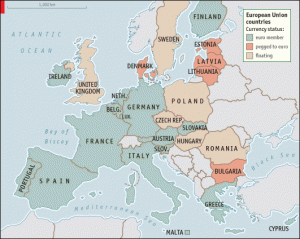
In addition, those on the cusp of joining remain firmly committed to doing so. For such economies, the economic crisis has actually strengthened the case for Euro membership. “As emerging economies they are prone to sudden shifts in foreign-investor sentiment, which makes for volatile currencies, so exchange-rate stability holds considerable appeal for them.” Romania and several baltic states have already had to go hat-in-hands to the EU and IMF to ask for assistance in order to stave off a complete loss of investor confidence. Poland is also vulnerable to currency decline, since many of its loans are denominated in foreign currency; it is currently aiming for Euro membership in 2012.

eastern-europe-wants-to-join-the-euro

Concludes the Economist, “For all its shortcomings, the euro zone is far more likely to expand than shrink over the next decade. Most EU countries that remain outside, bar Britain and Sweden, are eager to join.” This is certainly a bit glib, and ignores the imbalances that the currency is at least partially responsible for. Still, the tentative consensus is accepting of the Euro. It’s like the old joke about capitalism - “it’s the worst system– except for all of the others…”

SocialTwist Tell-a-Friend
Posted by Adam Kritzer | in Euro, Politics & Policy | No Comments »

General Uncertainity Pushes Dollar Upwards

Jun. 19th 2009
Over the last month, the US Dollar has steadily reversed its downward fall against the Euro. While it might still be premature to pronounce an end to the amalgam of intertwined trends that sent equities, commodities, and emerging market currencies (i.e. anything risky) up and the Dollar down, it’s worth examining this possibility in greater detail.
3m1
 
My philosophy of forex has always been to focus on the medium and long-term trends. Over the last two two-three months, the medium-term narrative was one of increased risk-taking. Generally, investors had become both more complacent with risk and more optimistic about the global economy’s prospects for avoiding economic depression. The US financial sector was shored up (or at least “vouched for”) by the US government, and a Fed-driven flood of liquidity poured money into the riskier sectors of the global financial markets.
 
The sideways trending of the USD/EUR doesn’t necessarily imply that this trend has run its course. Instead, I think it suggests that investors are looking for guidance as to what kind of narrative will predominate over the next few months- whether a continuation of the risk-aversion story, or a brand-new story. Investors tend to make their own reality, such that a pattern will inevitably emerge, and investors will find cause to affirm that pattern or negate that pattern. Simply, right now, there is no consensus on what that pattern is.
 
There is good reason for caution. The global economy (and forex markets) stand at a crossroads. Investors (want to) believe that the worst of the recession is behind us. But there is still good reason to believe that this is not the case. Unemployment is still rising, the housing market is falling, and GDP is still declining. Stock market investors may finally have taken notice of this contradiction, as the stock market rally has stalled of late.
 
Meanwhile, long-term rates have begun to tick up, but short-term rates remain frozen at record lows. Some analysts believe that the Fed will tighten monetary policy before the year is out, but the wide daily swings in interest rate futures contracts, imply a complete lack of consensus on this as well. The same goes for inflation, which is near 0% at the moment, but could easily explode as a result of rising recovering prices, record budget deficits, and the Fed’s own quantitative easing program.
 
There is no single event or data point that will shake investors from their uncertainty. Sure, a credit downgrade of US sovereign debt, another large-scale bankruptcy, a strong intimation of an interest rate hike, or a turnaround in GDP would all do the trick. In all likelihood, however, it won’t be so obvious, and investors will continue to selectively cull data that reinforces the case for optimism, pessimism, or further uncertainty.
SocialTwist Tell-a-Friend
Posted by Adam Kritzer | in Euro, Investing & Trading, US Dollar | 2 Comments »

Politics Weigh on the Euro, but Overshadowed by Other Factors

Jun. 15th 2009

With interest rate differentials, growth trajectories, and risk aversion weighing on (forex) markets, there’s no room in the picture for politics. I preface this post accordingly because current market dynamics are such that even the most dramatic political developments (short of the breakup of the EU) would probably be brushed aside. The long-term, however, is a different story, and investors ignore politics at their peril.

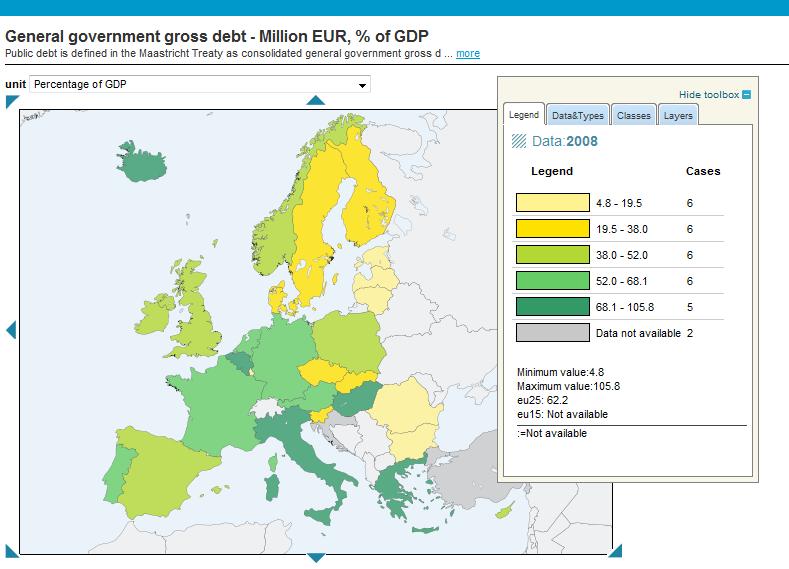
By its very nature, the Euro is perhaps most vulnerable to the vicissitudes of politics. The last week alone brought two significant developments: the downgrading of Ireland’s debt, and a crisis in Latvia. The former weighed directly in the Euro, while the latter probably didn’t have much of an effect. The reason being is that investors viewed the Irish downgrade as a possible precursor to downgrades in other EU economies. Spain and Italy, for example, are in equally precarious positions, and a 6% decline in GDP means German probably isn’t that far behind. In other words, investors may have to rethink their implicit assumption that the EU is currently less risky than the US.

EU government debt 2009
But how do you square fiscal instability against monetary instability? The US is printing money, but EU member states are (marginally) more likely to go broke. Is inflation more conducive to currency devaluation that sovereign bankruptcy? Perhaps the logic is that inflation is acceptable (albeit undesirable) whereas a large-scale default would shake the global financial system to its core; this being the case, it’s probably more practical to bet on the former.

The crisis in Latvia, meanwhile, came in the form of sudden pressure on currency to devalue its currency (known as the Lats), which is pegged to the Euro. The crisis only affects the Euro indirectly vis-a-vis the currency peg and any exposure that European investors have to Latvia. Thus, the Euro wouldn’t drop much as a result of a Latvian currency devaluation, even though the consensus is that such would be “bad” for everyone. For example, it would “trigger a wave of bankruptcies because 80 percent of private borrowing is in euros.”

The crisis is mainly relevant in that it has turned into a framing point for the future of the Euro, which Latvia is slated to join in 2012. “Euro zone entry would recede since the country would have to restart from scratch in the EU’s Exchange Rate Mechanism (ERM) with higher inflation and a bigger budget deficit.” Given that the EU is already slightly unstable (see above for example), why would it want to bring even more unstable economies into the fold of the Euro?

“There is some suspicion that Germany, the EU’s central economy, may want to slow down euro zone enlargement to preserve stability for existing members and perpetuate its orthodox influence over European Central Bank decision-making.” Still, “The EU is a community of law. Treaty rules for joining the single currency cannot simply be torn up in a crisis to admit countries in distress.” In short, there are compelling arguments for both sides. Analysts should watch closely, as the treatment of Latvia (i.e. whether the ECB bends over backwards to help it stay on track) will show how serious the EU is about spreading membership to the rest of Europe.

SocialTwist Tell-a-Friend
Posted by Adam Kritzer | in Euro, Politics & Policy | 1 Comment »

Euro Rises Despite EU Economic Malaise

May. 25th 2009

Their is no way to sugarcoat it; the EU economy is in poor shape, and is steadily worsening. In the most recent quarter, it contracted by 2.5%, most in at least 13 years. [It very well could have been the worst quarter in 50 years, but Eurozone economic data was only compiled beginning in 1996].

Germany’s economy is leading the pack (downwards), having contracted by 3.8% in the most recent quarter, and by 7% since the recession officially began. Compared to similar declines in other economies, “The 1.2% fall in France, large by any normal standards, almost counts as a boom,” quipped The Economist. It turns out that many of the EU’s headline economies were especially dependent on exports and/or housing to drive growth, both of which have been annihilated by the credit crisis. “One of the ironies of this downturn is that it was caused by global housing and credit busts, and yet the economies that have suffered most, such as Germany and Japan, sat out the credit boom.”

Still, some economists continue to wear rose-tinted glasses: “Hopes rose…that the worst could be over for Germany’s economy as a closely-watched index measuring the confidence of financial market players rose to a near three-year high in May, its seventh consecutive monthly gain.” Added Axel Weber, a member of the ECB’s governing council, “‘There is definitely hope that the euro zone economy will gradually stabilise in the later part of 2009.” A more realistic analyst responds: “That points not to a revival but rather to a slower rate of GDP decline in the present quarter (it could scarcely get worse).” To prove that economists truly create their own reality, another confidence indicator that was released on the same day fell to a six-year low.

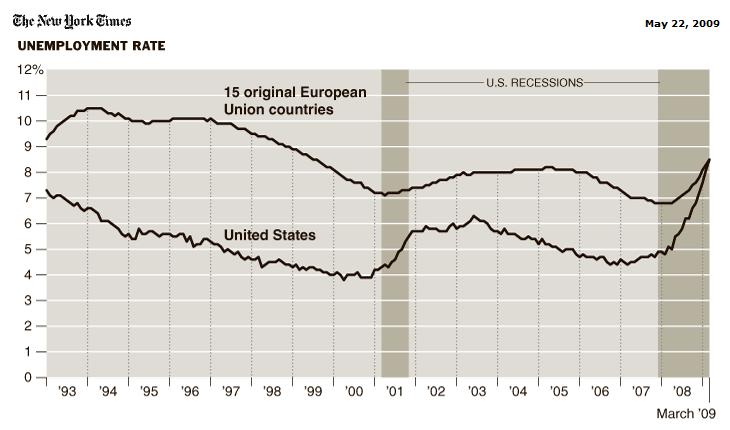
Other analysts have found solace in EU labor markets, which remain relatively buoyant due to a lack of flexibility in hiring and firing. In fact, “Unemployment in the United States has risen to European averages, and seems likely to pass them when international data for April is calculated.” While this might be good news for workers, however, it negatively impacts GDP growth by preventing the economy from returning to a stable production base.

eu unemployment rate

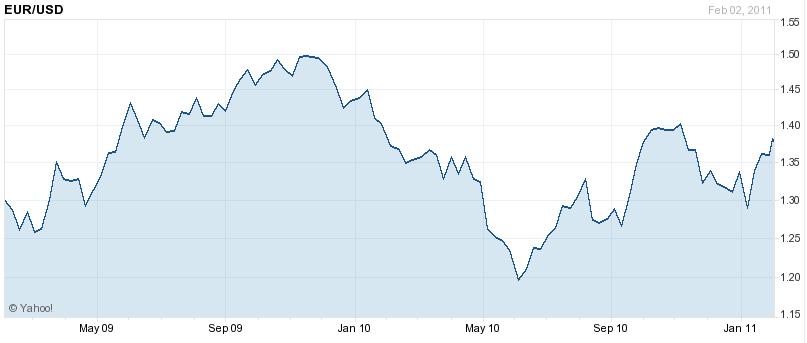
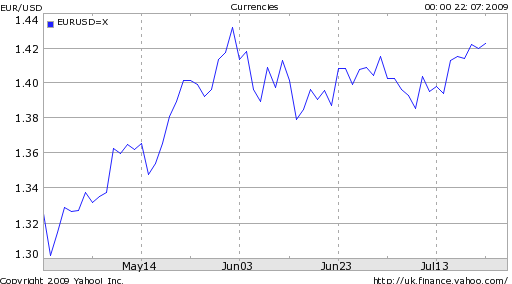
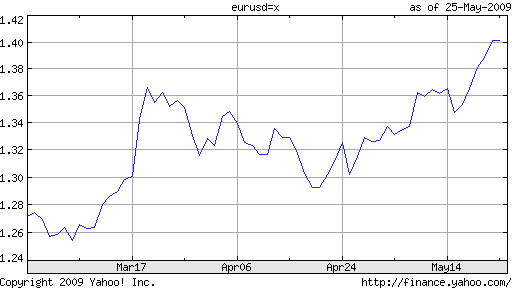
The Euro, meanwhile, has never been stronger. It has risen over 10% since touching a low against the Dollar on March 10, and recently broke through an important psychological barrier of $1.40. There are couple of explanations for this “contradiction.” The first is simply an application of the risk-aversion narrative. Simply put, “the euro is generally considered a risky bet on currency markets and therefore gains at times when there is greater perceived economic stability.” Recent trends suggest that financial market stability is more important than economic stability in the eyes of investors, but the idea is the same.

The other explanation concerns inflation, or rather the lack thereof. The European Central Bank’s response to the credit crisis has been much more restrained than its counterparts, most of which are pumping money into credit markets with little concern about the future implications. Sure, the ECB has authorized a program to extend low-interest loans to member banks, and plans to purchase up to $80 Billion in corporate bonds, but these measures pale in comparison to what the Fed and BOE have announced.

The ECB has also opted not to cut rates all the way to 0%, electing instead to hold its benchmark at 1%. Jean-Claude Trichet, head of the ECB, recently underscored that the role of the ECB is primarily to guard against inflation, rather than stimulate economic growth. “We are there to deliver price stability and price stability in the medium term is a crucial element in activating confidence,” he said. While there is certainly room for the debate as to whether this is economically sensible, Euro bulls can rest assured that their currency is being actively protected.

euro-rises-against-usd

SocialTwist Tell-a-Friend
Posted by Adam Kritzer | in Central Banks, Economic Indicators, Euro | 1 Comment »

Euro Continues to Rise, but Technical Obstacles Exist

May. 20th 2009

Over the last couple months, the Euro has thoroughly outperformed the Dollar, which recently fell to a five-month low on a trade-weighted basis. Over the same period, global stock and commodity prices have also risen quickly, which is not a coincidence.
Euro Rallies against DollarIn other words, investors are allocating capital on the basis of risk, rather than in accordance with (economic) fundamentals. For example, “ICE’s Dollar Index and crude oil have a correlation of minus 0.61 in the past two months, compared with minus 0.26 since the start of the year,” as rising oil prices and the declining Dollar feed back into each other.

Meanwhile, “Implied volatility on major currencies, which reflects investors’ expectations of currency swings, fell to 13.96 percent yesterday, from…17.22 percent at the end of March. A drop in volatility tends to signal less demand for options to protect investors from currency swings.” This indicator is now at its lowest level since the days preceding the Lehman Brothers bankruptcy and subsequent stock market collapse. One would normally expect a correlation between risk and return, but in this case, rising returns have been accompanied by lower risk.

Even more unbelievable is that this decline in risk is taking place against the backdrop of declining economic fundamentals. “Risk appetite in the currency market is nothing short of impressive considering the fact that the Fed reduced their growth forecasts,” said one analyst. However, “The euro-area economy will contract 4.2 percent this year, according to the International Monetary Fund, more than the projected 2.8 percent contraction in the U.S. and 4.1 percent slump in the U.K.” If investors were focusing on this divergence in economic growth, one would expect the Euro would be falling.

One hypothesis is that inflation-conscious traders are flocking to the Euro, since the ECB remains vigilant about fighting inflation, even in the face of declining prices and aggregate demand. After cutting rates to a record low 1% earlier this month, the ECB unveiled its own version of a quantitative easing plan, involving the purchase of 60 billion euros worth of low risk securities. But this is a pittance, both relative to the size of the EU economy (it represents a mere .6% of GDP) and compared to the Trillion Dollar Fed program. This led one analyst to call the ECB’s plan “chicken feed.” While all of this is noteworthy, it’s unlikely that this is having a meaningful effect on forex markets, which still remain focused on (avoiding) deflation.

If the Euro is to continue rising, it must overcome some technical obstacles. “The euro could hit a ceiling if the recent resilience of U.S. stock markets faces headwinds. ‘At some point…stronger nongovernment growth has to show up to sustain and justify these moves in equities.’ ” It’s interesting that the fear of Euro bulls is not that the EU economy won’t recover, but rather that US stock prices are overvalued. Given recent market movements, however, their concerns are reasonable, and “any disappointment [in corporate fundamentals] could provide an excuse to take profit [this] week — benefiting the dollar.”

SocialTwist Tell-a-Friend
Posted by Adam Kritzer | in Euro, US Dollar | 1 Comment »

Euro Resumes Decline After Brief Pause

Apr. 28th 2009

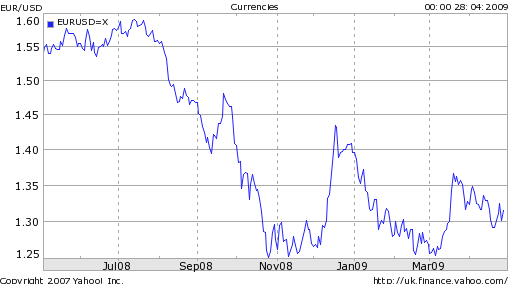
The one-year chart of the EUR/USD depicts a general downward trend, punctuated with steep “blips.” Every couple of months or so, it seems traders are temporarily jarred loose from their mindset of Euro bearishness, and find an excuse to bid up the common currency. Invariably, the Euro then resumes its downward course a few weeks later.
euro-declines-against-dollar-in-2009
The Euro’s recent trading activity fits this mold perfectly. The global stock market rally in March was accompanied by a spike in the Euro. While equities, commodities, and even other currencies continued to rise, however, the Euro peaked after a couple weeks and has since hovered around the $1.30 mark.  As one currency strategist summarized: “A breakdown of the correlation between the euro-dollar exchange rate and the S&P index indicates the currency pair ‘ has become a trade that is less about risk, a little more about euro rate specifics.’ ”

In other words, the decline in risk aversion has not expanded to include the Euro. This is somewhat surprising, since EU economic indicators have rebounded in the last month. The oft-cited German IFO index “rebounded from a 26-year low,” while “retail sales declined the least in 11 months in April after government stimulus packages improved consumer confidence.” On the other hand, EU lending activity, which is more correlated with economic growth, continues to decline. “The European Central Bank Wednesday released figures showing that banks in the currency area cut their lending to both companies and households in March.”

This is a huge problem for the EU, where the banking sector represents a comparatively important component of the economy.. “At the end of 2007, the stock of outstanding bank loans to the private sector amounted to around 145 percent of gross domestic product, compared to 63 percent in the United States.” This is belied by newspaper headlines that maintain the banking crisis is most severe in the US. In nominal terms, this might be true, but in relative terms, the EU is in much worse shape. Given that exchange rates are all relative, it is worth paying attention to this phenomenon.

The ECB is doing all that it can to help the situation, but many analysts and even some of the Bank’s own members remain critical. “The ambiguity of the ECB’s stance is not helping [the Euro," offered one analyst. The ECB's next meeting is scheduled for May 7, when economists predict the benchmark lending rate will be lowered to 1%. This will appease some investors, but not all. The head of Germany's IFO organization, for instance, has urged the ECB to slash rates down to .25%.

As ECB President Jean Claude Trichet has pointed out, lower rates will not automatically stimulate the economy: "Owing in particular to the very low rate on our deposit facility of 0.25 percent, this difference in policy rates doesn’t translate into equivalent differences in money market rates." In fact, money market rates have largely converged across the EU and US, despite the divergence in short-term rates, vindicating Trichet.

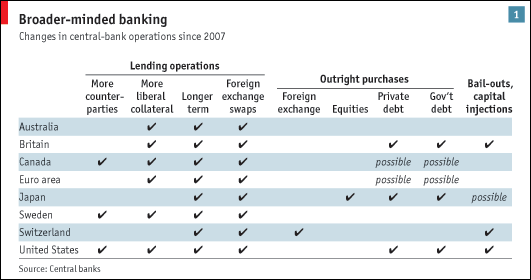
More important, then is the ECB's non-monetary initiatives. To quote Trichet again, "Comparing only the levels of policy rates without consideration of the resulting market rates and other economic variables is looking at just one part of a far broader canvas." The Economist recently published an excellent comparison of the various Central Banks' responses to the credit crisis. While some have embraced their newfound prominence, other Central Banks have shied from the spotlight, insisting that their mandates are limited to inflation targeting. The ECB probably falls into this category, as it has thus far stood on the sidelines - for better or worse- as its counterparts have turned on the printing presses and flooded their respective credit markets with liquidity. [Chart courtesy of The Economist].
central-bank-comparison
This could soon change, and “A commission headed by Jacques de Larosière, a former head of both the Bank of France and the IMF, has recommended that the ECB chair a new European Systemic Risk Council made up of its member central banks and supervisors.” Not all investors are convinced that the ECB can successfully break with tradition. “Alan Ruskin, head of international currency strategy in North America at RBS Securities…recommends investors sell the euro on ‘upticks’ as the ECB abandons ‘monetary orthodoxy’ and uses unconventional measures to spur growth.”

SocialTwist Tell-a-Friend
Posted by Adam Kritzer | in Central Banks, Euro | No Comments »

Euro Gains after ECB Rate Cuts

Apr. 4th 2009

Yesterday, the European Central Bank delivered a surprise to the forex markets; instead of cutting rates by the consensus expectation of 50 basis points, the ECB knocked down its benchmark lending rate by only .25%. The Bank also opted against certain non-standard measures that would accompany a change in monetary policy. At this point, all investors can do is wait until the next meeting to see if the ECB will finally intervene in credit markets as well as on behalf of beleaguered Eastern European currencies.

While Jean-Claude Trichet, President of the ECB, coyly refused to rule out the possibility of further rate cuts, analysts are puzzling over the relatively minuscule cut. After all, the consensus was that the ECB had already fallen well behind the curve, and was not struggling as quickly as possible to play catch up with its counterparts in the UK, US, and Switzerland. “ ‘By again buying time, the ECB risks falling further behind the curve…You cannot buy time forever.’ ”

ecb-lowers-rates-in-2009There are a few explanations. First of all, it’s possible that the ECB is selectively interpreting data as a basis for deriving a more optimistic economic forecast. Given the spate of recent bad news emanating from Europe, however, this seems unlikely. Besides, no less than Trichet himself has suggested that an economic recovery is unlikely to occur before 2010. There is also the possibility that the ECB is simply prioritizing its mandate to guard against inflation, rather than to stimulate economic growth. This theory is also unconvincing, given that price inflation has already fallen well below the ECB’s target of 2%.

Perhaps, the best explanation is technical: “A 50 basis point cut would have required the ECB to cut the interest that it pays on deposits by banks to zero, from 0.5%, in order to maintain the current spread between the two of 1 percentage point.” Along the same lines, “European interest rates are lower than those in the U.S. when making a comparison of real inter-bank lending.” Ultimately, it’s probably the Bank’s conservatism that is behind both its comparatively tight monetary policy and its failure to unveil a quantitative easing plan that would mirror those put forth by the Fed and Bank of England. In other words, the door for more drastic monetary prescriptions has been strategically left open in the EU, while all but closed in the US and UK.

Curiously, the “the smaller-than-expected rate cut ‘remains an all-round booster for the single currency.’ ” Prevailing trading patterns and market sentiment seemed to herald a decline in the Euro, as investors have recently prioritized capital preservation and vigilance against deflation. Based on the positive market response, however, we can conclude that there are still some traders for whom interest rate differentials are important. After all, the only remaining alternatives to the EU (from the standpoint of yield) are Australia and New Zealand, but both of these economies/currencies are perceived as risky.

Alas, the ECB’s role is not to make currency traders happy. Unless the ECB follows up with a big move next month, the result could be a “very prolonged slump in euro-zone activity.”

SocialTwist Tell-a-Friend
Posted by Adam Kritzer | in Central Banks, Euro | No Comments »

ECB Prepares to Lower Rates, Euro Rally Fades

Mar. 30th 2009

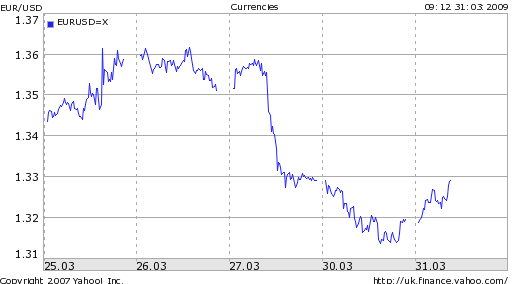
On Thursday, the European Central Bank will conduct its monthly monetary policy meeting. The consensus among analysts is that the meeting will lead to a 50 basis point cut, leaving the EU’s benchmark lending rate at 1%, a record low. Investors are also bracing for the ECB to announce certain unconventional steps, similar to the Fed’s program of quantitative easing, although not to such an extent. Analysts have speculated that the ECB “could intervene in bond markets to help ease companies’ financing problems.”

This marks an about-face from current policy and recent rhetoric, in which the ECB insisted that guarding against inflation was more important than providing economic stimulus. In fact, Jean-Claude Trichet, President of the ECB, has recently found himself on the defensive: “I don’t think it is justified to say we are doing less on this side of the Atlantic. We have automatic stabilizers,” he said during his quarterly testimony in front of European Parliament. In fact, the ECB had become an outcast among Central Banks for waiting a long time before finally agreeing to cut interest rates. Since embarking on a program of monetary easing, it has been playing catch-up by cutting rates at breakneck speed.

It appears that the ECB’s arm was twisted by the most recent economic data; a sudden drop in German manufacturing suggests that the recession is both spreading and deepening. Combined with a record drop in the EU economic sentiment, this “suggests that the euro zone economy will have contracted by roughly 2 percent quarter on quarter in the first three months of the year.” In addition, both producer and consumer prices have eased, such that inflation has fallen well below the 2% target level, and the ECB lost its last excuse for not dropping rates.

As a result both of the worsening economic situation, as well as the projected decline in yields, currency traders are once again questioning the Euro. The last couple weeks have been rife with commentary that the Dollar rally had come to an end as a result of the intensification of the Fed’s plan to use newly printed money to as a source of liquidity in the credit markets. “The dollar’s traditional trading patterns have been altered in the wake of new U.S. quantitative-easing measures. Risk appetite, stocks and funding currencies appear to hold lesser influence lately.”

euro-rally-fades-against-dollar

This week, the narrative in forex markets favors the Dollar. It could be that the safe-haven trade has returned to lift the Greenback, but more likely is that investors are comparing economic fundamentals when making bets on currencies. One analyst summarized his firm’s position as follows: “We have argued that the leveraging-de-leveraging axis has been the key driver in the foreign exchange market. We expect a new driver, anticipated growth trajectories, to emerge…[and] for the dollar’s uptrend to resume in the second quarter.”

SocialTwist Tell-a-Friend
Posted by Adam Kritzer | in Euro, US Dollar | 2 Comments »

USD/EUR: Conflicting Signals Make Predictions Difficult

Mar. 24th 2009

If you read analysts’ coverage of the Dollar decline (and consequent Euro rally), there is an even divide over whether it is sustainable. Economic data and technical indicators paint a nuanced picture, such that this kind of uncertainty is understandable.
euro-rallies-against-dollar
On the one hand are the the Dollar bears, who point to an economic recession that continues to deepen, and the seeming complacency of the Federal Reserve Bank towards inflation. If there is any doubt as to how the forex markets feel about the Fed’s plan to purchase over $1 Trillion in US government bonds, consider that the the Dollar just recorded its worst weekly performance in 24 years, while the Euro simultaneously recorded its strongest week since its inception in 1999. There’s not much nuance there.

Meanwhile, the economic picture is equally depressing. Summarized by Kathy Lien of GFT Forex:

The Empire state manufacturing survey plunged to a record low in the month of March while Industrial production fell 1.4 percent, driving capacity utilization back to its record lows.  Foreign investors reduced their holdings of U.S. assets by the largest amount since August 2007. Homebuilder confidence held near its record lows in the month of March as the slump in the real estate sector shows no signs of easing.

Unfortunately, there is a contradiction in the argument that the Dollar is being plagued both by economic collapse and by the risk of inflation. Writes Marc Chandler, head of FX strategy at Brown Brothers Harriman, “The pessimist camp wants it both ways. The US is going down the same path as Japan, where the end of a real estate bubble led to a banking crisis and a deep economic contraction. And they want to caution that printing of money will boost interest rates, fuel inflation and debase the currency.” He points out that history, as well as common sense, contradict this line of thinking.
Those that remain bullish on the Dollar argue that the Euro rally is a function of technical, rather than fundamental developments. First of all, we are approaching the end of a fiscal quarter. As evidenced by the Dollar decline which took place at the end of December, these periods are usually marked by portfolio rebalancing and hedging, such that it’s not uncommon to see large swings in forex markets. From a technical standpoint, when the Dollar failed to breach the $1.30 level against the Euro, many short sellers were probably forced to cover their positions, which accelerated the Dollar’s decline.

Bulls are confident that the pickup in risk-taking which catalyzed a 20% stock market rise is here to stay. “The move to the upside came after the government described a plan that will…generate $500 billion, and possibly $1 trillion over time, to buy hard-to-trade and badly deteriorated assets from banks.” The banks will be recapitalized, the financial system is being repaired, and everything will be okay, right?

The markets are certainly prone to false-starts. I can count numerous instances of government officials and market commentators insisting that “the worst is behind us.” Nevertheless, if this time proves to be different, it could be bearish for the Dollar, whose role as ’safe-haven’ currency would likely be eroded by a positive change in market sentiment.

SocialTwist Tell-a-Friend
Posted by Adam Kritzer | in Economic Indicators, Euro, US Dollar | 6 Comments »

The Split Yen

Mar. 9th 2009

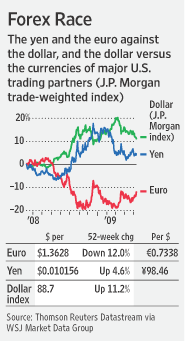
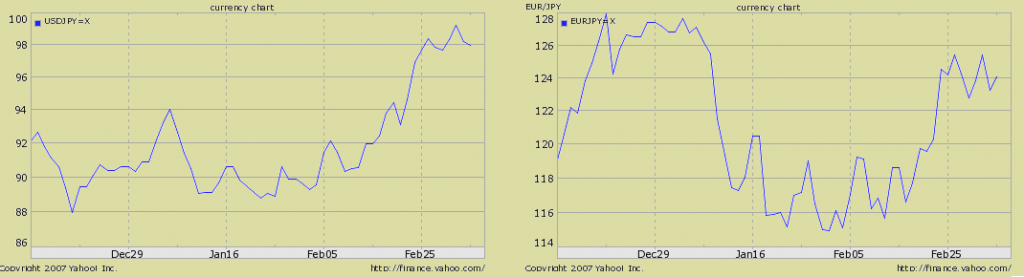
The Japanese Yen is increasingly resembling a patient with split personality disorder, moving in one direction (down) against the Dollar while behaving quite differently against other currencies.

yen-dollar-euro-comparison-fx-chart3

For most of the duration of the credit crisis, the Yen had mirrored the performance of the Dollar, both of which had performed well as so-called “safe-haven” currencies. For a while, the Yen even outpaced the Dollar, rising to a 13-year+ high. Over the last five weeks, however, the Yen has fallen off against the Greenback, while maintaining its value against other rivals. It’s unclear exactly what’s driving this split, but careful analysis suggests it is a product of changed investor psychology.

To elaborate, the Yen’s precipitous rise was due to financial- as opposed to economic- factors. As investors fled emerging markets en masse and unwound carry trades, it spurred a flood of capital back into Japan. This was not because the Yen was anything special; far from it, in fact. Rather, it was because the alternatives were perceived to be substantially more risky. This began to change in earnest when it was revealed that the Japanese economy shunk by over 12% (on an annualized basis) in the recent quarter. Given that Japan’s economy is famously dependent on exports, it didn’t take long for investors to connect Japan’s sagging GDP with its strong currency.

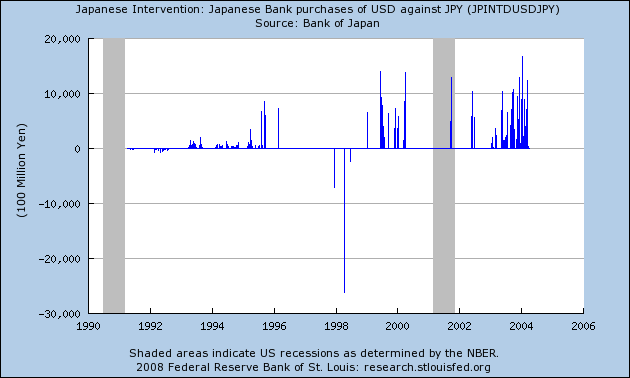
This prompted speculation that Japan would intervene in forex markets in order to prevent the Yen from rising further. In the end, Japan didn’t spend a dime. Fortunately, it didn’t have to, as investors took the hint, and sent the Yen tumbling against the Dollar. Technically, Japan hasn’t intervened since 2004 (see chart), but the threat of intervention combined with low interest rates ensured that in this case, words spoke just as loud as actions. It should be noted that Japan will use a small portion of its reserves to fund domestic economic initatives, but for now at least, none of it will be used to purchase Dollars in the spot market.
bank-of-japan-forex-intervention2

So why hasn’t the Yen reversed course against other currencies? Its stock market is sagging, and its economy is in equally bad, if not worse-than-average shape. The answer lies in interest rate differentials and investor risk tolerance. The rate gap between the Yen and the highest-yielding currency (New Zealand), has shrunk to less than 3.5%. Excluding Australia, and to a lesser extent the Euro, interest rate differentials are effectively negligible. Accordingly, investors have decided that the gains from an additional couple hundred basis points in yield are not offset by the perceived increase in risk associated with currency volatility. That this theory holds water is evidenced by the fall in the Japanese Yen that immediately registered when the Bank of Australia opted to hold rates steady at its most recent meeting.

SocialTwist Tell-a-Friend
Posted by Adam Kritzer | in Euro, Japanese Yen, US Dollar | 1 Comment »

UK, EU Central Banks Follow the Federal Reserve

Mar. 6th 2009

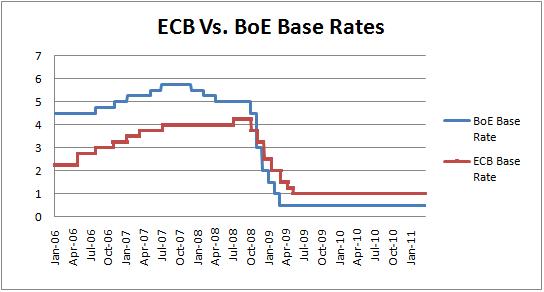
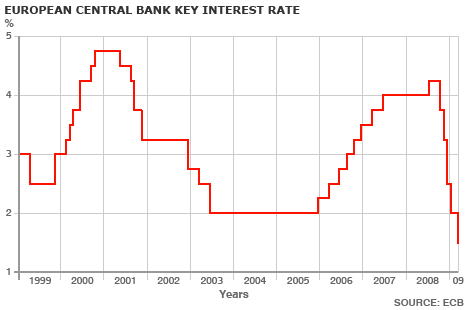
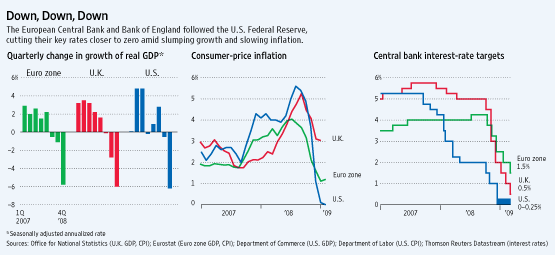
Yesterday, both the European Central Bank (ECB) and the Bank of the UK cut their benchmark interest rates to record lows. This is especially incredible in the case of the UK, whose Central Bank over 300 years old! You can see from the following chart that both Central Banks have more than made up for their respectively slow starts in easing monetary policy by effecting several dramatic rate cuts, following the example of the Federal Reserve. The baseline UK rate now stands at .5%, only slightly higher than the Federal Funds rate, and slightly lower than the 1.5% ECB rate.

Given that they have essentially reached the terminus of their monetary policy options, all three Central Banks are exploring further options aimed at pumping money into their respective economies. The Fed has already “announced a program to buy $100 billion in the direct obligations of housing related government sponsored enterprises (GSEs) — Fannie Mae, Freddie Mac and the Federal Home Loan banks — and $500 billion in mortgage-based securities backed by Fannie Mae, Freddie Mac and Ginnie Mae.” As I wrote in a related article, “this was quickly followed by repurchase programs, lending facilities, investments in money market funds, and option agreements, all of which were designed to supplement its ‘traditional open market operations and securities lending to primary dealers.’ The Fed’s efforts also worked to ease the liquidity shortage in credit markets abroad by entering into swap agreements with several foreign Central Banks suffering from acute Dollar shortages.”

In conjunction with the rate cut, the Bank of the UK, meanwhile, will pump £150bn directly into UK credit markets through liquidity support, buying public and private debt, and asset purchases. “The main purpose of quantitative easing is not to send the money supply into orbit but to stop it from crashing…the broad money held by households has risen at a worryingly slow rate over the past year, and holdings by private non-financial firms have actually been dropping.” In contrast to the monetary programs of the UK and US, the ECB has thus far refrained from the kind of liquidity support that would necessitate printing new money. Instead, “the central bank will continue offering euro-zone banks unlimited loans at the central bank’s policy rate until at least the end of this year.”

The interest rate cuts were announced simultaneously with a spate of macroeconomic data, which collectively paint a bleak picture. Eurozone growth is projected at -2.7% for 2009 and 0% for 2010. The current unemployment rate at 8.2% and climbing. The thorn in the side of the EU is represented by eastern Europe, where growth is falling at an alarming pace, dragging the EU down with it. While EU member states have pledged to intervene if one of their own falls into bankruptcy, it’s unlikely that they would intervene similarly if a non-EU member state went bust. The UK economy is similarly desperate, having contracted at an annualized rate of 5.8% in the most recent quarter. The wild cards are the real estate and financial sectors, the fortunes of which are increasingly intertwined.

So what do the forex markets have to say about all this? Economists have used the dual phenomena of risk aversion and deflation to explain the interminable weakness in the the Pound and Euro. Everyone is surely familiar with the notion of the US as “safe haven” during periods of global financial instability. The deflation hypothesis, meanwhile, suggests that the ECB (and to a lesser extent, the Bank of UK), fell behind the curve when easing liquidity. The ECB, especially has harped on inflation as a reason for cutting rates more quickly. Given that investors are now more concerned with capital preservation than price inflation, it follows that they would prefer to invest where Central Banks were more vigilant about deflation (i.e. the US).

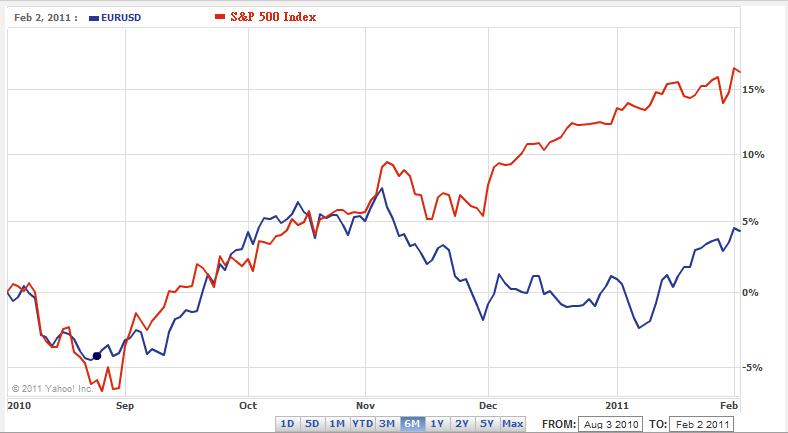
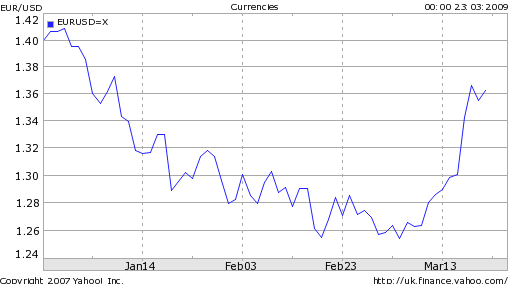
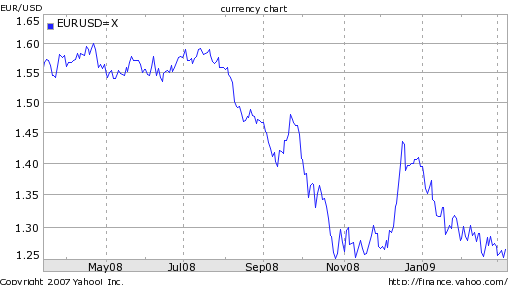
Personally, I think that the continued declines in both currencies, in spite of steep interest rate cuts, indicates that the deflation hypothesis is bunk, and investors remain fixated on risk aversion. By no coincidence, the temporary rebound in US stocks that took place in January was also accompanied by a bump in the Euro. (See chart below).

I think this mindset is reasonable, but only in the short-term. Given the current economic environment, I don’t think investors (and currency traders) can be faulted for ignoring the possibility that quantitative easing and liquidity programs will have to be funded with the printing of new money, which would be inherently inflationary. Many comparisons are being made with Japan, whose ill-fated quantitative-easing program succeeded only in inflating a bond-market bubble and vastly increasing Japanese public debt. According to one columnist, “it’s hard to argue that quantitative easing ended deflation; high oil prices did that. Meanwhile, the economy cured on its own most of the structural problems such as excess capacity and too much debt associated with the deflationary environment.”

In short, with a medium and long-term investing horizon in mind, I think the ECB’s approach to dealing with the credit crisis is more conducive to monetary stability. Thus, when investors grow weary of the idea of US as safe haven, they will no doubt focus instead on fundamentals. At which point, the ECB will likely be rewarded for fulfilling its anti-inflation mandate, in the form of a stronger Euro.

SocialTwist Tell-a-Friend
Posted by Adam Kritzer | in British Pound, Central Banks, Commentary, Euro | 7 Comments »

Eastern Europe Plagued by Currency Instability

Feb. 23rd 2009

The credit crisis continues to exact a devastating toll on the economies of Eastern Europe, and capital flight has caused the region’s currencies to plummet precipitously. This has prompted internal debate in countries such as Poland, Czech Republic, and Latvia - to name a few- as to whether the effects of the crisis would have been so blunt had they adopted the Euro. While certainly Euro membership would have spared them from currency instability, it would not have necessarily facilitated financial and economic stability, as Italy, Spain, and Greece have learned the hard way. Regardless of whether Eastern European countries are politically willing to commit to the Euro (itself doubtful), this debate is largely moot, since the credit crisis has all but eliminated their ability to meet the preconditions of membership in the short run. The New York Times reports:

The Baltic states would like to join as quickly as possible, but their economies are contracting so much that it would be impossible to meet the criteria, which, among other things, stipulates that budget deficits should be below 3 percent of gross domestic product.

Read More: Currency Issues Weigh on Eastern Europe

SocialTwist Tell-a-Friend
Posted by Adam Kritzer | in Emerging Currencies, Euro, Politics & Policy | 4 Comments »

ECB Hints at Rate Cut

Feb. 18th 2009

At its next meeting, to be held in March, the European Central Bank is all but certain to bow to pressure and cut its benchmark interest rate to a record low. This should not come as a surprise, for the ECB’s February decision to hold rates constant was met with a large outcry, in both public and private circles. Soon-to-be-released inflation data is expected to confirm that prices are rising at a slower pace, perhaps even below the ECB’s 2% benchmark. Members of the Bank are also paying attention to the Euro, the continued weakness of which is ironically a product of the ECB’s comparatively tight monetary policy, as investors guard themselves against the risk of deflation. The Guardian reports:

As the economy falters, speculation is also increasing that the ECB may expand its monetary toolbox, possibly through asset purchases, to boost growth while keeping rates relatively high compared to other central banks.

Read More: ECB’s Liikanen, Bini Smaghi say rates could move in March

SocialTwist Tell-a-Friend
Posted by Adam Kritzer | in Central Banks, Euro | No Comments »

ECB Holds Rates

Feb. 6th 2009

After "profound" debate, the European Central Bank voted yesterday to hold its benchmark interest rate constant at 2%. Despite the acknowledged fact that EU inflation has slid to the lowest level in a decade, the ECB remains unconvinced that it has been tamed. It is apparently concerned that further interest rate cuts could trigger a loss of confidence and hyper-inflationary spiral, from which it would be difficult to escape. The Bank's critics, meanwhile, insist that it is increasingly out of touch with economic reality and is falling further behind the curve, especially compared to the Fed and bank of England, which have already lowered rates to record lows. They further argue that this viewpoint is reflected in the Euro, which is losing the battle as safe haven currency with the Dollar. Nonetheless, it appears that investors accept the reasoning of the ECB, and the Euro reacted to the rate hold with indifference. The Financial Times reports:

The ECB president…said only that a zero interest rate policy had a “number of drawbacks” that should be avoided, without specifying what they were.

Read More: ECB halts rate cut after profound debate

SocialTwist Tell-a-Friend
Posted by Adam Kritzer | in Central Banks, Euro | No Comments »

EU Periphery Laments Euro Membership

Jan. 30th 2009

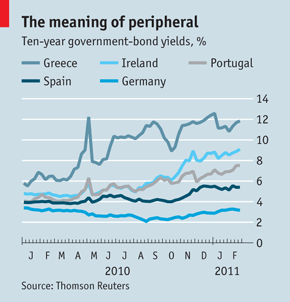
Only last year, Greece, Ireland, Italy, Portugal and Spain were collectively the pride of the EU, boasting strong growth characteristics and buoyant capital markets. In hindsight, this was but a mirage, as the stability of Euro-membership allowed such "peripheral" economies to embark on a colossal building boom and spending spree that was ultimately baseless. Greece, which is perhaps in the worst shape of the lot, witnessed its twin deficits (government debt and trade) rise to dangerous levels; given its membership in the EU, it is unable to resort to currency depreciation to rectify the problem.

The illusion has since been shattered, and it seems investors are trying to overcompensate for their previous naivete. Yields on government bonds for all five countries have begun to creep up, and a handful of speculators are betting on the possibility of default. Most experts insist that such a scenario is unlikely, but at the very least, the credit crisis has exposed the chinks in the armor of the EU, demonstrating that the currency also has its drawbacks. The New York Times reports:

While sharing a currency with some of the mightiest economies in the world helped Europe's poorer nations share in the wealth, a boon during boom times, in hard times the rules of membership are keeping them from doing what countries normally do to ride out economic storms, including enormous spending.

Read More: Once a Boon, Euro Now Burdens Some Nations

SocialTwist Tell-a-Friend
Posted by Adam Kritzer | in Euro, Politics & Policy | No Comments »

The Euro Paradox

Jan. 26th 2009

The deepening of the credit crisis in the EU has triggered a wave of self-reflection, prompting those on the inside to ponder life without the Euro and those on the outside pondering life with the Euro. Their opinions couldn't be any more divergent. Countries like Italy, Spain, and Ireland, for example, have blamed the Euro for their economic woes, arguing that easy monetary policy and cheap credit were responsible for their real estate bubbles. Some commentators, accordingly, have argued that structural differences between these countries and the economic powerhouses of Germany and France are so large that it doesn't make sense for them to share a common currency. Meanwhile, Eastern European countries, most of which are still outside the Euro, are clamoring to join as sudden depreciations in their respective currencies have exposed them to massive economic instability. Business Week reports:

What happened, in effect, was rapid economic isolation. This began as investors moved money from more risky regional stock and currency markets into safer, often euro-denominated, assets, in what economists call a "flight to quality."

Read More: The Euro's Growing Appeal

SocialTwist Tell-a-Friend
Posted by Adam Kritzer | in Euro, Politics & Policy | No Comments »

ECB is Behind the Curve

Jan. 19th 2009

At the beginning of last week, analysts predicted that the Euro would continue to fall, on the basis of a deteriorating economic situation and the likely consequence of an expected ECB rate cut. Sure enough, the data indicated a decline in both inflation and economic output, paving the way for a 50 basis point cut in the ECB's benchmark lending rate and a fall in the Euro. Unfortunately, the consensus among analysts is that the common currency is poised to fall further. Investor interest in European assets and securities is waning rapidly as a result of a increased credit/economic/currency risk and decreased yield. In addition, the ECB is probably "behind the curve," having waited longer than its counterparts in the US and Britain to ease monetary policy. The Wall Street Journal reports:

"The sentiment is that the ECB is required to play catch-up in cutting interest rates," said Robert Blake, a Boston-based senior currency strategist at State Street Global Markets. "This could lead to further downward pressure on the euro for some time to come."

Read More: Euro Poised to Fall on Rate Cuts

SocialTwist Tell-a-Friend
Posted by Adam Kritzer | in Central Banks, Euro | No Comments »

British Pound Oversold?

Jan. 16th 2009

Last week, the British Pound recorded its strongest performance against both the Dollar and Euro in nearly 20 years, on the basis of both technical and fundamental factors. On the surface, the Bank of England interest rate cut that prompted the rally would seem to be be negative for the Pound, since lower yield makes Britain a less attractive place to invest. On a deeper level, the relative modesty of the rate cut signalled to investors that the Bank of England is conscious of currency markets (the record decline in the Pound in 2008) when carrying out monetary policy. In addition, the BOE's proactive response to the credit crisis dwarfs the actions of the European Central Banks, which risks falling further behind the curve. In other words, investors began to question why they were pushing the Euro close to parity, when the economic fundamentals aren't much better in the EU than in the UK. Bloomberg News reports:

"The euro fundamentals are looking increasingly shaky," [said] a currency strategist. "It's clearer than ever the ECB has seriously misjudged the dire situation the region now finds itself in."

Read More: Pound Posts Record Weekly Gain Against Euro as BOE Cuts Rates

SocialTwist Tell-a-Friend
Posted by Adam Kritzer | in British Pound, Central Banks, Euro | 1 Comment »

Reflections on the Euro

Jan. 12th 2009

The last two weeks have been eventful for the Euro: the common currency celebrated its 10th anniversary, Slovakia became the 16th member currency, and 2008 came to a volatile close. Analysts have taken advantage of this confluence of developments to publish a tide of opinion outlining its future. Supporters argue that the currency has forced member states to become fiscally responsible, as they can no longer print money to fund budget deficits. Moreover, the credit crisis proved the currency's raison d'etre; it has been an island of stability in a sea of volatility, with the currencies of some unlucky countries declining by 20% or more. Exchange rate volatility and interest rate divergence, which can cripple even robust economies in times of crisis, was nowhere to be found in the EU. As a result, Denmark, Iceland, and even the UK, could conceivably adopt the Euro in the not-too-distant future, especially since the latter's British Pound is closing in on parity.

Meanwhile, the Euro's detractors maintain that a one-size-fits-all economic and monetary policy is still not appropriate for a region as economically diverse as the EU. For example, while low interest rates may have been conducive to stable economic growth in Germany and France, they probably fomented real estate bubbles in Spain and Ireland, making the collapse even more painful in those locales than it had to be. Regardless, the consensus is that the Euro is here to stay, and will probably become an increasingly viable alternative to the Dollar. The Wall Street Journal reports:

The euro has climbed sharply again since Mr. Bernanke cut rates virtually to zero last month and signaled his new policy would be "quantitative easing" — i.e., printing as much money as it takes to revive the U.S. economy.

Read More: The Euro Decade and Its Lessons

Read More:

SocialTwist Tell-a-Friend
Posted by Adam Kritzer | in Euro | No Comments »

UK, EU Rates Headed Downwards

Jan. 8th 2009

As investors gradually re-acquaint themselves with risk-taking, the interest rate story is once again dominating forex markets. For the last few weeks, this meant that investors were taking advantage of record-low US interest rates to fund carry trades in riskier currencies. Most recently, however, investors have begun to focus on the interest rate picture on the other side of the Atlantic. The Bank of UK just lowered rates to 1.5% and is "threatening" to match the Fed by dropping rates all the way to zero. The European Central Bank, meanwhile, is probably on the cusp of a similar interest rate cut. As commodity prices have relaxed and the credit crunch has slowed the expansion of the money  supply, the ECB is firmly justified in cutting rates, under the pretext of fulfilling its mandate, which is to guard against inflation. The upshot is that interest rate differentials, which have been fueling the Dollar's recent decline, may become less pronounced over the next year. Bloomberg News reports:

"There is increasingly more room for the ECB to be more aggressive on rate cuts. That will naturally put more pressure on the euro from an interest-rate differential perspective. We're seeing interest-rate differentials really come back into play in terms of a currency driver."

Read More: Euro Falls to Three-Week Low on Speculation ECB Will Cut Rates

SocialTwist Tell-a-Friend
Posted by Adam Kritzer | in British Pound, Central Banks, Euro | No Comments »

Pound Versus the Euro

Jan. 7th 2009

In recent years, the idea of parity seemed to pop up repeatedly in forex markets. First, the Canadian Dollar breached the mythical 1:1 barrier against the USD; then, it looked as though the Australian Dollar would follow suit. The most recent battle for parity is being waged across the Atlantic Ocean, between the British Pound and the Euro. Both economic and monetary circumstances favor the Euro, as the housing crisis pummeled the UK economy and the UK Central Bank subsequently embarked on a steep program of monetary easing. The Euro has probably also received a boost from the perception that the EU is one of the most stable economies and investing locales, outside of the US. In any event, investors tend to get carried away with psychological milestones and ignore economic fundamentals, which means the Euro could quickly achieve parity, before pulling back. The Wall Street Journal reports:

On Monday, one euro briefly bought almost 98 pence, a new record. That paves the way for parity “as early as this week,” wrote Ashraf Laidi, chief market strategist at CMC Markets.


Read More: The Battle of Hastings, Revisited in Forex Markets

SocialTwist Tell-a-Friend
Posted by Adam Kritzer | in British Pound, Euro | No Comments »

Central Banks Still Prefer Dollars

Dec. 18th 2008

Since its introduction only ten years ago, the Euro has ascended at an incredible pace. Perhaps the best proxy for its respectability is its growing share (currently estimated at 27%) of Central Banks' foreign exchange reserves. Still, most analysts reckon that the Dollar will remain ascendant for the near-term. For one thing, the perception remains that the US is the safest place to invest, and in fact this attitude has been reinforced by the current economic downturn. In addition, there is very limited doubt that the Dollar will be around for a very long time, whereas there are many skeptics who invariably insist that the Euro is on the verge of breaking up. In short, as the global economy rebalances itself, reserve accumulation will slow generally, and diversification into the Euro will slow specifically. Marketwatch reports:

In view of the value already tied up in holdings of U.S. government paper, it would take a decisive — and probably foolhardy — shift for the world's largest reserve holders in Asia or Latin America to transfer significant holdings of present reserves out of the dollar and into the euro.

Read More: Reserve shifts into the euro will slow

SocialTwist Tell-a-Friend
Posted by Adam Kritzer | in Central Banks, Euro, Politics & Policy | No Comments »

Central Europe Continues to Chase Euro

Dec. 16th 2008

While the credit crisis has led some skeptics to presage the end of the European common currency, some in Central Europe are still eager to join it. However, their cause may have been jeopardized by the credit crisis. The economies of Poland, Hungary, and Czech Republic-the three most qualified candidates to join the Euro-have been plunged into turmoil. Capital flight has wrought precipitous declines in all of their respective currencies. In light of record volatility and continued bearish sentiment, some analysts have argued that the Euro represents the key to their salvation. The only problem is that the credit crisis is scrambling their ability to meet the necessary pre-requisites to membership. Bond yields trade at an unacceptable spread to those of Euro members, inflation has yet to be tamed, budgets have shifted from surplus to deficit, and reserves are shrinking faster than they can be replenished. And yet, there are those who remain optimistic. Bloomberg News reports:

"In Poland and Hungary the crisis has increased the public support for euro adoption and I'm keeping my bet that both countries will enter ERM-2 in the second half of 2009. The more euro-skeptic Czechs may do it a year later," said [one analyst]. 

Read More: Euro Dreams Fade for Zloty, Forint, Koruna on Slump

SocialTwist Tell-a-Friend
Posted by Adam Kritzer | in Emerging Currencies, Euro | No Comments »

EU Stimulus No Help to Euro

Nov. 27th 2008

The European Union has unveiled an economic stimulus package to match the US, as the two economies continue to mirror each other’s strategies for fighting the credit crisis. Given the evident lack of effectiveness of the US plan, it is no surprise that analysts reacted pessimistically to the policy proposal. At this point, investors and consumers alike appear resigned to the inevitability of economic recession in both economies. In other words, there isn’t much that government can achieve, as their respective efforts will certainly be undermined by increased saving. Besides, investors (including currency traders) remain focused on the financial aspects of the credit crisis, rather than the economic aspects. Accordingly, the theme of risk aversion continues to dominate, as part of a trend that favors the Dollar. Reuters reports:

Analysts said that the plan marked a step in the right direction, but uncertainty about its efficacy, and general concerns about a deep slowdown in the global economy were keeping investors in the mood to sell risky assets.

Read More: EU stimulus package raises concerns

SocialTwist Tell-a-Friend
Posted by Adam Kritzer | in Euro, Politics & Policy | No Comments »

Euro: To Praise or Condemn?

Nov. 14th 2008

In light of the credit crisis, commentators on the Euro have taken to one of two extremes; either they believe the Euro is doomed, or they argue that the Euro represents the key to EU economic salvation. The naysayers point to recent trends in financial markets such as the widening spread between German and Italian bond yields. They further argue that a common monetary policy exacerbated the credit crisis by fomenting real estate booms in overheated economies, namely Ireland and Spain. Supporters, on the other hand, need to look no further than the complete economic collapse in Iceland to understand the advantages of the Euro. Moreover, some of the more fragile EU members (Luxembourg, Belgium) would have witnessed runs on their currencies, if not for their participation in the common currency. In the end, the Euro probably represents a viable investment alternative to the Dollar and it brings the benefit of relative stability to its members. While its supporters are prone to overstating its benefits, it’s not likely at risk of crumbling in the next few years. The Economist reports:

The euro’s defenders are convinced that the currency will still be there at the end of the crisis. That is a reasonable bet. But public support for the euro may still be painfully tested as economies deteriorate.

Read More: No room in the ark

SocialTwist Tell-a-Friend
Posted by Adam Kritzer | in Euro, Politics & Policy | No Comments »

Pound and Yen Big Movers in Crisis

Oct. 15th 2008

Forex traders, and by extension, forex analysts, tend to focus on the Euro-Dollar currency pair because the two currencies are the most highly-traded and perceived as the most stable. As the financial crisis swirls with renewed vigor, however, the Pound and the Yen have been thrust into the spotlight, although for opposite reasons. The Pound has been Pounded (for lack of a better word) by dismal economic data emanating from the UK; investors remain pessimistic that the UK will recover since housing prices are tanking and the Central Bank has been slow to react. In the case of the Yen, the picture is more financial than economic. Japan’s economy and its capital markets have been pummeled by the credit crisis, but ironically, its currency is considered one of the safest. The reason is that investors have dramatically reduced their short-Yen positions which had been built up as part of carry trade strategy. Now, the name of the game is risk avoidance, which is good for the Yen but bad for the Pound. Seeking Alpha reports:

Out of the currency majors, USD/CHF and EUR/USD are the tamer pairs whereas GBP/USD and USD/JPY are pairs which are seeing the most volatile moves in forex trading, reflecting the strong bias of the underlying sentiment.

Read More: Amidst Chaos, Some Clarity on the Forex Markets

Read the rest of this entry »

SocialTwist Tell-a-Friend
Posted by Adam Kritzer | in Euro, US Dollar | No Comments »

Monetary Policy: US versus EU

Sep. 27th 2008

US political and economic officials are now operating in panic mode, as the credit crisis enters a new stage of direness. Politicians are hard at work trying to hammer out a bill that would funnel as much as $700 Billion into mortgage securities in a last-ditch effort to raise investor confidence. Ben Bernanke, Chairman of the Fed, has warned that failure to pass the bill could send the US economy into a prolonged recession and asset prices into a deflationary tailspin. Accordingly, the Fed may continue to act unilaterally if the US government can’t be persuaded to come on board.

Contrast this frenzy with the relative air of calm across the Atlantic: although the European Central Bank has toned down its hawkish rhetoric, its focus remains on inflation, instead than the state of the economy. Accordingly, a change in the current monetary environment (whether rate hikes or rate cuts) still seems somewhat unlikely. However, a moderation in inflation combined with an economic contraction could force them to re-think their strategy, especially if EU member states step up their rhetorical attacks. In short, as the Fed ponders yet another interest rate cut, it looks like the EU-US interest rate gap could conceivably widen before it narrows, reports the The Wall Street Journal:

Interest-rate futures suggest investors believe the Fed is likely to cut its key rate soon, perhaps even before its next meeting on Oct. 28 and 29.

Read More: ECB Leans Toward Keeping Rates Steady Despite Market Turmoil

SocialTwist Tell-a-Friend
Posted by Adam Kritzer | in Central Banks, Euro, US Dollar | No Comments »

Bad News for the UK, EU

Sep. 11th 2008

The bad news is piling up in the US: Fannie Mae and Freddie Mac are in such dire shape that they will require the assistance of the US government merely to stay afloat. Meanwhile, Lehman Brothers, a large investment bank, is quickly crumbling a la Bear Stearns and could require a similar bailout. Fortunately for the US, the news across the Atlantic is just as bad, and getting worse. The median estimate for Eurozone GDP growth has been revised downward to an anemic 1.4% in 2008 and 1.2% in 2009. Analysts are speculating that the ECB will finally have to lower rates in order to prime the EU economy, and perhaps the Bank of UK will have to lower rates for a second time. It looks like this Dollar rally still has legs. Reuters reports:

Euro zone economic uncertainty was "particularly high," the European Central Bank president, Jean-Claude Trichet, said after the ECB left its interest rates at 4.25 percent on Thursday.

Read More: Dollar soars to highest level this year vs euro

SocialTwist Tell-a-Friend
Posted by Adam Kritzer | in British Pound, Euro | No Comments »

Decoupling Debunked

Aug. 28th 2008

When the credit crisis kicked off in 2007, many online forex traders and economic analysts quietly began to circulate the theory of "decoupling," which asserted the global economy was strong enough to weather a downturn in the US economy. In other words, it was expected that the credit crisis would be contained within the US, and the rest of the world would plod along, unaffected. This notion now appears to be completely without merit, except in a few isolated cases.

Instead, economies from Europe to Asia are sinking, and sinking fast. Some economies, namely Japan and Germany, have even begun to contract! Canada and Australia may slide into recession, regardless of what happens in commodity markets. Within this context, the Dollar’s 10% rally is not much of a mystery. In other words, this rally is probably more a function of economic weakness in other countries than of US economic strength. In addition, the end of de-coupling works both ways; a global economic downturn could further harm the US. A wave of negative economic data and/or the next round of debt write-downs could send the Dollar spiraling downwards. The Telegraph reports:

We are not witnessing a dollar rally so much as a collapse in European and commodity currencies. The race to the bottom has begun in earnest.

Read More: Dollar surge will not stop America feeling the effects of a global crunch

SocialTwist Tell-a-Friend
Posted by Adam Kritzer | in Euro, Japanese Yen, Politics & Policy, US Dollar | No Comments »

Euro Hurt by Slowing Economy, Inflation

Aug. 26th 2008

The Euro has dropped almost 10% against the Dollar in a matter of mere weeks and everyone is wondering why. Setting aside the factors which favor the Dollar generally (irrespective of the Euro) because they were explored in previous posts, let’s instead examine those factors weighing specifically in the Euro. First, the recent decline in commodity prices is causing European inflation to abate. The Euro had previously derived significant support from the ECB’s hawkish stance towards fighting inflation. With lower prices, however, the need for further rate hikes may have evaporated. Second, the Euro-zone economy is looking increasingly fragile. Based on the most recent data, it actually contracted in the second quarter. Truth be told, the ECB hasn’t yet turned its attention from inflation to the economy, but if both prices and economic growth continue to slow, the Central Bank may be forced to loosen its monetary policy. In fact, the perceived inevitability of this fate may already be propelling traders to dump the Euro. Money and Markets reports:

While upping his concern for the euro economy, European Central Bank President Trichet has maintained his focus on rising prices. The latest predictions…however, point towards inflation having already peaked…

Read More: Dollar’s Rise Helps Level the Currency Playing Field 

SocialTwist Tell-a-Friend
Posted by Adam Kritzer | in Central Banks, Euro | No Comments »

USD Reclaims Dominance

Aug. 15th 2008

The USD is officially trending upwards, having appreciated over 7% against the Euro in only a few weeks. Of course, hindsight is 20/20, and some analysts now claim that support for the Dollar had been building for several months. They point out that the first break for the Greenback came in March when the Fed stopped lowering interest rates. Then, at a meeting of the G8 nations, several high-ranking officials indicated that they were unhappy with the recent decline of the Dollar and suggested that coordinated intervention should be effected in order to prevent a further collapse of confidence. While this "verbal intervention" was ultimately not backed by any kind of substantive action, investors apparently took the hint.

Further comments by America’s Federal Reserve Bank and the Secretary of the Treasury made clear that the US remained committed to the Strong Dollar Policy. A reprieve in the rise of commodity prices, followed by the proposed bailout of the two cornerstones of American’s sprawling mortgage industry, convinced currency traders that the world’s economic policymakers simply would now allow the Dollar to fall further. Lo and behold, the Dollar failed to break through a resistance level at $1.60/Euro (near a record low), and has since rallied sharply. The International Business Times reports:

It seems that that the big money had committed to a long Dollar, and was waiting for the economic slowdown to spread to the Euro Zone. Once the Euro Zone began to experience a slowdown, it just became a matter of time before the short positions that had been built for several months would pay off.

Read More: U.S. Dollar Takes Control of Forex Markets

SocialTwist Tell-a-Friend
Posted by Adam Kritzer | in Euro, Investing & Trading, US Dollar | No Comments »

Euro Needs Better Governance

Aug. 6th 2008

Last week, the Forex Blog covered an IMF report that claimed the period of Dollar hegemony is nowhere near finished. This view appears to be widely held, and an American economist argued in a recent op-ed piece that the Euro still trails the Dollar in terms of global prominence. Certainly, he acknowledged the collapse in confidence that has sent the Dollar spiraling downward over the last few years. Central Banks are holding an ever-increasing portion of their reserves in alternative currencies, namely Euros. Many new bond and stock issues are denominated in Euros. But ultimately, the Dollar is still Numero Uno.

However, the potential exists for the Euro can one day catch up the Dollar, such that the world’s financial system would rest on two equal pillars. The key, argues the aforementioned economist, lies in better governance. The European Monetary Union lacks coherent leadership, preventing it from projecting power outside the EU and increasing the role of the Euro in the global economy. In addition, the process by which EU economic and monetary policy is determined lacks transparency. The current structure encourages members to act selfishly, and there is tremendous disagreement and controversy surrounding even minute issues. Until this system is reformed, the Euro cannot seriously hope to compete with the Dollar.

Read More: Reforms that would help euro punch its weight

SocialTwist Tell-a-Friend
Posted by Adam Kritzer | in Euro, Politics & Policy | No Comments »

ECB Hikes Rates

Jul. 3rd 2008

In a move that will shock some investors but please others, the European Central Bank has raised its benchmark interest rate by 25 basis points, to 4.25%. On several recent occasions, Jean-Claude Trichet had alluded to the possibility, in connection to soaring inflation. Critics, including several politicians, have countered that the ECB should also be cognizant of the macroeconomic picture in Europe, which is faltering amid the global credit crunch. But such naysayers should remember that the ECB is mandated to maintain price stability, rather than to explicitly facilitate economic growth. In any event, this move certainly throws a wrench into the forex markets. The Dollar had rallied over the last couple months, as traders had prepared for a narrowing US-EU interest rate differential in the medium-term. So much for that theory, reports The New York Times:

But the sharp rise in inflation has put Europe’s bank into a policy bind because it has been accompanied, in recent days, by evidence that the economy here is deteriorating much like that of the United States.

Read More: Eyes on Inflation, European Bank Raises Rate

SocialTwist Tell-a-Friend
Posted by Adam Kritzer | in Central Banks, Euro | No Comments »

EU Inflation CounterBalances Oil

Jun. 23rd 2008

Forex analysts reckon the two most powerful forces weighing on the Dollar are commodity prices and European prices, so-to-speak. With regard to commodity prices, it seems plausible that rising commodity prices have contributed to a weaker Dollar, as much as vice versa. Thus, when Saudi Arabia announced recently that it would increase oil production, the Dollar received a nice boost. Conversely, European prices, or inflation, are important for traders to monitor because they represent a proxy for the future of EU monetary policy. Specifically, Eurozone inflation just touched another high, at 3.7%, which analysts point out is now 1.7% higher than the ECB’s stated comfort zone. The likely result is an interest hike in the near-term, which would further widen the differential with US interest rates. Unless, of course, the Fed follows suit with a rate hike if its own. Forbes reports:

"High oil and food prices are already clearly denting any hopes for a pick-up of private consumption but only a severe deterioration of economic confidence indicators might prevent the ECB from pulling the rate trigger at the next rate-setting meeting."

Read More: Euro climbs as inflation figures cement rate hike expectations

SocialTwist Tell-a-Friend
Posted by Adam Kritzer | in Economic Indicators, Euro, US Dollar | No Comments »

Euro Aloof to Irish “No”

Jun. 17th 2008

Over the weekend, the people of Ireland resoundingly rejected the Lisbon Treaty, throwing up roadblock in the way of the most recent attempt to solidify the bond of the EU. Surprisingly, the Euro shrugged off the news and actually rose on the first day of trading following the release of the results. This marks a sharp departure from 3 years ago, when the rejection of a comparable treaty by the people of France and The Netherlands caused a panic in forex markets as analysts sounded the knell of the EU. The explanation for the diverging reactions is that the European Political Union has been de-coupled from the European Monetary Union. In this way, many Europeans may approve of the ECB and the Euro, while remaining skeptical about the loss of national political power at the hands of the EU. According to one expert, even if the political union were to completely dissolve, it is conceivable that the Euro would continue to exist, perhaps even flourish. The New York Times reports:

Certainly, political stalemate has not tarnished the euro so far. Since the rejection of the constitution by France and the Netherlands in 2005, the currency has risen 23 percent against the dollar, becoming an attractive alternative for bond traders and central bankers.

Read More: Despite Irish Vote, the Euro Remains Strong

SocialTwist Tell-a-Friend
Posted by Adam Kritzer | in Euro, Politics & Policy | No Comments »

Euro Outshines Yen

Jun. 16th 2008

Most of the stories and analysis featured on the Forex Blog concern the Dollar, or at the very least, how other currencies are performing relative to the Dollar. But there are many important currency pairs that don’t involve the Greenback, including the Euro/Yen. Last week, the Euro climbed to its highest level in 2008 against the Yen, thanks to diverging economies and interest rates. Neither economy is particularly strong, but the Bank of Japan is using especially bearish language to describe its faltering economy. It should be noted that despite a prolonged period of economic growth, the Bank of Japan avoided raising interest rates even once. Meanwhile, the European Central Bank is becoming increasingly hawkish in its monetary policy rhetoric. The result has been a sustained (and soon-to-widen) interest rate differential, which has contributed to a dynamic that is unique to these two currencies. Bloomberg News reports:

The yen fell against every major counterpart today after a government report showed Japan’s longest postwar expansion may be over.

Read More: Euro Climbs to Year’s Highest Against Yen on Rate Speculation

SocialTwist Tell-a-Friend
Posted by Adam Kritzer | in Euro, Investing & Trading, Japanese Yen | No Comments »

ECB, Unemployment Weigh on Dollar

Jun. 6th 2008

In the near future, this day may be looked back on as important in the battle between the Dollar and Euro that is currently being waged. The previous month had been relatively kind to the Dollar, which had gradually clawed its way back from a record low against the Euro. Then came yesterday, when Jean-Claude Trichet, leader of the European Central Bank, surprised investors when he announced that not only will the ECB not be cutting rates, but in fact, it may hike them. If enough members of the Central Bank become convinced that inflation is unlikely to abate, the rate hike could come as soon as next month. Today, the knockout punch was delivered, when the US unemployment rate came in at 5.5%. Not insignificant by itself, what was most shocking was that the crucial indicator had risen .5% from last month, its largest increase in more than a decade. Reuters reports:

That should undermine the dollar’s prospects…"The focus is on the unemployment rate, as it’s obviously starting to catch up with the softening in the payrolls figures…and that’s what the market is reacting to."

Read More: Dollar falls as US jobless rate shoots up

Read the rest of this entry »

SocialTwist Tell-a-Friend

A Chink in the Euro

Jun. 2nd 2008

The upcoming 10th Anniversary of the European Central Bank is being greeted with a flurry of commentary and analysis of its brief history. The consensus is that both the bank and the Euro currency over which it presides have come a long way. The respect that investors have come to accord the Euro with can be witnessed in its rapid appreciation over the last five years. The ECB has also been singled out for praise for its commitment to fighting inflation.

But the the fact that the overall Euro-zone economy is on solid footing masks some important disparities within.The economies of the so-called PIGS countries (Portugal, Italy, Greece, and Spain) for example, are faltering in the wake of the credit crisis, while their neighbor, Germany, notched strong quarterly growth of 1.5%. Some of the newest members of the EU are struggling, due in part to the Euro’s rise. This has led some commentators to return to the principal argument that initially opposed the Euro- that the economies of the Euro-zone were and continue to be too diverse, and that it does not make sense for them to be governed by a common monetary policy. Some of the original members, namely Italy, are openly disdainful of the perceived negative impact of the Euro on their respective economies. In fact, it is possible, though unlikely, that a protracted economic recession could lead some of them to abandon the Euro. The Times Online reports:

"The failure of eurozone governments to implement the necessary reforms during the recent good times may eventually sow the seeds of the break-up of the eurozone and the demise of the euro. Nothing lasts forever."

Read More: Reform failures may still kill off the euro

SocialTwist Tell-a-Friend
Posted by Adam Kritzer | in Central Banks, Euro | No Comments »

EU Economy Weakens

May. 26th 2008

While the credit crisis has ravaged the economies of the US and the UK, the EU has largely been spared. First quarter GDP grew at a healthy annualized rate of 2.8%, helped by a whopping 6% expansion in Germany. However, a number of economic indicators now suggest that all is not well on the European front. Business and consumer confidence indexes are trending downward. Manufacturing output is down. So are retail sales. Spain, which benefited the most during the credit boom, is now reaping the greatest losses during the crunch, and could put a drag on the entire Euro-zone. One prominent economist is predicting that the EU economy won’t expand at all in the second quarter.

Unfortunately, the only data point which is trending upwards is inflation. Even though the EU is much more efficient than the US in terms of its use of oil, record oil prices (as well as food prices) are taking their toll. As a result, the European Central Bank cannot (or will not) lower interest rates until price inflation returns to a more palatable level. Accordingly, EU member states are taking matters into their own hands by unveiling economic stimulus plans and tax cuts. As far as the Euro concerned, the ECB’s focus on price stability (at the expense of growth) is not hurting the common currency, although if the economy really tanks, the story could change depending on concurrent circumstances in the US. The Economist reports:

The ECB has a strict remit to keep inflation in check, so rising commodity prices are likely to keep interest rates high, lending further support to the euro.

Read More: The euro-area economy - Too good to last

SocialTwist Tell-a-Friend
Posted by Adam Kritzer | in Central Banks, Economic Indicators, Euro | No Comments »

Chinese Exporters Dump Dollar

May. 8th 2008

The anecdotal evidence that China is diversifying its forex exposure away from the Dollar continues to mount. To date, most of the focus has centered around the Central Bank of China, which is passively diversifying its reserves into European and higher-risk assets. Apparently, Chinese exporters are also getting nervous about the impact of a falling Dollar on their respective bottom lines. The RMB has risen 11% since the beginning of 2007, which means Chinese companies now receive 11% less on sales to destinations abroad than they did for equal-priced goods in 2007. As a result, some companies have taken to quoting prices in Euros or to adjusting Dollar-denominated prices every few months. Other companies are building assumptions of a more valuable RMB into their profit models, and setting prices accordingly. The New York Times reports:

“We are gradually increasing our emphasis on the domestic market until we can forget about the export market, because the profit margins on exports are so thin,” [said one exporter].

Read More: Some Chinese Exporters Prefer Euros to Dollars

SocialTwist Tell-a-Friend
Posted by Adam Kritzer | in Chinese Yuan (RMB), Euro, US Dollar | No Comments »

April Marks Dollar Turnaround

Apr. 30th 2008

Earlier this week, the Forex Blog speculated that the tide was turning on the Euro, which  had retreated from the $1.60 threshold. Sure enough, the month of April saw the best monthly performance by the Dollar in over two years. The sudden about-face by the Dollar stems from changes in interest rate expectations. Only a couple weeks ago, the consensus among investors was that the Fed would cut rates further at its next meeting; the only point of uncertainty was whether rates would be cut by 25 or 50 basis points.

As of today, however, there is only a 25% chance that the Fed will cut rates at all, if you go by futures prices. Regarding the Euro, investors are no longer so sure that the ECB will hike rates in response to surging inflation. In short, the new consensus is that the US/EU interest rate differential has stabilized. Then there is the economic picture; investors have "chosen" to be pleasantly surprised by the most recent economic data. While the economic downturn still seems inevitable, it may not be as severe as investors had previously feared. Reuters reports:

In contrast to slightly stronger U.S. data, the Ifo German business sentiment index this week showed the biggest monthly fall since September 2001.

Read More: Dollar heads for best month in 2-1/2 years

SocialTwist Tell-a-Friend

Forwards Gain Retail Appeal

Apr. 29th 2008

The anecdotal evidence for surging retail interest in forex is cropping up everywhere. Moreover, investors are no longer even limiting themselves to the spot market, utilizing derivatives to speculate on future exchange rates. In the UK, for example, 10% of investors intending to purchase real estate in the EU are utilizing forward agreements to hedge their exposure to the Euro, which has risen 10% against the Pound since the beginning of 2008. Evidently, prospective home buyers are hoping that the Euro returns to 2007 levels, which would significantly lower the cost of buying property there. However, if the Euro continues to appreciate, such investors could end up losing more than they bargained for. Homes Worldwide reports:

Even the movement in the markets over a couple of days can make the difference between owning a property and no longer being able to afford it.

Read More: Brits Gambling On Volatile Currency Markets

SocialTwist Tell-a-Friend
Posted by Adam Kritzer | in British Pound, Euro, Investing & Trading | No Comments »

Chinks in the Euro’s Armor

Apr. 28th 2008

2008 has witnessed a rapid appreciation in the Euro, which recently breached the psychologically important $1.60 barrier. Last week, however, the Dollar dramatically reversed course, leading many traders to speculate that the Euro’s best days may be temporarily behind it. There are two ideas underlying this theory. First, the Federal Reserve Bank is probably near the end of its tightening cycle, while the ECB has yet to begin. In addition, recent economic data suggests that the Euro-zone economy, which has appeared recession-proof in spite of the credit crisis, may soon falter. The best-case scenario, according to Dollar bulls, would be a loosening of monetary policy in the EU simultaneous with tightening in the US. If such a scenario were to obtain, it would bridge the interest rate differential between the two economies, which many believe is behind the weakness in the Dollar. The Wall Street Journal reports:

If bad news out of Europe starts to accumulate and the Fed stands pat, the dollar’s slide could taper off.

Read More: An Endgame for the Euro?

SocialTwist Tell-a-Friend

G7 Warns of Volatility

Apr. 18th 2008

For the last few months, EU politicians have whined about the appreciating Euro.  Aside from some token comments by the European Central Bank, however, the world failed to pay heed.  That changed last week, when the G7 formally and harshly warned that volatility in forex markets risks harming the global economy. But talk is cheap, and the real question is whether it will be backed up by action. Most analysts reckon that it will be difficult and would take time for the governments of the EU, US, and Japan, at the very least, to put together a coordinated plan of intervention.  Besides, the window has probably closed on action by Central Banks, which have conducted monetary policy irrespective of currency valuations. Reuters reports:

The U.S. Federal Reserve Board [is] nearing the end of its interest rate-cutting cycle, the European Central Bank [is] likely to reduce rates before the end of the year, and things might not get much worse for the U.S. economy. That suggests the dollar may recover in the coming months, with or without official intervention.

Read More: G-7 leaders talk tough on currency markets

SocialTwist Tell-a-Friend
Posted by Adam Kritzer | in Euro, Politics & Policy, US Dollar | No Comments »

Economists: Euro Correction Inevitable

Apr. 15th 2008

In a research note, two economists from Morgan Stanley predicted that the Euro will soon come crashing down, failing in its bid to rival the Dollar as a viable reserve currency. They observed that in the beginning of the decade, the Euro was viewed as joke from an economic standpoint. Since long-term economic fundamentals can’t reverse themselves in only a few years, they reasoned that the Euro’s rise must instead be a product of financial (capital flows) trends. Furthermore, as the EU becomes further integrated, a need will develop to diversify capital outside of the EU, thus reversing the trend of the last few years of diversification within the EU. The Globe and Mail reports:

The euro is overvalued because institutional investors…world have been diversifying out of their home markets at the same time as European investors have largely been diversifying within their home market.

Read More: The euro as reserve currency? Hah!

SocialTwist Tell-a-Friend
Posted by Adam Kritzer | in Economic Indicators, Euro | No Comments »

ECB Holds Rates

Apr. 10th 2008

The European Central Bank (ECB) has decided to hold its benchmark interest rate at 4%.  Despite signs that the EU economy is slowing, inflation is hovering around 3.5%, and the ECB has announced that its priority will be to maintain price stability. Jean Claude Trichet, President of the ECB, declared during the accompanying news conference that he "deplores" volatility in the forex markets, an indication that he is concerned that the Euro is appreciating too rapidly.  It doesn’t help the Euro’s cause that the Bank of England lowered its benchmark lending rate to 5% earlier in the week and that the Fed is also in the process of easing monetary policy. Both the US Dollar and British Pound recently touched record lows against the Euro.

Read More: Trichet says deplores excessive forex volatility

SocialTwist Tell-a-Friend
Posted by Adam Kritzer | in Central Banks, Euro | No Comments »

Euro Could Replace Dollar

Mar. 27th 2008

Two American economists recently conducted a computer simulation to determine how the role of the US Dollar as the world’s reserve currency will evolve over the next decade.  Their hypothesis- that the Dollar’s preeminence would be maintained- was contradicted by the simulation leading them to conclude that the Euro will overtake the Dollar within the next 10-15 years. This may be hard for many analysts to stomach, since the Dollar’s share in global currency reserves is 66%, compared to the Euro’s 25%. In addition, the Dollar has held its title for nearly 150 years, and it’s difficult to fathom its being replaced.

However, two factors have emerged within the last 10 years, lending support to the argument.  First, the US twin deficits have exploded; the current account deficit approximates $800 Billion and the national debt is estimated at $9.4 Trillion. Second, prior to the inception of the Euro, there didn’t exist a credible alternative to the Dollar. The Deutsch Mark and Japanese Yen initially seemed like potential candidates, but the German currency was folded into the Euro, and the Japanese economy has soured and taken over by deflation. Then there are peripheral factors, like US monetary policy, which is facilitating inflation and eroding the Dollar.  There are also signs that a neo-imperialist foreign policy has overstretched the US, and foreign Central Banks are becoming nervous.  The Financial Times reports:

Many developing countries will find it harder to maintain their dollar pegs. They may be reluctant to drop them now but there will come a point when the rise in inflationary pressures becomes unbearable.

Read More: This crisis could bring the euro centre-stage

SocialTwist Tell-a-Friend
Posted by Adam Kritzer | in Euro, Politics & Policy, US Dollar | No Comments »

Bank Collapses, Dollar Plummets

Mar. 17th 2008

Over the weekend, Bear Stearns, a prestigious American investment bank, hurriedly scrambled to find a buyer in order to avoid having to file for bankruptcy. While a buyer (JP Morgan) was ultimately secured, investors remained jittery, as the collapse of this magnitude is virtually unprecedented.  When forex markets re-opened on Monday, the Dollar crashed against all of the world’s major currencies, namely the Euro and the Yen. Furthermore, analysts are now beginning to view forex intervention as increasingly likely. It’s still unclear whether the Bank of Japan or the European Central Bank (with or without support from the Fed) would spearhead any such intervention.  At the breakneck speed at which events are unfolding, however, no one will be surprised if a plan is quickly cobbled together. The Wall Street Journal reports:

"Were such intervention to be seen, (the euro) could briefly trade down to $1.55, yet unless the (ECB) is prepared to back up such intervention with a rate cut, intervention will be futile," said [one analyst].

Read More: Dollar’s Slide Keeps Pace

SocialTwist Tell-a-Friend
Posted by Adam Kritzer | in Central Banks, Euro, Japanese Yen, US Dollar | No Comments »

Dollar Falls to Record Lows

Mar. 10th 2008

Over the last couple weeks, the Dollar has plummeted against all of the major currencies, falling below the $1.50 mark against the Euro for the first time ever.  It seems investors are reacting to a spate of negative economic data which are painting an increasingly bearish picture for the US economy.  In addition, the Fed seems likely to lower rates further while the ECB will maintain rates at current levels. For a brief period, talk of recession was actually helping the Dollar, as investors predicted that the global economy would be harmed more than the US economy, but it looks like that period has passed. As a result, the EU is growing increasingly alarmed, and the pressure is building for some kind of intervention.   AFX News Limited reports:

Euro group president Jean-Claude Juncker said currency markets are overreacting to the short-term outlook for the US economy. " We don’t like excessive volatility in exchange rates," Juncker said.

Read More: Euro group’s Juncker says currency markets reacting too hastily to US outlook

SocialTwist Tell-a-Friend
Posted by Adam Kritzer | in Euro, Investing & Trading, US Dollar | No Comments »

Fed vs ECB

Mar. 7th 2008

Yesterday, the European Central Bank (ECB) maintained its benchmark lending rate at 4%.  Meanwhile, America’s Federal Reserve Bank has cut rates by 2.25% over the last six months.  For years, the ECB existed entirely in the shadow of the Fed and conducted monetary policy accordingly, but in this latest downturn, it seems to have broken free. The reason for the split can be found in the Central Banks’ different mandates: the Fed aims to promote growth, while the ECB is charged primarily with creating price stability. Thus, the ECB can easily avoid succumbing to analysts’ expectations that it will ultimately lower rates.  In addition, while EU politicians are pressuring the ECB to hold down the common currency, the ECB’s mandate is actually supported by the expensive Euro because it lowers the cost of imports. The New York Times reports:

Mr. Trichet has long held that central banks do their best work when their threats to raise interest rates deter inflationary actions in the first place, avoiding the need for excessive swings in the benchmark rate.  [He] called this concept “credible alertness.”

Read More: In Europe, Central Banking Is Different

SocialTwist Tell-a-Friend
Posted by Adam Kritzer | in Central Banks, Euro | No Comments »

Dollar Notches Stellar Weekly Performance

Feb. 13th 2008

Last week, the USD recorded its best weekly performance since 2006, rising 3 cents against its chief rival, the Euro.  Apparently, analysts are becoming increasingly pessimistic about the effect of the America recession on the global economy.  The consensus is now that a dampened global economy will induce a trend towards risk aversion, which favors the world’s #1 and #2 reserve currencies, the Dollar and the Euro, respectively.  However, it also appears the near-term economic prospects for Europe are less rosy than originally forecast,.  Thus, if last week is any indication, the Dollar should receive a larger proportion of risk-averse capital. Reuters reports:

"Despite a torrent of bad economic news the dollar has been
on a tear this week, as the currency market recognized the fact that the slowdown in U.S. economic activity is likely to drag down growth in the rest of the G10 universe…"

Read More: Dollar set for biggest weekly rise since June 2006

SocialTwist Tell-a-Friend
Posted by Adam Kritzer | in Euro, Investing & Trading, US Dollar | No Comments »

ECB Holds Interest Rates

Feb. 12th 2008

At its meeting last week, the European Central Bank (ECB) held its Euro-zone benchmark lending rate at 4.00%.  While the decision itself came as no surprise, analysts were nonetheless waiting with baited breath to hear what remarks would accompany it.  Jean Claude Trichet, the Bank’s President, eased up on hawkish comments he made the previous month, when he signaled that his primary concern was inflation rather than the risk of economic recession. This month, however, he changed his rhetoric markedly, indicating that the ECB was less willing to preempt rising price levels and would instead shift its focus to the possibility of a ’sharp slowing’ of EU growth. Forbes reports:

Our view [is] that rate hikes are definitely off the agenda at this stage and by bringing a greater degree of uncertainty on the growth assessment, the ECB may be getting ready for a shift towards a more dovish policy language.

Read More: Euro sags after Trichet tones down hawkish stance

SocialTwist Tell-a-Friend
Posted by Adam Kritzer | in Central Banks, Euro | No Comments »

ECB to Avoid Rate Cuts

Jan. 29th 2008

When America’s dot-com bubble collapsed in 2001, the Federal Reserve Bank moved quickly to quell the panic by slashing interest rates.  The European Central Bank (ECB), on the other hand, was adamant that it would not have to follow suit since the European and American economies were no longer so intertwined.  Several months later, it became increasingly clear that the ECB was wrong, and it was ultimately forced to lower rates.  Now, some analysts fear that history is repeating itself, as America’s housing crisis threatens to run a similar course as the collapse of the stock market bubble. The Fed has lowered interest rates twice in the last few months, while the ECB has yet to act, insisting that its primary concern is inflation. For now, the interest rate differential is supporting the Euro, but if the ECB falls behind the curve, a stagnating EU economy could bring down the common currency.  The New York Times reports:

But when it comes to the economy, Europe remains optimistic it can decouple itself and withstand collateral damage from a possible recession in the United States.

Read More: Why the European Bank Is Sitting Back

SocialTwist Tell-a-Friend
Posted by Adam Kritzer | in Central Banks, Euro | No Comments »

Central Banks in the News

Jan. 14th 2008

As we wrote last week, the direction of the Dollar may be influenced more by external economic events rather than by internal activity.  Accordingly, it would behoove forex traders to direct their attention away from the Fed and towards the Bank of England and the European Central Bank, both of which face important monetary policy decisions later in the month. With regard to the Bank of England, futures markets have priced in a 2/3 chance that rates will be cut by 25 basis points. In the case of the ECB, the markets are expecting rates to be maintained at current levels. However, analysts will be scrutinizing the Banks’ respective press releases and monitoring other developments in this area due to the implications for the US-EU-Britain interest rate differential.  Reuters reports:

Some analysts think that hawkish comments from Trichet will be brushed aside with weaker economic data leading to the prospect of falling euro zone rates later in the year.

Read More: Pound down, others flat before ECB, BoE decisions

SocialTwist Tell-a-Friend
Posted by Adam Kritzer | in British Pound, Central Banks, Euro | No Comments »

ECB Mulls Rate Hike

Dec. 11th 2007

While holding rates steady at its meeting last week, the European Central Bank (ECB) raised the possibility of a rate hike at its next meeting, which is to be held on January 10.  Jean-Claude Trichet, President of the ECB, was especially forthright: "we will not hesitate to hike rates."  The Bank’s hawkish comments owe to a spate of recent economic data, which point to a strengthening Euro-zone economy.  At the same time, however, political pressure from certain EU member states is mounting for the ECB to rein in the Euro.  This notion is directly at odds with a rate hike, which would narrow the differential between EU and US interest rates, and provide further upward impetus for the Euro. Though, the pressure could subside since the EU economy is performing well, despite the strong Euro. DailyFX reports:

For those people who have been criticizing the Euro for hurting the Eurozone economy, their complaints continue to be refuted by economic evidence.

Read More: Euro Rallies on Strong Data and Hawkish Comments

SocialTwist Tell-a-Friend
Posted by Adam Kritzer | in Euro | No Comments »

A reprieve for the Dollar?

Dec. 5th 2007

The last two years have witnessed a veritable collapse in the value of the Dollar, which has declined over 25% against the Euro, alone.  While opinion remains divided, many analysts are predicting a (temporary) cessation in the Dollar’s downward slide.  The reasoning is that the worst possible scenario involving the American housing crisis has already been priced into the Dollar.  Furthermore, experts argue that the inevitable loosening of American monetary policy will help boost the American economy by preventing it from slipping into recession. Finally, there is the notion that China will begin to take steps to appreciate its currency relative to the Euro, which has
actually risen against the RMB.  The law of triangular arbitrage requires that any rise in the Euro against the Yuan must be matched by a proportional rise in either the Dollar/Euro or the Dollar/RMB rate, the latter of which seems unlikely.  Dow Jones reports:

There is also the possibility that official Chinese purchases of the euro could decline after last week’s visit by a delegation from the European Central Bank to Beijing, anxious to reduce upward pressure on the single currency.

Read More: Chances Of Dollar Bounce May Be Rising

SocialTwist Tell-a-Friend
Posted by Adam Kritzer | in Euro, Investing & Trading, US Dollar | No Comments »

EU Joins US in Calling for Yuan Revaluation

Dec. 1st 2007

In the campaign to pressure China into revaluing the Yuan, the US has by far been the loudest voice.  However, the rapid decline of the USD may have unintentionally earned the US a new ally in its fight: the EU.  Since the Chinese Yuan is essentially pegged to the USD, and the USD has declined against the Euro, the law of triangular arbitrage is such that the Euro has actually appreciated significantly against the Chinese Yuan.  EU officials are no longer standing by idly, since the exchange rate is beginning to deal serious harm to its balance of trade.  In fact, the EU now occupies third position on the list of countries with the largest trade deficits with China.  Because of the nature of China’s exchange rate regime, however, China’s ability to control the relationship of the Yuan with both the Euro and the USD will be difficult, if not impossible.  The Bangkok Post reports:

Given the fact that about 70% of China’s $1.4 trillion in foreign reserves are dollar-denominated assets and the majority of foreign trade transactions are cleared in US dollars, China has focused more on the RMB-dollar rate.

Read More: A tale of two currencies

SocialTwist Tell-a-Friend
Posted by Adam Kritzer | in Chinese Yuan (RMB), Euro | No Comments »

ECB Still Mulling Rate Hike

Nov. 13th 2007

At its last meeting, the European Central Bank (ECB) voted to maintain rates at current levels.  Nonetheless, inflation risks persist, and the ECB has not ruled out the possibility of hiking rates at its next meeting. At the same time, the Euro-zone economy is stalling, and the Bank has the onerous task of balancing these risks in trying to facilitate a "Goldilocks" economy. As a result, the ECB is in "information-gathering mode." Additionally, most of this information is publicly available economic data, and forex traders would be wise to do their own research, since the Euro-USD exchange rate outlook is tied closely to the monetary policy outlook. The Guardian Unlimited reports:

The ECB has said that slower growth in the 13-nation region would have an impact on its policy-relevant medium-term inflation outlook, and Gonzalez-Paramo said currency movements were one factor affecting growth.

Read More: ECB still in data-gathering mode

SocialTwist Tell-a-Friend
Posted by Adam Kritzer | in Central Banks, Euro | No Comments »

ECB to Hold Rates

Nov. 8th 2007

The European Central Bank (ECB) will likely maintain its benchmark interest rate at 4.00% at its meeting his week.  The Bank of England is also expected to hold its lending rate in place, at 5.75%.  While these two moves should be seen by Dollar bulls as acts of clemency, they are more akin to a stay of execution than to a commutation of its death sentence.  The reasoning is that it is inevitable that the US-EU interest rate difference will be bridged over the next few months, as the Fed continues to lower rates while the ECB is in the process of hiking them.  The only question is when.  Accordingly, analysts will be paying close attention to the language employed by the heads of the various Central Banks at their next meetings to get a sense of timing.

Read More: Dollar hovers above lows

SocialTwist Tell-a-Friend
Posted by Adam Kritzer | in British Pound, Central Banks, Euro, US Dollar | No Comments »

Europe Asks China to Revalue Yuan

Oct. 10th 2007

Evidently frustrated by the Euro’s appreciation against the USD, a group of EU ministers has turned its attention to China, calling on it to allow the Yuan to appreciate against the Euro.  While the Yuan has appreciated nearly 10% against the USD over the last two years, it has actually decreased in value against the Euro.  As a result, the EU trade deficit has set a fresh record nearly every month. Unfortunately, the Yuan basically remains pegged to the USD, and since the USD is depreciating faster against the Euro than against the Chinese Yuan, the law of triangular arbitrage dictates the Euro must be appreciating against the Yuan.  It appears China’s hands are tied.  Bloomberg News reports:

“I can assure you China will continue to adopt a reform oriented policy on its exchange-rate mechanism,” said a Chinese Foreign Ministry spokesman. “But these
adjustments have to be done gradually and in line with the market.”

Read More: EU Calls on China to Let Yuan Appreciate Against Euro

SocialTwist Tell-a-Friend
Posted by Adam Kritzer | in Chinese Yuan (RMB), Euro | No Comments »

Euro sets another record

Sep. 20th 2007

Today, the Euro set another record, breaching the $1.40 mark.  While theoretically a meaningless achievement, $1.40 was an important psychological and technical barrier, since many traders place stop orders and limit orders at round numbers, such as $1.40.  Accordingly, upon surpassing $1.40, the Euro quickly accelerated upward, creating a short squeeze, where those who bet the Euro would not pass $1.40 were forced to buy to cover their positions. EU politicians have been surprisingly quiet as the Euro rose rapidly against the Dollar, commenting only that they would monitor the situation.  However, it seems inevitable that the value of the Euro will begin to play a more serious role in EU economic policy, since it is already beginning to hamper growth.  AFP News reports:

“Excessive volatility and disorderly movements in exchange rates is undesirable for economic growth,” European Central Bank president Jean-Claude Trichet said.

Read More: EU finance chiefs on guard over euro strength, market turmoil

SocialTwist Tell-a-Friend
Posted by Adam Kritzer | in Euro, Investing & Trading | No Comments »

Trade data supports Yuan appreciation

Sep. 13th 2007

That the balance of trade between the US and China is becoming more and more lopsided in favor of China should come as no surprise to anyone.  In fact, economists yawned when the August trade data revealed a 33% jump in the Chinese trade surplus.  As a result, many are beginning to argue that China can allow the Yuan to appreciate at a faster pace against the Dollar, since it is obvious that China’s export sector will not be materially affected by a stronger Yuan.  In addition, China now exports more goods and services to the EU than to America, yet another statistic which supports the notion that China can allow its currency to appreciate against the Dollar (the implication here being that the Euro-Yuan exchange rate should be more important to China at this point).  Finally, China’s inflation rate is now hovering around 6.5%, its highest level in over a decade.  A more valuable Yuan would presumably make imports less expensive, thus lowering prices across the board for Chinese consumers. Bloomberg News reports:

The Chinese currency is selling for about 7.51 to the dollar. It has risen almost 6 percent against the U.S. currency in the past year while falling more than 3 percent against the euro, leaving the overall competitiveness of China’s exports little changed.

Read More: Rising Euro Is What China Needs to Dump Dollar

SocialTwist Tell-a-Friend

Interest rate story buoys Euro

Sep. 11th 2007

The Euro is closing in on the record high it achieved against the Dollar in July.  Once again, it is the interest rate story which is driving the currency skyward.  The continued rise of the collective economies of the EU is coinciding with a decline in the American economy, spurred by falling prices in the real estate and capital markets. As a result, economists are forecasting that this month’s respective central bank meetings will bring about a rate hike in the EU and a lowering of rates in the US. This prediction, which is also supported by the prices of interest rate futures, would narrow the EU-US interest rate differential to just 75 basis points!  Bloomberg News reports:

Traders also added to wagers the euro will strengthen against the U.S. dollar, figures from the Washington-based Commodity Futures Trading Commission
showed on Sept. 7.

Read More: Euro Rises to Month-High Against Dollar on Growth, Rate Views

SocialTwist Tell-a-Friend
Posted by Adam Kritzer | in Central Banks, Euro | No Comments »

US Job Slump Causes Dollar To Fall

Sep. 7th 2007

August reports show that the US lost 4000 jobs in one month. The biggest employment slump in several years, it appears that problems with the subprime market are affecting more people than ever. The dollar fell to a 30-day low after these reports went public. According to Reuters:

The euro vaulted to a one-month high of $1.3768 <EUR=> after the report before easing to $1.3751, up 0.5 percent. The dollar was down 0.8 percent at 114.42 yen <JPY=>, near a session low of 114.31 yen.

Read more: Dollar tumbles as August U.S. payrolls contract

SocialTwist Tell-a-Friend

Dollar Holds Steady as World Awaits US Data Reports

Sep. 4th 2007

Credit problems in the US have been the source of much turmoil throughout the global markets in the past few months. Tuesday was good for the US dollar, which held strong against both the yen and the euro. However, forthcoming economic reports from the US may or may not tip the scales. According to Reuters:

"The panic is almost over, but the market has lost its direction and is waiting for more news, especially any good news," said Kikuko Takeda, a currency strategist at Bank of Tokyo-Mitsubishi UFJ.

Read more: Dollar drifts as U.S. data awaited for direction

SocialTwist Tell-a-Friend

US Mortgage Troubles Now Affecting Euro

Aug. 14th 2007

The US subprime mortgage and credit sectors are in dire straits, which has investors around the globe scrambling to save their money. From Europe to Asia, everyone is experiencing shockwaves. Now, the euro can be counted amongst the Australian dollar and British pound sterling as an increasingly weakening currency. According to Reuters:

The euro hit a six-week low versus the dollar and a four-month low against the yen on Tuesday on a Spanish press report that Santander is facing $2.2 billion euro exposure to high-risk U.S. loans.

Read more: Euro falls as European exposure to US credit weighs

SocialTwist Tell-a-Friend
Posted by Amy Cottrell | in Euro | No Comments »

Euro’s Rise due to Optimism?

Jul. 23rd 2007

The Euro’s rise against the USD over the last year has been swift and unimpeded.  Many commentators have theorized that it is intense pessimism surrounding the US economy and economic conditions-namely the burgeoning twin deficits-that is responsible for the Dollar’s demise.  Now, a new theory is being batted around, one that is quickly gaining traction with analysts:

perhaps it is optimism directed towards the EU economy rather than pessimism towards the US that is causing the Euro to spike.  After all, the European economy has rebounded nicely and boasts stable monetary and trade statistics. However, this notion of European optimism, if it in fact exists, has some analysts worried that the markets are becoming too optimistic, and that if they are not careful, they will end up wrecking the European economy by driving up the Euro too high. The Times Online reports:

If the euro keeps rising without limit, Europe’s export industries will be decimated, as they were not only in Britain, but also in America in the mid-1980s and also in Japan after 1995.

Read More: The euro’s rise and rise is unsustainable

SocialTwist Tell-a-Friend
Posted by Adam Kritzer | in Economic Indicators, Euro | No Comments »

Norwegian Krone Rises on Rate Hike

Jul. 18th 2007

The Norwegian Krone is certainly not a very popular currency among participants in the forex markets.  Nonetheless, the currency has enjoyed a strong year, having moved away from clinging to the coattails of the Euro and has actually surpassed the common currency by a considerable margin.  In fact, the Krone recently touched a 10-month high against the Euro, and a multi-year high against the USD, spurred on by a rate increase by the Central Bank of Norway.  In addition, the consensus among analysts is that the Central Bank will hike rates several more times over the next year, bringing the benchmark rate to 5.75% by 2008.  Surely, the most opportunistic among us has already begun searching for a broker that facilitates trading in Krone!

Read More: Norwegian krone jumps as central bank hikes interest rates

SocialTwist Tell-a-Friend
Posted by Adam Kritzer | in Euro, Exotic Currencies | No Comments »

EU mulls currency “misalignment”

Jul. 17th 2007

With the Euro handily outperforming the USD, Japanese Yen and certain other major currencies, many EU leaders have begun lamenting the impact they foresee on the EU economy. As most amateur economists are doubtlessly aware, however, there is a tradeoff between control over one’s currency and control over one’s domestic economy. In other words, if the EU acted in concert to hold down the value of the Euro, the ability of the European Central Bank to conduct monetary policy would be severely constrained. Accordingly, Jean-Calude Trichet, President of the ECB, is insisting that any efforts directed towards holding down the Euro be political, rather than economic in nature. Surprisingly, he is not opposed to EU political leaders holding talks with their Japanese and possibly American counterparts to discuss the growing perceived “misalignment” between the Euro and the Dollar. The Financial Times reports:

Mr Trichet had made it very clear in his comments to the European Parliament last week that there should be a dialogue between European countries and their partners over currency matters.

Read More: View of the day: Currency Misalignment

SocialTwist Tell-a-Friend
Posted by Adam Kritzer | in Euro, Politics & Policy | No Comments »

ECB, France at odds over Euro

Jul. 7th 2007

The political furor surrounding the soaring Euro is reaching fever pitch, as European politicians clash with central bankers over the role of the state in determining exchange rates. Jean-Claude Trichet, President of the European Central bank (“ECB”) has argued that the Euro should be valued strictly by the markets. Politicians from EU-member states, on the other hand, have frequently argued that the surging Euro is hampering economic growth and should be used as a tool in economic policy-making. The newly-elected president of France, Nicolas Sarkozy, has been a vocal critic of the ECB, arguing that the Euro should actively be held down. The Financial Times reports:

In contrast to the US and Japan, where the finance ministry sets the exchange rate regime and intervenes in exchange markets, eurozone central banks hold and manage foreign exchange reserves and have responsibility for any market intervention.

Read More: ECB takes aim at Sarkozy over euro

SocialTwist Tell-a-Friend
Posted by Adam Kritzer | in Central Banks, Euro, Politics & Policy | No Comments »

ECB Defies Opposition and Hikes Rates

Jun. 7th 2007

The European Central Bank (ECB) today raised the benchmark European lending rate to 4%, its highest level in six years.  The move came amid fierce opposition by European politicians who rightfully fear that higher interest rates will only send the Euro higher against other industrialized currencies and crimp the European economy.  The Euro is hovering around record levels against the USD, Japanese Yen, and Chinese Yuan, even though its economy is probably the weakest of the bunch.  However, the nature of the European Union means the interests of all member countries need to be looked after; while many of the traditional European powerhouse economies are struggling, Eastern Europe, for example, is thriving.  Taking matters into his own hand, France’s new president, Nicolas Sarkozy, is threatening to legislate a forced decline in the Euro, and many analysts think he may succeed.  The Telegraph reports:

“Sarkozy and Prodi are not going to let go of this. There’s a groundswell of feeling that Europe is being taken for a ride by the rest of the world, and they’re not going to put up with it any more.”

Read More: ECB rates rise as gloves come off

SocialTwist Tell-a-Friend
Posted by Adam Kritzer | in Central Banks, Euro | No Comments »

Carry Trade Beginning to Unwind

May. 1st 2007

Nearly two months ago, China’s stock market declined 15% in one session, leading capital markets around the world to drop off precipitously. This collapse quickly spread to forex markets, where spooked traders began to unwind their Japanese yen carry trades, fearful that the volatility would trigger a short squeeze, causing the Yen to rapidly appreciate. While the yen has returned to its former low levels, it seems foreign investors have prudently unwound up to 60% of their short positions in the Yen, anyway.

A quandary has plagued analysts, who are attributing the failure of the Yen to appreciate to a surge of carry trade interest by Japanese retail investors. Long term Japanese interest rates remain pathetically low, and Japanese investors have taken to buying securities in American and Australia, where yields are significantly higher. However, if Japan’s Central Bank begins to raise rates- as analysts expect will take place as soon as May- investors could be persuaded to repatriate their capital to Japan. The Economist reports:

Retail investors’ direct share of Japan’s
foreign-currency market may be 20-30%, whereas individuals’ holdings of foreign
currency exceed foreigners’ holdings of Japanese securities. The clue to the
yen’s future, in other words, lies with the little man.

Read More: Out with a whimper

SocialTwist Tell-a-Friend
Posted by Adam Kritzer | in Economic Indicators, Euro | No Comments »

Euro hovers near all-time high

Apr. 30th 2007

The Euro is currently hovering above its all-time high against the USD, and is flirting with levels never-before-seen in the Euro’s brief, eight-year history.  The Euro had
toyed with the record for the last couple of weeks, before finally breaching it upon last Friday’s release of US GDP data, which indicated the US economy had weakened to its slowest pace of growth in over four years. Investors are now waiting to see how the Fed responds to this latest development, as the bank has found itself in the unenviable position of navigating rising inflation and a slowing economy. Reuters reports:

Benign inflation data and modest growth in Midwest business activity provided more evidence of slowing U.S. economic growth, keeping sentiment bearish for the dollar, traders said.

Read More: Dollar stays near record low vs euro in quiet
trade


SocialTwist Tell-a-Friend
Posted by Adam Kritzer | in Economic Indicators, Euro | No Comments »

Euro on Target to Break Through 2004 Record

Apr. 25th 2007

The Euro is quickly closing in on its all-time record against the USD.  The record exchange rate was clocked in December 2004, at $1.37 Euro/USD, but I suppose records exist for the sole purpose of being broken.  Besides, it was never really a question of if, but rather when the Euro would smash through the record.  If current trends continue, it looks like the when will be sooner rather than later, since the European economy appears to be entering a period of pronounced growth while the US economy has probably already peaked.

Analysts are now predicting that the European Central Bank will raise its benchmark lending rate by 25 basis points to 4% at its June meeting, which should give the Euro a further boost.

Read More: Euro nears record high against dollar

SocialTwist Tell-a-Friend
Posted by Adam Kritzer | in Euro | No Comments »

ECB cautions against Euro appreciation

Apr. 23rd 2007

“Pick your battles,” seems to be the mantra that Jean-Claude Trichet, President of the European Central Bank (“ECB”), is currently living by.  While the Euro is slowly inching closer to record levels against the USD, Trichet has largely been content to focus his energy on a different nagging currency: the Japanese Yen.  Trichet has invoked the phrase “two-way risks” in cautioning investors to beware the enormous potential upside of the Yen.  Trichet realizes that the Japan-EU interest rate differential, manifested through the carry trade, is responsible for the diverging Euro-Yen exchange rate.  Ultimately, it remains unclear whether the EU will continue to limit itself to rhetoric in the battle to hold down the Euro, or whether it will use more heavy-handed tactics.  Forbes reports:

“We believe the Japanese economy is on a sustainable path and that foreign exchange rates should reflect that,” Trichet said.

Read More: ECB’s Trichet says currency markets should be
aware of ‘two-way risks’

SocialTwist Tell-a-Friend
Posted by Adam Kritzer | in Central Banks, Euro, Japanese Yen | No Comments »

EU Leaders to Discuss Euro Appreciation

Apr. 20th 2007

As the Euro has gradually risen over the last year, EU leaders have been conspicuously silent.  Sure, generic comments had been made lamenting “volatility” in the forex markets.  But few politicians had made overt declarations that Euro’s appreciation was a matter that merited attention from EU member governments. This week, the silence was broken, as two notable politicians, the Prime Minister of Luxembourg and the Finance Minister of France, commented on the Euros’ appreciation, going so far as to discourage market participants from coaxing the Euro upward. IOL News reports:

“The markets should not embark on one-way bets.” Asked about the apparently resigned attitude of European countries…on exchange rates, Juncker [Luxembourg’s PM] hinted that there was more attention paid to the euro’s strength than reflected in the final statement.

Read More: EU finance chiefs to focus on surge of euro

SocialTwist Tell-a-Friend
Posted by Adam Kritzer | in Euro, Politics & Policy | No Comments »

Euro reaches two-year high against USD

Apr. 5th 2007

The demise of the USD continues, as the Euro rolls in the opposite direction, touching a two-year high against its American counterpart currency.  Analysts attribute the Euro’s sudden resurgence to the opposite directions that EU and US monetary policy appear to be headed.  In America, the question is no longer if rates will be lowered, but rather when they will be lowered.  Meanwhile, as Europe’s economy expands on the heels of export growth and strong industrial activity,
prices are rising and the European Central Bank is talking about raising rates. Bloomberg News reports:

ECB President Jean-Claude Trichet said he wants to ensure price stability in the euro region. Interest-rate futures contracts show the ECB is likely to raise borrowing costs by a quarter-percentage point by September while the Fed makes cuts.

Read More: Euro Jumps to Two-Year
High Versus Dollar on ECB Rate Outlook

SocialTwist Tell-a-Friend
Posted by Adam Kritzer | in Central Banks, Euro | No Comments »

ECB signals rate hike

Feb. 14th 2007

At its monthly meeting to determine the region’s monetary policy, the European Central Bank decided to leave rates unchanged at 3.5%, but signaled that it would likely hike rates next month. The Bank’s president, Jean-Claude Trichet, who is an advocate of transparency, used his trademark phrase of “strong vigilance” to convey the Bank’s intentions to financial markets. The move will propel European rates ever closer to US rates, narrowing the differential which many believe is the only thing standing in the way of a long-term USD decline. However, European political pressure will likely prevent rates from being raised too high, as politicians fear an expensive Euro is hampering the EU economic recovery. The Financial Times reports:

Mr Trichet, who stressed the ECB’s independence, expected inflation to rise again this year and said that “the decisions we take today are to ensure price stability later on”.

Read More: ECB signals rate increase in March

SocialTwist Tell-a-Friend
Posted by Adam Kritzer | in Central Banks, Euro | No Comments »

ECB rate decision to drive Euro

Feb. 8th 2007

The European Central Bank (ECB) is scheduled to meet tomorrow to mull the region’s monetary policy. With the Euo/USD exchange rate relatively unchanged over the last couple months, investors will be closely eying the ECB for signals about the direction of European interest rates over the coming months. The consensus is that the Bank will leave rates unchanged at the current meeting, but commentators have been quick to point out that inflation is slowly inching up, which could precipitate future hikes. Either way, Jean Claude Trichet, the notoriously transparent president of the Central Bank, will likely give investors a very clear picture of where he expects European interest rates will move in the near-term. DailyFX reports:

CB President Jean-Claude has been eager in the past to correctly steer market expectations, so if there is a chance of further hikes beyond March, the central bank will not want markets to totally dismiss the possibility of further moves.

Read More: Euro Price Action Contingent on ECB Decision, Commentary by Trichet

SocialTwist Tell-a-Friend
Posted by Adam Kritzer | in Central Banks, Euro | No Comments »

ECB rate decision to drive Euro

Feb. 8th 2007

The European Central Bank (ECB) is scheduled to meet tomorrow to mull the region’s monetary policy. With the Euo/USD exchange rate relatively unchanged over the last couple months, investors will be closely eying the ECB for signals about the direction of European interest rates over the coming months. The consensus is that the Bank will leave rates unchanged at the current meeting, but commentators have been quick to point out that inflation is slowly inching up, which could precipitate future hikes. Either way, Jean Claude Trichet, the notoriously transparent president of the Central Bank, will likely give investors a very clear picture of where he expects European interest rates will move in the near-term. DailyFX reports:

CB President Jean-Claude has been eager in the past to correctly steer market expectations, so if there is a chance of further hikes beyond March, the central bank will not want markets to totally dismiss the possibility of further moves.

Read More: Euro Price Action Contingent on ECB Decision, Commentary by Trichet

SocialTwist Tell-a-Friend
Posted by Adam Kritzer | in Central Banks, Euro | No Comments »

Commentary: USD on its last legs

Feb. 5th 2007

The USD has begun 2007 in neutral, idling against most of the world’s currencies, even gaining a few PIPS. However, this current period most likely represents a respite-rather than a reversal-from the USD’s long-term downward trend. The fundamentals behind the USD haven’t changed; if anything, they have worsened. Meanwhile, as the price of oil sinks back to sustainable levels and Central Banks move to diversify their reserves, governmental demand for USD-denominated assets may begin to stall.

The British Pound and Euro represent suitable alternatives to the USD. Both are strong currencies backed by political and monetary stability, as well as strengthening economies and rising interest rates. Risk-averse investors can already earn comparable returns from the side of the Atlantic opposite the US. In addition, as European capital markets expand and develop, foreign investors are discovering new assets to scoop up. Private equity and other forms of alternative investing are booming in Britain and the EU, which means even investors in search of risk have options in Europe.

Moreover, Asia and the Middle East are in early stages of developing regional currencies, which would also pose a threat to the dominance of the USD as the world’s reserve currency. As the global economy becomes more stable and as European and Asian capital markets surpass their American counterparts in size and clout, investors will no longer feel compelled to pool their wealth in American securities.

As former Treasury Secretary Robert Rubin recently noted, the only thing that is propping up the USD is that the demand for US assets (i.e. stocks and bonds) still exceeds supply. However, as equity prices approach levels never before seen and as the supply of bonds either dries up or yields are driven down to completely unattractive levels, the US will certainly lose its appeal to foreign investors and the USD will follow the foreign demand for US assets downward.

SocialTwist Tell-a-Friend
Posted by Adam Kritzer | in Euro, Politics & Policy, US Dollar | No Comments »

Relative EU exchange rates diverge

Jan. 29th 2007

One technique for estimating the relative value of the Euro is to aggregate the value of all of the constituent EU currencies, using relative price movements as proxies for currencies. In Spain and Italy, for example, wages have skyrocketed over the past five years while productivity has lagged, which means these countries are relatively more expensive now. Germany, on the other hand, has been the economic leader of the EU, having benefited from declining real wages and surging productivity. When viewed as a sum of its parts rather than as a whole, Europe is plagued by many of the same economic problems that beset America, such as a negative balance of trade. A weighted average of European prices reveals a picture of what the Euro should be worth. Based on these three countries, it looks like the Euro is between fairly valued and overvalued. The Economist reports:

Spain now has the second-largest current-account deficit in the world in dollar terms. Germany’s resurgence has set a challenge for the euro zone’s southern members. Without the option of devaluation, their medium-term outlook looks less than rosy.

Read More: Beggar thy neighbor

SocialTwist Tell-a-Friend
Posted by Adam Kritzer | in Economic Indicators, Euro | No Comments »

Euro displaces Dollar in global capital markets

Jan. 17th 2007

That the USD has remained the world’s de facto reserve currency has surely prevented the currency from declining significantly at a time when economic fundamentals seem to warrant it. However, the USD is slowly losing its luster as many of the world’s central banks have formally announced plans to diversify their foreign exchange holdings by holding more assets denominated in assets. As if that weren’t enough, a tally of global bond issues revealed that for the second consecutive year, more bonds were denominated in Euros than in USD. In addition, US stock exchanges accounted for just 15% of global equity offerings, down from 60% in 2000. The implications for foreign exchange markets are ominous: the role of the USD in global capital markets is diminishing, which is bad news for USD bulls. The Financial Times reports:

As recently as 2002, outstanding euro-denominated issuance represented just 27 per cent of the global pie, compared with 51 per cent for the dollar.

Read More: Euro displaces dollar in bond markets

SocialTwist Tell-a-Friend
Posted by Adam Kritzer | in Central Banks, Euro, US Dollar | No Comments »

ECB nervous over Euro appreciation

Dec. 15th 2006

Jean Claude Trichet, president of the European Central Bank, is know for his terse, deliberately vague commentary. This week, he veered slightly away from that modus operandi by speaking out against Euro “volatility” in forex markets. In other words, he has not been delighted by the Euro’s rapid appreciation against the USD. While Trichet indicated that such an appreciation is bad for EU growth, he did not encourage EU governments to attempt to stabilize the currency. Thus, it is not clear how the markets will react to such comments, although if it appears likely that the ECB will alter its monetary policy as a result of the Euro volatility, the markets will certainly take notice. The International Herald Tribune reports:

ECB President Jean Claude Trichet said that while globalization had led to lower import costs for manufactured goods, it had boosted demand and increased oil prices.

Read More: ECB president says volatility in currency markets not good for long-term growth

SocialTwist Tell-a-Friend
Posted by Adam Kritzer | in Central Banks, Euro, Investing & Trading | No Comments »

ECB raises interest rates

Dec. 7th 2006

The woes of the USD continued today, as the European Central Bank (ECB) raised its benchmark interest rate by 25 basis points, to 3.5%. The move was widely anticipated by economists, who predict two additional rate hikes in the spring will bring the ECB closer to the end of its tightening cycle and leave rates at 4%. Jean-Claude Trichet, president of the Central Bank, used GDP growth to justify the rate hikes and pointed to data that indicate the EU economy will grow by 2.9% this year, and by as much as 2.7% next year. While inflation does not loom as large as it did over the summer, the ECB is still clearly vigilant, which should be a cause of concern for Dollar bulls. Marketwatch reports:

Read More: European Central Bank lifts rates…

SocialTwist Tell-a-Friend
Posted by Adam Kritzer | in Central Banks, Euro | No Comments »

Euro to include more countries

Nov. 28th 2006

The Euro common currency seems keen on inviting more countries to join. The only problem is that the EU has established prerequisites for membership that even current members would find difficult to satisfy. These terms are framed around stability, especially with regard to price, currency, the economy, and the budget. Slovenia and Estonia have satisfied the economic and currency requirements but are experiencing difficulty in managing their respective budget deficits and controlling inflation. Meanwhile, other countries, such as Sweden and Belgium, which are eligible for Euro membership, are having trouble garnering public support for the common currency. In short, it could be five years or more before the Euro expands to include more members. The Economist reports:

Westerners are starting to feel uncertain too. The Euro zone may already have too many misfits (Italy, for example, or Greece).

Read More: An Uncommon Current

SocialTwist Tell-a-Friend
Posted by Adam Kritzer | in Euro, Politics & Policy | No Comments »

French President dampens Euro

Nov. 14th 2006

Why is it that every political leader thinks his nation’s currency is undervalued? South Korea, China, and Japan all actively engage in some form of currency manipulation. American politicians argue that the USD needs to depreciate in order to prevent the burgeoning trade deficit. Most recently, the president of France jumped on the bandwagon of forex intervention, arguing that Europe needed to take steps to hold down the value of its currency. He went so far as to challenge European political leaders to fight the efforts of the ECB to tighten monetary policy, which he sees as partially responsible for the Euro’s recent strength. However, opinions were mixed as to whether the Euro will suffer. The Financial Times reports:

[One analyst] was surprised at the zeal of the currency market’s reaction, given that there was little Mr Villepin could do about the strength of the euro other than lobby the ECB.

Read More: French PM sparks fall in euro

SocialTwist Tell-a-Friend
Posted by Adam Kritzer | in Euro, Politics & Policy | No Comments »

China pushes reserve diversification

Nov. 13th 2006

Every month, almost like clockwork, when China announces its new total of foreign exchange reserves, a cloud of paranoia descends on currency markets, as traders weigh the likelihood of China diversifying its reserves. This month was different, however, as this paranoia seems to have been born out by Zhou XiaoChuan, chairman of China’s Central Bank. He stated explicitly that China would *continue* to diversify its reserves, but did not specify particular currencies or investments that would be targeted. However, the consensus is that any diversification by China, regardless of the scope, would surely benefit the Euro.

“Plainly, there’s a lot of sensitivity on this issue, and as an investor, one has to respect the market’s reaction.”

Read More: China’s reserve plans keep forex market on edge

SocialTwist Tell-a-Friend
Posted by Adam Kritzer | in Central Banks, Commentary, Euro | No Comments »

ECB promises “strong vigilance”

Nov. 2nd 2006

At its monthly meeting held his week, the European Central Bank (ECB) left the benchmark Euro-zone lending rate unchanged at 3.25%. However, Jean-Claude Trichet, president of the ECB, announced that the ECB would exercise “strong vigilance” in monitoring economic conditions and weighing future rate hikes. While this kind of language could be confused as rather vague and generic, Trichet’s promise of “vigilance” has been used in the past to preface rate hikes. In addition, Trichet hinted that he would conform to the markets’ prediction that the ECB will raise rates in December. Meanwhile, the US economy is sputtering, and many economists expect the Fed to lower interest rates by a notch in the coming months, which could provide the impetus for the inevitable appreciation of the Euro. The Financial Times reports:

“We have a sneaking suspicion from the tone of the minutes that the ECB feels that it may well have at least a little more work to do in 2007 after December’s interest rate hike.”

Read More: ECB statement boosts the euro

SocialTwist Tell-a-Friend
Posted by Adam Kritzer | in Central Banks, Economic Indicators, Euro | No Comments »

Pound and Euro move in lockstep

Oct. 23rd 2006

In recent years, the British Pound and the Euro have begun to converge in value, so much so that both currencies have traded within 5% of each other for almost a year now. There are a couple of explanations for this trend. First, the relationship between the Pound and the Euro are largely symbolic. Perhaps, investors are grouping the two currencies together because of some perceived economic and/or political similarities. Second, it seems that all of the currencies that are supported by any semblance of sound economic fundamentals have risen against the USD, so it is possible that the Pound-Euro convergence is simply the result of both currencies simultaneously appreciating against the USD. Monetary policy and economic cycles are not aligned in Europe and Britain, so it doesn’t seem this link has any strong fundamental basis. Whatever the reason, in all aspects except for in name, the Pound has officially been absorbed into the Euro. The Financial Times reports:

From the euro’s launch in January 1999 until 2003, the pound initially traded in a wide 21.1 per cent range against the euro. Since then, volatility has been significantly reduced with the trading range falling to 8.6 per cent in 2004 and 7.1 in 2005.

Read More: Sterling in accord with the euro

SocialTwist Tell-a-Friend
Posted by Adam Kritzer | in British Pound, Euro, Investing & Trading | No Comments »

How does public debt affect currencies?

Oct. 19th 2006

By now, we all know that in the short run, interest rates and currency valuations are often correlated. In the long term, however, interest rate parity dictates that a country’s currency should move in the opposite direction as its domestic interest rates, in order to guarantee that investors in different countries receive comparable returns. This is consistent with financial economics, in that higher-yielding securities tend to elicit less demand, which means that the corresponding currencies sag due to insufficient capital inflows. Now, let’s apply this theory to the recent downgrade of Italy’s public debt. This downgrade will drive Italian interest rates higher as risk-averse investors flee Italy in search of safer investments. (Bond prices and interest rates move in opposite directions) The resulting capital outflows would cause the Italian currency (if it still existed) to depreciate. Fortunately for Italy, the capital outflows it suffers will be spread across the entire Euro-zone, and the net effect on the Euro will be negligible.

Read More: Euro shrugs off Italy downgrades

SocialTwist Tell-a-Friend
Posted by Adam Kritzer | in Economic Indicators, Euro | No Comments »

EU economy shows signs of life

Oct. 11th 2006

When Jean-Claude Trichet, president of the European Central Bank (ECB), threatened “vigilance” against inflation last month, markets braced for what they believed would be several consecutive rate hikes. Recently, however, inflation seems to have largely disappeared, thanks to a leveling off of commodity prices. In the eyes of Euro bulls, this trend has been offset by a spate of positive economic indicators, which suggest the EU economy is as strong as it has been in over five years. Economists are now projecting growth of 2.5% for the EU area this year, with productivity increasing and unemployment declining. The result should be higher interest rates and a proportionately stronger Euro. The Economist reports:

In the long run, theory suggests that higher growth, other things equal, should mean higher interest rates for a given rate of inflation.

Read More: The euro area’s economy

SocialTwist Tell-a-Friend
Posted by Adam Kritzer | in Economic Indicators, Euro | No Comments »

ECB lowers rate hike expectations

Sep. 26th 2006

Since reaching a one-year high over the summer, the Euro has been punished in forex markets, due primarily to a less favorable outlook for ECB rate hikes. Previously, analysts were expecting the ECB to raise rates three to four more times, raising the base rate to 4%. Now, however, analysts have revised their models to reflect one to two rate hikes. Forecasts for the Euro have been adjusted proportionately to undo the narrowing of interest rate differentials that Euro appreciation had been predicated on. The Daily News reports:

Steve Pearson at HBOS said the scaling back in rate hike predictions is probably a reaction to the drop in oil prices which should in turn drag euro zone inflation well below the European Central Bank’s 2 pct target rate.

Read More: Euro continues lower as investors rethink ECB rate hike prospects

SocialTwist Tell-a-Friend
Posted by Adam Kritzer | in Central Banks, Economic Indicators, Euro | No Comments »

ECB rate hikes appear uncertain

Sep. 1st 2006

Speculation has been building in forex markets over whether the European Central Bank (ECB) will raise interest rates at this week’s meeting. Previously, the consensus among traders was that the ECB would continue to tighten through the end of this year in order to keep pace with inflation. Since then, however, new data has been released, indicating that the European economies may have already peaked. Germany’s economy, for example, is now predicted to expand by less than 2% this year. Combined with moderating inflation, these new numbers indicate that another rate hike may not yet be needed. As a result, the narrowing interest rate differentials that USD bulls were fearing will not likely be realized for a few more months. Dow Jones News reports:

“There has been little indication that the central bank is prepared to step up the pace of its interest rate hikes and the likely timing for the next move is the meeting Oct. 5, with a further one in December leaving interest rates at 3.5% by year-end.”

Read More: ECB Unlikely To Hold Surprises For Euro

SocialTwist Tell-a-Friend
Posted by Adam Kritzer | in Central Banks, Economic Indicators, Euro | No Comments »

ECB to further tighten money supply

Aug. 10th 2006

Last week, the European Central Bank raised interest rates to 3%. This move had been telegraphed to investors over the preceding few weeks, and the markets hardly stirred when the rate hike became official. Investors are much less certain about what the future will bring, but the consensus is the ECB will continue to hike rates. Growth is slowly picking up, and decreasing unemployment is removing slack from the labor markets. Meanwhile, Europe’s inflation rate, the indicator which the ECB openly uses a basis for conducting monetary policy, is hovering around 2.5%, which means the bank could certainly stand to raise rates further, to the tune of 50 or 100 basis points. Unfortunately for USD bulls, the ECB is beginning to tighten just as the Fed nears a peak in its interest rate cycle, which will make investing in the EU a more attractive option. The Economist reports:

The ECB has said for a while that the euro area’s recovery is becoming more broadly based, shifting from exports towards domestic demand. If the American economy is slowing sharply, that is just as well.

Read More: Monetary policy in the euro area

SocialTwist Tell-a-Friend
Posted by Adam Kritzer | in Central Banks, Euro | No Comments »

Interest rates rise in Europe

Aug. 3rd 2006

The two most important Central Banks in Europe independently raised interest rates today. The European Central Bank (ECB) was first to announce a rate hike, in a move that was widely predicted by investors. The Central Bank of UK, however, caught most investors completely off guard when it announced a rate hike of its own. It appears to be a coincidence that both banks raised rates on the same day, as the economic policies of the UK and of Europe are not entirely related. The news made USD bulls nervous on two fronts: first, the narrowing of interest rate differentials means it is more attractive to move capital to Europe. Second, and less obvious, is the implication that growth is picking up in Europe, at the very moment it is slowing down in the US. The Financial Times reports:

Jean-Claude Trichet, ECB president… said that if the eurozone economy performed as the bank expected, “a progressive withdrawal of monetary accommodation will be warranted”.

Read More: ECB and UK join drive to raise rates

SocialTwist Tell-a-Friend
Posted by Adam Kritzer | in British Pound, Central Banks, Euro | No Comments »

US Asset Inflows Weaken in April

Jun. 15th 2006

A report released today showed that US portfolio inflows dropped sharply in April and were not enough to cover the trade deficit. This led to a decline in the USD’s value agains the euro. The euro briefly hit its session high of $1.2658 before settling at $1.2615, up 0.1% from yesterday, at 1:00pm. According to Forbes:

“To the extent the private sector suddenly decided they didn’t want U.S. securities that meant there were more dollars available on the foreign exchange market and that meant downward pressure on the dollar,” Chris Probyn, chief economist with State Street Global Advisors in Boston, said.

Read more: Dollar slips vs euro on weak April US asset inflows

SocialTwist Tell-a-Friend
Posted by Adam Kritzer | in Euro, US Dollar | No Comments »

Dollar Continues Advance Near 5-Week High Versus Euro

Jun. 13th 2006

As investors expect another rate hike by the Fed later this month, the US dollar came close to hitting its five-week high against the euro today. The Labor Department reported that US monthly wholesale prices were up 0.2% in May while the Commerce Department reported that retail sales rose by 0.1% in May. All of this has been in line with forecasts, thereby furthering the prediction that the Fed will raise interest rates soon. Forbes reports:

The upward shift in US interest rate expectations has helped the dollar, as has the general volatility engendered by this spike up. What has been bad for equities and commodities has benefited bonds and the dollar as they are considered to be less risky assets.

Read more: Dollar near 5-week euro highs on Fed rate hike expectations

SocialTwist Tell-a-Friend
Posted by Adam Kritzer | in Euro, US Dollar | 1 Comment »

USD Near One-Year Low Versus Euro

Jun. 5th 2006

The US Dollar dropped to $0.7704 against the Euro earlier today, the lowest level since May 2005, before climbing back up to $0.7722 during midday trading in New York. The USD drop came after low U.S. employment data was released last week, thereby lowering expectations that the Fed would raise interest rates this month. Reuters reports:

Reflecting market expectations that the dollar’s interest rate advantage is set to erode, currency speculators have increased their bets that the euro will appreciate against the dollar to record highs, data showed on Friday. “If you look at market positioning you can see that dollar bearish sentiment is pretty much growing across the board,” said Naomi Fink, foreign exchange strategist at BNP Paribas in New York.

Read more: Dollar near 1-year low vs euro as key cenbanks eyed

SocialTwist Tell-a-Friend
Posted by Adam Kritzer | in Euro, US Dollar | No Comments »

Ifo Data Stronger than Expected

May. 24th 2006

The latest Ifo survey released earlier today showed only a slight dip in German business expectations. The index dropped from its 15-year high 105.9 in April to 105.6 in May, much better than most had expected. While the Ifo may slip more in the coming months, a sharp dropoff is unlikely, as most believe the German economy should gain momentum later in the year. Forbes reports:

‘The smaller than expected drop in the index will help the euro to sustain its gains and will do little to dissuade many in the market who look for the ECB to hike by 50 basis points next month,’ said Mitul Kotecha.

Read more: Euro remains firm after strong Ifo data; market awaits US data

SocialTwist Tell-a-Friend
Posted by Adam Kritzer | in Economic Indicators, Euro | 1 Comment »

Euro Gains Support from OECD

May. 23rd 2006

Despite expectations of an interest rate hike by the ECB next month, the euro gained support as the OECD was only moderate in its calls for interest rate rises in the Eurozone. They said that the hikes should only be gradual and its chief economist Jean-Philippe Cotis said that the ECB should wait for second quarter GDP data before increasing rates further. The euro also gained support from Germany’s deputy finance minister Thomas Mirow when he indicated that the German economy was unaffected by the euro’s high level. Investors are currently awaiting tomorrow’s release of the Ifo survey on German business expectations. It is expected that it may show only a slight dip despite the euro’s high level.

Read more: Forex - Euro remains well-supported; market awaits German Ifo data tomorrow

SocialTwist Tell-a-Friend
Posted by Adam Kritzer | in Euro | No Comments »

ECB drives Euro to one-year high

May. 5th 2006

The European Central Bank deserves full credit for the Euro’s breakthrough to a one-year high against the USD, yet it didn’t lift a finger. Rather, the ECB all but assured investors it would raise interest rates by 25 basis points to 2.75% in June. Jean-Claude Trichet, President of the ECB, joked with investors that they have been able to predict European monetary policy with reasonable accuracy. Trichet also commented the EU’s economic recovery, which is driving inflation and necessitating the interest rate hike. Reuters reports:

The [Euro] has climbed over 3 percent against the dollar in the past month to its highest level in almost a year and to a similar comparative level on a trade-weighted basis.

Read More: ECB steps up inflation warnings, signals June

SocialTwist Tell-a-Friend
Posted by Adam Kritzer | in Central Banks, Euro | No Comments »

USD plummets against Euro

Apr. 25th 2006

Last year, the strength of the USD against the Euro came as a great surprise to currency traders and economists, alike, who believed it was only a matter f time before fundamental factors caught up with the dollar. In the last few months, however, the Euro has steadily climbed against the USD, all without much fanfare. This week, it crossed a psychological barrier and reached the milestone of 7-month high. The currency has been buoyed by strong economic indicators, notably German business confidence data. Marketwatch reports:

“The euro strengthened across the board as strong data and official comments contributed to expectations the ECB could ramp up its tightening path.”

Read More: Dollar low vs. euro, steadies on yen

SocialTwist Tell-a-Friend
Posted by Adam Kritzer | in Euro, Investing & Trading | 1 Comment »

Forex diversification talk buoys Euro

Apr. 24th 2006

As the EU economies gather momentum, the belief that the European Central Bank will tighten monetary policy to head off inflation is gaining widespread acceptance. And with it, talk of forex reserve diversification is spreading. Several OPEC countries have already announced they will begin to invest oil profits in Euro-denominated securities. Further, in a display of European solidarity, Sweden will adjust the composition of its reserves so that European assets represent a majority. Finally, Russia will soon begin rotating a portion of its $61 Billion oil fund into European bonds. AME Info reports:

With the breakdown of the EU Constitution well behind us, the market has feels that reserve diversification is a theme that is here to stay.

Read More: More Central Banks Talk of Diversifying to Euro

SocialTwist Tell-a-Friend
Posted by Adam Kritzer | in Central Banks, Euro | No Comments »

Euro breaks out of trading range

Apr. 14th 2006

For months, Euro bulls have used fundamental economic analysis to support their claim that the Euro was due to appreciate against the USD. They have since been joined by many technical analysts, who jumped on the Euro bandwagon after the Euro seemingly broke out of a tight range that it had been confined to for months. Forex markets have also begun to take note, using even insignificant economic indicators as a basis for Euro support. The USD, in contrast, has shown scant signs of life, despite improved prognoses for American monetary policy and a stabilizing trade imbalance. Dow Jones News reports:

The widely expected dollar demise slated for in the latter part of the year may be upon us, as the euro rallies to more than a two-month high versus the greenback and flirts with levels close to the year high.

Read More: Euro Strength Vs Dollar May Be Here To Stay

SocialTwist Tell-a-Friend
Posted by Adam Kritzer | in Euro, Investing & Trading | No Comments »

ECB may hike rates in June

Apr. 12th 2006

According to a senior member of the European Central Bank (ECB), the bank may raise interest rates at its next meeting, which is currently scheduled for June. As you may recall, there was a frenzy of speculation that surrounded the Bank’s last meeting, as many analysts had expected a rate hike. According to the official, however, the ECB merely wants to wait and confirm that actual growth and inflation figures accord with expectations. In short, it seems the ECB is in the process of tightening its monetary policy, but the pace may be a little slower than usual. Bloomberg News reports:
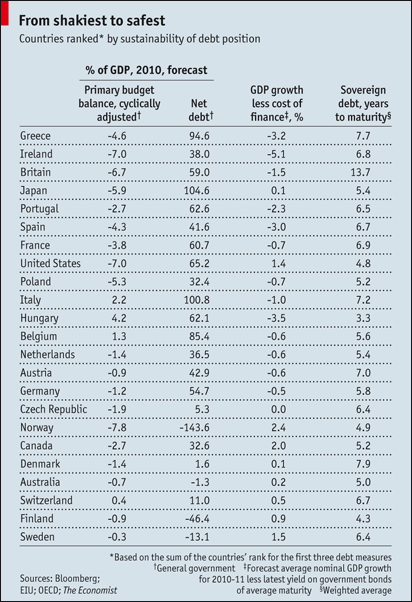
With the Federal Reserve also tightening credit and the Bank of Japan likely to do so before the end of 2006, the world economy faces the first round of synchronized rate increases in six years.

Read More: ECB’s Liebscher Signals June Rate Increase as Economy Picks Up

SocialTwist Tell-a-Friend
Posted by Adam Kritzer | in Central Banks, Euro | No Comments »

ECB: no rate hike in May

Apr. 6th 2006

In the days and weeks leading up today’s meeting of the European Central Bank (ECB), the Euro had begun to gather steam as traders and analysts braced for the bank to signal a rate hike in May. Such a move would be a step towards reducing the differential between European and American interest rates. Jean-Claude Trichet, president of the ECB, had a different agenda, however, delicately warning investors not to expect such a rate hike. Analysts quickly reconfigured their models, hoping that the rate hike will merely be postponed by a month, rather than cancelled. The Financial Times reports:

Market expectations still point to rates of 3.25 per cent by the end of the year, but whereas this was a 100 per cent certainty before Mr. Trichet’s comments, the probability fell to 80 per cent afterwards.

Read More: Euro slips as Trichet douses May hike hopes

SocialTwist Tell-a-Friend
Posted by Adam Kritzer | in Central Banks, Euro | No Comments »

EU economic data may trigger rate hike

Apr. 4th 2006

Headlining a recent spate of economic data was the monthly report on EU manufacturing data, which indicated Euro-area manufacturing is growing at the fastest rate in nearly five years. Echoed by other economic indicators, the data suggests that the European economic recovery is slowly feeding into labor markets. On Thursday of this week, the European Central Bank is scheduled to meet to discuss the future of EU economic policy. The consensus is that the bank will leave rates unchanged at this meeting, but will signal the likelihood of a rate hike in May. The Financial Times reports:

The strength of the indices suggested the stronger growth expected to be shown in gross domestic product figures for the first quarter of 2006 would continue into the second quarter.

Read More: EU manufacturing recovery gathers pace

SocialTwist Tell-a-Friend
Posted by Adam Kritzer | in Central Banks, Economic Indicators, Euro | No Comments »

OPEC diversification gathers momentum

Apr. 1st 2006

In all likelihood, the next couple of years will witness a narrowing of interest rate differentials between the US and Europe. Accordingly, many analysts are predicting risk-averse investors to begin migrating their capital from the US to Europe, which would cause the Euro to appreciate. Leaders of Central Banks have begun to make their own preparations in response to this expected trend. The United Arab Emirates has already announced its intention to increase the portion of its forex reserves held in Euro-denominated assets from 2% to 10%. Other Arab nations, including Iran and Syria, are mulling similar propositions. If these nations ultimately decide to diversify, it could feed back into forex market psychology and hasten the dollar’s decline. Dow Jones News reports:

U.A.E. officials have repeatedly said that if they move out of dollars, it will be because of market dynamics rather than because of politics. Such a move would reduce the risk that the central bank would incur heavy losses should the dollar weaken sharply.

Read More: Threat Of Middle East Reserve Move Stresses The Dollar

SocialTwist Tell-a-Friend
Posted by Adam Kritzer | in Central Banks, Euro, US Dollar | No Comments »

USD harmed by talk of interest rates, diversification

Mar. 30th 2006

Jean Claude Trichet, President of the European Central Bank (ECB) recently cautioned investors to expect EU interest rates to remain at historically low levels in the near-term. Nonetheless, analysts still expect the ECB to raise its benchmark interest rate next month. In fact, interest rate futures, which reflect investors’ collective expectations for future monetary policy, have three rate hikes priced into them. In addition, the last few weeks have seen heightened speculation that Asian and OPEC Central Banks will soon diversify some of their reserves into Euros. Many analysts have opined that the prospective combination of narrowing interest rate differentials and reserve diversification will soon send the dollar on a downward spiral. The Financial Times reports:

The debate was kickstarted by…the central bank of the United Arab Emirates, which may increase the share of its reserves held in euros from 2 to 10 per cent on valuation grounds.

Read More: Dollar dips on narrowing yield gap

SocialTwist Tell-a-Friend
Posted by Adam Kritzer | in Euro, Investing & Trading, US Dollar | No Comments »

Iran Oil Bourse to open in March

Mar. 3rd 2006

Later this month, Iran will inaugurate its much-anticipated oil bourse, whereby it will begin accepting payment for its oil in Euros, instead of in USD. Many analysts are already predicting that the bourse will mark the beginning of the end of the Dollar’s status as the world’s reserve currency. If other oil exporting nations follow the example of Iran, the demand for USD to settle oil purchases will decline. The central banks of these countries could conceivably begin to hold Euros instead of dollars in their foreign exchange reserves, which would deal a major blow to the dollar. FXStreet reports:

[Iran] has declared war on the U.S. Dollar’s world reserve status. That starts on March 20th, 2006 with their new Petro-euro oil bourse. The Fed will stop revealing M-3 on March 23rd, 2006. Coincidence?

Read More: Is the Federal Reserve Preparing for Iran?

SocialTwist Tell-a-Friend
Posted by Adam Kritzer | in Central Banks, Euro, Investing & Trading | 5 Comments »

ECB rate hike buoys Euro

Mar. 2nd 2006

Yesterday, as expected, the European Central Bank (ECB) hiked its benchmark short-term interest rate to 2.5%. It’s hard to believe that only six months ago, the ECB was drawing the ire of all of Europe for not acceding to political pressure to lower interest rates. In contrast, most economists now reckon Europe’s Central Bank will raise rates two or three more times in as many months. The economies of the European Union are showing signs of growth, and inflation is alive and well. As a result, many currency traders are now predicting the Euro will get a nice kick, as foreigners begin to move funds into the Euro-zone to take advantage of higher returns. The Financial Times reports:

“US cyclical support is probably close to a peak, and Trichet’s comments have bolstered a trend that was already in place,” said one analyst, who was sticking by his forecast that the euro would hit $1.25 in three months’ time.

Read More: Red letter day for Euro

SocialTwist Tell-a-Friend
Posted by Adam Kritzer | in Central Banks, Euro | No Comments »

EU GDP may be higher than expected

Feb. 22nd 2006

On paper, the collective economies of the European Union appear stagnant and pathetic, having grown by only 1.6% per year, from 1999-2004. However, it is important to note that when GDP figures are first released, they represent educated guesses, at best. After thorough re-calculation, Euro-area real GDP actually averaged 2.1% in the same time period. Meanwhile, Britain’s economy grew by 2.7% annually during those years, a figure that was revised upwards from 2.1%. As a result, it seems the current performance of the EU economies is being understated, which could provide a case for eventual Euro appreciation. The Economist reports:

On past experience, Europe’s statisticians should add half a percentage point to their first guesses of GDP growth. By also switching to American practices, they could boost growth even further.

Read More: A numbers racket

SocialTwist Tell-a-Friend
Posted by Adam Kritzer | in Economic Indicators, Euro | No Comments »

ECB expected to move ahead with rate hike

Feb. 15th 2006

Despite the continued lackluster performance of the EU’s largest economy, the European Central Bank (ECB) is still expected to raise interest rates next month, for the second time in over five years. Traders were undeterred by the release of economic data, which indicated Germany’s economy stalled over the last quarter and that investor confidence is sagging. Economists still expect the EU economy, as a whole, to grow by 2.3% this year, and further expect the ECB to move ahead with monetary tightening in order to keep pace with inflation. A narrowing interest rate differential between the EU and US will surely benefit the Euro in the short term. AFX News Limited reports:

One economist noted that the [German] economic sentiment indicator points to significant optimism in Germany, providing further evidence that the outlook is relatively bright. “There is nothing here to stop the ECB from raising rates in March,” she added.

Read More: Euro steady as market continues to price in ECB rate hike

SocialTwist Tell-a-Friend
Posted by Adam Kritzer | in Central Banks, Economic Indicators, Euro | No Comments »

ECB suggests rate hike

Feb. 2nd 2006

The European Central Bank met today to discuss the near-term future of European monetary policy. As analysts expected, the ECB left rates unchanged. The body also reinforced analysts’ expectations by hinting it would raise rates at its next meeting, which is scheduled to take place in March. In fact, credit markets have already priced in a 25 basis point rate hike at such a time. While Jean-Claude Trichet, president of the ECB, announced that the performance of Euro-zone economy supported a tightening of monetary policy, he cautioned pundits not to expect multiple rate hikes. Euro bulls are eagerly awaiting the rate hike, which represents a step towards narrowing the interest differential between the EU and the rest of the developed world. Forbes reports:

“The press conference has effectively endorsed the markets expectation for an interest rate rise at the March meeting, without giving further clues as to the likely progression of rates thereafter,” said a …senior FX strategist.

Read More: Euro steady after Trichet hints at March ECB rate hike

SocialTwist Tell-a-Friend
Posted by Adam Kritzer | in Central Banks, Euro | No Comments »

ECB leaves interest rates unchanged

Jan. 16th 2006

At its most recent meeting, the European Central Bank (ECB) elected to maintain interest rates at current levels. While the lack of tightening shouldn’t come as a surprise to anyone, Euro bulls are surely reeling, as an increase in interest rates would have narrowed the differential between the EU and the rest of the world, and likely buoyed the Euro in the process. However, Jean Trichet, President of the ECB hinted towards the possibility of a rate hike at the bank’s next meeting, in March. He cited an economic turnaround in some of the EU’s largest economies, due to a surge in exports. The Wall Street Journal reports:

Recent data from the 12-nation euro-currency zone had confirmed the forecasts made by the ECB and national central banks, implying that a case for gradually tightening monetary policy remains. Many economists expect the ECB to raise rates gradually to 3% by the end of 2006.

Read More: ECB Suggests Rate Increase Is Still Possible

SocialTwist Tell-a-Friend
Posted by Adam Kritzer | in Central Banks, Euro | No Comments »

Euro-index futures contract debuts on NYBOT

Jan. 12th 2006

The New York Board of Trade (NYBOT) recently became the first exchange to offer a futures contract for trade-weighted Euros. Previously, institutions and companies wishing to hedge their exposure to the Euro currency were forced to buy contracts on a specific currency pair (typically the USD-Euro pair). With the advent of this new futures contract, they will now be able to protect themselves against changes in the Euro, relative to a basket of currencies. In addition, individuals who wish to bet solely on or against the Euro, can now do so, without worrying about how the USD will perform relative to the Euro. The Financial Times reports:

The NYBOT contract is based on a weighted average of the euro against five other currencies; the US dollar, sterling, yen, Swiss franc and Swedish krona. This is less comprehensive than the 23 currencies the European Central Bank uses to calculate the euro’s nominal effective exchange rate.

Read More: Nybot set to offer euro contracts

SocialTwist Tell-a-Friend
Posted by Adam Kritzer | in Euro, Investing & Trading | No Comments »

Economic Data may drive ECB rate hike

Jan. 9th 2006

In the last few weeks, the Euro finally broke through a level of resistance, against the USD, appreciating several cents. Whether the Euro continues to trade outside of its range will depend largely on whether the ECB raises interest rates in the next few months. Accordingly, Euro bulls are anxiously awaiting the release of German investor confidence data. While such data seems trivial and would not normally merit serious consideration, currency traders believe data supporting solid growth in Europe’s largest economy could be enough to tip the ECB in favor of hiking rates in the near-term, which would in turn, support the Euro. Bloomberg News reports:

“Amid the prevailing dollar-bearish sentiment, strong data in Germany could surely push up the euro again. Should the index rise more than expected, it will certainly raise expectations for ECB rate hikes,” said one currency strategist.

Read More: Euro May Advance on Speculation German Investor Confidence Rose

SocialTwist Tell-a-Friend
Posted by Adam Kritzer | in Economic Indicators, Euro | No Comments »

Belgium fuels possibility of rate hike

Dec. 30th 2005

In a recent press conference, the ECB’s representative from Belgium hinted that the ECB is ready to raise interest rates for the second time in as many months. When questioned about current interest rate levels, he stressed that rates cannot remain low forever, much to the chagrin of many EU politicians, who want to be certain the EU economies are on solid footing before the cost of borrowing is increased. The Belgian representative also expressed his confidence in the recent performance of the EU economies, and stated that it was important that the EU continue to keep pace with inflation. Bloomberg News reports:

[His] remarks on interest rates and his upbeat assessment of the economic outlook helped push up the euro from a two-year low against the dollar.

Read More: ECB’s Quaden Says Rates Won’t Stay Put `Eternally

SocialTwist Tell-a-Friend
Posted by Adam Kritzer | in Central Banks, Euro | No Comments »

ECB signals further rate hikes

Dec. 23rd 2005

Yesterday, I reported that Central Banks are becoming more transparent in matters of monetary policy. As if on cue, today the European Central Bank and Bank of England offered separate insight into the directions of their respective interest rates. The ECB hinted that it would likely raise interest rates twice in the next year from the current level of 2.25%, while the Bank of England indicated that a cut in its interest rates would take place in March. The corresponding changes in interest rate differentials should benefit the Euro and hurt the British Pound. Reuters reports:

But some analysts see U.S. rate rises stopping there. The latest report about the ECB is seen as likely to boost the euro. “It’s a reminder that not only the Fed but also the ECB is raising interest rates,” said one currency strategist.

Read More: Euro jumps briefly on rate speculation, pound down

SocialTwist Tell-a-Friend
Posted by Adam Kritzer | in British Pound, Central Banks, Euro | 1 Comment »

Rydex introduces currency ETF

Dec. 14th 2005

Rydex Investments has finally introduced its much-anticipated currency ETF, which is the first of its kind. Exchange Traded Funds (ETF), while very similar to trusts and mutual funds, trade on an exchange like shares of stock. One ‘share’ of this particular ETF is equivalent to 100 Euros, currently valued around $120. The ETF will rise and fall in synch with the Euro currency, so investors can buy or sell shares much like they would go long or short actual Euros. The downside to the ETF is that investors will be charged an annual management fee of .4%, assessed monthly. After adjusting for interest, however, this fee will likely be closer to .1-2%. Marketwatch reports:

The Euro Currency Trust, with annual expenses of 0.4% of assets, allows investors to gain exposure to the euro currency, and could also be used as a hedging instrument. According to Rydex, the fund’s sponsor….the fund is eligible for short sale and margin purchases.
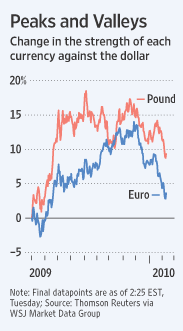
Read More: Euro ETF begins trading

SocialTwist Tell-a-Friend
Posted by Adam Kritzer | in Euro, Investing & Trading | No Comments »

ECB hikes interest rates

Dec. 1st 2005

For the first time in nearly five years, the European Central Bank (ECB) has hiked interest rates, from 2% to 2.25%. Three weeks ago, Jean Trichet, President of the ECB, signaled that the ECB would likely raise rates at its December meeting. For that reason, the markets did not react strongly to the news. Moreover, Trichet cautioned investors not to expect additional rate hikes. However, as inflation is still hovering well above the ECB’s target of 2%, thanks in part to high energy prices, it seems the ECB will likely follow up with another round of rate hikes next month, which should provide broad support for the Euro. The Economist reports:

But Mr. Trichet must tread carefully. Higher interest rates mean a stronger currency, which can hobble the exports crucial to economic recovery in the euro zone.

Read More: Trichet’s dilemma

SocialTwist Tell-a-Friend
Posted by Adam Kritzer | in Central Banks, Euro | No Comments »

ECB interest rate hike no longer guaranteed

Nov. 21st 2005

Last week, Jean Trichet, president of the European Central Bank (ECB), insinuated that investors could reasonably expect the ECB to begin raising interest rates, possibly as soon as December 1. While testifying before the European Parliament’s Committee on Economic and Monetary Affairs, however, he backtracked from his earlier comments, by stating that investors should not expect a “series of rate hikes.” While the exact meaning of his comments is debatable, it seems investors should no longer take monetary tightening for granted. If the ECB raises interest rates at all in the short term, it is likely to do so only once or twice in order to give the economies of the EU plenty of time to adapt to a rising interest rate environment. Meanwhile, currency traders are furious at Trichet for the excessive volatility he injected into forex markets.

Read More: Euro’s gains fade as Trichet reins in rate hopes

SocialTwist Tell-a-Friend
Posted by Adam Kritzer | in Central Banks, Euro, Investing & Trading | No Comments »

ECB about to hike interest rates

Nov. 18th 2005

Due primarily to lackluster investment and economic growth, inflation has not concerned EU central bankers in recent years. Core inflation is a meager 1.3%, well below the EU benchmark interest rate of 2%. Now, however, rising energy prices have begun to affect consumer spending habits as well as raised production costs for many businesses. A great deal of circulation has swirled over whether the ECB will preemptively head off inflation by hiking interest rates at its December meeting. The consensus among economists and EU officials is of overwhelming support for a rate hike for such inflationary reasons. Today, Jean Trichet, President of the ECB confirmed the inevitability of a rate hike, which provided support for the Euro. The Financial Times reports:

Trichet said the ECB was “ready to take a decision to move interest rates and moderately augment the present level of intervention rates in order to take into account the level of risks to price stability”.

Read More: Euro fights back as Trichet signals rate hike

SocialTwist Tell-a-Friend
Posted by Adam Kritzer | in Central Banks, Euro | No Comments »

Eastern Europe prepares to adopt Euro

Nov. 14th 2005

In the next few years, a bevy of eastern European countries are scheduled to adopt the Euro, and EU officials are already beginning to make the appropriate preparations. Estonia will be first (2007) followed by Slovakia (2008) with Latvia, Lithuania, Slovenia, Czech Republic, Hungary, and Poland slated to adopt shortly thereafter. While the economies of eastern Europe are small in comparison to those nations currently on the Euro, their presence will nonetheless be felt for an important reason: inflation. The collective economic stagnation of western Europe has resulted in low rates of domestic inflation. The economies of eastern Europe, in contrast, have boomed in the last few years, spurring high rates of inflation. Once these nations adopt the Euro, the ECB may begin to think critically about the risks posed by inflation. The Economist reports:

Estonia, due to adopt the euro on January 1st 2007, is a rare economic star by the debt-drenched, slow-growing standards of the euro zone. Whereas growth in the euro area is well under 2%, Estonia’s economy last quarter expanded at a cracking 9.9% annual rate.

Read More: Flights to Frankfurt

SocialTwist Tell-a-Friend
Posted by Adam Kritzer | in Euro, Politics & Policy | No Comments »

Civil unrest in France threatens Euro

Nov. 8th 2005

For almost two weeks, France has been plagued by rioting, who have burned vehicles by the thousands and clashed with police. Economists and political analysts are now beginning to asses the political and economic implications of the civil unrest. Several have speculated that the rioting will spread to neighboring European countries, which would significantly disrupt the Euro-zone economy. Currency traders are also beginning to react to the riots, in theorizing that they are indicative of negative sentiment towards the French economy. If these riots are not soon quashed, the Euro will likely continue to suffer. Reuters reports:

“Concerns about the ongoing riots in France, to the extent they are a reflection of the social consequences of prolonged anemic growth in the eurozone, may also be playing some role in limiting the euro’s ability to benefit from improved interest rate support.”

Read More: Dollar reaches 2-year high against euro

SocialTwist Tell-a-Friend
Posted by Adam Kritzer | in Euro, Investing & Trading | 1 Comment »

Why have the US and EU economies diverged?

Nov. 4th 2005

Over the last decade, the US economy has grown on average by 3% per year. Over the same period, the economies of the EU have collectively grown by 2%. In a new research paper, two prominent economists have attempted to make sense of this disparity. There theory is multifold, taking into account differences in government, education, and monetary policy. It is a combination of these three structures, they argue, that has driven the US economy to outperform that of the EU, and by extension, the perennial strength of the USD.

First, the US government is largely laissez-faire, meaning it attempts to allow capitalism and free markets to flourish, whenever possible. EU governments, in contrast, have attempted to implement socialist policies within a capitalist framework, including protectionist economic policies and jobs protections, which detract from economic growth. Next, the US government spends more money on education than their EU counterparts, and relatively more Americans have advanced degrees than Europeans. Finally, American policy makers have attempted to use monetary and fiscal policy to smooth business cycles (dampen the highs and raise the lows), whereas EU governments have turned to such tools of economic policy only when their economies need stimulating. The moral of the story is that the US has done a much better job than the EU over the last decade in facilitating economic growth. At the same time, this paper has outlined steps for EU governments to improve their respective economies.

SocialTwist Tell-a-Friend
Posted by Adam Kritzer | in Economic Indicators, Euro, US Dollar | 2 Comments »

ECB cools speculation over rate hike

Nov. 3rd 2005

When Jean-Claude Trichet, President of the European Central Bank (ECB), hinted several weeks ago that the ECB was poised to raise interest rates, the Euro immediately jumped almost 2%. Today, however, Trichet sang a different tune, insisting a hike in interest rates was not indeed imminent. The announcement clearly came as a shock to economists and investors, many of whom had predicted the ECB would raise rates for the first time in two years, on the basis of Trichet’s earlier comments. According to the ECB, interest rates are at an appropriate level, whereby inflation is contained without constraining economic growth. Bloomberg News reports:
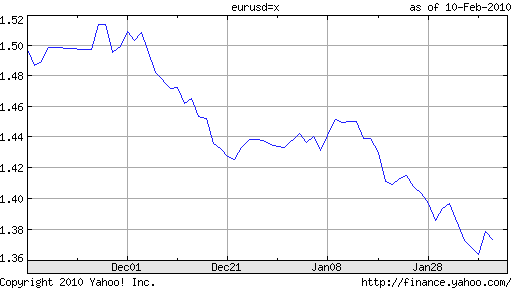
“Trichet was expected to be quite hawkish, so the euro is being sold on disappointment with the more dovish comments…The market will now be looking for signs that the rate hike [will happen in] December.”

Read More: Euro Drops as Trichet Damps Speculation About Rate Increases

SocialTwist Tell-a-Friend
Posted by Adam Kritzer | in Central Banks, Euro | No Comments »

Tony Blair tries to spark the EU economy

Nov. 1st 2005

The performance of the collective EU economy has been nothing short of pathetic in the last few years, and is set to grow at only 1.5% this year. As the current leader of the EU, British Prime Minister Tony Blair has been charged with spearheading the Euro-area economic turnaround. He has proposed a comprehensive plan for structural reforms, including less job security, fewer social safety nets, and government subsidized spending on research & development. It has been theorized that the socialized policies of the EU create few incentives to work and have resulted in massive unemployment. If EU member countries eliminate certain job protections, thereby restoring this incentive to work, it may ignite their respective economies and spark the Euro in the process. The Economist reports:

Growth has consistently lagged behind America’s in recent years, particularly in continental Europe, where unemployment rates often hover near double digits (well above 10% in the cases of Germany and Belgium).

Read More: When growth and social protections clash

SocialTwist Tell-a-Friend
Posted by Adam Kritzer | in Euro, Politics & Policy | No Comments »

Merkel to become Chancellor of Germany

Oct. 13th 2005

Investors around the world have been waiting anxiously for the outcome of the political deadlock that emerged from last week’s national elections in Germany. It was finally revealed that the challenger, Angela Merkel, will assume the position of Chancellor, as Gerhard Schroeder steps down. This did not come without compromise, however, as Merkel’s Christina Democratic Party was forced to build a “Grand Coalition” and share power with other political parties. While Merkel’s eventual victory will no doubt be good for Germany, it may be very difficult for her to push her reform agenda through the other parties involved in the power-sharing arrangement. The Economist reports:

Ms Merkel will struggle to implement the main planks of her proposed reform programme: lower non-wage labour costs, further labour-market reforms…and radical tax reform.

Read More: Merkel clinches it, but the price is high

SocialTwist Tell-a-Friend
Posted by Adam Kritzer | in Euro, Politics & Policy | No Comments »

ECB weighs growth and inflation

Oct. 6th 2005

In a somewhat surprising move, the European Central Bank (ECB) has opted to hold its benchmark interest rate at 2%. The ECB has found itself in the precarious position of trying to reconcile the risks of inflation with prospects for growth in conducting its monetary policy. Due in part to rising fuel prices, Euro-area inflation has reached a 1-year high, at 2.5%. Meanwhile, growth prospects are also improving as domestic consumption and exports pick up. While a few prominent economists have called on the ECB to lower interest rates, the ECB rarely bows to external pressure. The Financial Times reports:

Although Jean-Claude Trichet was expected to take a more hawkish tone in the afternoon press conference, highlighting inflationary pressures, the threat of weakening growth remains and few analysts expect any upward move for rates until well into next year.

Read More: ECB keeps rates at 2% despite inflation risk

SocialTwist Tell-a-Friend
Posted by Adam Kritzer | in Central Banks, Euro | 2 Comments »

Euro Plunges due to political deadlock

Sep. 19th 2005

The German elections are now history, and any prospects for economic reform are all but lost. Most political commentators agree that the near-split between Merkel and Schroeder represents the worst-case scenario for Germany, from the perspective of reform. In fact, it is still unclear as to who the official Chancellor of Germany is, as both candidates have separately claimed victory. Regardless of who ultimately prevails, it seems the most plausible outcome will be a sort of ‘grand coalition,’ in which several parties share power. In any event, Germany will likely fail to achieve meaningful economic reforms. Fundamental and technical analysts alike have already proclaimed the Euro will suffer. The Financial Times reports:

The euro was pummelled by investors as political chaos loomed in Germany after the weekend election failed to provide a clear winner. The euro sank to a low of $1.2101, a decline of about 1.6 per cent from Friday’s intra-day high.

Read More: Euro falls as German political chaos looms

SocialTwist Tell-a-Friend
Posted by Adam Kritzer | in Euro, Politics & Policy | No Comments »

“Politischer stillstand” continues to drag down Euro

Sep. 17th 2005

‘Politischer stillstand,’ a German phrase which translates literally into ‘political gridlock,’ perfectly characterizes the current German political situation. Investors and traders are becoming increasingly concerned that one of two scenarios will emerge following the election. First, Gerhard Schroeder could win, and forestall the implementation of much-needed structural and economic reforms. Second, if either Merkel or Schroeder win by a slight margin, and no clear-cut majority is produced, it could also sabotage any attempts at reform. It seems, therefore, that only a clear Merkel victory will be enough to reverse the Euro’s recent declines. You can bet currency traders will be waiting anxiously for the results of the election, which will likely determine the short-term course of the Euro. The Wall Street Journal reports:

The election victors will almost certainly have to make concessions to form a coalition, which could hinder its ability to deliver on its most ambitious promises for economic overhaul.

Read More: Euro Falls Anew Amid Uncertainty Over German Vote

SocialTwist Tell-a-Friend
Posted by Adam Kritzer | in Euro, Politics & Policy | No Comments »

Euro falters amid German political concerns

Sep. 15th 2005

German elections are scheduled for this weekend, and currency traders are beginning to price their predictions into the forex markets. The consensus implications for the Euro are as follows: a Gerhard Schroeder victory will likely send the Euro reeling, while an Angela Merkel victory will likely prop of the currency. Schroeder is the incumbent German Chancellor, and Merkel is the challenger. Investors generally feel a Merkel victory will benefit the German economy, for she has promised to implement certain structural reforms intended to revive Germany’s ailing economy. Regardless of who wins, you can expect significant Euro volatility in the days following the election. The Wall Street Journal reports:

“Germany faces the risk of a political deadlock after the elections . . . this doesn’t bode well for further reforms in Germany and therefore could weigh on the euro,” said a senior currency strategist.

Read More: Euro Falls on Views on Election

SocialTwist Tell-a-Friend
Posted by Adam Kritzer | in Euro, Politics & Policy | 2 Comments »

Renewed Faith in Euro

Aug. 26th 2005

Forex markets are arguably the least predictable of all capital markets. Traders and investors must reconcile technical analysis with economic indicators with fundamental considerations, which frequently paint vastly different pictures. This week, it seems forex traders have had a collective change of heart, abandoning the USD and embracing the Euro. Traders bullish on the Euro argue that a host of economic indicators and political developments reveal the EU economy is improving as politicians prepare to enact much-need structural reforms. Additionally, money managers are now touting the Euro as a ‘defensive play,’ due in part to rising natural resource price. The Financial Times reports:

Mounting international confidence in the prospects for the eurozone was neatly encapsulated by portfolio flows data released earlier in the week, which showed the eurozone attracted net inflows into its equity and bond markets.

Read More: Increasing optimism buoys euro

SocialTwist Tell-a-Friend
Posted by Adam Kritzer | in Euro, Investing & Trading | No Comments »

‘RedTower’ deemed most accurate currency forecaster

Aug. 24th 2005

According to Bloomberg news, RedTower, a small Scottish money manager, was the most accurate currency forecaster last year. In a survey conducted among institutional forex traders, RedTower correctly predicted the Euro would fall to $1.22, while the most other analysts forecasted a prolonged period of appreciation. RedTower claims its prediction was largely based on international disparities in the price of beer, proving that inspiration can come from the most unexpected places. In the same survey, however, RedTower managers forecasted the price of oil would not reach $45 by year-end. So much for clairvoyance… Bloomberg news reports:
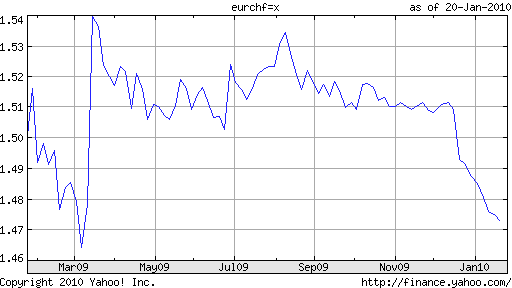
It was the first time Redtower topped the ranking for currency forecasts, according to Bloomberg data. Bank of Tokyo Mitsubishi, HBOS Plc and Credit Suisse First Boston came second, third and fourth, respectively.
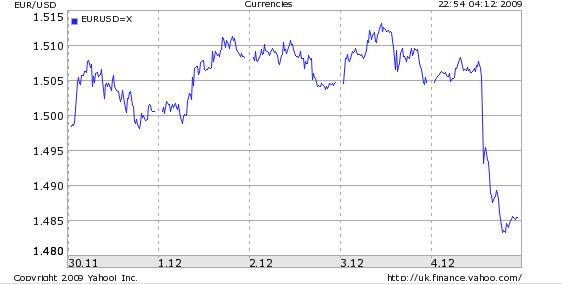
Read More: Winning Dollar Forecaster Gains Insights Drinking Dutch Beer

SocialTwist Tell-a-Friend
Posted by Adam Kritzer | in Euro, Investing & Trading | No Comments »

Euro buoyed by economic data

Aug. 22nd 2005

It seems the dog days of summer have set it. Capital markets are trading sideways, amid a veritable absence of new developments. It is in this climate that the release of European portfolio data is enough to light a spark in currency markets. According to reports, foreigners poured $140 Billion into European capital markets, in June alone. Many traders are confident that these portfolio inflows and the recent strong performance of European equities will provide a floor for the Euro currency. Others are counting on Asian Central Banks to prop up the Euro, by continuing to diversify their vast foreign exchange holdings.
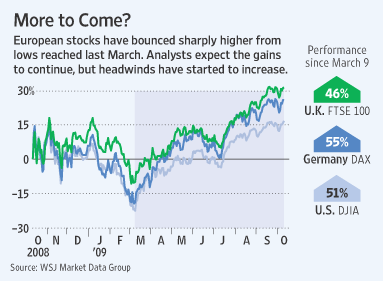
With the eurozone equity market continuing to perform strongly and suggestions that July’s Chinese revaluation may precipitate further reserve diversification into the euro, “global capital flows should be supportive of the euro through the second half of 2005.”

Read More: Euro rallies as portfolio flows jump

SocialTwist Tell-a-Friend
Posted by Adam Kritzer | in Economic Indicators, Euro | No Comments »

IMF warns of slowing growth in EU

Aug. 11th 2005

The International Monetary Fund (IMF) recently reported on the prospects for growth in Euro-area economies. The report reinforced what most economists have argued for months: growth is slowing in the EU. The IMF now forecasts 2005 real GDP growth of 1.3% for the Euro, down from earlier forecasts of 1.9%. In comparison, it is expected the US economy will achieve 3.5% growth this year. The IMF also expects inflation in the Euro-area to decline. While it now seems that all of the pieces are in place for a cut in interest rates, the ECB voted last week to maintain current interest rate levels. It seems the Bank is simply resistant to economic logic. Xinhua News reports:

The IMF urged euro-zone governments to cut their budget deficits. It also warned that the euro-zone’s economic recovery remains vulnerable to soaring oil prices or the euro’s further appreciation.

Read More: IMF cuts economic growth forecasts for euro-zone

SocialTwist Tell-a-Friend
Posted by Adam Kritzer | in Economic Indicators, Euro | No Comments »

Will the ECB ever lower rates?

Aug. 5th 2005

European politicians, desperate to deflect negative attention, have repeatedly blamed the European Central Bank (ECB) for the economic woes of EU members. They argue that the ECB is unnecessarily targeting inflation, when it should be stimulating growth. Is the ECB responsible for the lackluster growth of the EU, and should it lower rates? The answer to both questions is ‘maybe.’ Tight fiscal policies and a strong Euro deserve at least some of the blame. The problem, argues one analyst, is not with the ECB’s monetary policy, itself, but rather the way in which it is communicated to the public. There is a fundamental lack of transparency and clarity in central bank decision making, which has the unintended consequence of confusing investors and consumers. The Economist reports:

While the ECB’s prime task is price stability, it is also legally charged with supporting growth. Last year it could have cut interest rates to offset the impact of the rising euro; today it should stand ready to ease monetary policy to cushion the impact of structural reform and fiscal discipline.

Read More: Less bashing, please

SocialTwist Tell-a-Friend
Posted by Adam Kritzer | in Central Banks, Euro | No Comments »

Father of the Euro currency found dead

Aug. 1st 2005

Wim Duisenberg, former head of the European Central Bank, passed away at age 70. Mr. Duisenberg served this position from 1998 until 2003, during which he steered the multi-sate adoption of the Euro common currency. He has since been replaced by Jean-Claude Trichet. Economists and politicians continue to argue over who deserves the brunt of the blame for the Euro’s current troubles. However, all agree that Mr. Dusienberg should be commended for his leadership, in successfully implementing the Euro-system without agreement on economic and monetary policy. The Fiancial Times reports:

On Sunday a European Commission spokesman said: “As the first president of the European Central Bank Mr Duisenberg played a decisive role in the building of the monetary union and to the success of the introduction of the euro. “His dedication and determination as the head of the ECB allowed for the rapid establishment of the independence, credibility and competence of this institution.”

Read More: Enemy of inflation who steered euro

SocialTwist Tell-a-Friend
Posted by Adam Kritzer | in Euro | No Comments »

Euro on the verge of dissolving?

Jul. 18th 2005

After the French and Dutch rejection of the EU Constitution, many policy-makers have started to question the sensibility of a European economic union and the concomitant Euro currency. Lately many leaders have come forth and publicly criticized the Euro, blaming the currency for their respective economic woes. A new survey by two prominent HSBC economists asserts that a breakup of the Euro will become increasingly likely, if certain structural reforms are not implemented. The report goes on to argue that the nations that comprise the EU are too fundamentally different to warrant a common currency. The one-size-fits-all monetary policy has proved especially damaging, as interest rates cannot be adjusted in response to civerging regional economic conditions. The result is growing economic disparity. The economies of Germany and the Netherlands are languishing; meanwhile, bubbles are forming in regional property and asset markets, spurred by unnaturally low interest rates. Unless a miraculous economic turnaround is staged, it seems EU leaders may succumb to popular pressure and dissolve the Euro. The Guardian Unlimited reports:

It is worth remembering that there were huge legal and practical problems over creating the euro in the first place. But those were overcome. It would therefore be foolish to exclude the possibility that the euro may at some point lose members or even break up altogether.

Read More: Stop the euro - we may want to get off

SocialTwist Tell-a-Friend
Posted by Adam Kritzer | in Euro, Politics & Policy | No Comments »

EU problems plague Asian Central Banks

Jun. 24th 2005

Asian Central Banks currently hold over $2 trillion Dollars in foreign exchange reserves, 70-75% of which are USD-denominated securities.  As the USD precipitously declined in value over the last few years, Central Banks lost tens of billions of dollars in relative terms.  As a result, many began to ponder the diversification of their reserves into other major currencies, such as Euros or Yen. In fact, for the last year, many Central banks have begun to slow their purchases of US Treasury securities- without going so far as to sell existing securities.  With all of the turmoil surrounding the Euro, Central Banks have begun to reevaluate this strategy.  Central banks are not "traders;" they are not concerned with short-term currency fluctuations.  What do concern them, however, are long-term trends such as the political uncertainty surrounding the future of the EU. While it is not likely that the EU will abandon the Euro, it is possible that certain nations will back out. Dow Jones news reports:

And at the very least, the political turmoil in the E.U. has raised questions about whether the diverse, 25-nation group can efficiently manage a unified economy and a common currency. Because of the turmoil, central banks have turned "euro-neutral from euro-positive", the Tokyo foreign exchange dealer said.

Read More: Threats To Euro Could Slow Asia Reserves Diversification

SocialTwist Tell-a-Friend
Posted by Adam Kritzer | in Central Banks, Euro, US Dollar | 2 Comments »

Euro’s decline plaguing Central Banks

Jun. 24th 2005

Asian Central Banks currently hold over $2 trillion Dollars in foreign exchange reserves, 70-75% of which are USD-denominated securities.  As the USD precipitously declined in value over the last few years, Central Banks lost tens of billions of dollars, in relative terms.  As a result, many began to ponder the diversification of their reserves into other major currencies, such as Euros or Yen. In fact, for the last year, many Central banks have begun to slow their purchases of US Treasury securities- without going so far as to sell existing securities. 

With all of the turmoil surrounding the Euro, Central Banks have begun to reevaluate this strategy.  Central banks are not "traders;" they are not concerned with short-term currency fluctuations.  What do concern them, however, are long-term trends such as the political uncertainty surrounding the future of the EU. While it is not likely that the EU will abandon the Euro, it is possible that certain nations will back out. And this presents a potential problem for Central Banks holding Euros. Dow Jones news reports:

And at the very least, the political turmoil in the E.U. has raised questions about whether the diverse, 25-nation group can efficiently manage a unified economy and a common currency. Because of the turmoil, central banks have turned "euro-neutral from euro-positive", the Tokyo foreign exchange dealer said.

Read More: Threats To Euro Could Slow Asia Reserves Diversification

SocialTwist Tell-a-Friend
Posted by Adam Kritzer | in Central Banks, Euro, US Dollar | No Comments »

Euro’s decline plaguing Central Banks

Jun. 24th 2005

Asian Central Banks currently hold over $2 trillion Dollars in foreign exchange reserves, 70-75% of which are USD-denominated securities.  As the USD precipitously declined in value over the last few years, Central Banks lost tens of billions of dollars, in relative terms.  As a result, many began to ponder the diversification of their reserves into other major currencies, such as Euros or Yen. In fact, for the last year, many Central banks have begun to slow their purchases of US Treasury securities- without going so far as to sell existing securities. 

With all of the turmoil surrounding the Euro, Central Banks have begun to reevaluate this strategy.  Central banks are not "traders;" they are not concerned with short-term currency fluctuations.  What do concern them, however, are long-term trends such as the political uncertainty surrounding the future of the EU. While it is not likely that the EU will abandon the Euro, it is possible that certain nations will back out. And this presents a potential problem for Central Banks holding Euros. Dow Jones news reports:

And at the very least, the political turmoil in the E.U. has raised questions about whether the diverse, 25-nation group can efficiently manage a unified economy and a common currency. Because of the turmoil, central banks have turned "euro-neutral from euro-positive", the Tokyo foreign exchange dealer said.

Read More: Threats To Euro Could Slow Asia Reserves Diversification

SocialTwist Tell-a-Friend
Posted by Adam Kritzer | in Central Banks, Euro, US Dollar | No Comments »

Britain, EU contemplate rate cuts

Jun. 23rd 2005

Britain recently became the latest European nation to entertain the possibility of interest rate cuts.  In its last meeting, held earlier this month, two of the Bank of England’s nine governors voted to cut the federal interest rate by 25 basis points to 4.25%.  There were other members who felt the interest rate cuts made economic sense, but should not be carried out because they would not be widely expected.  Additionally, the minutes from the most recent ECB meeting reveals it, too, is giving serious consideration to rate cuts.  Investors and traders, alike feel rate cuts by both central banks are becoming increasingly likely, reflected in changing bond prices.  The Financial Times reports:

On Wednesday the December Euribor future hit a record high, with the market pricing in about a 40 per cent chance of a cut in eurozone interest rates by the year’s end.  The euro has fallen 5 per cent on a trade-weighted basis since the start of the year, a sign of poor economic prospects, leading to market expectations of rate cuts.
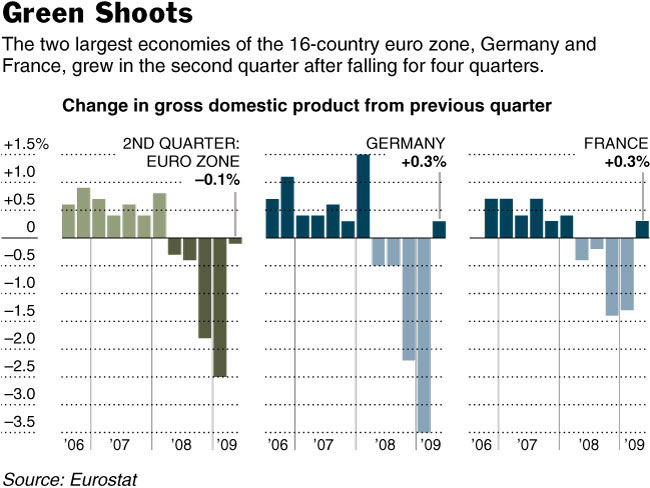
Read More: Central banks flag rate cuts

SocialTwist Tell-a-Friend
Posted by Adam Kritzer | in British Pound, Central Banks, Euro | No Comments »

ECB may finally cut interest rates

Jun. 21st 2005

In response to signs its economy may be slowing, Sweden’s Central Bank lowered domestic interest rates to 1.5%, which is a record for the small Scandinavian nation. Sweden is one of several European countries, not on the Euro, that recently cut rates. The move may provide impetus for the European Central Bank (ECB) to do the same. Economists and high-ranking EU officials have been publicly urging the ECB to cut rates, as the largest European economies collectively stagnate. Nonetheless, the president of the ECB has repeatedly ruled out the possibility of rate cuts, arguing current rates are neutral, given inflation and growth levels. Meanwhile, uncertainty over the future of the EU abounds. Several prominent investment banks are forecasting a period of continued decline for the Euro. Goldman Sachs, for example, has set a year-end target of $1.10 for the Euro. The Financial Times reports:

It was the euro that bore the brunt of the bearish sentiment, suffering from “guilt by loose association…” The euro “remains acutely sensitive to indications the ECB might cut rates,” added Mr Mohi-uddin. 

Read More: Euro slides further on rate cut talk

SocialTwist Tell-a-Friend
Posted by Adam Kritzer | in Central Banks, Euro | No Comments »

Italy ponders return to Lira

Jun. 15th 2005

Last week, Italy’s welfare minister suggested the Euro was responsible for Italy’s economic malaise and urged a return to the Lira. This week, he announced plans to circulate a petition calling for just that, and will soon begin to collect the necessary signatures.  What is the likelihood of his plan being brought to fruition?

On one hand, many Italians are fervently against the Euro, scapegoating it for the nation’s economic problems. On the other hand, as a member of the Euro common currency system, Italy is able to take advantage of extremely low interest rates on the debt it services, saving billions of dollars per year.  A return to the Lira would be accompanied by a rise in interest rates, and increased expenditure on debt service. Italy’s Prime Minister, Silvio Berlusconi, is currently abstaining from the debate, although he is undoubtedly in support of the Euro.  The Economist reports:

The League’s campaign helps to deflect the blame from his government and towards Brussels, which this week began proceedings against the Italian government for running an excessive budget deficit.  Mr Berlusconi may choose not to jump on board the League’s ill-conceived bandwagon, but nor is he rushing to stand in its way.
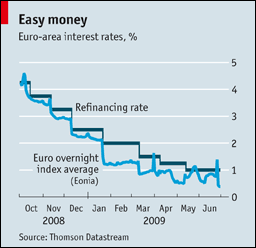
Read More: That Lovely Lira

SocialTwist Tell-a-Friend
Posted by Adam Kritzer | in Euro | 1 Comment »

An easy way to trade the Euro
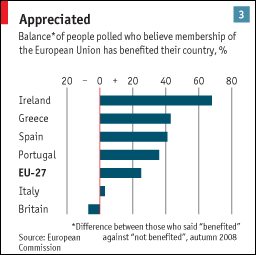
Jun. 9th 2005

Rydex funds has filed an application with the SEC for the first currency ETF, which will trade on the NYSE under the symbol "FXE." Short for ‘exchange traded fund,’ ETFs are typically index funds which can be bought and sold much like stocks. This particular ETF will purportedly mimic the Euro, and will allow traders to place bets on the Euro as though they were trading the currency, itself. There are a few notable differences, however. ETFs are subject to certain taxes and commissions, unlike direct currency trading. In addition, traders will not be able to achieve the same amount of leverage (buying on margin). CBS Marketwatch reports:
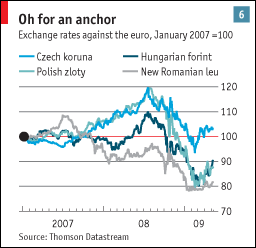
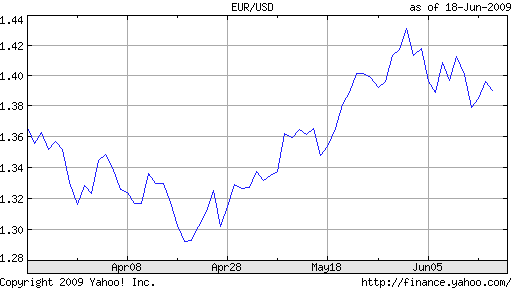
Traditional foreign-exchange accounts…typically offer 100-to-1 leverage. With the ETF, most investors will be limited to traditional margin requirements, which at best offer a two-to-one ratio.

Read More: First Currency ETF Filled

SocialTwist Tell-a-Friend
Posted by Adam Kritzer | in Euro, Investing & Trading | No Comments »

The woes of the Euro

Jun. 9th 2005

The saga of the battered Euro is far from over. In the wake of French and Dutch rejection of the Constitution, politicians are examining whether the Euro should continue to exist. Many experts are renewing their objections to the Euro, on the grounds that it is not appropriate for a region as large and diverse as the EU to share a common currency. The universal monetary and fiscal policies applied equally to different economies has a resulted in dangerous imbalances. Perennially low interest rates have stimulated the economies of some EU nations to the point of overheating. Meanwhile, Europe’s largest economies are stagnating, as the strength of the Euro has hurt exports. The Euro has also failed to integrate Europe’s vast labor and capital and labor markets, which originally served as the pretext for monetary union. It seems the economies of Europe are fundamentally too different to merit a common currency. The Economist reports:

Unfortunately for euro-boosters, recent policy moves have all been in the wrong direction. Not only has the stability and growth pact, which was supposed to help force fiscal policies into rough alignment, been weakened.

Read More: Can this union be saved?

SocialTwist Tell-a-Friend
Posted by Adam Kritzer | in Euro | No Comments »

Croatia’s Euro peg comes under fire

Jun. 7th 2005

Croatia’s national currency, the Kuna, is currently pegged to the Euro. The currency is constrained by bands, which prevent it from fluctuating more than 15% against the Euro. The Central Bank has announced that it may not longer be able to support the peg, but the reason is not intuitive. Amateur economists might consider the recent drama surrounding the EU and the Euro’s subsequent depreciation, but this would be incorrect. The true reason is a gradual inflow of capital into Croatia has exerted upward pressure on the Kuna.  Spurred by higher interest rates, many banks have exchanged Euros for Kunas, driving the currency to new highs against the Euro. In response, Croatia’s Central Bank has flooded the market with Kunas, to ’sterilize’ the capital inflows and prevent the currency from appreciating.  The Central Bank, however, has informed the public that this type of intervention cannot be sustained. The Financial Times reports:

[A representative of the Central bank] added that the current arrangement, which permits the kuna to float against the euro within a 15 per cent "price corridor" could not be preserved unless market forces were restrained. The system is sustainable, but the costs of sustaining it are higher and higher," he said.

Read More: Croatia’s central bank fights pressure on euro-peg

SocialTwist Tell-a-Friend
Posted by Adam Kritzer | in Central Banks, Euro | No Comments »

FREE Daily Updates

Enter your email address:

Delivered by FeedBurner

Subscribe

Add to Google
Add to My Yahoo!
Add to MyMSN
Subscribe at NewsGator Online
Subscribe at Bloglines
RSS Feed

© 2004 - 2009 Forex Blog.org. Currency charts © their sources. While we aim to analyze and try to forceast the forex markets, none of what we publish should be taken as personalized investment advice. Forex exchange rates depend on many factors like monetary policy, currency inflation, and geo-political risks that may not be forseen. Forex trading & investing involves a significant risk of loss.