Forex Blog: Currency Trading News & Analysis.

Archive for the 'Swiss Franc' Category

SNB: Intervention Back on the Table

Jan. 26th 2010

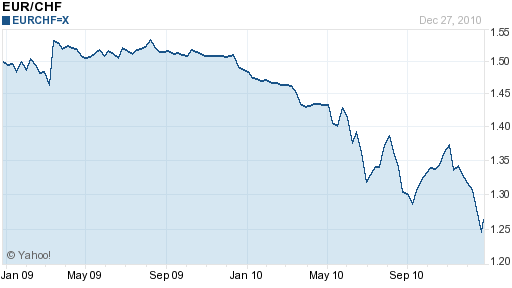
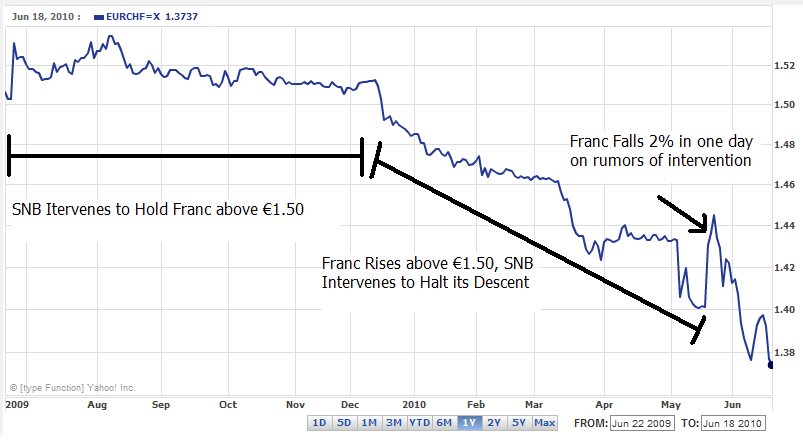
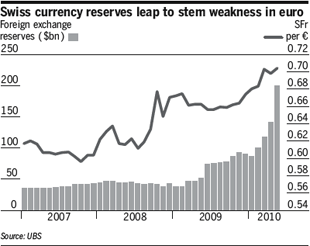
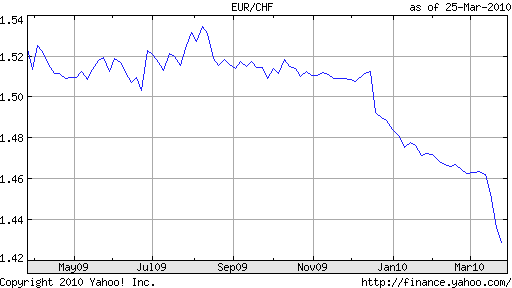
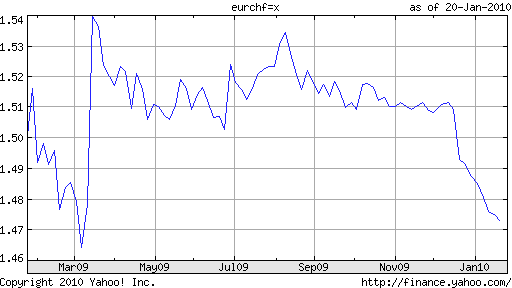
Pull up a 1-year chart of the Euro against the Swiss Franc, and you’ll quickly notice a salient trend: the exchange rate has hovered slightly above €1.50 since last March, with three notable deviations. The first occurred last March, when the Swiss National Bank (SNB) intervened in currency markets on behalf of the Swiss Franc, causing the Franc to shoot up instantly by more than 5%. The second took place in June, when the SNB threatened (it may or may not have actually intervened) intervention again, and the Franc shot up in order to create a buffer zone. The final deviation can be seen at the end of December, when a generalized decline of the Euro also manifested itself against the Swiss Franc, as it fell significantly below the €1.50 threshold.

Euro - Swiss Franc 2009 -2010
It’s not clear whether €1.50 was ever conveyed by the Swiss National Bank explicitly, or whether it was merely accepted implicitly by the forex markets. Regardless, traders certainly respected this boundary, and for most of 2009, dared not challenge it. At the end of December, as I said, there were two important developments, which bore on the EUR/CHF cross. First, credit downgrades and the (far-off) prospect of sovereign default in the EU set loose a wave of panic, after which the Euro has generally fallen. The second development was a subtle change in the wording of the SNB’s forex policy. Previously, it had promised to prevent any “appreciation” in the Swiss Franc, whereas now it is only interested in stopping an “excessive” appreciation.

It’s not clear whether the Swiss Franc suddenly blasted through the €1.50 because investors believe(d) it was undervalued, or if instead it merely got caught up in the Euro’s weakness. Perhaps, investors realized that now they had an excuse to sell the Euro and no longer had to worry about whether actually doing so would risk provoking the SNB. It was probably a combination of both.

For its part, the SNB (through its President and chief mouthpiece Philipp Hildebrand) is already sending subtle clues to the forex markets about the Franc’s prospects. Hildebrand recently told reporters both that “Raising interest rates would be inappropriate,” and “Since the recovery is still fragile, the current expansionary monetary stance will need to be maintained until the recovery strengthens and deflationary pressures recede.” In other words, those that bet on Franc’s appreciation shouldn’t expect any return on their investment, in the form of higher interest rates.

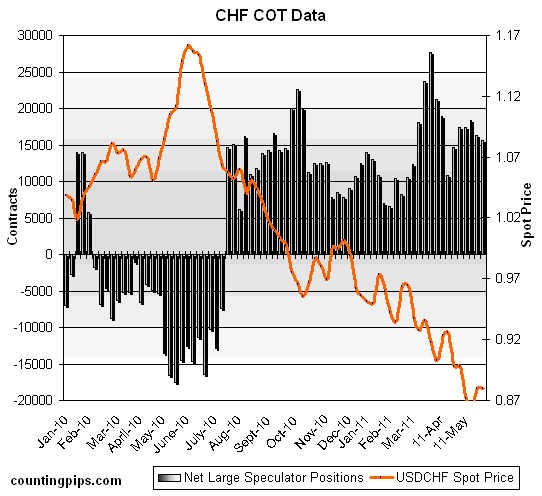
He also reiterated the SNB’s stance on the Franc more explicitly: “Our policy is clear: we will resolutely prevent an excessive appreciation as long as there are deflationary risks.” Given that the markets called his bluff in December, investors are unfazed: “The difference in the number of wagers by hedge funds and other large speculators on an advance in the franc compared with those on a drop, so-called net longs, was 13,926 on Jan. 12 compared with net shorts of 2,780 a week earlier.”

In all likelihood, the Franc will continue to hover around €1.50, only below that barrier, rather than above it. As long as the Franc remains basically stable, either in literally not moving, or in appreciating at a snail’s pace, the SNB probably won’t get involved. After all, the change in wording to its forex policy is a tacit admission that €1.50 is arbitrary and that perhaps the Franc could stand to gain a little bit, especially in the context of the EU fiscal issues. Not to mention that intervention is expensive and ineffective in the long-term.

If traders really get ahead of themselves, though, Hildebrand has already proven that he’s not afraid to act.

http://www.forexblog.org/2009/03/swiss-bank-fulfills-promise-of-forex-intervention-franc-collapses.html
SocialTwist Tell-a-Friend
Posted by Adam Kritzer | in Euro, Swiss Franc | No Comments »

SNB Could Intervene…Again

Sep. 29th 2009

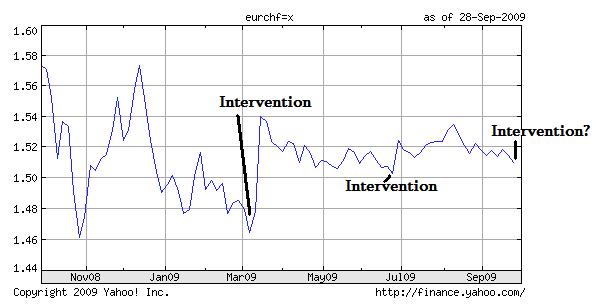
After a brief “hiatus,” the Swiss Franc is once again rising, and is now dangerously close to the $1.50 CHF/EUR “line in the sand” that spurred the last two rounds of Central Bank Intervention.

Both from the standpoint of the Swiss National Bank (SNB) the Franc’s appreciation is vexing, while from where ordinary investors are sitting, it’s downright perplexing. That’s because based on the standard litany of factors, the Franc should be falling.

SNB Swiss Franc Intervention
The Swiss economy remains mired in its worst recession in 17 years, and is projected to shrink by at least 2% this year. In addition, deflation has already set in, with prices falling at an annualized rate of .8%. To be fair, signs of recovery are emerging, and a plurality of economists believe that growth will return in 2010, as will inflation.

But downside economic risks remain, namely the worsening labor market. There is also the fact that the Swiss economy remains heavily weighted towards exports, the demand for which remains slack. From a comparative standpoint, though, projections of recovery are not unique to Switzerland. Financial markets have long since stabilized in most industrialized countries, which many have interpreted as a harbinger for better things to come.

On the monetary front, Swiss interest rates remain among the lowest in the world, as the SNB has gradually guided its benchmark lending rate to .25%. It is also in the process of expanding its quantitative easing program, by pumping liquidity directly into the credit markets, in order to mitigate against deflation. In this sense, the SNB is arguably behind the curve. In the US and EU, for example, speculation is already mounting that interest rate hikes will take place as soon as 2010. Economists are less concerned about a shortage of liquidity in those economies, and more nervous about how the potential excess of liquidity can be withdrawn from the financial system before it turns into a problem. Economists in Switzlerland aren’t even close to beginning to have that conversation.

According to the SNB, the problem lies in the Swiss Franc, which has remained oddly buoyant. While capital has flowed out of the US, for example, it actually seems to flowing into Switzerland. Members of the SNB have attributed this to the “safe haven,” notion, whereby investors still view the country as a safe haven from the financial turmoil. Perhaps slightly irrational, but real nonetheless.

Despite strong rhetoric and equally strong action, the Franc has slowly edge back to the 1.50 mark. Policymakers have pledged to defend the currency vigorously, and it now appears as though another intervention is looming. Given that the SNB has intervened to depress the Franc twice in the last six months, you would think that it would have some credibility with some investors. It seems the lesson is that Central Banks are no match for the markets, and investors realize that ultimately, the SNB is no exception.

SocialTwist Tell-a-Friend
Posted by Adam Kritzer | in Central Banks, Swiss Franc | 3 Comments »

Swiss National Bank Still Committed to FX Intervention

Jul. 17th 2009

When the Swiss National Bank (SNB) intervened three weeks ago in forex markets, the Swiss Franc instantly declined 2% against the Euro. Since then, the Franc has risen slowly, and it’s now in danger of touching the “line in the sand” of 1.5 EUR/CHF that analysts have ascribed to the SNB.

swiss-franc
That’s not to say that the Central Bank lacks credibility. Quite the opposite in fact. Every time a member of the SNB speaks about the possibility of intervention, the markets react. For example, “Swiss National Bank Governing Board member Thomas Jordan said the central bank remains willing to intervene in currency markets to prevent a further appreciation of the Swiss franc..The franc declined against the euro after the remarks.” Also, “The Swiss National Bank is sticking decidedly to its policy to prevent an appreciation of the Swiss franc, SNB Chairman Jean-Pierre Roth said in an interview published on Friday…The Swiss franc dipped after Roth’s comments.”

In addition, given that the SNB premised its intervention on deflation fighting, its credibility is now higher than ever, since the latest figures imply an inflation rate that is well into negative territory: “Swiss consumer prices dropped 1 percent year-on-year in June, the same rate as in May when prices fell at their fastest rate in 50 years, underscoring deflation dangers although most of the drop was due to oil.” Despite a fiscal stimulus, coupled with an easing of monetary policy and quantitative easing, the Swiss money supply is barely growing. At this point, the only thing the SNB can do is (threaten to) manipulate its exchange rate.

Perhaps this is why traders are willing to push back against the SNB, backed by “foreign-exchange analysts [that] argue that the SNB won’t have an appetite to continue buying foreign currencies in large amounts much longer.” The SNB is also fighting against the perception that Switzerland is one of a handful of financial safe havens. The fact that the Swiss Franc is probably undervalued is also contributing to the steady inflow of capital into Switzerland.

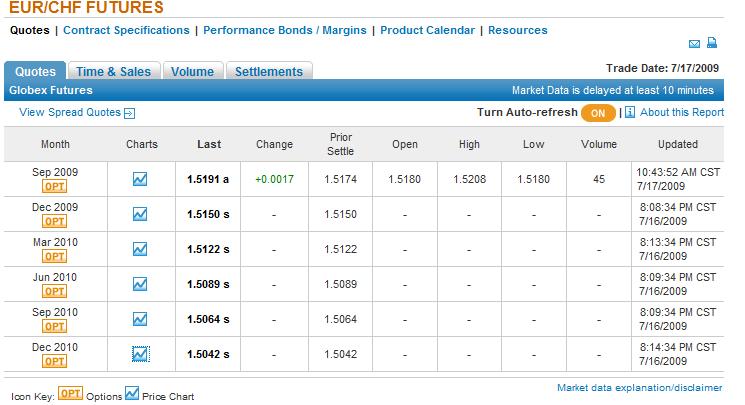
Still, investors are afraid to step across the line. Futures prices for the EUR/CHF are all hovering slightly above 1.50, for the next 18 months. Prior to the latest round of intervention, the expectation was for a steady rise in the Swiss Franc.

chf-futures-prices

In addition, “There are significant options in place for the euro near the CHF1.50 level on the expectation the SNB will carry through another intervention if its resolve is questioned.” While the SNB would probably prefer a slight buffer zone, it will nonetheless rest assured as long as the Franc doesn’t appreciate further: “The SNB is just trying to stop the franc from becoming a one-way bet. ‘If the euro stays in the [current] CHF1.50 to CHF1.54 band, I think the SNB would be satisfied.’ “

SocialTwist Tell-a-Friend
Posted by Adam Kritzer | in Central Banks, Swiss Franc | 1 Comment »

SNB Intervenes on Behalf of Franc

Jun. 26th 2009

Back on March 12, the Swiss National Bank issued a stern promise that it would actively seek to hold down the value of the Swiss Franc (CHF) as a means of forestalling deflation. The currency immediately plummeted 5%, as traders made a quick determination that the SNB threats were made in earnest. Over the months that followed, however, investors became complacent and the Franc slowly crept back up.

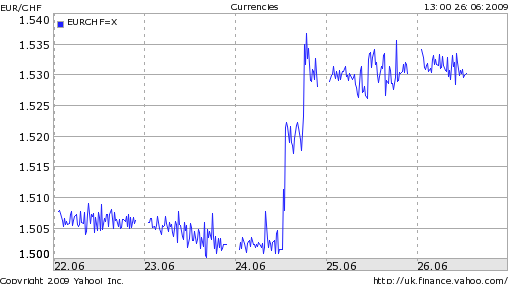
That was until this week, when the SNB sprung into action, buying Euros on the open market. “The franc slid as much as 2.4 percent versus the euro and 3.3 percent against the dollar, the biggest declines since…March 12.” It’s not clear why the SNB suddenly intervened after months of inaction. The Central Bank didn’t hold a press conference to “celebrate” its intervention, and the only indication was a vague declaration last week that “policy makers will act to curb any ‘irrational appreciation’ of the franc.”

swiss-franc-rises-after-snb-intervention

Analysts have speculated that the SNB is (arbitrarily) targeting the exchange rate of $1.50 Francs/Euro, which is plausible given that the intervention occurred very close to that level: “They’re trying to put a line in the sand at 1.50. There’s a big debate as to whether they will continue doing this, and for how long they will remain successful.” After all, the idea of intervention is more effective than intervention itself. The SNB can only buying so many Euros; the real value is in the threat to continue buying, which keeps investors from building up speculative positions.

While the SNB has been criticized as “protectionist” for its actions, its premise for intervention is well-grounded. According to the OECD, “Switzerland should keep interest rates close to zero well into 2010 and mull more fiscal stimulus to fight a deep recession and the risk of deflation.” Modest deflation has already set in, facilitated by a collapse in aggregate demand. Varying forecasts are calling for an economic contraction in 2009 equal to -2.5%-3%, and even a modest contraction to follow in 2010. Q1 GDP growth was negative and the consensus is that Q2 will prove to have been more of the same. If this trend continues, 2009 will be the worst year economically in over 30 years. Still, economic indicators suggest the bottom is soon approaching, and the overall picture is consistent with the rest of Europe.

The real concern is that other Central Banks will imitate the Swiss approach. “In the past couple of weeks we have had five or six central banks, including the Bank of Canada and the Bank of England, talking down their currencies. Like Switzerland, they are fearful that currency appreciation could offset the stimulus to the economy,” noted one analyst. Monetary and economic conditions remain abysmal worldwide, and most banks have already exhausted the tools available to them. Interest rates are universally close to zero; fiscal “stimuli” will push the OECD debt/GDP ratio past 100% in 2009; quantitative easing has given rise to wholesale money printing. Currency devaluation may be the only option left.

SocialTwist Tell-a-Friend
Posted by Adam Kritzer | in Central Banks, Major Currencies, Swiss Franc | No Comments »

Swiss National Bank Renews Threat of Intervention

May. 7th 2009

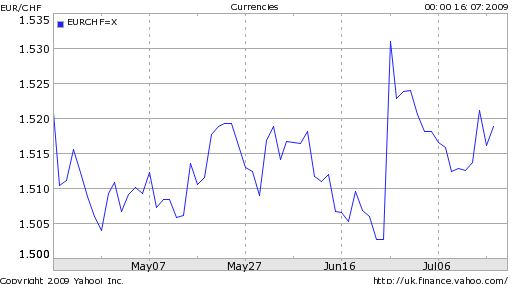
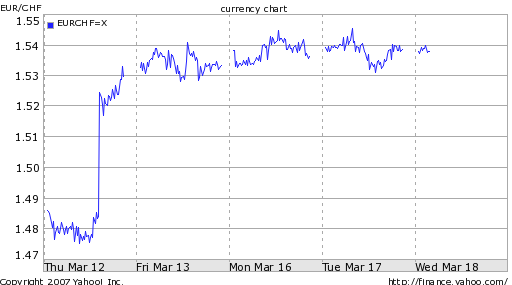
When the Swiss National Bank (SNB) announced oln March 12 that it would intervene in forex markets for the first time since 1994, the Franc immediately plummeted up to 5% against select currencies. Since then, the currency has largely clawed back some of its losses, prompting talk of round two: “Speculation about an imminent intervention in the foreign-exchange markets was rife…after the euro fell to CHF1.5031, the lowest level seen since March 12 when the SNB began selling Swiss francs against euros.”

swiss-franc-rises-despite-snb-interventionIt was unclear whether the Central Bank had chosen a magic threshold, such that a rise by the Franc above which would trigger a sale of Francs in the open market. Earlier in the week, one analyst asserted, “With the euro/franc exchange rate almost at pre-intervention levels – the euro jumped to a level above CHF1.52 after the SNB intervention in March from CHF1.4843 before the announcement – the stage is set for the SNB to either put up or shut up.”
Sure enough, both the Chairman of the SNB as well as a board member both announced yesterday that the campaign to hold down the the Franc is still in effect, and will soon enter a new phase. Thus far, the Bank has relied on various forms of quantitative easing to deflate its currency, both through direct currency transactions and purchases of bonds. The goal of such quantitative easing is only proximately to deflate the Franc; the ultimate goal is to ward off deflation. Given that the Bank had already lowered its benchmark interest rate close to zero, manipulating its currency was/is one of its few remaining options. “As long as the environment does not improve and as long as deflation risks are visible in our monetary policy concept, we will stick to this insurance strategy resolutely,” said Chairman Jean-Pierre Roth.

As the economic recession takes hold, the Swiss economy is forecast to contract 3% in 2009, but to grow in 2010. Consumer sentiment has fallen to the lowest level since 2003. Inflation, meanwhile is projected at -0.5%; deflation, in other words. Still, Switzerland maintains that its motivation is not to boost the economy, but only to increase monetary stability. National Bank governing board member Thomas Jordan “reiterated the interventions have nothing to do with a beggar-thy-neighbor policy, a strategy to weaken a country’s currency to improve the situation for domestic exporters.”

Given that forex intervention is usually doomed to failure, the SNB must rely on a combination of luck and improved fundamentals to keep the Franc down. Thus, when the next round of intervention was announced yesterday, the Franc fell by a modest .75% against the Euro, as investors largely shrugged of the news. Fortunately, the initial pledge to intervene coincided with a pickup in investor sentiment, and decline in risk aversion. This has reduced demand for the Swiss Franc, which had previously been bid up as a so-called “safe haven” currency. As long as the stock market rally continues, investors will stick to higher-yielding currencies and the Franc should be “safe.”

SocialTwist Tell-a-Friend
Posted by Adam Kritzer | in Central Banks, Major Currencies, Swiss Franc | 2 Comments »

Swiss Bank Fulfills Promise of Forex Intervention, Franc Collapses

Mar. 17th 2009

Last week, the Forex Blog concluded a post on the Swiss Franc by suggesting that the Swiss National Bank (SNB) could artificially depress the value of its currency, which had “not just posted strong gains against the euro since late August but has gained 8% on a trade weighted basis.”

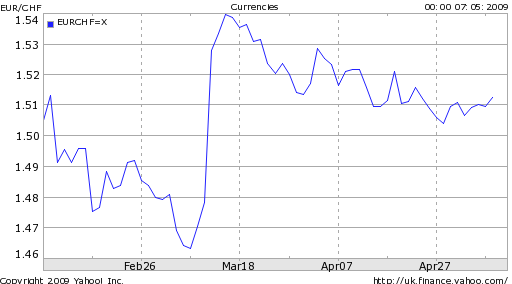
The very next day, the SNB followed its widely anticipated rate cut by announcing that it would indeed intervene in forex markets, “implementing” a decision to buy foreign currencies. The Swiss Franc immediately fell into a tailspin, falling 7 units against the Euro, and more than 3 against the Dollar. According to one trader, “the way this was communicated was intended at maximizing its shock value.” By the end of the week, the Franc had posted a record decline, as investors remained alert to the possibility of further invention.

swiss-franc-falls-against-the-euro
This is the first ’solo’ intervention since 1992 by the SNB, which has “followed a noninterventionist policy when it came to its currency, occasionally hinting at interventions but never following it up. It remained on the sidelines in September 2001 when the euro traded even lower than its present rate, at 1.44 Swiss francs.” It is also the first intervention by any Central Bank since 2003, when Japan intervened unsuccessfully to try to halt the rise of the Yen.

Evidently, the SNB felt justified in its decision not only because of a deteriorating economy, but more importantly because of monetary conditions. Inflation is now projected to dissappear by 2010, and may even “slow to the point where prices broadly fall.” Traders also speculated that the move was designed to relieve downward pressure on Eastern European economies, whose economic woes are being compounded by the fact that much of their debt is denominated in Swiss Francs.

It is doubtful that Switzerland will receive much sympathy from other countries, nearly all of whom have thus far refrained from forex intervention in spite of widespread economic contraction and the risk of deflation. In the words of one analyst, “It is troubling that a country with a current surplus larger than 10% of GDP feels compelled to depreciate its currency.”

The greater concern is that this could ignite some kind of “currency war,” where Central Banks around the world compete with each other to see who can most debase their respective currency. Traders are already speculating that the Bank of Japan could be next: “The BoJ should pay close attention to the SNB’s actions, given that both central banks have expressed a desire to see their currencies weaken.”

SocialTwist Tell-a-Friend

Swiss Franc Rises on a Trade-weighted Basis, but Down against the Dollar

Mar. 11th 2009

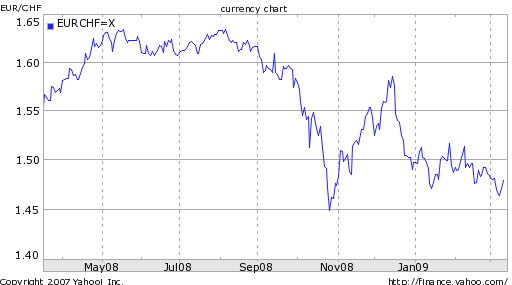
Most of the “safe haven” talk in forex circles has focused on Japan and the US. Switzerland, meanwhile, has also attracted is fair share of risk-averse investors, who are piling into Franc-denominated assets, despite the deteriorating Swiss economic situation. In fact, February witnessed an inflow of $4 Billion, most of which was targeted towards gold and money-market funds. The Swiss Franc, as a result, has appreciated by 9% (on a trade-weighted basis), since the summer.

euro-to-swiss-franc-exchange-rate-chart
The Swiss National Bank (SNB), meanwhile, has cut interest rates by 225 basis points over the last six months. If it delivers on a unanimously-anticipated 25 basis point cut at its meeting tomorrow, its benchmark lending rate will stand at a paltry .25%. To the frustration of the SNB, the “deflation trade” is still in vogue, as traders have counter-intuitively taken to betting on the countries and currencies that offer the lowest interest rates. From an economic standpoint, this trend is eroding the effectiveness of an easy monetary policy, such that the SNB has been forced to consider less conventional approaches.

This would probably take the form of quantitative easing, in the same vein as that which the US and UK are currently pursuing. Under such a policy, the SNB would buy credit instruments on the open market, and pay for them by printing money. This would have the dual effect of devaluing the Franc and easing liquidity problems in Swiss securities markets. While normally a country in Switzerland’s position (especially one whose banks have recently come under fire for secret bank accounts would take flak for such a policy, Swiss (economic) neutrality largely eliminates this burden. Another alternative, which has been proposed by the heir-apparent for SNB chief, is to create a ceiling on the value of the Franc.

Either way, a lower Franc looks like a real possibility. Says one analyst, “Switzerland is likely to…cut interest rates and intervened [sic] verbally to weaken the Swiss franc, threatening unsterilised intervention. If this does not work, and we are sceptical that it will, actual intervention may be required and we suspect this will have some impact. The bottom line is that the franc looks vulnerable.”

SocialTwist Tell-a-Friend

Swiss Franc in Spotlight

Jan. 29th 2009

The Swiss Franc is in the same boat as the US Dollar and Japanese Yen, benefiting from an increase in risk aversion and an unwinding of carry trade positions. In other words, the currency rising on the back of the sound monetary policy of the National Bank of Switzerland, with its low rate of inflation and proportionately low interest rate. Despite the fact that the Swiss economy is poised to contract in 2009, its economy is in better shape than its rivals, and its current account balance is still in surplus. As a result, the consensus among analysts is that investors will continue to flock to the Franc, as Switzerland is sill perceived as a relatively low-risk place to invest. Especially compared to the Euro, which has risen against the Dollar of late, the Swiss Franc remains undervalued. Bloomberg News reports:

Investors are drawn to the franc in times of international tension and economic upheaval because of the country’s history of neutrality and political stability.

Read More: There's Nothing Swiss Can Do to Stop Franc's Rise

SocialTwist Tell-a-Friend

Credit Crisis Could Lift Yen, Franc

Jul. 31st 2008

As the credit crisis has unfolded, the Dollar has remained (relatively) strong, especially considering the deteriorating state of its economy. The reason for this, of course, is that in times of crisis, investors flock to perceived safe havens, such as the US and EU. However, an especially pessimistic series of economic developments has called into question the wiseness of this strategy. A handful of American banks and mortgage institutions have already collapsed, and bankruptcies in all sectors of the economy will surely become more common. The picture in Europe is equally bleak. Several economic indicators have fallen to multi-year lows, and the ECB’s decision to hike rates looks increasingly misguided. Given these circumstances, where can investors turn? Perhaps, to Japan and Switzerland, reports The Market Oracle:

The Swiss franc and the Japanese yen…were the great beneficiaries during the Crash of ‘87, the Debt Crisis of 1998 and again during the current credit crisis, enjoying sweeping and massive upward moves.

Read More: Crisis Currencies Poised to Surge as Frightened Capital Flows from Risk to Safety

SocialTwist Tell-a-Friend

© 2004 - 2010 Forex Blog.org. Currency charts © their sources. While we aim to analyze and try to forceast the forex markets, none of what we publish should be taken as personalized investment advice. Forex exchange rates depend on many factors like monetary policy, currency inflation, and geo-political risks that may not be forseen. Forex trading & investing involves a significant risk of loss.