Marketplace

  • Forex
  • Advertise here

Features

Helpful Links

Contact

April 29, 2008

Forwards Gain Retail Appeal

The anecdotal evidence for surging retail interest in forex is cropping up everywhere. Moreover, investors are no longer even limiting themselves to the spot market, utilizing derivatives to speculate on future exchange rates. In the UK, for example, 10% of investors intending to purchase real estate in the EU are utilizing forward agreements to hedge their exposure to the Euro, which has risen 10% against the Pound since the beginning of 2008. Evidently, prospective home buyers are hoping that the Euro returns to 2007 levels, which would significantly lower the cost of buying property there. However, if the Euro continues to appreciate, such investors could end up losing more than they bargained for. Homes Worldwide reports:

Even the movement in the markets over a couple of days can make the difference between owning a property and no longer being able to afford it.

Read More: Brits Gambling On Volatile Currency Markets

April 25, 2008

AUD Nears Parity

The word "parity" is becoming a mainstay of traders in the forex markets.  In 2007, it applied to the Canadian Dollar, which had rallied 70% over the course of five years to reach the mythical 1:1 level against the USD.  This year, it is the Australian Dollar that is threatening to surpass the Dollar in value. The AUD has always benefited from general USD weakness, but now the focus is shifting to the AUD, itself. The most recent Australian price data suggests that inflation in Australia remains problematic, which could force its Central Bank to raise the benchmark lending rate to 7.5%.  In addition, high commodity prices and consequently strong exports should provide demand for the currency. As always, analysts are divided over the likelihood of parity, but that hasn't stopped them from bandying the term about. The Australian Age reports:

Parity was never a "ridiculous suggestion." "But it's probably a bit tougher going because the Australian economy is slowing," says one analyst. "Then again, if you saw a reacceleration in growth, that might be a different story."

Read More: Our dollar on a roll...

April 21, 2008

FXCM Introduces ETF Alternative

Forex Capital Markets (FXCM) recently unveiled a product that represents a viable alternative to currency exchange trade funds. A currency ETF is "index-passive" because it is linked to an index and rises and falls in line with the value of the currency with which it is associated.  FXCM's Enhanced Dollar Index programs, however, are "actively managed" and  aim to capture all of the upside of currency movements with only some of the downside. This is achieved through sophisticated trading algorithms that combine a leveraged index approach with market timing and directional investing. To explain in more concrete terms, a leveraged investment in a Dollar ETF would yield an above-market return if the ETF appreciates, but a proportionately below-market return if the ETF loses value.  The Enhanced Dollar Index Program, in contrast, would yield the same above-market return in the first scenario but a smaller loss in the second scenario.

Read More about FXCM Enhanced Index Programs

April 16, 2008

USD May be Nearing Bottom

The USD continues to dominate conversation in forex circles, as investors ponder whether the currency will fall further or whether it has already sunk as low as it can go. One commentator recently encapsulated the debate into six factors, three bullish on the Dollar and three bearish.  Number one on the side of bearishness is the interest rate situation. Short term US rates are negative in real terms, and savvy investors are using the Dollar to fund carry trades in order to take advantage of higher yields outside the US. The second and third factors are technical: based on one measure, the Dollar is not nearly as "oversold" as it was in 1992, the last time the Dollar suddenly reversed a multi-year decline.  In addition, the "open interest" on the Euro is not as large as it should be if traders were preparing to dump it.

First on the list of factors supporting a bullish outlook is the US recession. This is somewhat counter-intuitive, but history shows that US economic weakness typically coincides with Dollar strength.  Perhaps this is because many countries depend on the US to drive the global economy.  In fact, the Dollar is already rising against certain emerging market currencies that rely on the US as an export market. In addition, overseas investors tend to park their capital in the US during periods of global economic instability because of its continued reputation as a safe haven.  Second, the economies of the UK and the EU are already weak and growing weaker every day.  The only reason their respective Central Banks have not eased monetary policy is because they are also focused on combating inflation. However, they may soon have to sacrifice price stability in favor of economic growth, at which point interest rate differentials will begin to reverse themselves in favor of the US.  The final reason for bullishness is technical; based on a series of indicators different from those listed above, the Dollar IS oversold  and the recent slip downward may presage an upward shift.

Read More: Has the U.S. Dollar Bottomed?

April 14, 2008

The Future of FX

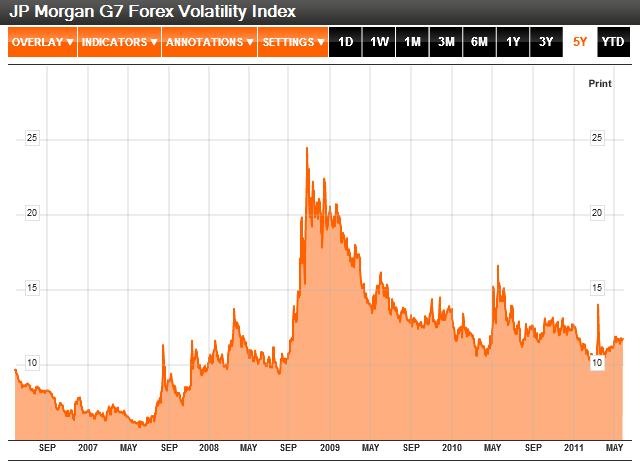
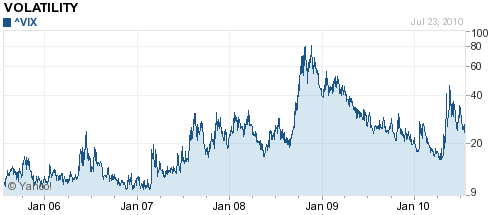
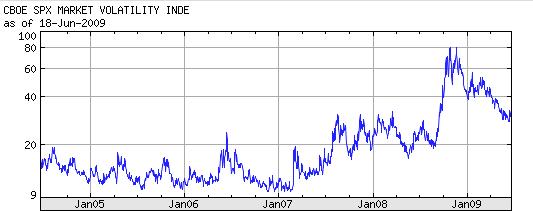
For a recent article, EuroMoney Magazine pulled together some of the top currency analysts on Wall Street for a comprehensive discussion on the state of forex.  The conversation zigs and zags, covering such varied topics as volatility, interest rates, trading strategies, emerging markets, central banks and market infrastructure.  Among other things, it was noted that volatility has surged by 50% since the inception of the credit crunch, returning to levels last seen at the beginning of the decade.  One of the participants broached the possibility of deflation, but that was quickly dismissed by the others due to surging food and energy prices. It was also noted how Central Banks are caught between fighting inflation and facilitating growth, in deciding whether to raise or lower rates, respectively. The main theme in the markets is the sagging Dollar, which is being punished for both economic and strategic reasons as investors sell it in response to the economic downturn and to fund carry trades. Finally, one participant commented that despite growth in liquidity, forex strategy hasn't evolved much, and the markets remain vulnerable to a huge sell-off due to the "mob mentality."

Read the Discussion in its Entirety

April 09, 2008

Retail Appeal of Forex Grows

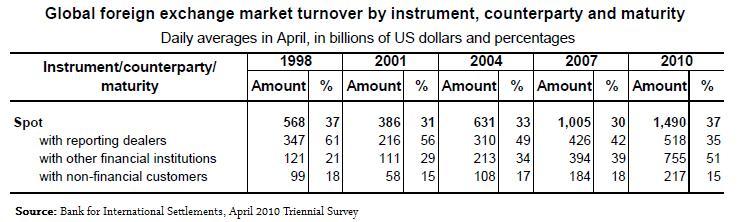
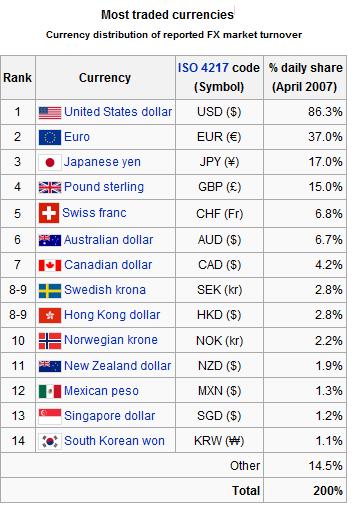
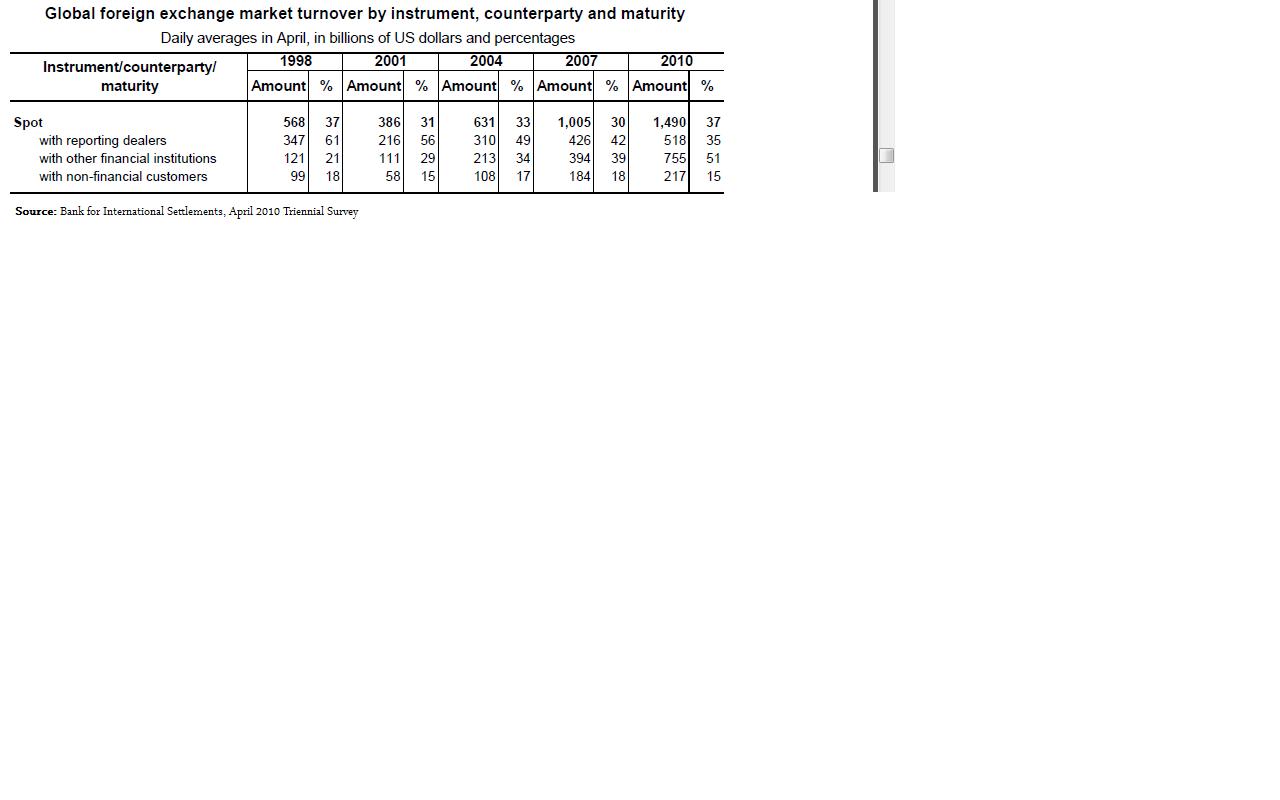
With average daily turnover of $3 Trillion, the foreign exchange markets are the largest financial markets in the world.  Despite boasting such impressive volume and liquidity characteristics, forex is nonetheless considered extremely risky, and thus viewed as the bastion of experienced traders.  This is slowly beginning to change, as investors have moved to diversify their portfolios away from the traditional allocation of stocks, bonds, and cash.  Investing directly in forex still not recommended by financial advisers.  However, there exist alternative strategies, such as buying CDs denominated in foreign currencies and/or securities that are issued by foreign companies and trade on domestic exchanges.  These kinds of "indirect" strategies typically take the form of either "single play" or "double play" strategies. With both strategies, investors attempt to profit through cross-border interest rate disparities, but with "double play" trades, investors seek to profit from currency appreciation as well. The New York Times reports:

Mr. Orr advised currency buyers to research foreign nations and their credit risks, determine at the start their own risk-reward ratio and tolerance to volatility, and have exit strategies, while watching their positions constantly.

Read More: While Alluring, Foreign Currencies Can Be Elusive

April 07, 2008

USD: Where is it Headed?

The last week has seen a spate of positive developments in the financial markets, including reassurances by several bulge bracket investment banks that their respective capital positions are in strong and in no need of shoring up. As a result, some analysts are speculating that the worst of the credit crunch has already been priced into securities and the USD, and that actual write-downs on subprime mortgage obligations won't match the "Himalaya-like guesstimates." At the same time, job losses are mounting and the unemployment rate recently crossed 5% for the first time in two years. Interest rate futures contracts suggest a 20% chance that the Fed will cut rates by 50 basis points at its meeting on April 30. Then, there is the ECB, which has been vocal about fighting inflation and European financial markets, which have benefited from "domestic" investors diversifying within the EU rather than to the US.  Thus, there is no definitive answer regarding where the Dollar is headed in the near-term: everyone seems to have their own opinion.  Bloomberg News reports:
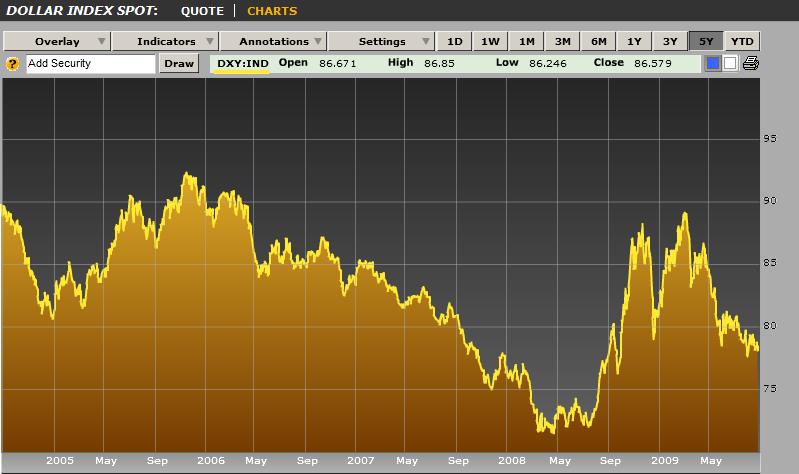
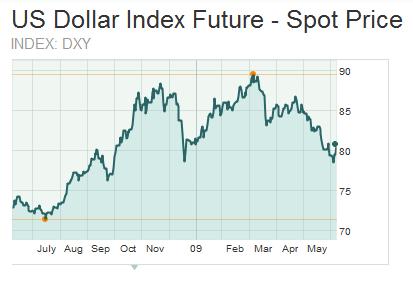
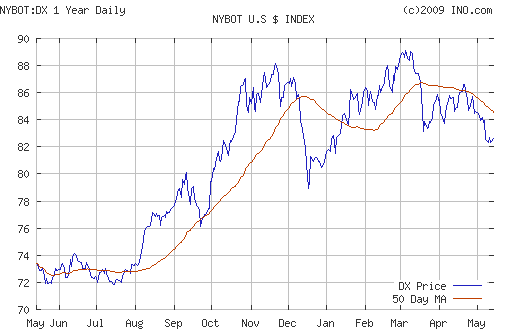
The Dollar Index traded on ICE Futures in New York, which tracks the currency against those of six trading partners, dropped 0.2 percent to 72.049, its third straight decline. It was at a record low of 70.698 on March 17.

Read More: Dollar Falls Against Euro; Report May Show Payrolls Declined

April 04, 2008

Forex Leads Equities

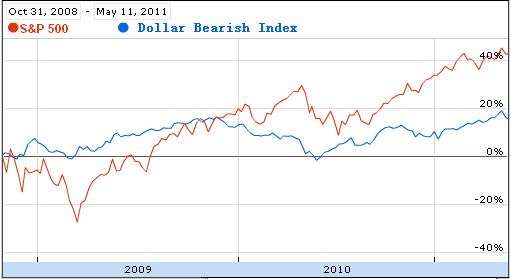
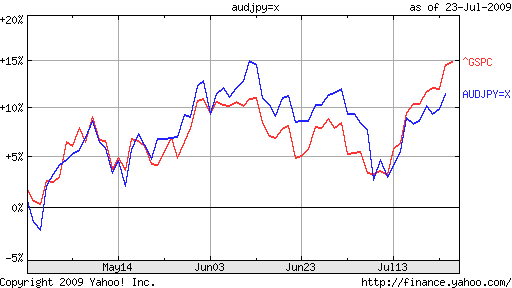
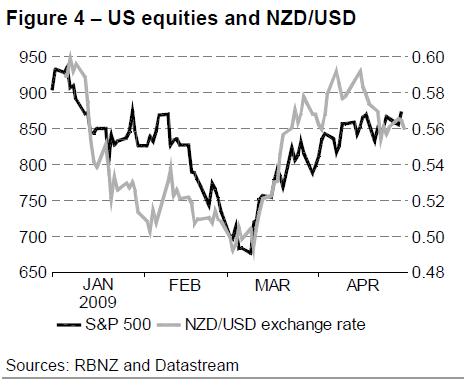
In recent months, the credit crunch has ignited a global trend towards risk aversion.  As a result, a correlation has developed between equities, which serve as a proxy for risk, and certain currencies.  The Forex Blog previously covered the link between the S&P 500 and the Japanese Yen, whereby the Japanese Yen moved inversely with the S&P as a decline in  risk appetite led carry traders to unwind their positions. Perhaps, this connection can be seen in other currencies.  Since the forex markets are open 24 hours a day and are the most liquid financial markets in the world, macroeconomic events are often priced into currencies before they are priced into equities. In addition, carry trading strategies have expanded beyond the Japanese Yen.  In fact, the USD is now a decent candidate as interest rates are negative,when adjusted for inflation.  Thus, an increase in risk appetite could simultaneously boost the S&P and punish the Dollar!

Read More: Using Currencies to Time Equity Moves

April 03, 2008

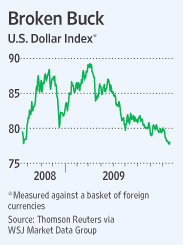
USD: Worst Quarter in 4 Years

In the first three months of 2008, the USD notched its worst quarterly performance since 2004, falling over 8%. During the same period, the Dollar lost 10% of its value against the Japanese Yen and 6.4% against a broad basket of currencies. Forex analysts reckon the slide was so steep because investors have taken stock of the US economic situation and have concluded that recession is inevitable. The story is also being driven by interest rates. The Fed has already cut rates by 300 bps in the current cycle of easing, making the benchmark federal funds rate the lowest in the industrialized world, in real terms. Meanwhile, the European Central Bank is giving every indication that it will maintain rates at current levels in order to keep a lid on inflation. As a result, the Dollar could fall further, especially if the Fed continues to hike rates and investors use the currency to fund carry trades. Reuters reports:

[According to one analyst], "And to call a bottom now is still a very risky call. It's too early to say the worst is behind us and the dollar's in for a sharp rebound."

Read More: Dollar logs weakest quarter vs euro since 2004

April 02, 2008

Barclays Introduces Carry Trade ETN

Through its trademark iPATH line of funds, Barclays Bank recently introduced a new ETN designed to mimic the carry trade.  In accordance with this strategy, this note is linked to  the performance of the Barclays Intelligent Carry Index, which aims sell low-yielding currencies and use the proceeds to invest in those that offer higher yields.  This index holds varying combinations of the so-called G10 currencies, which includes all of the majors as well as the Norwegian Krona and Swedish Krona.  Traditionally, carry traders have sold one specific currency (i.e. Japanese Yen) in favor of another currency (i.e. the New Zealand Dollar).  By instead purchasing this note, which will trade under the ticker ICI, investors can buy a share of an entire portfolio, optimized expressly for this strategy. Comtex reports:

The index is composed of ten cash-settled currency forward agreements, one for each index constituent currency, as well as a "Hedged USD Overnight Index" which is intended to reflect the performance of a risk-free U.S. dollar-denominated asset.

Read More: Barclays Launches New iPATH ETN

March 31, 2008

Dollar Decline: Not a Sure Thing

Since 2002, the Dollar has lost 70% of its value, relative to the Euro.  Meanwhile, the same factors that signaled bearishness in 2002 persist in 2008, or even worsened in some aspects.  The twin deficits are still growing, though the current account deficit may be leveling off.  The US economy is headed towards recession.  Inflation is set to rise due to soaring commodity prices and a loosening of monetary policy.  As a result, many investors are betting that the Dollar's slide will continue well into the near future.

However, prudent investors would be wise to "handle with care." While not entirely applicable to forex markets, efficient markets theory dictates that inherent in a security's current valuation is all relevant, publicly available information. Thus, all of the bad news listed above has already been priced into the Dollar, to some degree at least. The rule of diversification is in full effect when betting on forex. Thus, rather then putting all of one's chips directly behind one currency, an investors could buy foreign securities (stocks and bonds) instead, which also capture any currency appreciation (and depreciation).  Investors can also purchase Treasury Inflation Protected Securities (TIPS), whose yield is linked to inflation and, thus, acts as a hedge against a declining Dollar. The Wall Street Journal reports:

While some market watchers believe the six-year dollar bear market isn't over yet, investors should recognize that trends in the currency markets are typically marked by volatile ups and downs along the way.

Read More: Don't Bet the Farm on Dollar's Skid

March 26, 2008

Return of the Carry Trade?

After the Fed cut its benchmark lending rate by 75 basis points last week, the Dollar immediately rallied 2.5% against the Japanese Yen, marking its highest daily rise in nine years.  Some analysts are at a loss to explain this phenomenon, since a narrower interest rate differential should have produced the opposite effect.  Perhaps, the answer can be found in the carry trade, whereby investors sell Yen in favor of higher-yielding currencies.  Support for the carry trade typically moves inversely with volatility.  For example, when risk aversion rises due to economic uncertainty, investors typically unwind their carry trade positions.  With the Fed rate cut last week, however, risk aversion actually fell, and the S&P 500 Index surged.  By no coincidence, the Yen fell. Reuters reports:
As U.S. stocks rallied, with investors willing to take on more risk, the dollar recouped some of Monday's sharp losses versus the low-yielding yen.

March 24, 2008

The Rising Threat of Intervention

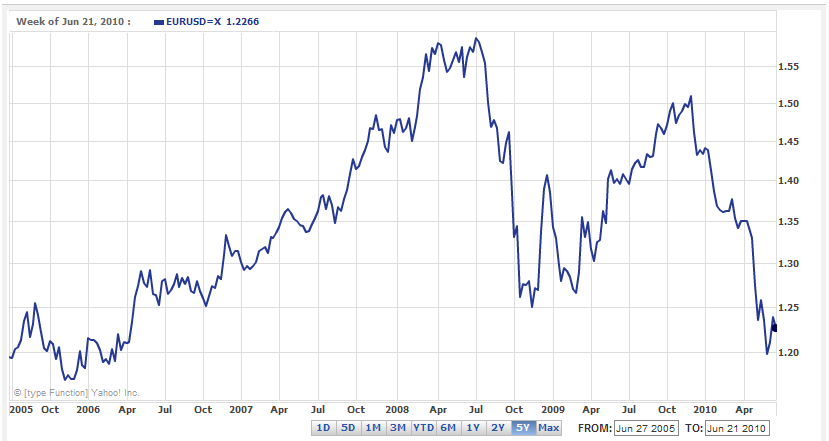
Last week, the Euro retreated from the record high of $1.60 that it achieved earlier in the week. Policymakers are still concerned, however, and are perhaps using this lull to come up with a plan of action should the Dollar resume its slide. In fact, the consensus among analysts is that coordinated intervention is likely if the Euro crosses a certain threshold- perhaps $1.65. In order to be successful, the intervention would need to involve the Federal Reserve Bank and the European Central Bank principally, as well as the peripheral participation of the Central Banks of Switzerland, Japan and England.  The situation is complicated by the monetary policy of the ECB, the tightness of which is causing the interest rate differential with the US to widen dramatically. Already, volatility levels in forex markets are slowly climbing, suggesting that investors are bracing themselves for a big move.  The Guardian UK reports:

ECB Executive Board member Lorenzo Bini Smaghi said in a speech on Tuesday markets sometimes overshot, with possible negative implications for the world economy. Since his speech, the dollar has strengthened by almost 2 cents against the euro.

Read More: Euro intervention edging nearer, but still distant

March 20, 2008

USD: 0 for 3

In a recent commentary piece, the Market Oracle used the analogy of baseball to outline why this will be an "off year" for the Dollar, listing three reasons to support its claim. Consumer spending was listed first because it represents the largest component of US GDP.  Since much consumption is financed through borrowing and since the credit crunch has forced banks to rein in lending, the Oracle reasoned that consumer spending will be especially hard hit. Next, there is the worsening employment picture. As its moniker implies, the "jobless recovery" that has characterized the US economy over the last few years did not add many jobs, and due to the economic downturn, jobs are now being shed.  Finally, the Market Oracle has identified the Federal Reserve as a primary contributor to the decline of the Dollar. While the Fed is trying to shore up the economy, it is simultaneously enabling inflation.  Thus, even if the battle is won and recession is averted, the Fed may still find that it has lost the war- on prices.

Read More: Three Strikes Against the U.S. Dollar

March 10, 2008

Dollar Falls to Record Lows

Over the last couple weeks, the Dollar has plummeted against all of the major currencies, falling below the $1.50 mark against the Euro for the first time ever.  It seems investors are reacting to a spate of negative economic data which are painting an increasingly bearish picture for the US economy.  In addition, the Fed seems likely to lower rates further while the ECB will maintain rates at current levels. For a brief period, talk of recession was actually helping the Dollar, as investors predicted that the global economy would be harmed more than the US economy, but it looks like that period has passed. As a result, the EU is growing increasingly alarmed, and the pressure is building for some kind of intervention.   AFX News Limited reports:

Euro group president Jean-Claude Juncker said currency markets are overreacting to the short-term outlook for the US economy. " We don't like excessive volatility in exchange rates," Juncker said.

Read More: Euro group's Juncker says currency markets reacting too hastily to US outlook

March 06, 2008

ML Introduces 5 Currency ETNs

Together with a consortium of large banks, Merrill Lynch recently formed ELEMENTS, which unveiled five new currency Exchange Traded Notes (ETNs).  Before ML entered the market via ELEMENTS, there were only two banks offering currency ETF products: Barclays Capital and Rydex, whose funds are branded CurrencyShares and iPath, respectively.  ETNs differ from ETFs in that the former represent a debt obligation whereas the latter represent a form of equity.  In practice, however, since the risk of default is relatively low, the two types of securities are functionally equivalent.  Both pay interest slightly below the benchmark interest rates of the currencies to which they are connected. The five new ELEMENTS ETNs are separately tied to the performance of the Canadian Dollar, Euro, Swiss Franc, British Pound, and Australian Dollar. Index Universe reports:

Why would anyone choose the new ELEMENTS ETFs? Because they make semiannual cash dividend payments to noteholders based on the interest income. The iPath ETNs, in contrast, incorporate that income into the value of the note ... a kind of "virtual interest" that is only realized when the noteholder sells.

Read More: Currency Market Gets More Competitive 

March 05, 2008

Technical Analysis - The Basics

Yesterday, the Forex Blog featured a story that explained how to make money when volatility is low.  The consensus of the article is that investors must shift their strategy from trading to trending, which requires an adjustment in outlook from short-term to long-term.  But given that volatility is low and that currencies often move laterally against each other, how do you know which direction to bet on, and accordingly, when to buy or sell?  The answer requires some minor technical analysis, involving two of the most basic tools available: support and resistance. These terms represent approximate price levels within which a specific currency appears to be trading.  The significance of these levels is usually arbitrary, and is likely grounded in psychology rather than any real math. Furthermore, once the pattern is spotted, the support and resistance levels often become self-fulfilling, keeping the currency rangebound. But, when, for whatever reason, the currency dips below or rises above the range, it is probably a signal that it is a good time to sell short or buy, respectively. Trading Markets reports:

Though support and resistance are rather basic when it comes to technical analysis, they can be extremely effective for dexterous traders. And really, sometimes, keeping things simple is the best course of action anyway.

Read More: Using Support and Resistance in Forex Trading

March 04, 2008

How to Profit from Low Volatility

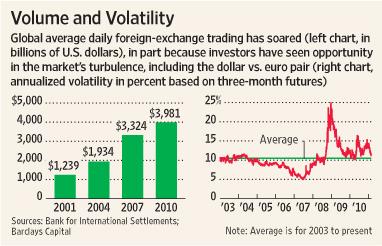
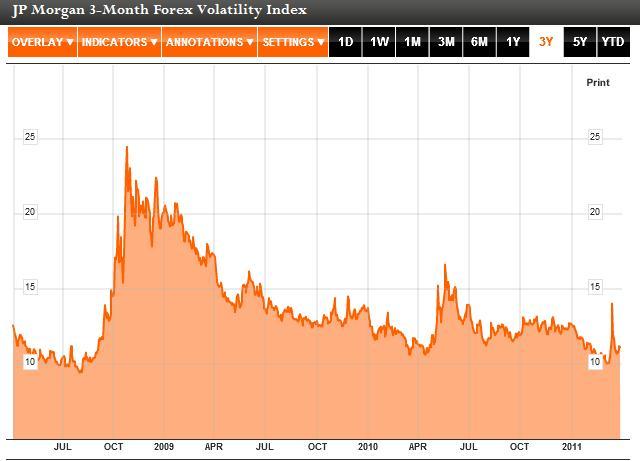
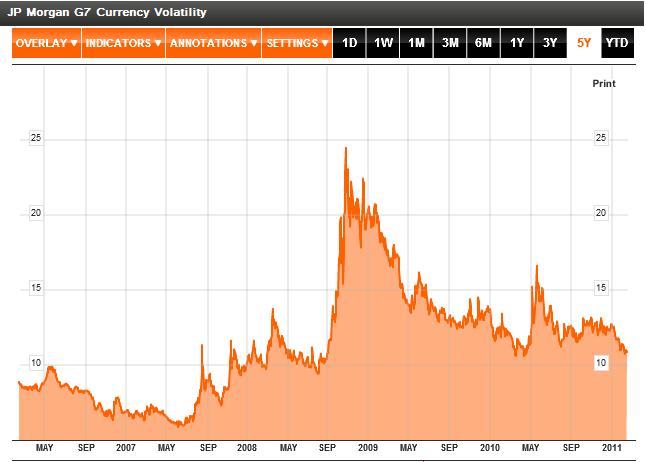
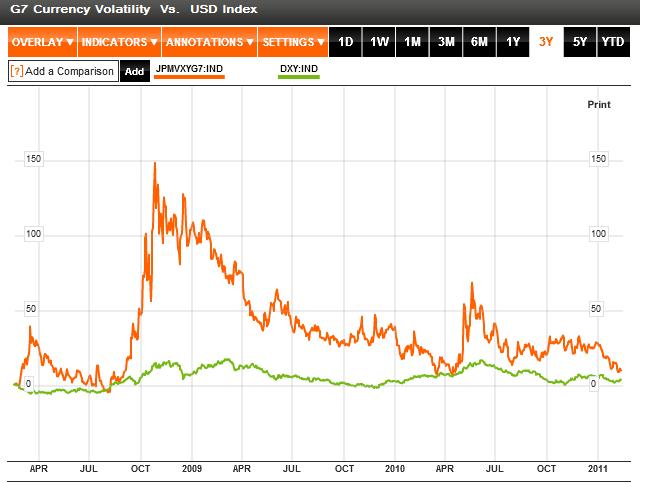
Based on several indexes, volatility in forex markets is nearing historic lows.  How can this be explained, given the enormous daily swings in equity and bond markets? The first explanation is that business cycles, and by extension, monetary policies, are gradually synchronizing across the industrialized world, especially among the USA, EU, and Japan. When inflation rates and interest rates are similar across different countries, this mitigates any theoretical need for changes in exchange rates. The second explanation is that the tremendous growth in forex volume ($3 Trillion per day and rising) is increasing liquidity and lowering volatility.

More importantly, is it possible to profit in a climate where volatility is lacking? The answer is "of course."  It simply involves a shift in strategy.  When volatility is high, trading is usually the most profitable strategy: using technical analysis and churning your "portfolio" on a daily basis.  On the other hand, when volatility is low, then trending is probably the best bet. Don't forget: volatility is not the same as directional movement.  If a currency appreciates every day by only a small increment and without any wild swings, volatility is low but the profit potential is high.

Read More: Making the Most of a Benign Environment

Continue reading "How to Profit from Low Volatility" »

February 28, 2008

USD: What is the story?

Recent news reports have painted a downright bleak picture of the US economy. Home prices are now falling. Equity prices are also falling, at an annualized rate of 20%.  Meanwhile, energy and food prices are rising, dipping into what little purchasing power consumers can still claim.  Somehow, as DailyFX, recently reported, the Dollar has held its own. Their reasoning is that there is a struggle being waged in forex markets between yield and growth. On the one hand are investors who are bearish on the Dollar because of interest rates that are headed downwards, despite already being low.  On the other hand are investors who think that yield is comparatively unimportant, since the rate cuts are needed to shore up the economy. While interest rate differentials do not favor the US, the economic growth that they are intended to bring about tell a different story. DailyFX reports:

The only problem with this thesis is that 2 percent interest rates or 100bp is about as low as the market expects the Fed will go. If banks are forced to take more write-offs and the US economy deteriorates further, the Federal Reserve may be forced to go below 1.00 percent.

Read More: What Matters More For the US Dollar:  Yield or Growth?

February 21, 2008

Canadian Loonie Defies Logic

Over the last few years, commodity prices, equity values, and interest rate differentials all favored Canada.  By no coincidence, the Loonie rallied to such an extent that it soon reached parity with the USD. The relationship between these trends and the Canadian Dollar seemed so cut-and-dried that few analysts paid attention to anything else.  In the last couple months, however, these relationships seem to have suddenly dissolved.  For example, as the price of oil has begun to rise again, the Loonie has unexpectedly lost value.  Meanwhile, the inverse correlation between risk aversion and the Loonie has lost all validity, such that if the S&P 500 increases, the odds that the Canadian Dollar will also appreciate is essentially an even money bet. The Canadian Economic Press reports:

"The breakdown is still quiet tentative but it’s weakened in the last few sessions. For Canada in particular there isn’t one story in the market. We have several different stories going on at the same time."

Read More: Breakdown of Forex Correlations Has Market Participants on Guard

February 15, 2008

Forex Forecast

Forex Forecast- try saying that three times fast! The Market Oracle, an online financial publication, has done even better, preparing a one-year forecast for all of the major currencies along with a detailed analysis of the major factors driving each currency in the month of February. The Dollar and Yen are projected to be the strongest performers in this time frame, benefiting from a trend towards risk aversion.  It should be noted that this prediction is consistent with news reported by the Forex Blog earlier this week. On the other hand, currencies that have been propped up by the Yen carry trade, namely those of Australia, New Zealand, Canada and South Africa, will face selling pressure.  The British Pound is projected to underperform slightly, due to an easing of British monetary policy, which will narrow the interest rate advantage claimed over the US.

Finally, the Euro is something of a wildcard.  On the one hand, the EU economy is stagnating, and the ECB has hinted that rate cuts are a possibility. On the other hand, the Euro theoretically stands to inherit a significant amount of risk-averse capital, especially from foreign investors looking for a stable alternative to the Dollar.  Accordingly, the Market Oracle forecasts a short-term decline in the value of the Euro but a long-term appreciation.

Read More: Currency Market Strategy and Forecasts for February 2008

February 13, 2008

Dollar Notches Stellar Weekly Performance

Last week, the USD recorded its best weekly performance since 2006, rising 3 cents against its chief rival, the Euro.  Apparently, analysts are becoming increasingly pessimistic about the effect of the America recession on the global economy.  The consensus is now that a dampened global economy will induce a trend towards risk aversion, which favors the world's #1 and #2 reserve currencies, the Dollar and the Euro, respectively.  However, it also appears the near-term economic prospects for Europe are less rosy than originally forecast,.  Thus, if last week is any indication, the Dollar should receive a larger proportion of risk-averse capital. Reuters reports:

"Despite a torrent of bad economic news the dollar has been on a tear this week, as the currency market recognized the fact that the slowdown in U.S. economic activity is likely to drag down growth in the rest of the G10 universe..."

Read More: Dollar set for biggest weekly rise since June 2006

February 05, 2008

Kiwi Rises and Falls with Risk Aversion

Most of the world's major currencies are affected by a variety of technical and fundamental factors, such that only taking into account one factor is tantamount to using P/E multiples as the sole basis for purchasing shares of stock. The New Zealand Dollar, which barely qualifies as a major currency seems to be one of the few exceptions to this common sense rule.  The preponderance of carry traders involved in trading the Yen ensures that the NZD inversely tracks the Japanese Yen.  In addition, the demand for Kiwi is directly proportional to appetite for risk, such that when risk aversion declines, the Kiwi increases, and vice versa.  The reasoning is quite simple: the Kiwi boasts the highest interest rates in the industrialized world. Because the investment climate in New Zealand is less stable than in other industrialized countries, New Zealand often witnesses capital flight during periods of global economic uncertainty.  The New Zealand Herald reports:

Gains in equities markets emboldened investors to take chances, prompting use of the low-yielding yen to buy assets in higher-yielding currencies like the kiwi in carry trades.

Read More: Equities send dollar up

February 01, 2008

Yen as Proxy for Risk Aversion

The US stock market has lost over 10% of its capitalization since reaching an all-time high in October of last year.  Meanwhile, the Japanese Yen has climbed at least as much in proportional terms since bottoming out around the same time.  Coincidence?  At least one analyst doesn't think so. Because of the steadfast popularity of the carry trade, the Japanese Yen appears to have developed an inverse correlation with the US stock markets.  The reasoning is actually quite simple. When aversion to risk is low, investors borrow in Japanese Yen and make investments denominated in other currencies, the Dollar for one.  When risk-aversion increases, as it has in the current economic environment, investors have been quick to close out their carry trade positions, causing the Yen to rise. Maktoob Business reports:

If the situation of stock markets is improving, the USD/JPY is likely to be increasing. It means that more carry trade transaction are being carried out.

Read More: Fundamental analysis - Market Correlations

Continue reading "Yen as Proxy for Risk Aversion" »

January 24, 2008

Foreign Investors Target US

So-called 'Sovereign Wealth Funds' are the talk of the town, stealing headlines as part of a multi-billion dollar buying spree.  Anecdotally, stories of these funds and other institutional foreign investors have made a big splash, epitomized by a few high-profile investments in struggling American investment banks.  It no longer appears these stories were isolated, as suggested by some pretty compelling economic data.  In 2007, total foreign direct investment into the United States totaled $400 Billion, which represents a 90% increase over 2006.  In addition, the first few weeks of 2008 saw a frenzy of activity, which suggest this trend will continue.  Investment in the US is being driven primarily by a weak Dollar and attractive stock market valuations.  If the bad news on the US economy continues to pour in, analysts warn that foreigners could play an even larger role in mitigating against recession. The New York Times reports:

The weak dollar has made American companies and properties cheaper in global terms. Even as Americans confront the prospect of a recession, economic growth remains strong worldwide, endowing oil producers like Saudi Arabia and Russia and export powers like China and Germany with abundant cash.

Read More: Overseas Investors Buy Aggressively in U.S.

January 21, 2008

Volatility Drives Yen

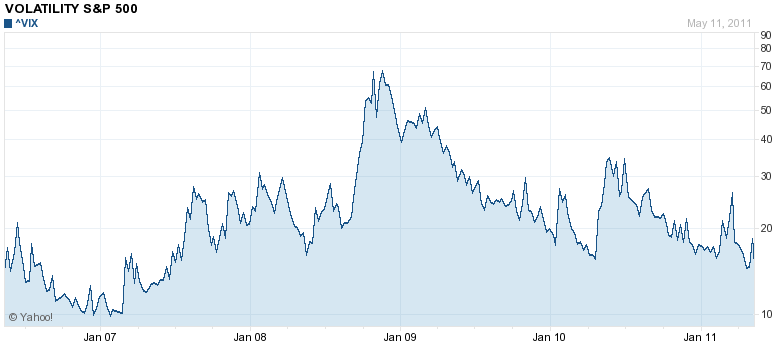
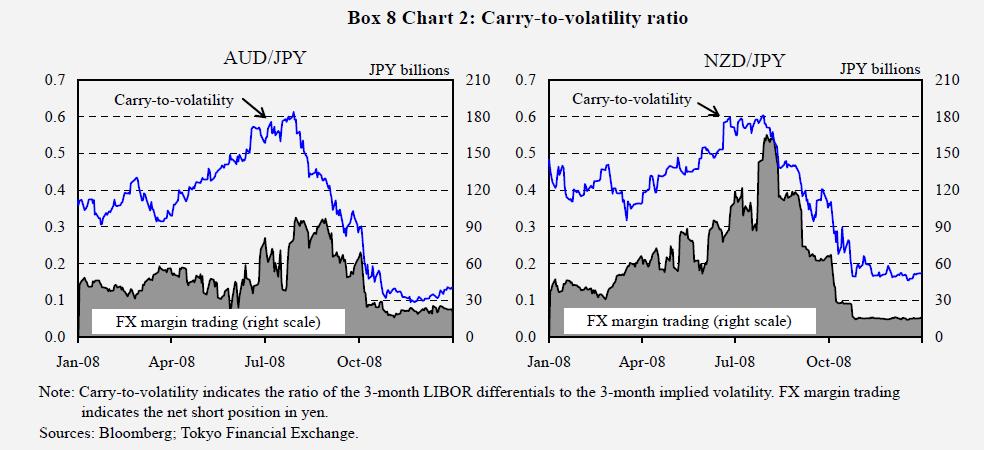
As Asian capital markets crash in unison, the Japanese Yen is rising at its fastest pace in years.  Taken out of context, that sounds like a contradiction, since a positive correlation typically obtains between the strength of a nation's economy, capital markets, and currency.  However, the Yen is unique, as most forex traders are doubtlessly aware.  The Yen rises and falls with the whims of the carry trade, which in turn is tied closely to volatility.  And in case you haven't noticed, global capital markets are seesawing to such an extent that by some measures, volatility levels have reached a nine-year high.  One analyst has drawn a parallel between the current credit crisis and the 1998 Asian economic crisis, which also produced a Yen rally.

Read More: History Points to a Yen Rally

January 15, 2008

Risk Aversion Lifts Carry Trade

Since July, the Japanese Yen has notched a stellar performance in climbing 15% against the Dollar, without garnering much attention.  Within the last week, however, analysts have begun to take notice, as the carry trade temporarily collapsed and the Yen appreciated by another 3%. 'But Japan's Central Bank is no hurry to raise interest rates,' you are probably wondering. 'What on earth is all the fuss about?' Volatility, the sworn enemy of carry traders has exploded.  Global capital markets, including the US stock market, are in a state of turmoil. The financial services industry, the perennial bulwark of the US economy, is set to record its worst year in recent memory.  Leading the way, so-to-speak, is Citigroup, which recently announced that it will write-down an additional $10 Billion in worthless subprime paper and will also receive a proportionately large infusion of capital.  Cue exit music for carry traders. Bloomberg News reports:

"The global and risk environment is dominating yen pricing,'' said Chris Turner, head of currency research at ING Financial Markets in London. "There's risk aversion in the background.''

Read More: Yen Rises as Traders Pare Carry Trades on Credit-Market Losses

January 07, 2008

Forex Themes for 2008

Last week, the Forex Blog recounted what happened across forex markets in 2007, in all of its drama. Now, we would like to offer a nice counterpoint, in the form of the major themes expected to dominate forex headlines in 2008, courtesy of Dow Jones. The list includes eight distinct themes, though there is some overlap.  Three of the themes pertain directly to the USD, which is the currency most worth watching in the upcoming year.  The fundamentals bode well for the Dollar; the economy has not suffered from the credit crunch nearly as much as economists feared; the cheaper currency has boosted exports; foreigners have proven surprisingly willing to finance the twin deficits.

Then, there is inflation, which has reared its ugly head in the US as well as abroad. Foreign Central Banks, especially in Asia, may have to tighten monetary policy in order to maintain price stability. Those countries with already-high interest rates, such as Australia and New Zealand, are expected to keep rates high.  The next theme, accordingly, is the carry trade, which should continue its run due to the aforementioned high interest rates.  Next is China, which will be watched on two fronts: its economy and its currency, both of which are expected to continue rising. 

The final two themes pertain especially to the Middle East: currency pegs and Sovereign Wealth Funds. As the Dollar declined in 2007, several nations in the Mid East mulled the possibility of de-linking their respective currencies from the Dollar, but thus far, the status quo has obtained.  Sovereign Wealth Funds also made a big splash in 2007 with several high-profile investments in the US, implicitly underscoring their their commitment to the Dollar.  They represent a growing force in global capital markets, and will be watched vigilantly in 2008.

View the Complete List Here

December 27, 2007

Investment Banks Expand into Retail Forex

Forex is becoming hot!  Average daily volume has surged past $3 Trillion, as the credit crunch has increased volatility and the Dollar has collapsed.  In fact, Saxo Bank, one of the most prominent acts in retail forex trading, may record $500 million in revenue this year.  As a result, several of the world's largest investment banks have announced plans to enter the burgeoning retail forex market.  Citigroup is teaming up with a Danish bank to offer online currency trading.  Deutsche Bank is stepping up marketing of its proprietary retail trading platform.  Even Goldman Sachs is entering the fray, via a 10% investment stake in a British retail forex company.  However, not everyone is optimistic, reports GulfNews:

Some think the reputational risks of enabling individual investors who may not be able to afford to lose substantial sums in what are notoriously volatile markets outweigh the possible revenue stream.

Read More: Global banks compete for growing forex business

December 19, 2007

Carry Trade Gains Favor

It's been rough sailing for the Yen carry trade of late; the technique had been sagging in popularity due to the credit crunch and the associated trend towards risk aversion.  Over the last few weeks, however, the Yen has fallen, which is to say the Yen Carry Trade is making a comeback.  First came the announcement that the world's leading Central Banks would be injecting hundreds of billions of dollars in the banking system, in order to ease growing liquidity concerns.  Next, the Bank of Japan hinted that it would hold rates at .5%, the lowest in the industrialized world.  Finally, a continued surge in commodity prices virtually ensures that countries rich in natural resources, such as Canada and Australia, remain viable "targets" for carry traders.  Overall, the story remains focused around volatility.  In fact, one investment bank discovered an inverse correlation between the S&P 500 and the Japanese Yen.  In other words, the appetite for risk appears closely correlated with the strength of global capital markets and the popularity of the Yen carry trade.  Bloomberg News reports:

Over the last fortnight, that odd correlation with equities has broken down...Instead the fundamental factors behind carry trades have come to the fore again. Investors are paying attention to Japan's economy.

Read More: The resources to carry on

December 18, 2007

Trading Forex Becomes Less Profitable

The return a hedge fund delivers is separated into alpha and beta; accordingly, the goal of of a good hedge fun manager is to deliver as much alpha as possible, whereby alphas is measured by the return generated in excess of beta, what is returned "naturally" by the market.  In the case of forex, the beta is effectively zero, since one currency's gain is automatically another currency's loss.  Thus, any and all return generated by forex investors is officially recorded as alpha.  Historically, forex was a bonanza for hedge fund managers that speculated exclusively on currencies, who averaged annualized returns of 12%, controlling for differences in trading strategies. 

That return has steadily dwindled, and in fact, the average professional forex trader lost 2.6% in 2006.  The reasoning should be self-evident: increased competition.  From the perspective of daily trading volume, participation in the forex market has tripled since 2001.  Arbitrage (buying in one market and selling into another) has steadily eroded returns to the extent that one online forex brokerage now quotes the bid/ask spread to five decimal places!  Fortunately, the evaporation of profits should drive many hedge funds out of forex in search of other investing opportunities, creating new opportunities in forex.  The Financial Times reports:

Volatility was now back to historic norms, aiding managers. "The last three years have been really quite disappointing for the industry and it needs to produce some gains in the next couple of years to justify its existence."

Read More: Dollar slide 'hit currency managers'

December 16, 2007

Central Banks Inject Liquidity

After months of delay and perhaps overly wishful thinking regarding the global credit crunch, the world's Central Banks are finally ready to take action. America's Federal Reserve Bank will join forces with the Bank of Canada, the Bank of England, the European Central Bank and the Swiss National Bank as part of a concerted effort to introduce greater liquidity into global capital markets.  Under the plan, the Banks will auction off tens of billions of Dollars worth of bonds denominated in their respective currencies, and lend the proceeds to commercial banks.  The goal of the plan is to to limit growing risk aversion, which has caused banks to significantly rein in lending.  Further, while the move is designed primarily to boost confidence in equity markets, certain sectors of forex may also receive a bump.  High-yielding currencies such as the New Zealand Kiwi and Australian Dollar, which have been shunned in recent months, seem to be the most likely beneficiaries.  Forbes reports:

"If the market is convinced that central banks are finally doing enough to ease the liquidity situation we are likely to see the funding currencies (the yen and the Swiss franc) fall back, and higher-risk currencies like the Aussie and Kiwi currencies, rally."

Read More: Dollar rises as Fed, other central banks move to shore up liquidity

December 08, 2007

Volatility is Hurting Carry Trade

While covering the emergence of the carry trade over the last couple years, the Forex Blog has echoed the sentiments of the self-proclaimed experts, who argued that Japanese interest rates would never rise enough to seriously threaten the carry trade. Instead, any threats would have to come in the form of volatility, which would theoretically drive traders to spur the comparatively high returns of carry trading in favor of low risk.  As if on cue, the carry trade has retreated significantly as the credit crisis aka housing bubble shockwave has rippled through global capital markets.  As the negative fallout builds, many of the carry traders who braved the first storm are rushing for the exits.  Bloomberg News reports:

Volatility implied by dollar-yen currency options expiring in one week with a strike price near current levels rose to 13.25 percent… Traders quote implied volatility, a gauge of expected swings in exchange rates, as part of pricing options.

Read More: Yen Advances on Concern Credit Losses Will Deter Carry Trades

December 05, 2007

A reprieve for the Dollar?

The last two years have witnessed a veritable collapse in the value of the Dollar, which has declined over 25% against the Euro, alone.  While opinion remains divided, many analysts are predicting a (temporary) cessation in the Dollar’s downward slide.  The reasoning is that the worst possible scenario involving the American housing crisis has already been priced into the Dollar.  Furthermore, experts argue that the inevitable loosening of American monetary policy will help boost the American economy by preventing it from slipping into recession. Finally, there is the notion that China will begin to take steps to appreciate its currency relative to the Euro, which has actually risen against the RMB.  The law of triangular arbitrage requires that any rise in the Euro against the Yuan must be matched by a proportional rise in either the Dollar/Euro or the Dollar/RMB rate, the latter of which seems unlikely.  Dow Jones reports:

There is also the possibility that official Chinese purchases of the euro could decline after last week's visit by a delegation from the European Central Bank to Beijing, anxious to reduce upward pressure on the single currency.

Read More: Chances Of Dollar Bounce May Be Rising

November 21, 2007

Carry Trade Continues to Suffer

The carry trade is officially unwinding, if not coming to an outright end; the result is that the Yen is belatedly joining the ranks of the rest of the world's major currencies, which have risen tremendously against the Dollar.  The reason for the sudden weakness in the carry trade (i.e. Yen strength) is volatility.  The US "credit crunch" began to significantly effect US bond and stock market valuations almost four months ago, but the full impact still hasn't been felt.  The latest development concerns the quarterly earnings release for Freddie Mac, an American company whose main purpose is to provide liquidity to the US mortgage market, through the buying and selling of mortgage-backed securities.  However, Freddie Mac is now bleeding money, and while it is unofficially guaranteed by the federal government, investors are seriously questioning its ability to prop up the ailing market for housing CDOs.  And this uncertainty is causing investors to eschew risk, in short, to abandon the carry trade in favor of more traditional forex strategies.  Reuters reports:

The low-yielding Japanese currency tends to do well in times of risk aversion because investors unwind carry trades that use cheaply borrowed yen to buy higher-yielding currencies.

Read More: Dollar sinks to 2-year low vs yen, euro hits highs

November 20, 2007

Swiss Franc Benefits from Volatility

As the Japanese Yen continues to enjoy the carry trade limelight, another currency fulfilling a similar role has been largely overlooked: the Swiss Franc.  While not quite as low as rates in Japan, Swiss interest rates are still extremely modest by international standards. As a result, many carry traders have used the Swiss Franc in much the same way as the Japanese Yen, selling it short in favor of higher-yielding currencies. And, just as the Japanese Yen has begun climbing over the last few months, so has the Swiss Franc.  The volatility in capital markets caused by the credit crunch is just as prevalent in forex markets, and is leading currency traders to eschew yield (high interest rates) in favor of stability, which benefits currencies like the Franc. The Economic Times reports:

Another trader with a multinational bank said with carry trades now coming under heavy pressure and banks being reluctant to fund investors entering into such trades, risk aversion seems to be taking over the global currency markets.

Read More: Swiss franc safe haven for carry trade

November 16, 2007

Yen Carry Trade: Going Strong or Coming to an End

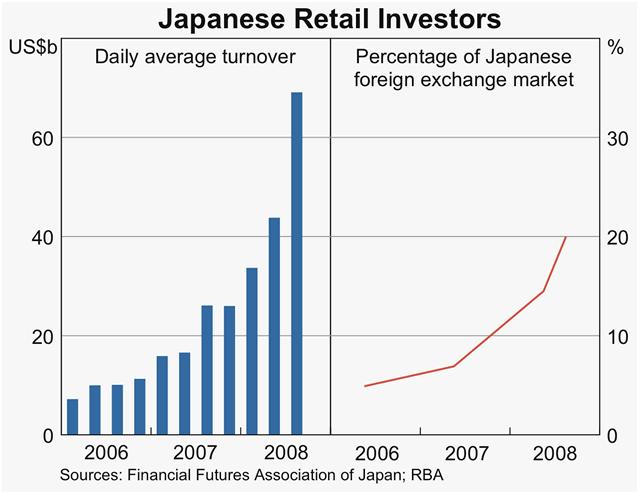
Yesterday, the Financial Times ran two stories on the Japanese carry trade, painting a seemingly contradictory picture.  The first article profiled the rise in the number of retail forex accounts in Japan, projected to reach 1 million by year-end.  More amazing is the fact that many of these traders are actually quite sophisticated, taking long and short positions in multiple currencies, though of course the most popular bet remains the carry trade, which involves going short the Yen and long a higher-yielding currency.  Meanwhile, as the second article expounded, the Yen carry trade is under pressure, having appreciated nearly 5% against the US Dollar, Euro and Australian Dollar.  The cause is certainly volatility in global capital markets, precipitated by what has been termed a "credit crunch," itself caused by the slump in housing prices. The hoard of Japanese retail investors may have to reverse their positions...

Read More: Pressure grows on yen carry trades and Forex Lures Japanese Investors

November 14, 2007

Australia Intervened in Forex Markets

According to recently-released documents, the Central Bank of Australia intervened on behalf of its currency in August, marking the first such intervention in over six years.  Surprisingly, its purpose in intervening was to lift up its currency, rather than hold it down, which is the reason most central banks intervene.  Apparently, the global credit crunch that flared up over the summer, generated tremendous volatility in forex markets.  As a result, many carry traders- for whom volatility is anathema- quickly unwound long positions in the high-yielding currencies Australia and New Zealand, causing them to plummet.  However, both currencies have since resumed their appreciation, which means any future intervention will likely be aimed at holding the Australian Dollar down. Bloomberg News reports:

The Australian dollar underwent "a particularly sharp depreciation in mid-August as the increase in global risk aversion arising from the credit-market crunch triggered an unwinding of carry trades."

Read More: Australian Central Bank Bought Currency to Ease Market Turmoil

November 05, 2007

Volatility Threatens Carry Trade

Advocates of the carry trade have long argued that the only thing that could possibly put an end to their fun would be a significant rise in Japanese interest rates, which seems quite unlikely at this point.  However, a new threat to the carry trade has emerged: volatility. Global capital markets have see-sawed over the last few months as credit concerns have surfaced, often related to America's housing bubble.  This month, the Australian Dollar and New Zealand Kiwi have been the two worst performers among the world's 17 most actively-traded currencies.  This is notable because these two currencies are most likely to be on the long end of carry trades.  Bloomberg News reports:

The currencies also slid against the U.S. dollar as Citigroup Inc. said it will report as much as $11 billion in additional writedowns, reducing demand for so-called carry trades.

Read More: Australian, New Zealand Dollars Fall on Renewed Credit Concerns

November 01, 2007

200+ Awesome Investing Websites

What better way to invest in your future than through the Internet? At any given time of day, and from any Internet connection, you can gain access to investing news and business summaries. You can plan your future through watch lists and online portfolios, as well. You can trade equities, CDs, roll over your IRA and compare fund families - all online and at your convenience. But, with so many sites to choose from, how do you make the right decisions about where to spend your precious time and money?

That's where we come in - to provide you with the sites that will offer you the most bang for your buck. From analysts to tools for young investors, we've broken the sites down into easy-to-manage categories. All categories are in alphabetical order and the sites within those categories also are listed alphabetically. Plus, we've added a little commentary to each link to let you know what to expect from these sites.

Continue reading "200+ Awesome Investing Websites" »

October 18, 2007

Australian Dollar Approaches Parity

Over the last few months, the Australian Dollar has risen over 15% against the USD, bringing the currency to a 23-year high. With parity (1:1 exchange rate) in sight, some analysts are beginning to draw parallels between the Australian Dollar and the Canadian Dollar, which skyrocketed to parity against the USD just last month.  Both economies are rich in natural resources, relying heavily on them to drive exports.  In fact, more than half of Australia's exports are comprised of natural resources.  It is no surprise that as oil, gold, and a host of other raw materials have surged to record highs, the Australian economy has outperformed even the rosiest of expectations.  With China's economic boom promising to keep raw material prices high for the near future, the prospects for Australia's economy, and hence its currency, are brighter than ever.

What’s more, the basic divergence in growth is clearly tipping towards the momentum underlying the Aussie economy with consumer spending, business investment and export income promising strength for the economy and currency in the months to come.

DailyFX reports: Australian Dollar: The Next to Reach Parity?

October 09, 2007

How to Profit from a Falling Dollar

The Dollar has been sliding steadily for close to a year, and Wall Street has been rushing to introduce a spate of new investment products to help investors profit accordingly.  For those who do not want to trade currencies directly, Exchange Traded Funds (ETF’s), probably represent the best alternative. The typical currency ETF tracks a basket of currencies and most ETFs are characterized by low fees.  In fact, over $2.7 Billion is currently invested in such ETF’s, which have risen from virtually nothing over the last 7 years. Another option is to buy CDs or other money market instruments denominated in other currencies. Online banks such as Everbank offer such products. Yet another option is to buy shares in mutual funds that aim to mimic the returns offered by investing directly in foreign money market instruments.  Finally, one can simply buy shares in foreign companies or in American multinational companies that do significant business abroad.

Read More: Opinion divided on currency trading

September 28, 2007

Global forex volume surges

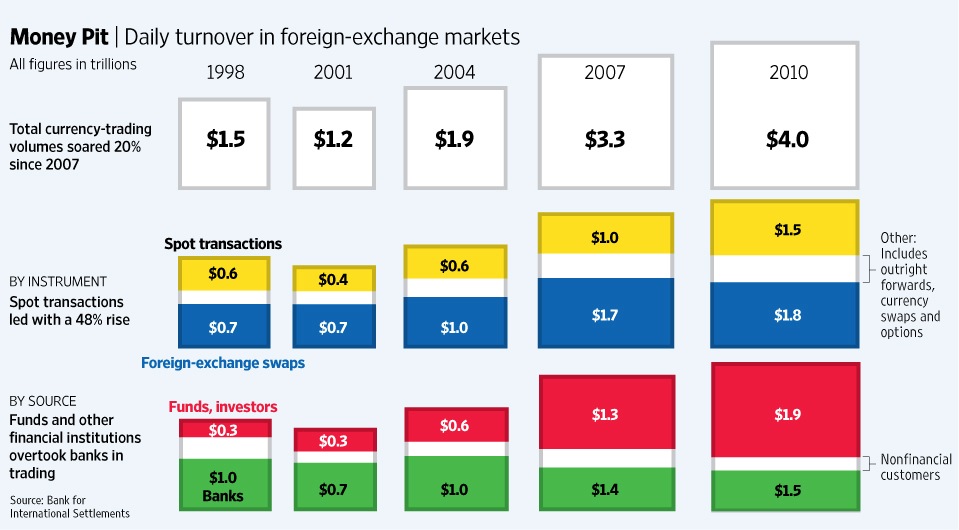
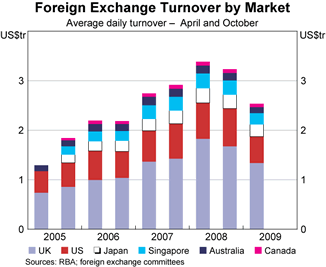
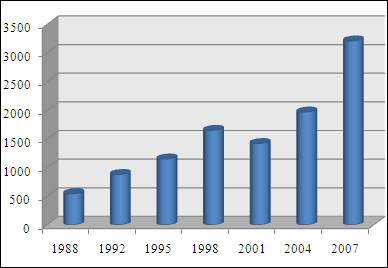
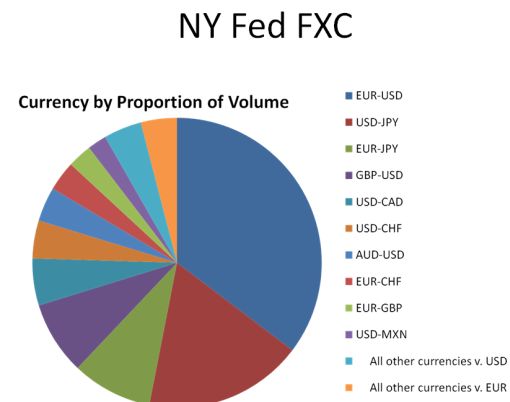
The Bank of International Settlements just released the results from its first survey of Central Banks in over three years, and the results were startling.  Forex volume rose 71% to $3.2 trillion per day, cementing the status of forex as the world's largest market. Trading in forex derivatives also surged, to an average of over $2 trillion per day.  While the role of the USD has slipped somewhat, it remains the world's reserve currency as evidenced by the fact that it represents over 40% of all forex volume. FinFacts reports:

"A significant expansion in the activity of investor groups including hedge funds" as well as individual investors also contributed to the increase."

Read More: Global daily turnover in currency markets rises...

September 25, 2007

FXCM offers Fractional Pip Pricing

Forex Capital Markets LLC, the largest Forex Dealer Member, recently announced that it would begin offering so-called “Fractional Pip Pricing” in an effort to reduce the bid-ask spreads it offers customers. Previously, most, if not all forex brokers that cater to retail forex investors, quoted forex rates out to four decimal places (i.e. 1.4101 USD/Euro). However, due to its strong liquidity relationships with banks that facilitate forex trading, FXCM has negotiated tighter bid-ask spreads for its customers, which will enable it to quote exchange rates to five decimal places (i.e. 1.41007 USD/Euro. While FXCM expects to narrow spreads further in the future, it remains to be seen whether the competition will follow suit.

Read More: FXCM's New Lower Spreads: Fractional Pip Pricing

September 21, 2007

The Yen Also Rises

The Japanese Yen is finally appreciating, though how long the upward streak will last is anyone’s guess.  These days, the Yen rises and falls on the whims of carry traders.  However, the enemy of the carry trade is volatility and the Fed’s lowering of US interest rates injected enough uncertainty into the markets to send carry traders slowly towards the exit.  As a result, currencies such as the Australian Dollar and New Zealand Kiwi, long popular with in carry trading circles, were quickly dumped as traders bought Yen to cover their positions. Whether the Yen can sustain its momentum depends primarily on the Central Bank of Japan. Bloomberg News reports:

Carry trades utilizing the New Zealand dollar lost 1.9 percent today, according to data compiled by Bloomberg, after gaining 2.3 percent so far this week as the Federal Reserve reduced the U.S. rate a half percentage point to 4.75 percent.

Read More: New Zealand Dollar Drops as Japanese Investors Return to Yen

September 20, 2007

Euro sets another record

Euro sets another record Today, the Euro set another record, breaching the $1.40 mark.  While theoretically a meaningless achievement, $1.40 was an important psychological and technical barrier, since many traders place stop orders and limit orders at round numbers, such as $1.40.  Accordingly, upon surpassing $1.40, the Euro quickly accelerated upward, creating a short squeeze, where those who bet the Euro would not pass $1.40 were forced to buy to cover their positions. EU politicians have been surprisingly quiet as the Euro rose rapidly against the Dollar, commenting only that they would monitor the situation.  However, it seems inevitable that the value of the Euro will begin to play a more serious role in EU economic policy, since it is already beginning to hamper growth.  AFP News reports:

“Excessive volatility and disorderly movements in exchange rates is undesirable for economic growth,” European Central Bank president Jean-Claude Trichet said.

Read More: EU finance chiefs on guard over euro strength, market turmoil

September 19, 2007

Canadian Dollar Nears Parity

With its continued strong performance against its neighbor to the south, the Canadian Dollar is almost defying logic, having jumped to 99cents against the USD in a matter of days. In purchasing power parity terms, the Loony is already among the most expensive in the world.  However, achieving parity (i.e. an exchange rate of 1:1) has a psychological value that can’t be cast in economic terms. Plus, it doesn’t hurt that high commodity prices have helped Canada to maintain years of strong growth and become America’s largest trading partner in process.  And after the Fed chopped 50 basis points off of the US Federal Funds Rate, the Canada-US interest rate differential is virtually non-existent. One commentator thinks a 1:1 exchange could provide a basis for more economic cooperation between the two nations.  The Globe and Mail reports:

“Parity is a very normalized level. Our [US and Canada] economies have become so closely intertwined that I think down the road what you're thinking about is more of a North American bloc.”

 
Read More: A call for parity doesn't look so loony now

August 29, 2007

Investment in European Stocks Weakens Yen

While the US had a rough day yesterday, European stocks performed well enough to tempt investors away from the yen. Though a stable currency, the yen is a low-yielding investment and traders are ready to try their hand at a riskier venture with European stocks. There is no word yet on how this may affect Wall Street. According to Forbes:
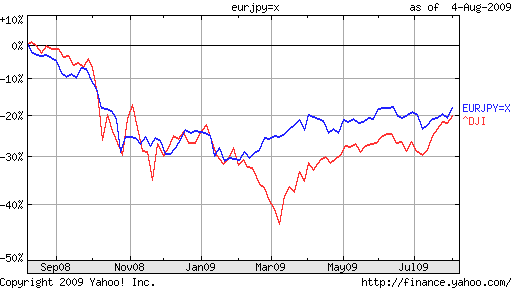
This has pushed the yen down as investors make tentative steps back to engaging in the risky carry trade - where investors sell low-yielding currencies such as the yen to buy higher-yielding ones elsewhere. With no US data due this afternoon, how equities fare on Wall Street is likely to determine whether the rise in risk appetite can be sustained.

Read more: Yen falls back as stable European stocks prompt revival in risk appetite

August 20, 2007

Forex Becoming Popular in Jamaica

A huge turnout at the recent "Jamaica Forex Expo" shows that foreign exchange trading is becoming a widespread practice in Jamaica. This expo was organized by the Market Traders Institute (MTI), which has reportedly trained nearly 1500 Jamaicans thus far. It would seem that citizens of this impoverished nation have found a new hope for their future with the help of forex trading. According to Jamaica Gleaner News:
"Trading on the forex has been my path to financial independence," proclaimed one patron who was in attendance at the expo.

Read more: Interest in forex trading grows in Jamaica

July 29, 2007

Slight Unwind in Yen Carry Trade

Last week witnessed a sudden unwinding in the yen carry trade, as a global market downturn affected investor sentiment towards risk. Volatility is the only market force that could seriously contend at collapsing the carry trade, and last week produced significant volatility. All of the world’s majors fell against the Yen, namely the New Zealand Kiwi, which fell by 7.5%. The kiwi, you may recall, has been one of the main currencies on the other end of the carry trade, due to its high interest rates. However, analysts are reluctant to proclaim an outright end to the popular carry trade, preferring to wait and see how volatile the world’s capital markets appear in the coming weeks. The Financial Times reports:

The wave of risk reduction also prompted investors to take profits in the Australian and New Zealand dollars, which have surged this year from central bank credit tightening or expectations of more tightening to come.

Read More: Yen hits 3-month high versus euro

July 19, 2007

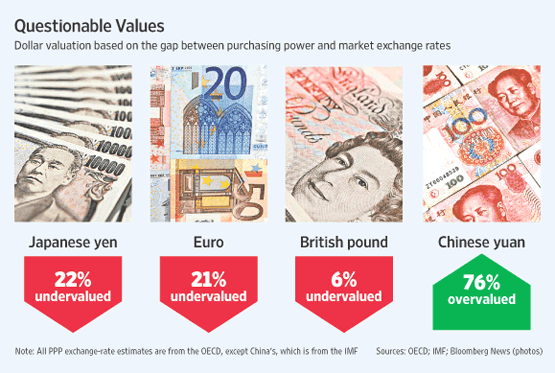
Big Mac Index Offers Currency Valuations via PPP

The Economist just released its an updated iteration of its famous Big Mac Index, underscoring growing disparities in currency valuations. For those of you that aren’t familiar, the Big Mac Index uses the price of a McDonald’s Big Mac sandwich in different countries as a proxy for measuring purchasing power parity (ppp), that perennial staple of economics that theorizes a country’s currency and its inflation rate should move in opposite directions. Thus, where a Big Mac is observed to be more expensive than in the US, it would suggest that country’s currency is overvalued relative to the USD. Of course there are numerous other factors in the local price of a Big Mac, including raw materials and taxes, but the index still packs a pretty profound punch. Unsurprisingly, the most undervalued currencies can be found in Asia- notably the currencies of Japan, China, Thailand, Indonesia, etc. The most comparatively expensive Big Macs (and hence most overvalued currencies) can be found in Europe, especially in Scandinavia and Northern Europe.

Read More: The Big Mac Index

July 09, 2007

Yen Descends to Record Low

The Japanese Yen has slid to a record low against the Euro, with no obvious end in sight to the wounded currency’s multi-year decline. The basis for the continued yen weakness is the expectation that Japan will hold interest rates at current levels until the end of the summer, a notion that was reinforced by the Bank of Japan yesterday. As a result, carry traders, who categorically fear volatility, can feel confident that a continued low interest rate environment will support the viability of the Yen carry trade in the short-term. However, there are a few risks in the horizon, namely that Japan’s economy and stock market are outperforming and could prompt a series of rate hikes in the fall and lure Japanese capital back to Japan. DailyFX reports:

The rallies are becoming overextended of course and the risk of some action by the Japanese government is increasing, but until carry traders have a reason to bail, they probably will not.

Read More: Japanese Yen Continues to Fall

June 22, 2007

Yen Falls to Record Lows

This week, the President of the Central Bank of Japan essentially ruled out the possibility of a near-term rate hike, which was exactly the kind of reassuring news forex carry traders wanted to hear. As a result, the Yen quickly dropped to record lows against the Euro, British Pound and Australian Dollar, as well to a four-year low against the USD.  Surprisingly, the Swiss Franc, would seem an excellent candidate to fund the carry trade, is also surging. Now that any near-term volatility-which is the bane of carry traders-has been removed, the carry trade is likely to thrive. High-yielding currencies, such as the New Zealand Kiwi, will likely attract continued attention from speculators. At this point, it seems the only thing that could possibly slow the carry trade is a Japanese rate hike, or the mere threat of one.

Read More: Carry trades hit yen but Swiss franc surges

June 12, 2007

FXCM Expo in Dallas - July 14 & 15

The next FXCM Expo will be held in Dallas on July 14 & 15. On Saturday the 14th, FXCM will present over 20 free workshops, geared towards all trading levels from beginner to advanced. Paid workshops are held on Sunday the 15th.

Read more details at FXCMExpo.com.

June 10, 2007

USD Receives a Boost from Treasuries

Over the last few weeks and accelerating towards the end of last week, the US bond market collapsed.  During that period, the 10-Year US Treasury yield rose 50 basis points to 5.15%, its highest level in nearly a year.  Meanwhile, the USD rose to its highest levels in a couple months.  Coincidence? Of course not. The relationship between the USD and US interest rates has become increasingly predictable, to the extent that increases or decreases in rates are consistently followed by a proportionate change in the value of the USD.  As a result of globalization, capital can be quickly moved to the country that offers the highest risk-adjusted return.  This is especially relevant for the US, which as the world’s least risky country (from a financial standpoint), tends to attract a big chunk of the world’s savings.  Forex traders should take note.

Read More: Dollar continues to strengthen from jump in Treasury yields

June 06, 2007

Loonie could Reach Parity against USD

Last week, the Canadian Dollar traded at 94 cents against the USD, its highest level in over 30 years. This event is even more unbelievable considering the Loonie’s all time low against the USD occurred less than five years ago, in 2002.  Now, many analysts are cautiously optimistic that the Loonie will be trading at parity with the USD by year-end, and perhaps continue appreciating past that point.  Rising natural resources prices and a strong economy may drive Canada’s Central Bank to raise interest rates, at the same time that its neighbor to the south is contemplating lower rates.  However, not all analysts are quite so optimistic. The Associated Press reports:

But with an expected dampening in the industrial and manufacturing sector on its way, other analysts predict the Canadian dollar will start to weaken because commodity prices will pull back a bit and Canada's economy may start to struggle because of the strength of the loonie.

Read More: Canadian dollar no longer 'a weakling'

June 04, 2007

Carry Trade Affects Swiss Franc

Low volatility combined with even lower interest rates has made the Japanese Yen into a popular target among forex traders, who borrow in Yen and short the currency in favor of higher-yielding alternatives.  It turns out the Japanese Yen, however, is not the only currency that is being driven downward by the carry trade; the Swiss Franc (CHF) has also become a victim in the last couple years.  Switzerland’s benchmark interest rate, at 2.25%, is the second lowest among industrialized nations, after Japan.  Moreover, the Swiss Franc is highly stable and liquid, which means it is well-suited for the carry trade.  Dow Jones News reports:

With global risk appetite remaining strong and carry trades remaining one of the primary driving forces in global currency markets, the franc is unlikely to get much respite from rate hike expectations.

Read More: Swiss Franc Slide Likely To Continue

May 13, 2007

Warren Buffet Returns to Forex

Two years ago, Warren Buffet made headlines when he entrenched a $20 Billion dollar bet that the USD would decline in the near term. Unfortunately for Mr. Buffet, who happens to be one of the world’s most respected investors, the Dollar had a great year, and Buffet lost almost $1 Billion. [However, over the course of the bet, which actually began three years prior, his company, Berkshire Hathaway, reputedly pocketed over $2 Billion]. Now, after a long hiatus, Buffet is returning to forex markets, though with much coyness; he has not announced explicitly which currency he is betting