Marketplace

  • Forex
  • Advertise here

Features

Helpful Links

Contact

May 08, 2008

Chinese Exporters Dump Dollar

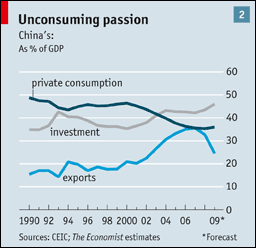
The anecdotal evidence that China is diversifying its forex exposure away from the Dollar continues to mount. To date, most of the focus has centered around the Central Bank of China, which is passively diversifying its reserves into European and higher-risk assets. Apparently, Chinese exporters are also getting nervous about the impact of a falling Dollar on their respective bottom lines. The RMB has risen 11% since the beginning of 2007, which means Chinese companies now receive 11% less on sales to destinations abroad than they did for equal-priced goods in 2007. As a result, some companies have taken to quoting prices in Euros or to adjusting Dollar-denominated prices every few months. Other companies are building assumptions of a more valuable RMB into their profit models, and setting prices accordingly. The New York Times reports:

“We are gradually increasing our emphasis on the domestic market until we can forget about the export market, because the profit margins on exports are so thin,” [said one exporter].

Read More: Some Chinese Exporters Prefer Euros to Dollars

April 11, 2008

RMB at Record Low

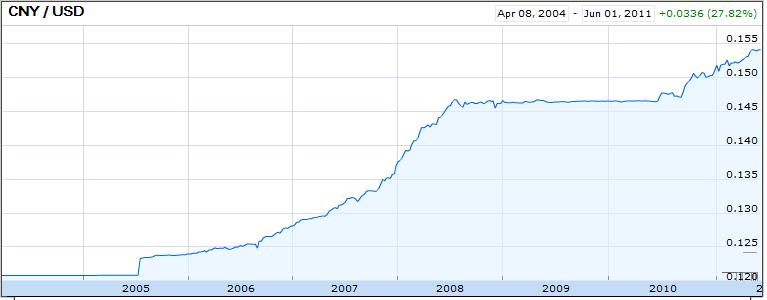
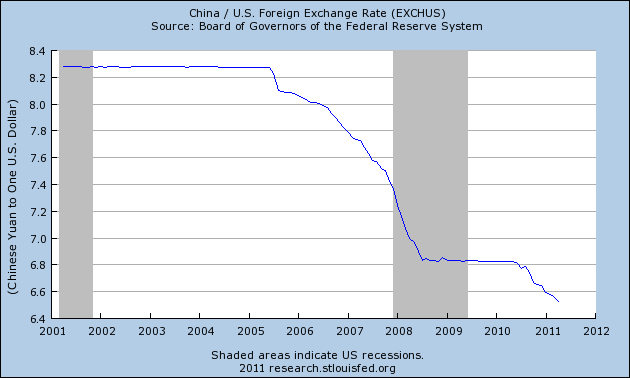
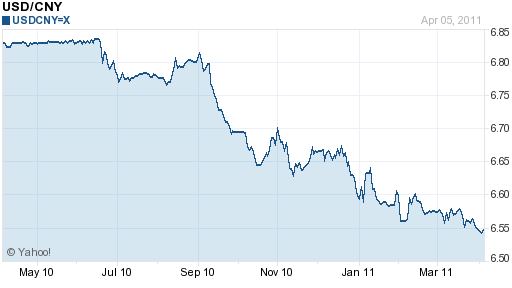
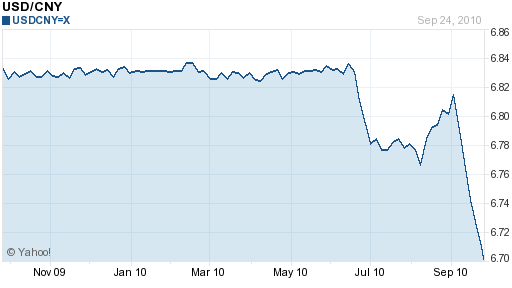
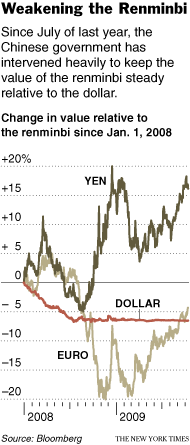
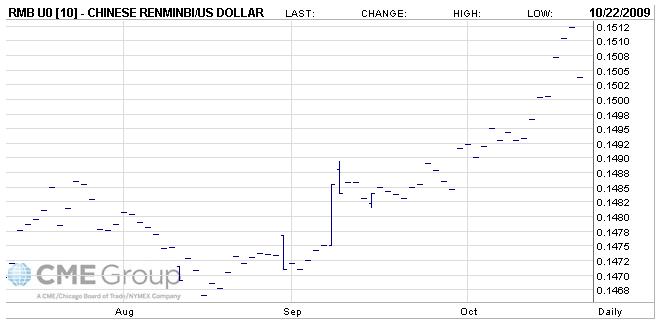
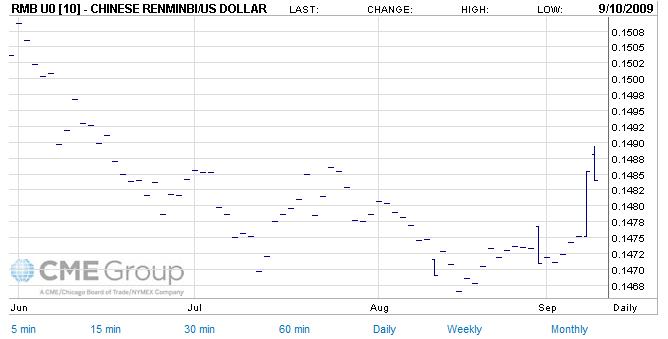
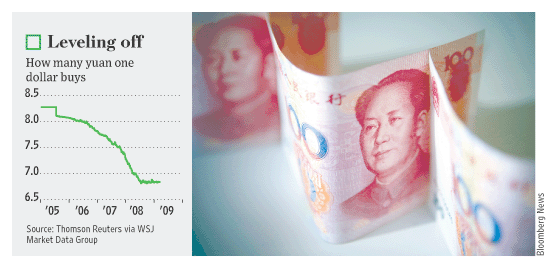
The lack of fanfare not withstanding, the Chinese Yuan, or RMB, continues to appreciate against the USD. This week, it crossed the psychologically important barrier of 7 RMB/Dollar, a level last seen in the 1990's. Since its revaluation nearly three years ago, the Yuan has risen 16% against the Dollar, a rate which appears to be growing exponentially given the 4.5% rise already notched in 2008. Due to the Dollar's continued weakness against all of the major currencies, the RMB has actually fallen against the Euro over the same period. Most analysts reckon the Yuan will continue appreciating, perhaps to 6.5 by year-end. The New York Times reports:

"The appreciating renminbi is a signal the Chinese government is sending to the export companies to switch away from the U.S. and other overseas markets and turn toward the domestic market."

Read More: Yuan Hits Milestone Against Dollar

February 25, 2008

Commentary: Yuan et al Must Appreciate

Although the Chinese Yuan is ostensibly allowed to fluctuate in value, the reality is that the size of its fluctuations and the pace of its appreciation are tightly controlled by China's Central Bank.  Since its currency is still effectively fixed to the Dollar, China is severely curtailed in its ability to conduct monetary policy and must closely mirror US policy.  Same goes for the rest of Asia, excluding Japan. While US monetary policy was relatively tight, as it has been for the last five years, this necessity didn't cause too many problems; most of these economies would have kept interest rates high irrespective of the US.

Since the Fed began loosening monetary policy over the last six months, however, many of the emerging economies in Asia, especially China, have been forced into a bind.  On the one hand, lowering interest rates is exacerbating the problem of inflation.  On the other hand, they want to keep their currencies stable so as not to limit economic growth.  In short, Central Banks must determine which is more important: fighting inflation or promoting growth. According to some economists, these economies are so strong, having grown by nearly 10% collectively last year, that they can afford to slow down, if it will result in greater price stability.  But the only way to stabilize prices is to drastically raise interest rates, which will put even greater pressure on their currencies to appreciate.

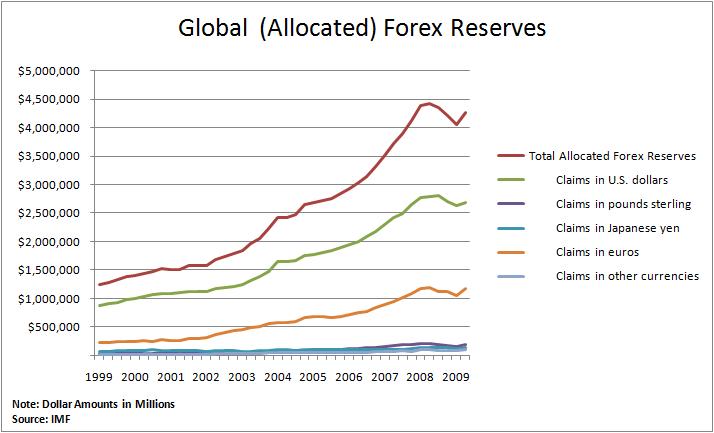
In addition, the Central Banks of Asia have amassed a staggering $4 Trillion in foreign exchange reserves.  In the past, this has been a neutral, sometimes profitable activity.  Since the Fed began cutting rates, the interest rate differential has been turned upside-down such that Central Banks are now losing money on each unit of local currency they sell in exchange for Dollars.  According to one analyst, over $160 Billion has been lost since July 2006, and those losses will mount with each additional intervention.

Read More: Fed's Lower Rates Pressure China to Strengthen Yuan

February 20, 2008

China's Trade Surplus Expands Further

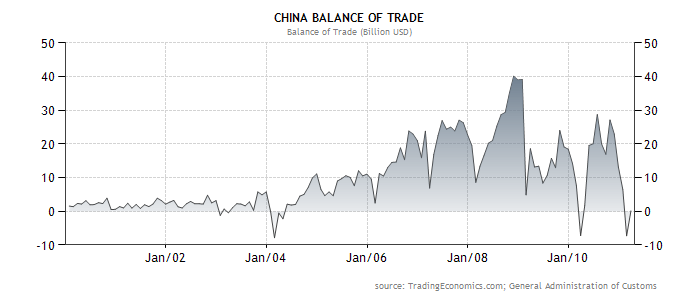
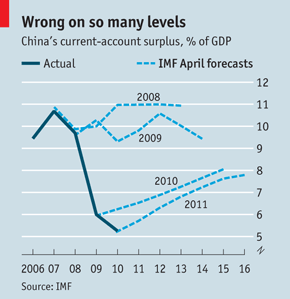
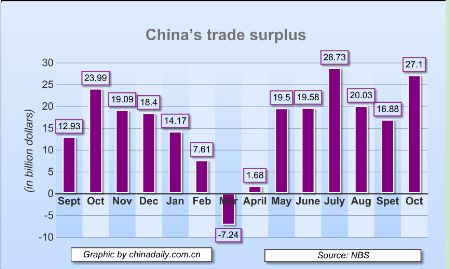
China's trade surplus grew 22.6% year-over-year for the month of January, on top of export growth of 26.7%.  If there is any silver lining to what many policymakers would consider bad news, it is that growth in imports is slightly outpacing growth in exports.  Unfortunately, that is unlikely to allay the critics, and there are still many of them. The argument remains unchanged- that China is not allowing its currency to rise fast enough.  On paper, however, the Yuan has appreciated by 15% since China officially de-pegged it from the Dollar in July 2005.  In addition, the G7 failed to scold China in its annual meeting, which suggests that economic policymakers are becoming less concerned with China's forex policy.  Ironically, the revaluation of the Yuan is probably boosting the value of of China's exports in the short-term, because other countries are now paying more for the same quantity of imports.  AFP reports:

The International Monetary Fund...urged the Chinese government to loosen the reins on the yuan. "We encourage a faster pace of appreciation that would be helpful for addressing China's key economic challenges and would also contribute to preserving global economic stability."

Read More: China's trade surplus rises 22.6 percent in January

February 08, 2008

China is Earning Negative Carry

China's foreign exchange reserves currently approximate $1.5 Trillion, the majority of which is denominated in USD.  Moreover, the Central Bank of China earns interest on every Dollar it adds to its reserves but must also pay interest on every RMB note that it must issue to offset the Dollars. Since the Fed began easing monetary policy, the amount of carry (the difference between what the Central Bank receives on Dollars and pays on RMB) earned by the Central Bank has completely inverted, such that it now loses 250 basis points on average for each Dollar exchanged for RMB. 

Based on the rate at which China is currently accumulating reserves, this amounts to between $5 Billion and $10 Billion per month, depending on which method of accounting is utilized. Furthermore, this trend has been exacerbated because China is accumulating reserves at a faster rate than its economy is growing. Some analysts have speculated that this could turn into a major political issue, with important implications for the RMB/Dollar exchange rate. The Financial Times reports:

The renminbi has started to appreciate more rapidly in recent months, rising at an annualised rate of about 20 per cent, compared with 6-7 per cent over the whole of 2007.  In the longer-term, say economists, China will have no choice but to allow its currency to appreciate faster, even in the face of entrenched domestic resistance.

Read More: Beijing starts to pay for forex ‘sterilisation'

January 19, 2008

Chinese Yuan Accelerates Upwards

When Henry Paulson was appointed Secretary of the US Treasury last year, he made China and its purportedly undervalued currency a cornerstone of his economic plan. Lo and behold, several months ago, the Yuan suddenly accelerated in its upward path against the Dollar, rising at an annualized rate of 14%. Currency futures are now pricing in an 8% rise in 2008, while several economists are forecasting a 10% increase.  Ironically, there are still American policymakers who think the Yuan is appreciating too slowly, as well as Chinese policymakers who reckon it is increasing too rapidly.  Accordingly, the current pace probably represents a fair compromise.  Besides, inflation is threatening the US, so a slow appreciation would enable the economy to adjust to higher prices in the long term.  While China also faces rising inflation, it doesn't want to send investors the message that the movement of its currency is uni-dimensional, which would encourage further inflows of speculative capital.  The Economist reports:

But Chinese policymakers have stressed the need for gradual adjustment. To show that the currency is not just a one-way bet, the PBOC may try to nudge the yuan a bit lower in coming days.

Read More: Revaluation by stealth

January 16, 2008

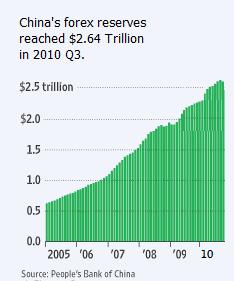
China's Forex Reserves Roar Past $1.5 Trillion

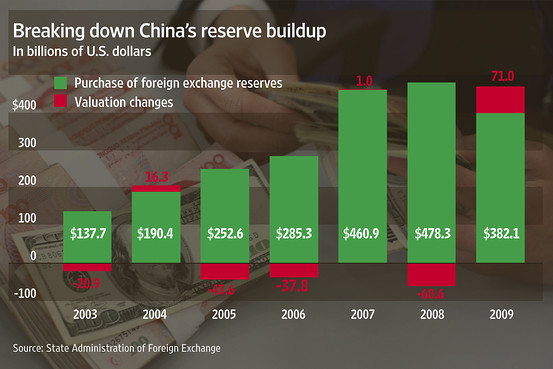
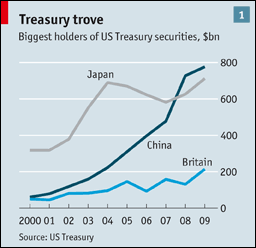
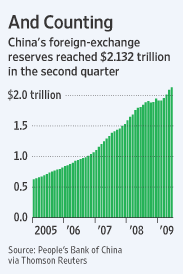
On January 24 last year, the Forex Blog reported with great fanfare that China's forex reserves had breached the epic milestone of $1 Trillion. [In hindsight, it turns out that the psychologically important barrier was broken several months earlier, but that is beside the point].  Less than one year later, China's forex reserves reached another important threshold, soaring past $1.5 Trillion. It appears that new reserves are being accumulated at  an exponential rate, having increased $460 Billion last year and over $30 Billion in the month  of December alone. By no coincidence, China's 2007 trade surplus of $262 Billion shattered the previous record and is expanding at a comparably supersonic pace.

Most analysts reckon that the country is locked in a vicious cycle: when its trade surplus grows, its forex reserves grow proportionately. Moreover, the lopsided trade imbalance th\at China maintains with most of the world ensures that the demand for Chinese Yuan exceeds the supply. In the short run, a more expensive currency equates to higher prices paid for its exports which only increases the trade surplus and forex reserves further, and exerts still more pressure on the currency to appreciate.  Meanwhile, as the Yuan rises, the value of China's forex reserves, which are denominated predominantly in USD, falls.  What a conundrum indeed! Xinhua News reports:

The value of Chinese RMB against the US dollars has appreciated by over six percent in 2007. The central parity rate of the RMB was 7.2672 to the US dollar on Friday.

Read More: Forex reserve tops $1.53 trillion

December 28, 2007

The Record Rise of the Chinese Yuan

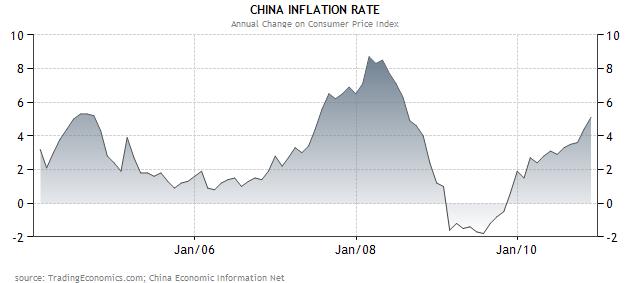
Earlier this week, the Chinese Yuan recorded its highest one-day increase in value in the two years since it was famously revalued against the Dollar.  The currency rose nearly .4% and prompted renewed speculation that China's Central Bank will either widen the trading band to .8% or will generally allow the currency to appreciate faster.  In fact, the political and economic consensus continues to maintain that the Yuan is not appreciating rapidly enough.  While it rose over 6% against the Dollar, for example, it actually lost value to several of the world's major currencies.  Furthermore, its decline against the Dollar is less impressive when China's skyrocketing inflation rate and burgeoning trade surplus are taken into account.

There are still a few analysts who are bucking the trend and arguing that the Yuan is fairly valued.  This notion is supported by a recent World Bank analysis, which updated its calculation of China's purchasing power and reduced its PPP-equivalent GDP in the process. However, this opinion is echoed by only a small group of analysts, and an overwhelming majority continues to call for and anticipate a further appreciation of the Yuan.  Bloomberg News reports:

Forward contracts show traders are betting on an 8.7 percent advance in the yuan to 6.7344 per dollar in the next 12 months. The median estimate of 28 analysts surveyed by Bloomberg News is for a rate of 6.88 by the end of 2008.

Read More: Yuan Rises Most Since End of Peg as China Seeks to Curb Prices


December 21, 2007

China off the Hook...Again

Since even before the dawn of the Forex Blog, commentators have been speculating that the US Treasury Department would officially brand China as a "currency manipulator" in its semi-annual report to Congress.  Such a label is important because it would enable the US to levy tariffs and other economic penalties against China.  However, another report has been issued, and one more time the Treasury Department glossed over China's de facto control over the Yuan. The report did criticize China for failing to appreciate the RMB rapidly enough, since the 12% gains it has racked up over the last two years have been largely offset by inflation.  The report also referred to China's widening trade surplus and accompanying growth in foreign exchange reserves.  US politicians, however, are less than pleased, and are preparing to take matters into their own hands.  The Associated Press reports:

"In refusing to brand China as a currency manipulator, which is so obvious, the Administration gives Congress no choice but to act on its own. This report is the strongest case possible for our legislation," said [one high-ranking Senator] Schumer.

Read More: US stops short of accusing China of currency manipulation

Continue reading "China off the Hook...Again" »

December 13, 2007

OECD: Chinese Yuan Still Too Low

The Organization for Economic Cooperation and Development (OECD) recently issued a report on the Chinese Yuan, which thoroughly assessed the currency’s appreciation since it was “revalued” over two years ago.  While the Yuan has technically risen over 10% against the USD, the OECD concluded that in real terms, the currency has actually fallen. The official rate of inflation hit 6.5% this year, and international economists reckon the true figure is probably much higher. Furthermore, the government recently revised its estimate for full-year GDP growth to 11.4%, which means price levels may rise further, eating into the real value of the RMB.  In fact, the OECD estimates that the Yuan remains undervalued by as much as 40% and views the “solution” as a combination of tighter monetary policy and looser exchange rate policy.  The Associated Press reports:

While the report did not directly criticize China's foreign exchange controls, it noted that efforts to tighten money supply to counter inflation were not having much impact.

Read More: OECD Says China Grip on Yuan Too Tight

December 10, 2007

China Trade Surplus Sets New Record

Despite, or perhaps because of the appreciating Yuan, China's trade surplus with the US is growing by 50% on an annualized basis, and is set to surpass $250 Billion for the year.  In theory, the more expensive Chinese currency should reduce US dependence on Chinese exports and narrow the trade imbalance.  In practice, the US is actually importing a greater quantity of goods and services from China and is also paying higher prices because of the appreciating Yuan.  Ironically, the US Treasury Secretary is scheduled to discuss this matter with his Chinese counterpart next week, and is expected to pressure China to appreciate the RMB even faster against the Dollar. Unfortunately, China's hands are partially tied as a result of an agreement it already signed with the EU, under which it promised to appreciate the RMB against the Euro. Bloomberg News reports:

Under the current regime, the yuan is allowed to move as much as 0.5 percent against the U.S. dollar every day, from the previous limit of 0.3 percent. "There will be a broadening of the trading band again in the next few months," said one analyst.

Read More: China Trade Surplus Probably Held Near Record, Fueling Tension

December 01, 2007

EU Joins US in Calling for Yuan Revaluation

In the campaign to pressure China into revaluing the Yuan, the US has by far been the loudest voice.  However, the rapid decline of the USD may have unintentionally earned the US a new ally in its fight: the EU.  Since the Chinese Yuan is essentially pegged to the USD, and the USD has declined against the Euro, the law of triangular arbitrage is such that the Euro has actually appreciated significantly against the Chinese Yuan.  EU officials are no longer standing by idly, since the exchange rate is beginning to deal serious harm to its balance of trade.  In fact, the EU now occupies third position on the list of countries with the largest trade deficits with China.  Because of the nature of China’s exchange rate regime, however, China’s ability to control the relationship of the Yuan with both the Euro and the USD will be difficult, if not impossible.  The Bangkok Post reports:

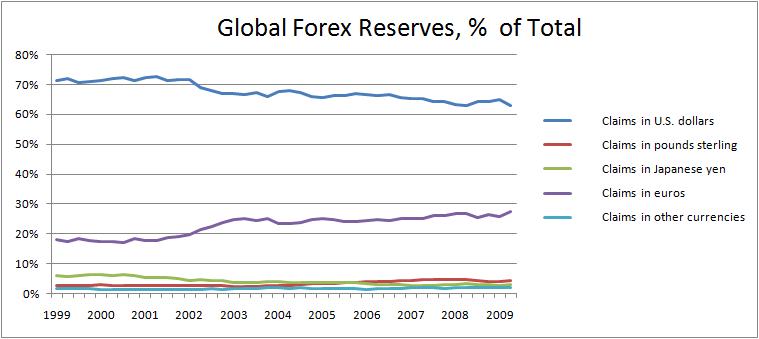
Given the fact that about 70% of China's $1.4 trillion in foreign reserves are dollar-denominated assets and the majority of foreign trade transactions are cleared in US dollars, China has focused more on the RMB-dollar rate.

Read More: A tale of two currencies

November 15, 2007

Why China Should Not Dump the Dollar

In fact, China may have to increase its exposure to the dollar, according to the comments of Brad Setser of the Council of Foreign Relations: "In my mind, so long as China resists more rapid appreciation of the renminbi versus the dollar, it's rather difficult for China to diversify in any meaningful way against the dollar. If China really started to diversify away from the dollar, I think it's a big enough player that it would put downward additional pressure on the dollar."

And additional downard pressure on the USD should be what China is trying to avoid. China, being the largest exporter to the U.S. does not want to see appreciation of its currency against the USD, as that would make its goods more expensive (and therefore less competitive) in America.

In fact, Setser goes on to say that in order to prevent the USD from sliding even further downward against the RMB, China would have to not only retain its present stock of USD, but in fact buy even more.

Read more: Can China Dump the Dollar?

November 07, 2007

China talks up Diversification

A high-ranking official in China's government recently gave a speech urging the Central Bank to (continue to) diversify its vast holdings of foreign exchange, currently estimated at $1.4 Trillion and rising.  The speech was atypical in its level of directness, as Chinese officials tend to speak with a certain degree of circumspection if they think there is any possibility that their comments will reach the public. Specifically, he advocated making a play on the current volatility in forex markets, by selling “weak currencies” in favor of “strong currencies.”  In fact, the most recent data shows that China is already doing just that: its holdings of US government bonds have declined even as its reserves have risen.  The Financial Times reports:

Although he later tried to play down his comments, saying he had not been speaking in an official capacity, the damage was done.

Read More: Dollar sinks to new lows

October 29, 2007

Chinese Yuan Reaches Milestone

The Chinese Yuan has crossed the psychological barrier of 7.5 RMB/USD, a level last seen nearly a decade ago.  The currency’s appreciation has been gradual but visible, not withstanding the cries of western bureaucrats.  By all accounts, the Yuan will continue rising, though not at the same pace as its trade surplus, which is projected to jump from $177 Billion in 2006 to $300 Billion in 2007.  Predictions regarding the extent of the appreciation range from 20% to 400%, the implication being that it depends who you ask. But the general consensus is clear: the Yuan is pointing upwards.  Bloomberg News reports:

Non-deliverable forward contracts show traders are betting the yuan will reach 7.0070 in 12 months, a gain of 6.9 percent from the spot rate, and 6.95 by the end of 2008.

Read More: Yuan Gains Past 7.5 for First Time in Decade as Surplus Widens

October 24, 2007

US Presses China to Revalue

You have to admire the US for its persistence in pressuring China to appreciate the Yuan, though it’s not as if anyone seriously expected it to back off. Fresh from the recent G8 conference and enjoying the spotlight of the media, US Treasury Secretary Hank Paulson called in China to put its money where its mouth is, and relax its hold on the Yuan. Paulson expressed dissatisfaction with the pace at which the Chinese currency has appreciated- approximately 10% since 2005.  He even insinuated that there would be repercussions for the US-China trade relationship if this demand was not at least partially fulfilled.  To add insult to injury, he warned that US public opinion of China is already at a low point, in the wake of the quality control issues with Chinese exports and the subsequent recalls.  Reuters reports:

“While we are trying to lower barriers to trade, there is a risk that some in China are stepping away from long-standing policies of closer global economic integration -- policies which have been a source of

China's incredible growth.”

Read More: Paulson wants faster China yuan rise


October 10, 2007

Europe Asks China to Revalue Yuan

Evidently frustrated by the Euro’s appreciation against the USD, a group of EU ministers has turned its attention to China, calling on it to allow the Yuan to appreciate against the Euro.  While the Yuan has appreciated nearly 10% against the USD over the last two years, it has actually decreased in value against the Euro.  As a result, the EU trade deficit has set a fresh record nearly every month. Unfortunately, the Yuan basically remains pegged to the USD, and since the USD is depreciating faster against the Euro than against the Chinese Yuan, the law of triangular arbitrage dictates the Euro must be appreciating against the Yuan.  It appears China’s hands are tied.  Bloomberg News reports:

“I can assure you China will continue to adopt a reform oriented policy on its exchange-rate mechanism,” said a Chinese Foreign Ministry spokesman. “But these adjustments have to be done gradually and in line with the market.”

Read More: EU Calls on China to Let Yuan Appreciate Against Euro

October 03, 2007

China Launches Forex Investment Arm

After much delay, China finally launched the bureau charged with diversifying its $1.4 trillion foreign exchange reserves. The agency will be capitalized with $200 billion and will invest in assets slightly more risky than US treasury securities. Most currency analysts view diversification as tantamount to the sale of dollar-denominated assets, but in practice, this may entail only the movement of funds into riskier dollar-denominated assets. In fact, the investment arm’s opening move was a $3 billion investment in The Blackstone Group, an American financial conglomerate. Dollar bulls can hold off on worrying just yet.

Read More: China's trillion-dollar kitty is ready

September 13, 2007

Trade data supports Yuan appreciation

That the balance of trade between the US and China is becoming more and more lopsided in favor of China should come as no surprise to anyone.  In fact, economists yawned when the August trade data revealed a 33% jump in the Chinese trade surplus.  As a result, many are beginning to argue that China can allow the Yuan to appreciate at a faster pace against the Dollar, since it is obvious that China’s export sector will not be materially affected by a stronger Yuan.  In addition, China now exports more goods and services to the EU than to America, yet another statistic which supports the notion that China can allow its currency to appreciate against the Dollar (the implication here being that the Euro-Yuan exchange rate should be more important to China at this point).  Finally, China’s inflation rate is now hovering around 6.5%, its highest level in over a decade.  A more valuable Yuan would presumably make imports less expensive, thus lowering prices across the board for Chinese consumers. Bloomberg News reports:

The Chinese currency is selling for about 7.51 to the dollar. It has risen almost 6 percent against the U.S. currency in the past year while falling more than 3 percent against the euro, leaving the overall competitiveness of China's exports little changed.

Read More: Rising Euro Is What China Needs to Dump Dollar

July 16, 2007

China to Float the Yuan?

Since it was freed from its fixed exchange rate regime two years ago, the Chinese Yuan has appreciated nearly 9% against the USD. While the Yuan’s exchange rate is clearly managed by the Chinese government, many commentators agree that its rise has given off the aura of a floating currency. One economist thinks China will cement this perception the conclusion of the Beijing Olympics-to be held in 2008-and allow the currency to float freely, at which point it could surge by as much as 10% against the USD. Evidently, China is growing tired of the lack of control it has over its domestic economy due to its exchange rate policy and is clearly overwhelmed by the need to continue growing its forex reserves (which now stand at $1.33 trillion) in order to control the Yuan. Bloomberg News reports:

“They have to adopt a free-float system; it's not a question of whether they will, but a question of when. After the Olympics, the new leadership will be firmly in place.”

Read More: Yuan May Trade Freely After Olympics, UOB's Suan Says

June 25, 2007

How to Value a Currency

With the US government doggedly clinging to the notion that China is manipulating its currency and insisting that the communist country be punished accordingly, it bears asking “how can we determine that a currency (in this case the Yuan) is in fact undervalued, and if so, by how much.  One notable economist has laid out three general techniques for “valuing a currency,” which may prove useful to all of you amateur economists.

First, there is the concept known as “purchasing power parity,” which suggests that a pair of currencies should fluctuate in value relative to each other based on changes in their respective interest rates and inflation. Second, there is the notion of a “sustainable” or “fundamental equilibrium” exchange rate which brings a country’s current account into balance- neither deficit nor surplus.  Third, historical exchange rate data can be regressed against various economic indicators (productivity, employment, etc.) in order to distill the select few that had the most direct effect on the currency in the past. The most current economic data can then be plugged into the resulting equation and tested against actual exchange rates.  However, while economists agree that these techniques are the most theoretically sound, they ignore the fact that currencies today seem less tied to the laws of plain economics than they do to financial economics- capital flows.

Read More: Misleading misalignments

May 27, 2007

Commentary: What to do about the Chinese Yuan?

The Chinese Yuan refuses to die as a topic of conversation among forex speculators. In theory, the currency is among the world’s most prosaic; since its famous “revaluation” by the Chinese government nearly two years ago, the Yuan aka RMB has appreciated at a leisurely pace, roughly equivalent to 3% per year. Last week, the CCP took a step further in liberalizing its currency system by widening the band in which the Yuan is permitted to fluctuate, to .5% daily.

However, this did little to appease foreign diplomats and American politicians, who contend that the Yuan remains vastly undervalued, and that the Chinese government is guilty of currency manipulation. Two American Senators, Lindsey Graham and Charles Schumer, are still threatening to introduce a latent piece of legislation into Congress, which would slap a 27.5% tariff on all Chinese imports, unless the CCP promptly increases the value of the Yuan. (The 27.5% represents an average of the high and low estimates, 40% and 15%, respectively, of the extent of the Yuan’s undervaluation relative to the USD.) For its part, China maintains that not only is the currency fairly valued, but also that it will not be pressured into hastening the Yuan’s rate of appreciation. So, two questions need to be answered: Is the Yuan undervalued and if so, should China allow it to appreciate at a more rapid pace?

The first question is probably the trickier of the two to answer. Economists use admittedly crude techniques to value currencies. One method involves a calculation of purchasing power parity (PPP), which dictates that currencies should adjust in value relative to each other in inverse proportion to their respective price levels. In the case of the Yuan, PPP analysis suggests that the Yuan may be undervalued by as much 50%. However, this is to be expected; since income levels in China are vastly lower than in the US, one would expect prices to be lower, irrespective of exchange rates. Other methods used to estimate the fundamental value of the Yuan involve sophisticated statistical analysis, producing estimates of undervaluation ranging from 0% to 50%. In short, it appears as though the Yuan remains marginally undervalued, but the extent of which remains guesswork.

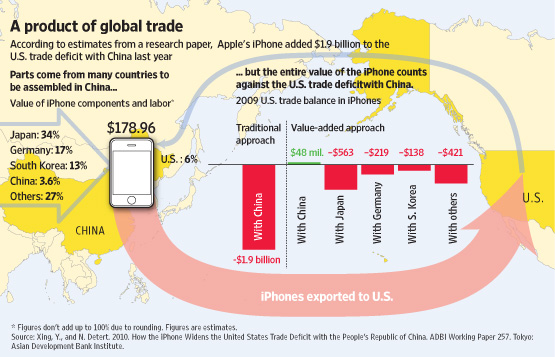
Upon concluding that the Yuan is undervalued, should China be expected to allow the currency to fluctuate more freely (i.e. appreciate)? It depends on who you ask.  American officials argue that the revaluation of the Yuan represents a crucial piece of the drive to reduce the burgeoning US trade deficit. However, upon closer examination, this notion is revealed to be false since most of China’s exports to the US are themselves repackaged products from other parts of Asia. Further, a sudden revaluation of the Yuan would likely result in the relocation of Chinese production to facilities to other low-wage countries, thus doing little to stem the US trade deficit. From China’s point of view, its economy is helped by an artificially cheap currency in that its export sector receives an indirect subsidy. However, it is constrained in its ability to conduct monetary policy as well as in its need to accumulate massive forex reserves, both of which would be relaxed in the event of a revaluation.

Not withstanding that China’s stubbornness mean it will not be bullied into appreciating its currency, it is probably in everyone’s best interest if it capitulates. My prediction, for what it’s worth, is that China will ultimately allow the RMB to appreciate at a slightly faster pace against the USD, probably somewhere in the neighborhood of 5% a year.

May 22, 2007

China’s Forex Arm Begins Investing

China’s Central Bank recently made waves in forex markets when it created several state-owned organization charged with investing a portion of China’s $1.2 Trillion in forex reserves.  Scant additional information was released until last week, when it was revealed that the first major investment would be a $3 Billion stake in The Blackstone Group, which is planning an Initial Public Offering.  While it should be clear that China is taking its plan to diversify its reserves seriously, the news should come as a partial relief to Dollar Bulls, because in this case, the diversification will not involve the sale of USD.

Read More: Blackstone details float as China takes $3bn stake

May 20, 2007

China Increases Yuan Trading Band

In a sop to western policymakers, China recently announced that it would widen the Chinese Yuan’s daily trading band, from .3% to .5%.  In theory, this means the Yuan will now be permitted to fluctuate by up to .5% per day against the USD.  In practice, however, the Yuan’s daily rate of appreciation probably won’t exceed .05%, and only then on an especially volatile day.  Two years ago, China revalued the Yuan and since then, the currency has appreciated at an annualized rate of 3%.  However, the west was not mollified, and continued to pressure China relentlessly to allow the Yuan to appreciate further.  Unfortunately for the west, this latest policy change is unlikely to have any practical impact on the valuation of the Yuan, as analysts are predicting the currency will appreciate by only another 3% this year.  Bloomberg News reports:

The yuan never moved the maximum permitted under the previous limit. It moved 0.13 percent from the daily reference rate on April 16, the most this year, according to Bloomberg data.

Read More: Yuan Rises to Highest Since July 2005 on Wider Trading Band

April 12, 2007

China’s forex reserves surpass $1.2 Trillion

Last fall, China’s reserves officially surpassed the $1 Trillion mark, a watershed event that would have been nearly unthinkable several years ago.  This week, China announced that its reserves now exceed $1 Trillion, having grown by almost 40% year-over-year and showing no signs of slowing.  Most of the increase can be attributable to growth in China’s trade surplus, which now exceeds $40 Billion, on a quarterly basis.  China has already delegated the management of $250 Billion of its reserve to a state agency; perhaps this latest development will compel it to further delegate active management of the reserves.  Xinhua News reports:

Continuous growth of forex reserve has in fact increased the pressure on appreciation of the Chinese currency, which in turn has exerted greater pressure on value preservation of China's forex reserves, which are estimated to reach 2.9 trillion U.S. dollars in 2010.

Read More: China's forex reserve tops 1.2 trillion USD

April 10, 2007

BOJ spurs carry trade

To no one’s surprise, the Bank of Japan has announced that it would maintain Japanese interest rates at the current level of .25%.  Carry traders seized upon the opportunity to continue borrowing Yen at near-record lows, and selling the Japanese currency in favor of higher-yielding alternatives.  In fact, the news was met with such gusto that the Euro was almost immediately propelled to an all-time high against the Yen, which continues to plumb the depths of forex disfavor.  At this point, analysts and economists are feeling fairly certain that Japanese interest rates will remain at current levels in the near-term, a sentiment which supports the viability of the carry trade. Forbes reports:

One analyst commented: “with BoJ expectations stable, currency market volatility subsiding and risk aversion abating, carry trades are recovering, keeping the yen under pressure.” He sees no immediate catalyst for a yen recovery.

Read More: Euro hits record high against yen as carry trades continue

April 01, 2007

China reconsiders reserve diversification

China, which recently unveiled plans to set up an agency under the aegis of the state that would manage the country’s surging forex reserves, is having second thoughts of sorts.  While the plan to more actively manage its reserves remains on coarse, the likelihood that this result in diversification has been somewhat diminished.  Estimates of the fraction of China’s reserves held in USD-denominated assets fall in the 70% range, which means that any decline in the USD could have multi-billion dollar ramifications for the value of China’s reserves.  And surely diversification would put tremendous downward pressure on the USD, which means China would likely experience the offsetting of gains from diversification with the relative decline in the value of its USD-denominated assets.  Forbes reports:

“Everyone knows that they should try to cut their US dollar assets. But, of course, if China wanted to make such a move, a big cut, our losses would be large as well. That would be very difficult to do.”

Read More: China diversification away from dollar would mean forex losses

March 18, 2007

China raises interest rates

China’s Central Bank, in an effort to rein in the nation’s runaway economy, recently raised the country’s benchmark lending rate by 27 basis points. With most countries, an increase in interest rates would propel the country’s respective currency upward in value, as risk-averse investors would bring capital to that country’s bond markets. In the case of China, however, monetary policy tends to have a pretty negligible effect on the currency, primarily because the Yuan remains pegged to a basket, and its appreciation is being carefully managed by the government.

Read More: China announces 0.27 percentage point increase in key interest rates

March 13, 2007

China FX Firm to Manage $200 Billion+

Several months ago, China announced that it would sponsor the creation of several state-owned investment firms that would be charged with managing China’s ever-growing stock of foreign exchange reserves. This week, China unveiled further details, indicating that the first one of these investment firms will be capitalized with $200-250 Billion in assets. This firm will use the proceeds of a bond offering for such an amount to buy forex reserves directly from China’s Treasury, with the explicit goal of earning a return in excess of the interest it must pay on the bonds. In order to achieve this, the firm will almost be forced to invest in non-USD denominated assets, which would surely exert downward pressure on the USD. The Shanghai Daily reports:

The State Administration of Foreign Exchange will run the daily operation of the country's forex reserves, while the new forex investment company, under the State Council, will run the investment side.
Read More: China's 1st forex firm to issue US$200b bonds

China FX Firm to Manage $200 Billion+

Several months ago, China announced that it would sponsor the creation of several state-owned investment firms that would be charged with managing China’s ever-growing stock of foreign exchange reserves. This week, China unveiled further details, indicating that the first one of these investment firms will be capitalized with $200-250 Billion in assets. This firm will use the proceeds of a bond offering for such an amount to buy forex reserves directly from China’s Treasury, with the explicit goal of earning a return in excess of the interest it must pay on the bonds. In order to achieve this, the firm will almost be forced to invest in non-USD denominated assets, which would surely exert downward pressure on the USD. The Shanghai Daily reports:

The State Administration of Foreign Exchange will run the daily operation of the country's forex reserves, while the new forex investment company, under the State Council, will run the investment side.

Read More: China's 1st forex firm to issue US$200b bonds

February 11, 2007

China to actively manage forex reserves

China recently announced plans to begin actively managing its foreign exchange reserves, currently valued at more than $1 Trillion. Concurrent with this announcement, China formally created The State Foreign Exchange Investment Company, which will initially be capitalized with more than $200 Billion. Another Chinese investment company will be given $100 Billion. These steps represent the culmination of several years of intense speculation that China would make more of an effort to manage its burgeoning reserves in order to maximize returns. Whether these two investment companies intend to diversify the reserves by investing in non-US assets is anyone’s guess, but at the very least, the US cannot be certain that China will continue to support the USD through its purchase of US Treasury bonds, which offer minimal yields.

Read More: China to set up firm for managing forex reserves

January 24, 2007

China’s reserves surpass $1 Trillion

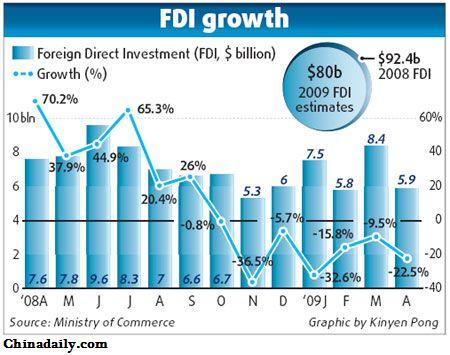
The unthinkable has happened: China’s foreign exchange reserves have surpassed the historic level of $1 Trillion. Since the late 1990s, when China was continuously inundated with foreign direct investment, it has been forced to remove the foreign currency from circulation in order to mitigate the risk of inflation. Now, China has found itself in the unenviable position of managing the world’s largest cash reserves. As everyone knows by now, most of these reserves are held in USD-denominated assets, a phenomenon that has heretofore provided support for the USD while thoroughly muddling US bond markets. Imagine the effect on US capital markets if China decreased its USD holdings and invested the proceeds in its own economy. The Gulf News reports:

The composition of China's reserves is secret, but economists believe about 70 per cent is in US Treasury bills, much of the rest in euros and a small amount in yen. Purchases of assets in other currencies are believed to be growing as the bank diversifies its holdings.
Read More: China in dilemma over forex reserves

January 15, 2007

Declining Yuan hurts Chinese Exporters

Since China revalued the Yuan in July 2005, the currency has appreciated by over 6% against the USD. Having since moved past the Hong Kong Dollar, the currency is showing no signs of slowing down. American politicians and trade representatives could not be happier. Their Chinese counterparts, on the other hand, are peeved. Many Chinese exporters have been forced to lower their prices in order to offset the rising yuan and maintain their competitiveness in overseas markets. Such exporters are complaining to anyone who will listen that a more expensive yuan is already eating into their profits. While China’s government prizes stability, it has not yet given any indication that it will halt the appreciation of the yuan in order to placate such malcontents. The Associated Press reports:

“When they started out on this process, they knew that some people would be hurt,'' said Rothman. “If they can see the results are necessary to put the economy on a sounder footing long-term, then they can deal with the pain.”
Read More: China's exporters suffering as currency rise

January 04, 2007

Yuan nears parity with HKD

Ignited by the threat of American trade sanctions and diplomatic pressure, the Chinese Yuan is now soaring against the USD. Last summer, it cleared through the psychological hurdle of 8 Yuan/USD and is now barreling towards 7.8. While this doesn’t strike most people as a significant milestone, the 7.8 barrier represents parity with the Hong Kong Dollar. Having traded below the HKD for nearly 13 years, the Yuan is now only weeks or even days away from overtaking its Hong Kong rival. In many ways, this event is symbolic of the broader economic Chinese economic explosion and its probable outstripping of the Hong Kong economy. Some analysts are predicting that when parity is breached, Hong Kong will immediately move to tie its currency to the Yuan, while others believe that the event will pass without much fanfare. The Financial Times reports:

Hong Kong-owned factories in China, long spoiled by renminbi-US dollar currency stability, are less than enthusiastic about the consequences of a stronger renminbi.
Read More: HK braces itself as renminbi nears parity

December 29, 2006

Yuan appreciation would benefit Baht, says Thailand

Last week, the Central Bank of Thailand implemented a series of draconian capital controls, designed to prevent foreign speculators from pouring funds into Thai capital markets and contributing to the appreciation of the Baht, which has been furious this year. Realizing this would ultimately be an inadequate means of grounding the Baht, Thailand has since added that an appreciation in the Chinese Yuan would take some of the upward pressure off of the Baht. Because the Yuan is effectively pegged to the USD, countries that run trade surpluses with the US and also have flexible exchange rate regimes (such as Thailand) must shoulder the brunt of the USD decline. The Wall Street Journal reports:

The Bank of Thailand [has since] removed capital controls on foreign investments specifically destined for the stock market. Controls on other investments remained in place.

Read More: A Rising Yuan Would Aid Baht, Thai Minister Says

December 26, 2006

China to copy Singapore model of FX management

Having recently surpassed the $1 Trillion mark and showing no signs of abating, China's swollen forex reserves are in dire need of some serious management. China's de facto pegging of the Yuan to the USD has forced it to segregate its foreign exchange reserves rather than inject them back into its economy. Meanwhile, a 100 basis point decrease in US interest rates costs China as much as $10 Billion annually in lost returns. As a result, China is now considering copying Singapore’s enormously successful model, in which Temasek, a government-funded company, makes billion-dollar investments in enterprises around the world. Whether a Chinese version of Temasek would lead to more or less USD-denominated investments is anyone’s guess, as Forbes reports:

China funded a study trip around Asia earlier this year looking at how various governments manage their reserves, including Singapore. The massive growth of China's foreign exchange reserves has triggered calls for their holdings to be diversified and put to better use.
Read More: China considering Temasek-like vehicle for forex management

December 12, 2006

Economist Urges Asia to accept fall of USD

Last week, a well-respected Japanese economist publicly urged Asian nations to take joint action in accepting the fall of the USD against their respective currencies. He encouraged them to fight the temptation to intervene in forex markets, because such could potentially cause massive instability. Most Asian nations would lose on two fronts of the USD continued to decline; their economies would suffer due to less competitive exports, and their USD-denominated reserves would become relatively less valuable. However, it seems that most of these countries could withstand a 20% decline in the USD, despite any negative short term fallout. The New York Times reports:

“It would be very difficult to achieve such coordination. However, we have seen Asia coordinate in some areas where they normally compete, such as when India and China bid for foreign energy assets.”
Read More: Leading Asian Economist Urges Joint Action on Dollar

December 11, 2006

China to better manage forex reserves

As China’s FX reserves soar past the $1 Trillion mark, the country may begin taking the management of these reserves a little more seriously. In the past, China merely issued Yuan to those in possession of foreign currency, and then proceeded to remove the currency from circulation and stash it in risk-free investments overseas. Now, however, China’s reserves are so gargantuan that it risks losing out on billions in potential profits by failing to intelligently invest and diversify its holdings. As one would expect, reconfiguring these reserves would involve not only investing in different types of securities, but also in many different currencies, steps which have serious implications for world forex and capital markets. AFX News reports:

The finance ministry [could] issue 200-400 bln yuan worth of bonds with maturities of at least 10 years. The bond proceeds can be used to buy foreign currencies from the central bank which may then be invested in overseas markets.
Read More: China needs new institution to manage part of huge forex reserves

November 26, 2006

HKD could peg to Yuan

Over the last few months, the Chinese Yuan has picked up its pace of acceleration, to such an extent that it is now rising by an annualized rate of 7%. This has spurred two points of speculation: first, for how long will the Yuan continue to rise at this pace and second, will Hong Kong link its Dollar currency (HKD) to the Yuan? The answer to both questions is ‘probably not.’ The Yuan’s current rise is probably a conciliatory gesture to carping foreigners. With regard to the second question, Hong Kong is probably not likely to peg its currency to the Yuan because currency stability is important to its position as one of the world’s foremost financial hubs. In addition, Hong Kong is not subject to the level of international pressure that plagues its counterpart, so there is no real incentive for it to link its currency to the rising Yuan. The Economist reports:

As Hong Kong and mainland China become more economically and financially integrated, it seems inevitable that the Hong Kong Dollar will eventually be replaced by the Yuan. However, a merger will not make sense until the Yuan becomes fully convertible.
Read More: Yuan for all, all for yuan

November 06, 2006

Yuan Revaluation to Continue

Chinese governmental officials have been somewhat quiet about the Chinese Yuan of late, perhaps not wanting to incite certain American politicians that are trying to lead the passage of a tariff on Chinese imports. In a recent press conference, officials broke the silence by hinting that the Yuan would witness an “accumulated slight revaluation”- meaningless rhetoric which translates roughly into ‘business as usual.’ In other words, barring some unforeseen economic or financial developments, forex traders can probably expect a 2-3% appreciation of the Yuan in 2007.

Read More: China Says Yuan to Continue `Accumulated Slight Revaluation'

October 10, 2006

China: forex reserve diversification is difficult

Last week, I wrote a commentary piece on the implications of the burgeoning global stock of forex reserves, the most pressing of which is the risk that the USD will plummet when/if countries decide to diversify their reserves into other currencies. Perhaps in response to my posting, an advisor to China’s Central Bank commented today that diversification would be a difficult task. He identified the Japanese Yen and the Euro as viable alternatives, but insisted that because the US was China’s primary trade partner, it makes sense for China to hold its reserves in USD-denominated assets. If the USD falls, as many expect it will, China will compensate by allowing the Yuan to depreciate proportionately. Forbes reports:

“If there's a hard landing in the US and the dollar plunges, and we maintain a managed floating system, the yuan will fall along with the US dollar.”
Read More: China forex regime suitable, 2 pct yuan rise too small

September 20, 2006

China’s forex reserves on track to reach $1 trillion

This month, the locomotive that is China’s stockpile of forex reserves surged ahead, to $954 Billion, with economists now predicting that the $1 Trillion mark will be breached in October. Export-dependent countries-notably China and Japan- have accumulated gargantuan reserves over the last decade, as an alternative to allowing their currencies to appreciate. In most countries, Central Banks take the currency that foreigners used to pay exporters, and allow it to circulate in the economy. China and Japan have instead taken to hoarding their reserves in order to decrease demand and thud hold down the value of the Yuan and Yen, respectively. The Asia Times Online reports:

More foreign-exchange reserve demands more hedging money in local currency, which may weaken the controlling capacity of China's monetary policy, impose pressure on the appreciation of the yuan, and exacerbate foreign-trade frictions.

Read More: China's mushrooming forex reserves

September 14, 2006

Commentary: RMB’s appreciation is tied to inflation

A couple weeks ago, I posted on this very subject- that the value of the Chinese Yuan is largely tied to inflation and interest rate differentials. With this week’s commentary piece, I wish to further expound upon this theory, because it appears to really carry weight. Most traders who have an opinion on the Chinese Yuan base their forecasts for the Yuan’s appreciation on political developments: how much diplomatic pressure the world will apply to China and how much China will capitulate on this most delicate of economic issues. A Stanford economist, however, has demonstrated that political guesswork might not be necessary, by connecting the Yuan’s appreciation to several important economic indicators.

Let me explain. There are two closely related theories in classical economics which attempt to account for changes in the relative value of currencies: interest-rate parity and purchasing power parity. The theories hold that the relative value of a nation’s currency should move inversely with price levels and interest rates, respectively. The reasoning is straightforward enough: the return on risk-free investments denominated in two different currencies should be equal in order for the markets to clear. However, as in many areas of economics, the gap between theory and reality in currency markets is significant, for high interest rates often attract risk-averse foreign investors instead of repelling them, which ultimately leads to the currency increasing in value.

In contrast, the Stanford economist seems to have established that the laws of parity seem to be holding in the case of the Chinese Yuan. It turns out the China-US inflation and interest rate differentials have almost perfectly mirrored the movement of the Yuan in the past year. As growth in the US began to drive inflation, the Fed raised interest rates to the extent that they currently exceed Chinese rates by over 3.5%- the precise amount by which the Chinese Yuan has appreciated against the USD this year! This phenomenon indicates that the Central Bank has allowed the Yuan to appreciate only so much as to offset the value by which the USD has been eroded by inflation. Coincidence? Probably Not. In short, we should expect the Yuan to appreciate only by the amount that American price and interest rate levels exceed those of China.

September 10, 2006

China and Japan discuss currency appreciation

For the first time, officials from China’s Central Bank will meet publicly with their counterparts in Japan, a nation that knows a thing or two about currency appreciation. Over 20 years ago, the world’s industrialized nations signed the Plaza Accord Agreement, which laid out a plan for devaluation of the USD against the Japanese Yen. The purpose of the agreement was to help the US stem its current account deficit and simultaneously emerge from an economic recession. [Note the similar circumstances which currently surround the attempt by the US to depreciate the USD against the Yuan.] Anyway, the result of the agreement was a Japanese recession, and ultimately, an asset price bubble which continues to plague Japan to this day. Chinese officials hope to learn from Japan’s travails and avert a similar economic implosion.

Read More: China seeks to learn from mistakes of 1985 Plaza Accord

September 06, 2006

China’s forex reserves near $1 trillion

China’s foreign exchange reserves may soon surpass the mystical threshold of $1 trillion. This month, they soared to $950 Billion, as China’s current account surplus was promptly reinvested in foreign securities. If China allowed the new Yuan to circulate in the money supply, the result would be double-digit inflation. Instead, China holds all of the surplus yuan in the form of foreign currency, a habit which exerts severe upward pressure on the yuan and may soon overwhelm China’s monetary system to the point where it has no choice but to allow the yuan to appreciate. China Daily reports:

“We will take comprehensive measures to avoid further significant growth in the foreign exchange reserves,” said the vice president of China’s Central Bank.
Read more: China forex reserves hit $954.5 billion

August 30, 2006

Chinese Yuan may mimic rate differentials

While interest rate differentials have been closely linked to relative values of the USD, Euro, and Japanese Yen, most people never figured the hot topic would ever be applied to the Chinese Yuan. After all, few international investors seriously care about interest rates in China, right? One economist, however, has established a strong relationship between the China-US interest rate differential and the value of the Chinese Yuan. Specifically, he figures that the Yuan’s annual appreciation will equal or come close to equaling the difference in American and Chinese interest rate levels. His reasoning is that those who invest in Chinese assets require a return equal to the yield on comparable US investments. Since American interest rates are currently 3.3% above Chinese interest rates, he theorizes that the Yuan will appreciate 3.3% this year to make up the difference. The Wall Street Journal reports:

The bottom line is that China’s Central Bank must carefully watch inflation and interest rates in the U.S. when formulating its own exchange-rate-based monetary policy.
Read More: The Yuan and the Greenback

August 21, 2006

RMB trading becomes more volatile

Charting the value of the Chinese Yuan (RMB) against the USD reveals the currency is appreciating at a snail’s pace. When you add volatility to the chart, the story becomes less black-and-white. Over the last six months, the RMB has begun to test the limits of the .3% daily trading band imposed on it by China’s Central Bank. Now, the currency routinely gains or loses .2% in a single day. While the gains have largely been offset by losses, this is still a positive development because it shows China is slowly moving towards a point in which the Yuan is allowed to freely fluctuate against the USD. China is certainly not going to capitulate to western interests by drastically revaluing its currency; rather, it will continue to move slowly and test the waters, until it is clear that China’s economic and financial infrastructure can accommodate a floating currency. The Economist reports:

[HSBC] puts weight on a recent statement by …the central bank's monetary policy committee, that China could cope with an annual appreciation of 5%. That's slower than America would like—but about as fast as it can expect.
Read more: China's currency- Ups and downs

August 01, 2006

Commentary: Chinese Yuan remains undervalued

With my first commentary piece, I would like to address several issues concerning the Chinese Yuan. Let me begin by saying there is a tremendous amount of information and a wide array of often-conflicting opinions surrounding the Chinese Yuan. The problem with most financial analysts is that they often fail to grasp the big picture: in this case, the determinants of the Chinese Yuan’s value are multifarious, and take in financial, economic, and political factors, which most analysts fail to consider.

As most of you are probably aware, the Chinese Yuan has appreciated over 3.5% in the last year, including the 2.1% revaluation that the Chinese government effected last July. Many economists insist the Yuan is still undervalued by 35%, a figure that politicians love to quote. Analysts have also backed this estimate and incorporated it into their models that predict the Yuan will appreciate by 5% this year. You can look at RMB currency futures for proof that this is indeed the consensus forecast.

Both of these figures are ill-conceived and downright misleading. First of all, while the Yuan could clearly stand to appreciate, the extent to which it’s undervalued is probably closer to 10-15%. A true estimate of the Yuan’s fair value must make adjustments for inflation in order to account for differences in purchasing power. As China’s economy has expanded, inflation has grown at a proportional rate, eroding the value of the Yuan. At this point, China’s ability to produce cheap goods is probably more closely related to a surplus of unskilled labor and free capital, than to an undervalued currency.

Secondly, and just as important, is the fact that China will likely continue to appreciate the Yuan at its own pace. On several occasions, Chinese political leaders have invoked an ancient Chinese proverb when discussing the revaluation of the Yuan. The proverb states that one should take small steps in this type of situation. Whether China is genuinely nervous about revaluing or whether it simply wants to keep benefiting from an undervalued currency is anyone’s guess. What is not debatable is China’s stubbornness, reflected in its refusal to bow to western pressure when shaping its economic policy. In short, when an analyst tells you that the Yuan will appreciate by more than 3% this year, you should react with skepticism.

July 31, 2006

Yuan picks up steam

In the last two months, the Chinese Yuan has soared by nearly .6% against the USD. Compare that with the 1.2% that the Yuan appreciated in the prior 10 months, and an interesting picture begins to emerge: is China finally relaxing its control over the Yuan, allowing its value to be determined by market forces? The short answer is ‘no,’ but the long answer is ‘yes.’ Specifically, the last two months represent a sop to international economists and western politicians, who have hinted that China’s failure to continue ‘revaluing’ its currency would bring about negative consequences for its economy. While China is nowhere near letting the Yuan float freely against the basket of currencies it is currently pegged to, the last two months were certainly a small step in that direction. The Shanghai Daily News reports:

“The central bank is likely to follow up with …faster yuan appreciation through widening the yuan/dollar trading band, said the chief economist at Goldman Sachs Asia.
Read More: Yuan growth picks up in time to tackle trouble

July 26, 2006

China is urged to diversify reserves

China’s foreign exchange reserves are currently the largest in the world; analysts are predicting they may soon surpass one trillion dollars. The majority of the reserves have long been parked in USD-denominated assets, mostly Treasury securities. Because the RMB is slowly appreciating against the USD, when China converts these securities back into Yuan, it will incur massive losses. Further, the longer it waits-assuming the Yuan continues to appreciate in value-the larger China’s losses will be. For this reason, China’s National Bureau of Statistics is recommending for it to begin transferring some of its holdings into assets denominated in other currencies and mitigate its foreign exchange risk. Since China’s reserves are so large, any move away from the USD would have significant fallout in forex markets.

The National Bureau of Statistics warned against the exchange risk associated with tying too much money up in assets denominated in a single currency which threatens to steadily decrease the value of the reserves
Read More: China urged to switch out of dollars

July 24, 2006

US offers incentive for Yuan revaluation

This month marks the one-year anniversary of China's revaluation of its currency. At the time, commentators and economists predicted China would continue to incrementally revalue its currency, and gradually move towards a market-based exchange rate. In reality, the Yuan has appreciated by less than 1.5% against the USD, and American business interests are once again calling for blood. The American political establishment has responded by introducing a new strategy, one that involves offering China a greater role on the geopolitical stage in return for dismantling the de facto peg to the USD. Specifically, the US may help China negotiate a larger share in the International Monetary Fund (IMF), so that it will have a greater ability to influence decision making. The Wall Street Journal reports:

The IMF has been trying to get China-and by extension South Korea, Taiwan, and some other Asian nations that track China's exchange rate- to reduce their reliance on weak-currency driven exports.
Read More: U.S. Plots Deal Over Yuan Revaluation

July 21, 2006

China Raises Reserve Requirement

Earlier today, China announced that the minimum amount that banks must place with the central bank will be increased by 0.5% beginning August 15. This reserve requirement increase caused the yen to reach its one-week high against the USD. It came as a disappointment to Washington however that there was no further discussion of yuan flexibility, but it is likely that this debate will heat up in the coming weeks and months. Forbes reports:

Bank of New York currency analyst Neil Mellor noted that Ba Shusong, an influential government economist said today that China needs to widen the yuan's trading band to help control excess liquidity.

A further widening of the trading band 'could easily come within the next few weeks,' Mellor reckoned.

Read more: Yen gains against dollar as China raises reserve requirement

July 06, 2006

Assessing China's Forex Regime Change

A year ago, China adjusted the yuan by 2.1% versus the dollar and allowed it to float within tight bands. Still, US economists believe that the yuan remains grossly undervalued and want it to be able to float more freely. The US trade deficit with China hit $202 billion last year, perhaps largely due to the yuan being so undervalued. Wei Benhua spoke at a press conference in Paris earlier today and indicated that China still needs more time to assess the yuan reform. According to Wei, via the Gulf Times, the management of forex reserves are carried out under three guidelines:

First is to maintain the liquidity of reserves. We need to have liquid reserves. The second principle is the safety of our reserves — we want to be very secure. The third is profitability. After you meet the first requirements, you want as much profit as possible.

Read more: China needs time to assess forex reform, official says

May 18, 2006

Senators Criticize Snow for Letting China off the Hook

Last week, the Treasury Department released its semi-annual report on exchange rates. The report stopped short of accusing China of being a "currency manipulator". Now, Secretary John Snow is under fire from Congress. Finding China's currency to be intentionally overvalued against the USD most likely would have triggered talks between the US and China and possibly led to economic sanctions. By not making such a claim, the Treasury has invited criticism from Sens. Charles Schumer and Lindsey Graham, who are sponsoring legislation that would impose high tariffs on China should it fail to adjust its currency. Most economists believe that the Chinese yuan is overvalued by anywhere between 15% to 40% against the dollar. The Washington Post reports:

Sen. Charles Schumer, D-N.Y., said Treasury's report last week that declined to brand China as a currency manipulator was "a technical and legalistic dodge." "China is a manipulator," Schumer said at a Senate Banking Committee hearing, "and the administration is afraid to say so."

Read more: Sens. Criticize Treasury on China Currency

May 11, 2006

US: China not a currency manipulator

The eagerly awaited semi-annual Treasury report on exchange rates has finally been released, and the results may have serious implications. Many members of Congress, among others, had been hoping the US would use the report to officially label China a currency manipulator, which would justify the use of trade sanctions and other economic penalties. Instead, while admitting it was concerned about widening economic balances engendered by China’s artificially low exchange rate, the Treasury Department stopped short of formally accusing China of currency manipulation. The report may provide the impetus to propel a bill, which would punish China economically, through Congress. The New York Times reports:

They [Senators Schumer and Graham] can be expected to challenge the Treasury report's conclusion, but they have also kept their bill calling for tariffs on hold while watching how China responds.
Read More: China Not Manipulating Currency, U.S. Says

May 09, 2006

Congress wants Yuan revaluation in 2006

Earlier this year, US Senators Charles Schumer and Lindsey Graham proposed a bill that would slap a 27.5% tariff on all Chinese imports, in the event that China failed to revalue the Yuan in a timely manner. After meeting with senior Chinese banking officials, however, the Senators agreed to postpone voting on the bill. This week marked another about-face, as they publicly announced that the bill would be reintroduced at the end of the year if China does not allow the Yuan to appreciate 7-10%, in a demonstration that they take US relations seriously. The Washington Post reports:

“My hope is that between now and the end of the year you will have a revaluation somewhere in the double-digit area,” said Sen. Lindsey Graham.
Read More: Senator wants China revaluation by end-2006